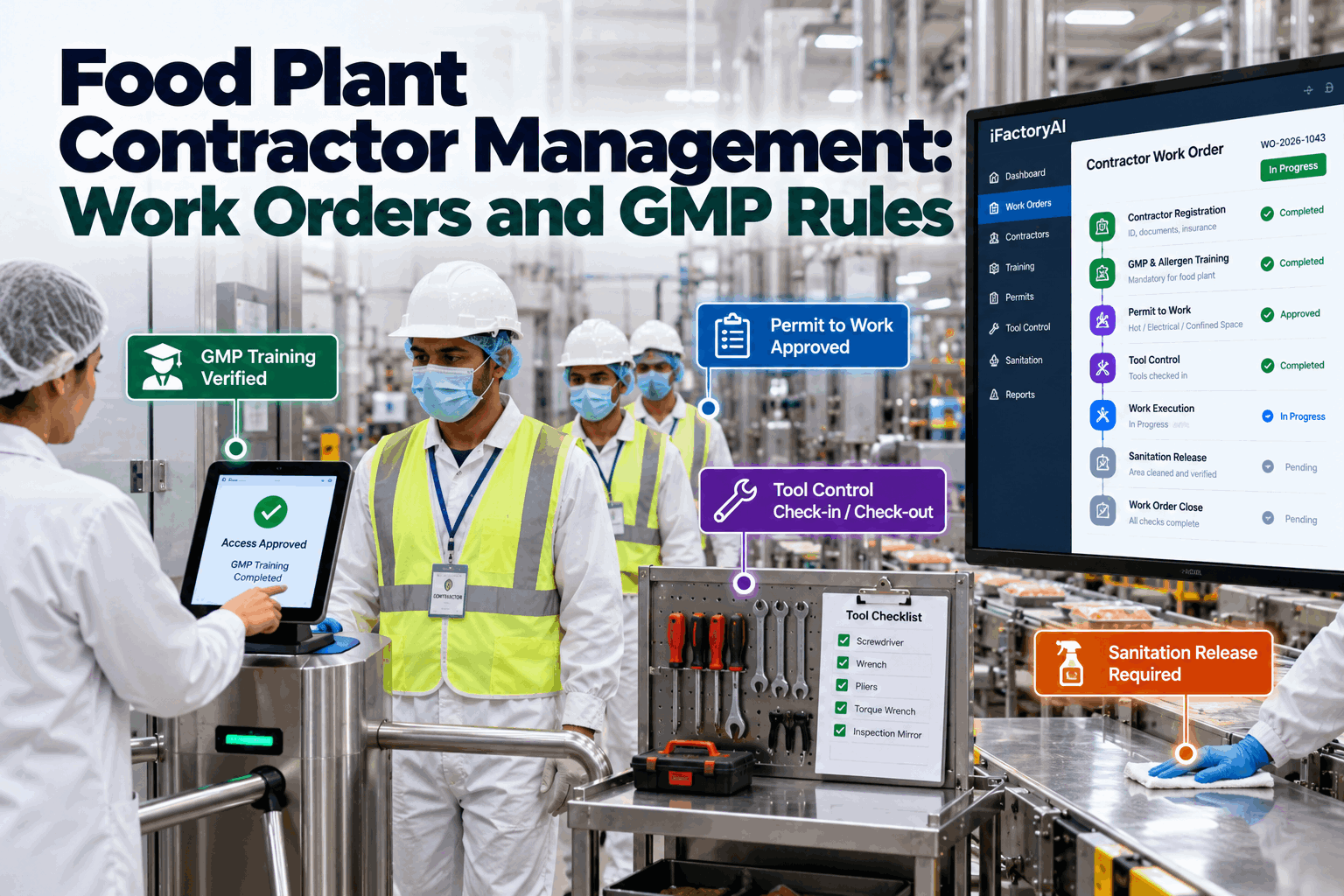
Ask a food plant manager how outside contractors are controlled and you will usually hear about a sign-in sheet, a safety induction and a hope that the GMP rules were read. That is where most of the risk sits. A refrigeration technician arrives without allergen training, a tool box goes in with twelve tools and comes out with eleven, a permit is signed after the work starts, and the job is closed before anyone releases the area for sanitation. Food plant contractor management ties every outside job to one work order, so GMP training, tool control, permits and sanitation release are checked before work starts and before it closes. See it in a contractor workflow demo.
Food Plant Contractor Management: Work Orders and GMP Rules
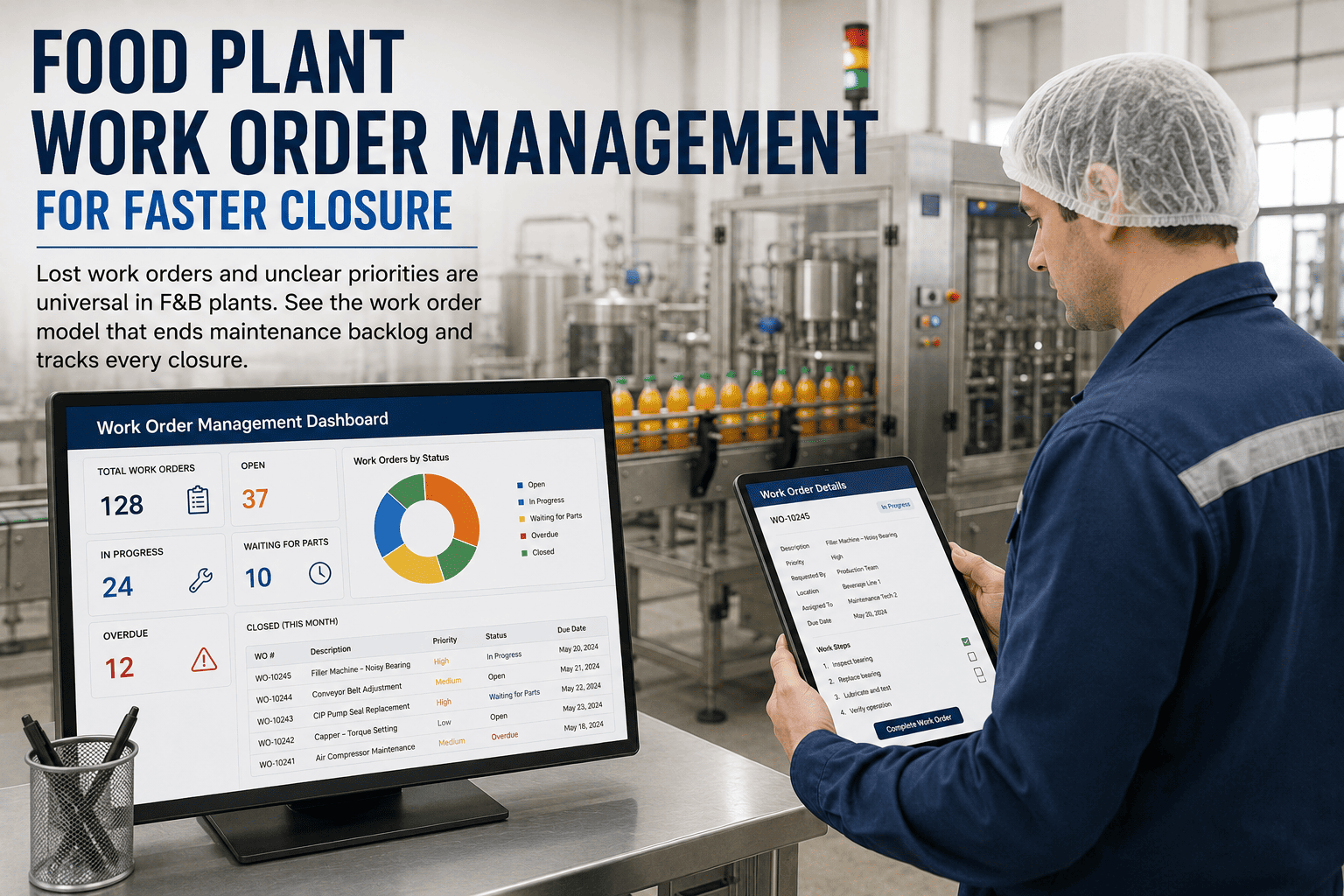
Every outside job runs through one work order. GMP and allergen training is verified before work, tool lists are checked in and out by voice, permits are held until signed, and sanitation release is required before the job can close.
- Training, tools, permits and release on one work order
- A job pack template and examples for common contractors
- GMP rules for contractors and visitors, enforced in the flow
Why Outside Jobs Create Food Safety Risk
Contractors bring tools, materials and habits from outside the plant.
Your own staff work under GMP rules every day. Contractors may be on site for a few hours, work in unfamiliar areas and carry tools, hardware and parts that could end up in product. A paper sign-in cannot prove that the person was trained, that every tool left the area or that the line was cleaned afterwards. Our food safety specialists can review how you control contractors today.
Unverified training
Induction assumed, not checked.
Loose tool control
Tools and small parts not counted.
Permit gaps
Work started before sign-off.
No release step
Jobs closed before sanitation.
Tool Control: A Worked Example
If the count does not match, the job does not close.
Take one maintenance job on a packaging line. The contractor checks out a tool list by voice at the start, and checks the same list back in at the end. Any difference blocks the work order until the missing item is found. All figures are illustrative. Walk through your own jobs in a working session.
Large tools are easy to count. The risk is in blades, bits, fasteners, tape and snap-off parts. Putting these on the tool list means the system asks for them back, and a missing blade segment becomes an immediate search instead of a finding after production restarts.
The Five Gates on Every Contractor Work Order
Each job passes the same checks, in the same order.
The work order carries the gates, so nobody has to remember them and nobody can skip one under time pressure. Map your gates and records with our implementation team.
A contractor working near an allergen line needs more than a general induction. Recording which areas each person is cleared for, and checking it against the work order location, keeps the right people in the right places.
GMP Rules for Contractors and Visitors
The rules are simple. Enforcing them is the hard part.
Contractors and visitors follow the same GMP program as staff, set by your own food safety plan. The work order puts those rules in front of the contractor before the job and records that they were accepted. Review your rules with our food safety team.
Personal items
Jewelry, watches and loose items removed.
Clothing and nets
Plant clothing, hair and beard nets in place.
Glass and brittle plastic
Broken items reported and controlled.
Hands and health
Handwashing and illness rules followed.
See Every Contractor Job Controlled From Request to Release
Training, tools, permits and sanitation release on one work order, with the close held until every gate is met.
From Request to Release
One flow for every outside job.
A contractor job follows the same path whether it is a short visit or a multi-day shutdown task. Each step records who did what and when, so the work order becomes the record. Plan your flow with our workflow team.
Request
Job, area and contractors named on the work order.
Verify
Training and area clearance checked.
Issue
Permits signed, tools checked out by voice.
Work
GMP rules and area limits applied.
Release
Tools in, area cleaned, sanitation signs off.
A Contractor Job Pack Template
The same checklist, built into the work order.
Many plants keep a paper job pack for contractors. The workflow turns each line into a gate that must be met, instead of a box someone may tick later. Use this as a starting template and adapt it to your own food safety plan. Build yours with our solutions team.
Before the job starts
- Names of everyone on the job
- GMP and allergen training verified
- Areas and zones cleared for entry
- Permits signed and tool list checked out
Before the job closes
- Tool list checked back in, count matched
- Waste, parts and materials removed
- Area cleaned and inspected
- Sanitation release recorded
Examples: Three Common Contractor Jobs
Different contractors, different risks, one workflow.
The gates stay the same, but the risks and records change with the job. Here are three examples of how plants set them up. Talk through your own with our application team.
Ammonia and cold storage
Permits and area limits first, plus tool control around open product zones.
Panels and lockout
Lockout verified before work, tool lists kept short and counted back.
OEM technician on a line
Allergen status checked, small parts counted, release required before restart.
An AI Agent That Keeps the Job Honest
Hands-free for the contractor, strict for the record.
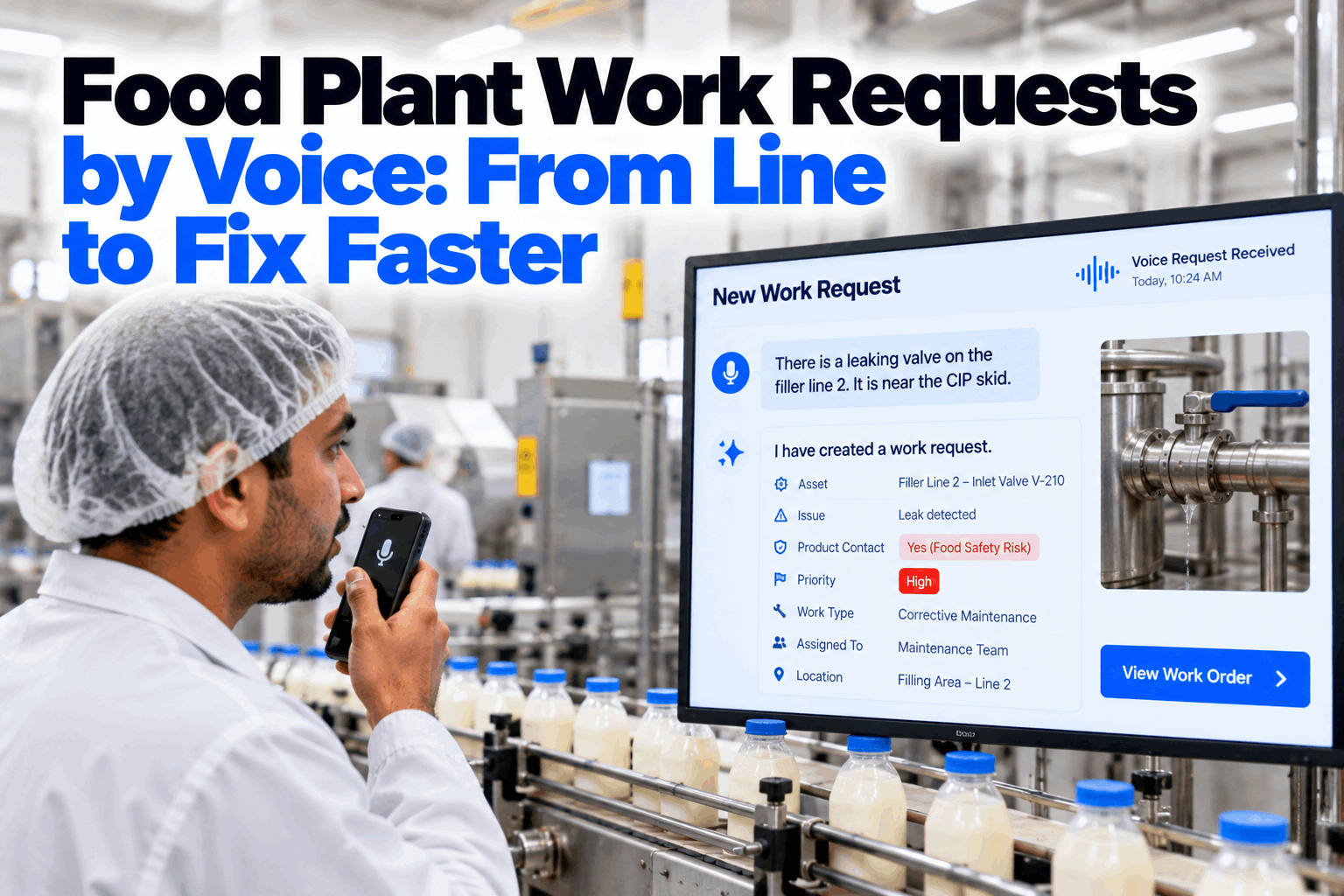
Contractors work with gloves on and tools in hand, so tool control happens by voice. The agent matches what is said against the tool list, asks about anything missing and holds the work order until the count is right. Ask our AI team how it works on your jobs.
Contractor Management Best Practices
Most problems come from skipped steps, not missing rules.
These are common patterns in food plants that run contractors well, and the ones that cause problems. A short readiness review can show where you stand.
What works
- Training checked per person, per area
- Tool lists including small items
- Permits held until signed
- Sanitation release before every close
What fails
- Sign-in sheets as the only record
- Induction videos with no check
- Tool counts done by memory
- Jobs closed to meet the schedule
How iFactory Runs Contractor Workflow
Contractor control, on your own network.
iFactory links work orders, training records, permits, tool lists and sanitation sign-off into one flow, checks each gate in order and holds the job until every step is met. It runs on an on-prem AI server inside your plant, so records stay on your network and are ready for the audits you face. Fit questions go to our solutions team.
Training gate
GMP and allergen training verified before work.
Voice tool control
Tool lists checked out and in by voice.
Permit holds
Work waits until permits are signed.
Area clearance
People cleared per zone and allergen area.
Sanitation release
Required before any job can close.
On-prem
Plant records stay in the plant.
The figures and examples on this page are illustrative. Your own contractor rules, training requirements and release steps follow your food safety plan, and we set them up with you during the pilot.
Turnkey AI: Delivered, Connected and Live in 6–12 Weeks
You do not build this. It arrives ready.
iFactory ships as a pre-configured NVIDIA AI server with the software pre-loaded, racked and ready. Rack it, plug in power and Ethernet, and the AI is live on your network. Our team handles cabling, network setup, PLC, SCADA, DCS and CMMS integration, training record links, voice setup, operator training and 24×7 remote monitoring. Data stays on your network. For a scope matched to your plant, request a turnkey quote.
Ship, network and data
Server installed. Work orders, training records and contractor lists connected.
Model training and pilot
Gates, tool lists and permits set up. Live workflow runs on a few contractor job types.
Go-live and training
Workflow live for all outside jobs. Teams and contractors trained. 24×7 monitoring begins.
Frequently Asked Questions
What is food plant contractor management software?
Software that puts every outside job on a work order and checks training, tools, permits and sanitation release in order, so nothing is skipped and every step is recorded.
How is contractor training verified?
Each person on the work order is checked against training records, including GMP and allergen training, before they are cleared to enter the area.
How does voice tool control work?
The contractor states the tools they are taking in and later returning. The system checks the spoken list against the job's tool list and holds the job if anything is unaccounted for.
What happens if a tool is missing?
The work order stays open and the supervisor is notified, so the item is found before the area returns to production.
Does it handle permits?
Yes. Required permits such as lockout, hot work or confined space are tied to the job, and work does not start until each one is signed.
Who gives the sanitation release?
Your sanitation lead or the role your plan names. The work order cannot close until that sign-off is recorded.
Can we use our own GMP rules and forms?
Yes. Rules, tool lists and release steps follow your food safety plan, and can differ by area and job type.
Where is the data stored?
On the on-prem server inside your plant, available on dashboards for plant managers, food safety and maintenance teams.
How do we start?
Start with one or two contractor job types. A 6-week pilot sets up the gates, tool lists and release steps and runs them live. To plan it, contact our team.
Find the Gaps in Your Contractor Process This Week
In thirty minutes we walk through how contractors enter, work and leave your plant today, and show what a controlled work order flow would change. You keep the notes either way.
- 1Your current contractor policy
- 2The sign-in and induction forms
- 3Your GMP rules for visitors
- 4Permit types you use
- 5A recent contractor job that went wrong