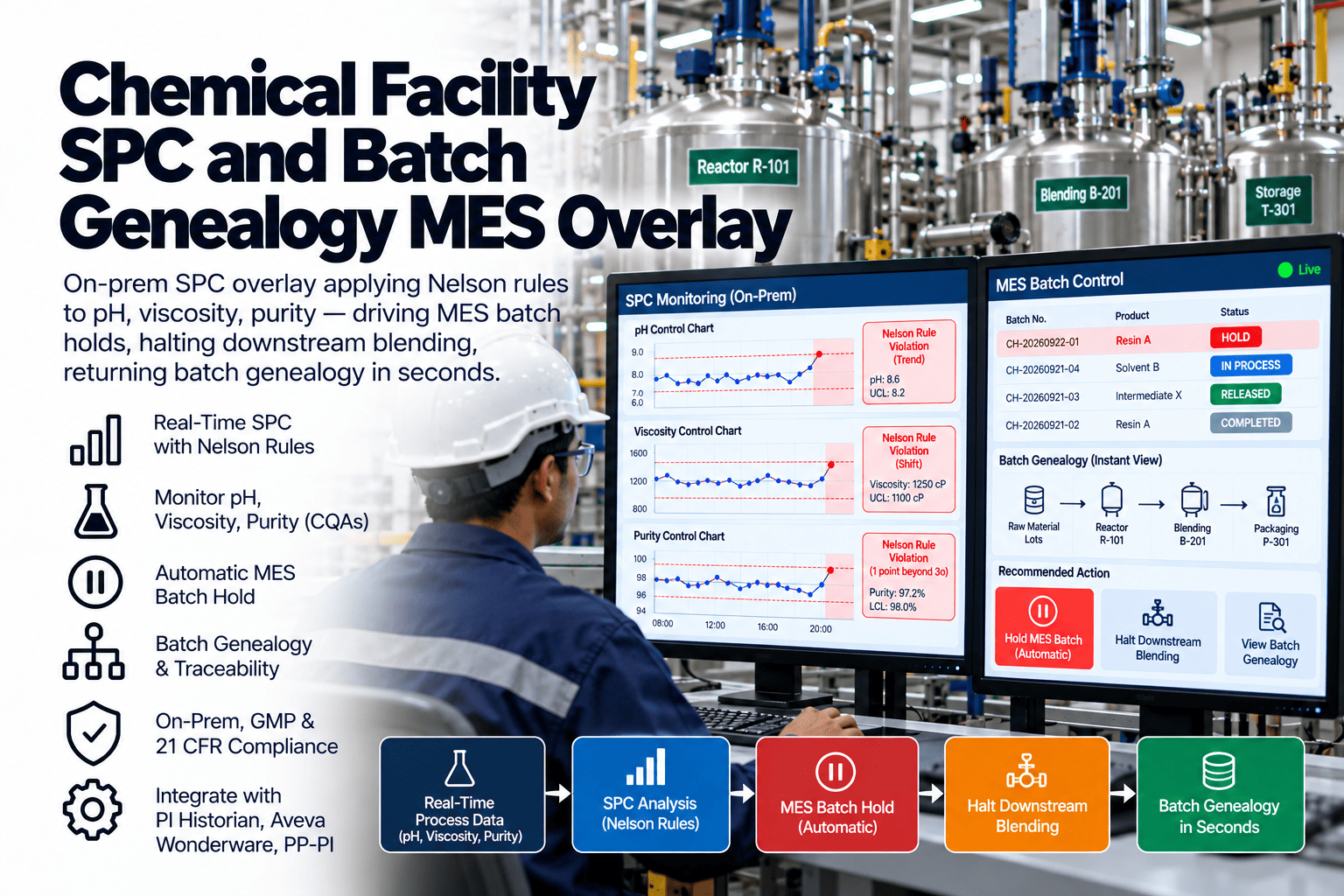
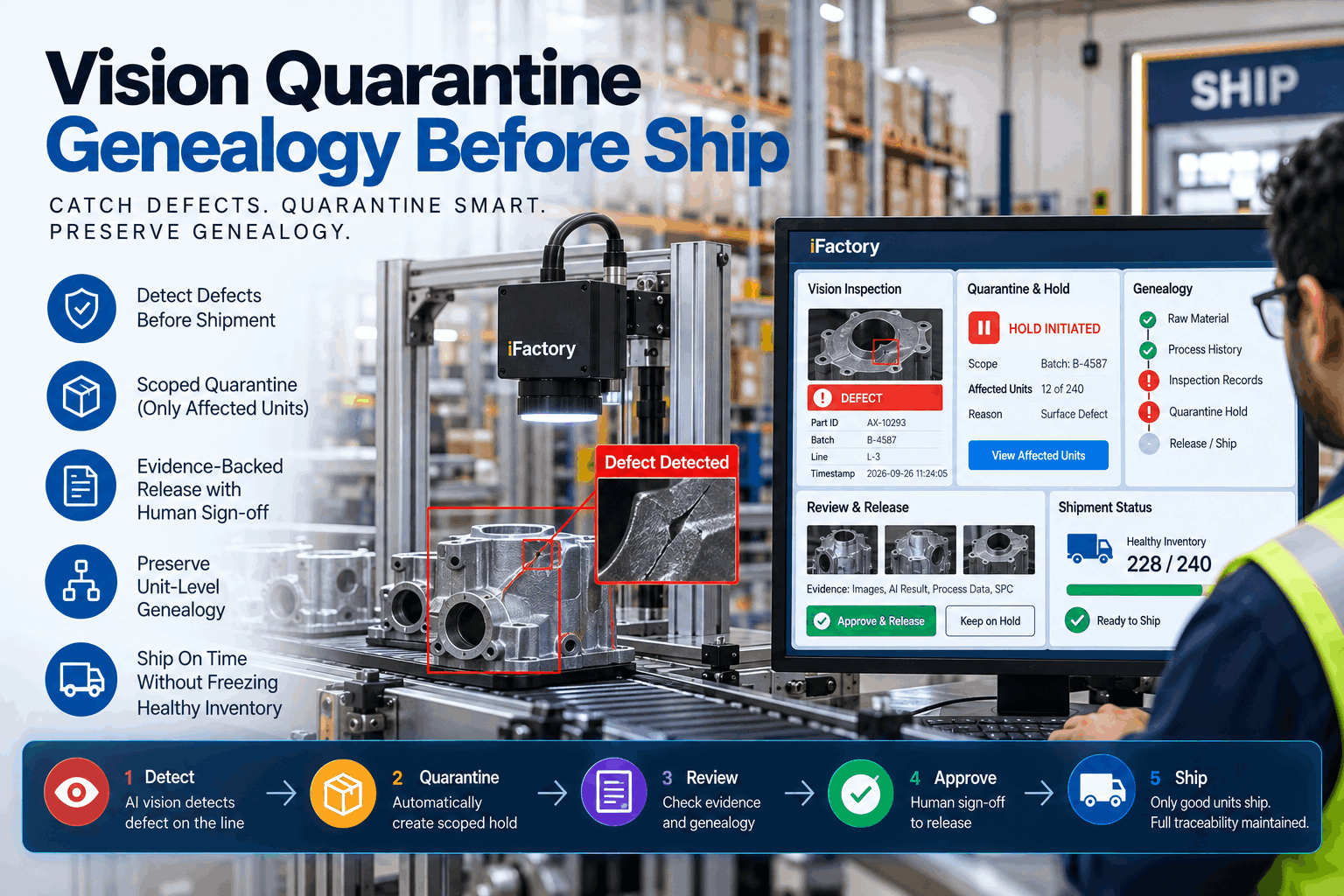
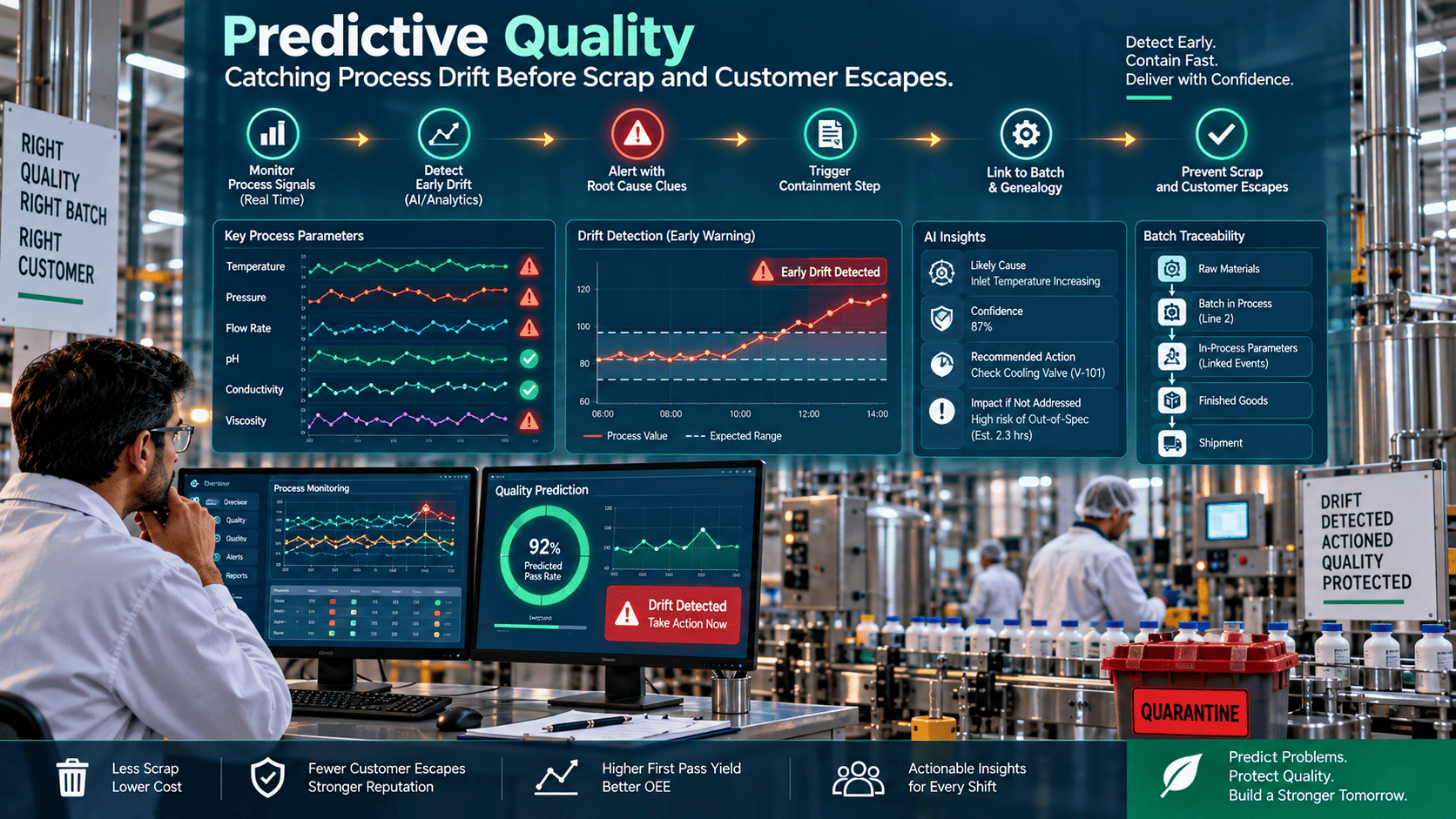
A chemical batch that drifts out of pH or viscosity spec during reaction has minutes to hours before it moves to blending, and hours to days before the blended material has shipped. Traditional SPC plots the excursion on a chart nobody watches in real time; the deviation is caught at end-of-batch lab release, at the customer's incoming, or during the next audit. FDA, EPA, OSHA, and 21 CFR expectations are that quality events are contained fast and traced back through complete batch genealogy. On-prem SPC + genealogy overlay closes the loop — Nelson rule fires, MES batch hold posts, downstream blending halts.
iFactory / Chemical facility SPC overlay
Hold Drifting Chemical Batches Before They Move to Blending — On-Prem Overlay
On-premise SPC overlay on your existing MES or plant historian applying Nelson and Western Electric rules to pH, viscosity, purity, and other CQAs — driving MES batch holds automatically, halting downstream blending, and returning full batch genealogy from raw material through customer shipment.
Batch 2026-B-11847 · 4,200 kg · in blend
USL · pH 8.4
LSL · pH 7.6
Nelson rule 3 · 6 rising · MES hold + downstream blend halt
MES + historian
overlay, no rip-replace
MES batch hold
auto-posted
The Problem in Chemical Facility SPC Compliance
A typical chemical batch operation runs reactors, blenders, and packaging on an MES that captures batch records and a historian (PI, Aveva, Wonderware) that logs pH, temperature, pressure, viscosity, and other critical quality attributes. Modern SPC — Nelson eight-rule set, Western Electric zone rules — is well understood in theory but rarely applied in real time to running batches. The typical loop is retrospective: batch completes, samples go to lab, lab release takes hours, then someone reviews the historian trend and notices the Nelson pattern that was building during reaction. By then the batch has moved to blend and blended material is on the shipping dock.
Where Chemical SPC Compliance Actually Fails
Chemical facility SPC failure modes are consistent across reactor, blend, and fill operations. Each is a specific loop timing gap that overlay closes without touching the MES.
Nelson pattern in historian
pH or viscosity Nelson pattern visible in historian trend but not surfaced in real time. Operator focused on setpoint; pattern noticed only at end-of-batch review.
Downstream propagation
Suspect batch moves to blending or filling while lab release cycle runs. Blend absorbs the excursion; downstream containment now covers larger volume.
MES batch record silent
Excursion visible in historian but batch record in MES completes without flag. Batch release proceeds; excursion emerges only in retrospective review.
Genealogy takes days
When excursion is caught, tracing which raw material lots, blend batches, fill lots, and customer shipments carry the material takes days of walking through MES records.
What Good Looks Like in Chemical SPC Overlay
A working chemical facility overlay holds four disciplines together — Nelson/WE rules on CQAs live, MES batch hold, downstream halt, and genealogy in seconds.
Nelson/WE Live
Nelson 8-rule set and Western Electric zone rules applied to pH, viscosity, purity, temperature, and other CQAs from the historian in real time. Fire detected within seconds of pattern completion.
Real-time patterns
MES Batch Hold
Rule fire drives batch hold in MES — batch status moves to hold, subsequent process steps blocked, operator alerted with rule context. MES record captures the hold with full audit trail.
Hold in MES, not paper
Downstream Halt
Batches downstream of the held batch (in blending queue, in fill scheduling) automatically halted pending disposition. Prevents blend contamination and preserves batch identity for review.
Halt before propagation
Genealogy Seconds
Batch genealogy from raw material lots through reactor batch, blend batch, fill lot, and customer shipment returned in seconds. Recall or notification decisions made in minutes, not days.
Recall-ready
How iFactory AI Fits
iFactory AI overlays your chemical MES (SAP PP-PI, AspenTech aspenONE, Werum PAS-X, Siemens Opcenter, Rockwell FactoryTalk), historian (PI, Aveva, Wonderware, Ignition), and LIMS — on-premises, driving MES batch holds and returning batch genealogy without replacing MES or historian.
Historian Rule Engine
Overlay Layer
On-prem engine subscribes to historian tags (OPC UA, PI OLEDB, historian native protocol) for CQAs. Nelson 8-rule set, Western Electric zone rules, and custom plant rules applied per tag in real time.
MES Actuator
Overlay + MES
Rule fire drives MES batch hold via MES integration (SAP PI/PO for PP-PI, batch execution engine for others). Operator alert with rule fired, CQA, and current batch value. Full MES audit trail preserved.
Downstream Halt
Overlay + MES
Held batch triggers halt on downstream batches in blend queue and fill scheduling. Prevents blend contamination. Automatic; supervisor override with reason capture for legitimate operational needs.
Genealogy Engine
Overlay + MES
Batch genealogy indexed from raw material lots to customer shipments. Query returns full tree in seconds; recall or notification decisions made in minutes. Regulatory audit posture strengthened.
Ask your chemical plant compliance manager how the last regulatory audit response for a batch deviation actually played out — hours or days from finding the trigger event to producing the full genealogy tree. If it was days, the on-prem overlay closes exactly that gap. Because the historian data was always there; the loop wasn't. Book a chemical SPC overlay review.
12-Week Chemical SPC Overlay Pilot
One production line (reactor + blend + fill), twelve weeks. The pilot deploys the overlay on-prem, connects to historian and MES, activates Nelson rules on key CQAs, drives first automated MES holds, and closes the first month of genealogy-ready loop discipline.
Weeks 1–3
On-Prem + Connect
Overlay deployed inside plant firewall. Historian tag subscriptions active. MES integration read-tested. Baseline current-state loop cycle time.
Weeks 4–6
Rules Live (Read)
Nelson and Western Electric rules live on selected CQAs in read-only mode. Rule fires surface to supervisor. False-fire rate tuned against operator judgement.
Weeks 7–9
MES Holds Active
Overlay drives MES batch holds via integration in production. Change control per site's MES change process. First automated holds and downstream halts.
Weeks 10–12
Genealogy + Audit
Batch genealogy queries active for triggered holds. First mock regulatory audit exercise. Full-month report on cycle time, holds issued, genealogy query performance. Rollout to sister lines scoped.
Who Owns the KPI
Chemical facility overlay crosses compliance, plant IT, operations, and regulatory affairs. Each function owns a specific KPI or the loop stays retrospective and the audit posture stays fragile.
Chemical Plant Compliance Manager
Rule-fire-to-batch-hold cycle
Owns the loop outcome — time from Nelson/WE pattern completion in historian to MES batch hold. Overlay drives cycle from shifts to seconds.
Plant IT / OT Lead
Historian subscription integrity + MES call success
Owns the integration reliability — historian tag availability, MES call success rate, and overlay uptime. Standard OT monitoring on both sides.
Operations Supervisor
False-hold rate + supervisor override cadence
Owns the operational discipline — false-hold rate low enough that operators trust the system, and legitimate overrides captured with reason for audit.
Regulatory Affairs
Genealogy query time for audit response
Owns the audit outcome — time to produce full batch genealogy tree for regulatory audit or customer complaint. Seconds instead of days.
FAQ
Does this integrate with SAP PP-PI, AspenTech aspenONE, Werum PAS-X, or our specific MES?
Yes, through each MES's documented integration point. SAP PP-PI accepts batch status changes via BAPI (BAPI_PROCORD_CHANGE_STATUS) or IDoc; AspenTech aspenONE integrates via aspenONE Process Explorer web service or database; Werum PAS-X accepts external batch instructions via its integration adapter; Siemens Opcenter and Rockwell FactoryTalk both expose batch execution engine APIs. Where the MES is custom or proprietary without standard integration, the overlay can drive hold flags via database write or supervisor alert with confirmation workflow. What matters is that batch hold state changes flow through the MES's own transaction chain, preserving the batch record integrity that regulatory audit depends on. Overlay never bypasses the MES; it drives the MES.
How does the overlay meet 21 CFR Part 11 or Annex 11 requirements for regulated chemical operations?
On-prem deployment is the baseline that makes 21 CFR Part 11 (US FDA) and EU GMP Annex 11 compliance achievable — data stays inside the plant validated environment, audit trails live with the MES the overlay integrates with, and the overlay itself carries the electronic records and signatures that a regulated system requires. The deployment supports the site's computerized system validation approach with IQ/OQ/PQ artifacts, change control aligned to the site's validation SOPs, and 21 CFR Part 11 or Annex 11 technical controls (unique user IDs, secure timestamping, tamper-evident audit trail, electronic signature workflow for critical operator actions). Where the site runs GAMP 5-based validation, overlay components align to GAMP category classification. What the overlay avoids is the cloud-egress patterns that regulated sites can't accept without adding compensating controls that often outweigh the value.
Book a chemical SPC overlay review to see the validation posture.
How does batch genealogy actually reach from raw material through customer shipment?
Batch genealogy is only as complete as the MES traceability model that captures it. In a mature chemical MES, the model captures raw material lot consumption at reactor charging, reactor batch identity through reaction, blend batch composition (which reactor batches went into which blend), fill lot composition (which blend batches went into which fill lots), and delivery composition (which fill lots went to which customers on which orders). The overlay's genealogy engine walks that model — pre-indexed for query performance — and returns the tree in seconds. Where the MES model has gaps (some sites don't record blend composition rigorously, or don't tag fill lots to customer shipments), the genealogy query returns what the model supports and flags gaps for manual completion during audit response. Closing MES traceability gaps is often the highest-value work the overlay's genealogy queries surface — because a gap that hides for years reveals itself the first time an audit needs the tree.
Stop letting chemical batch deviations close on retrospective cycles.
Hold One Chemical Line's Deviations on MES — Live
Bring one chemical production line's MES, one recent batch deviation event with its historian trend, and current genealogy-query cycle time. We'll walk what the on-prem overlay would have held automatically, and demonstrate the batch genealogy tree in seconds.