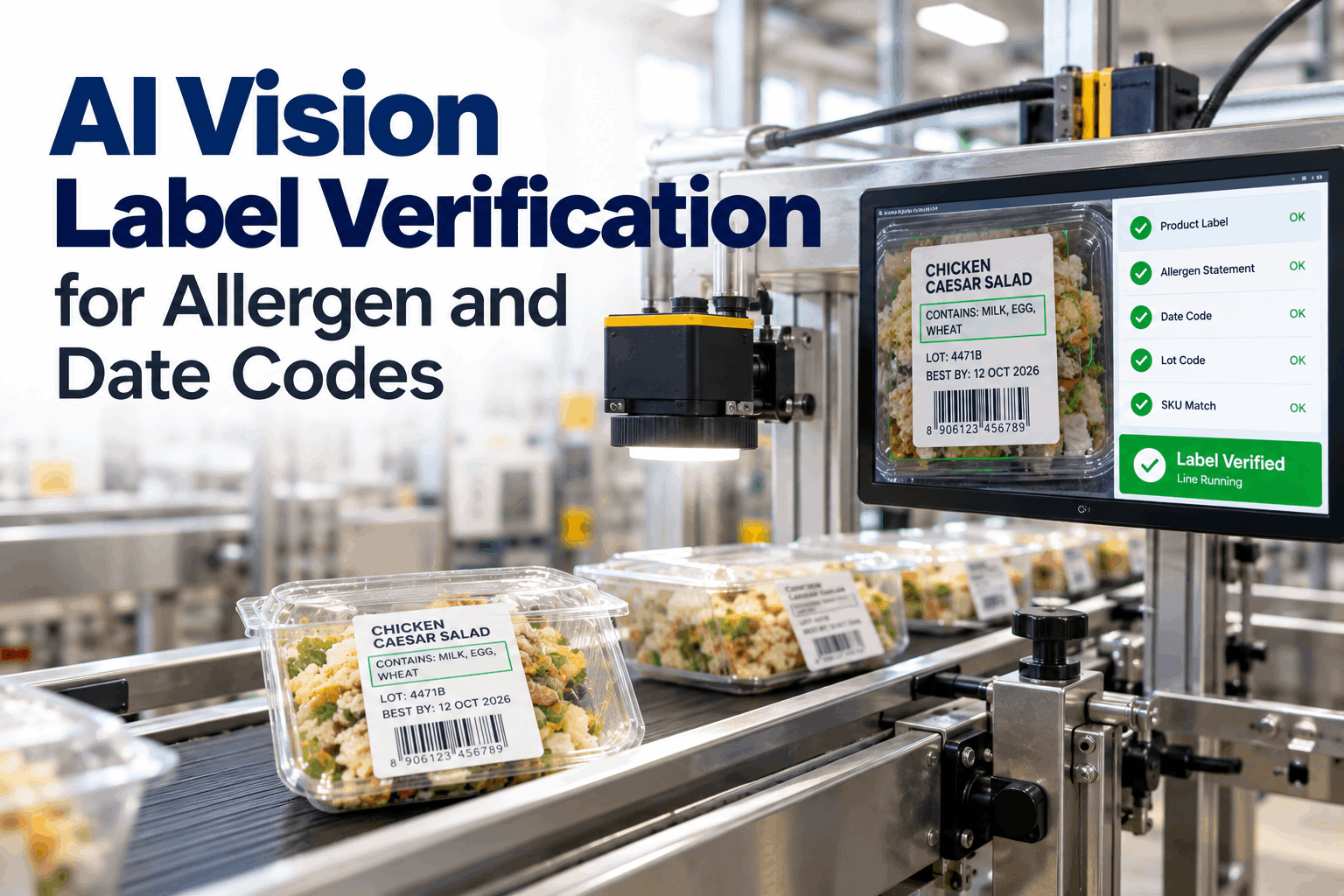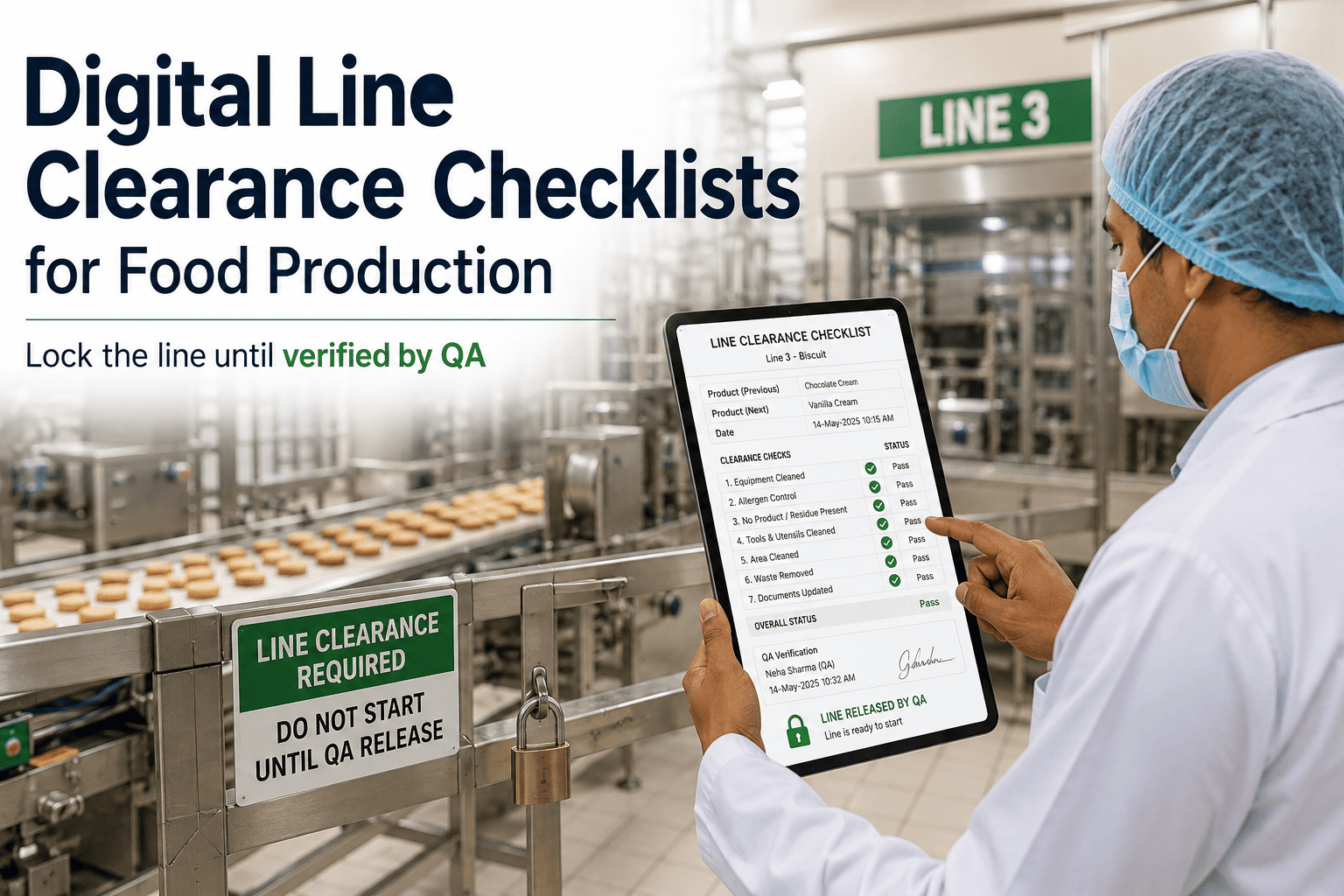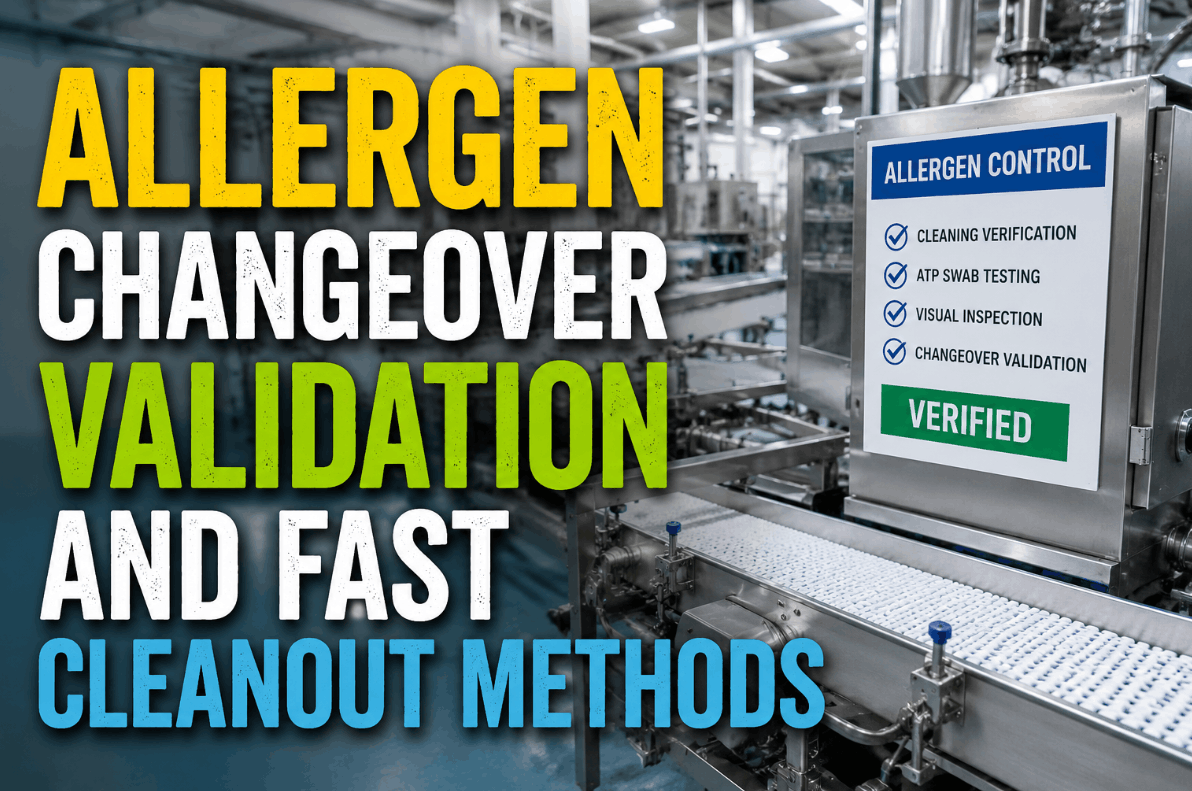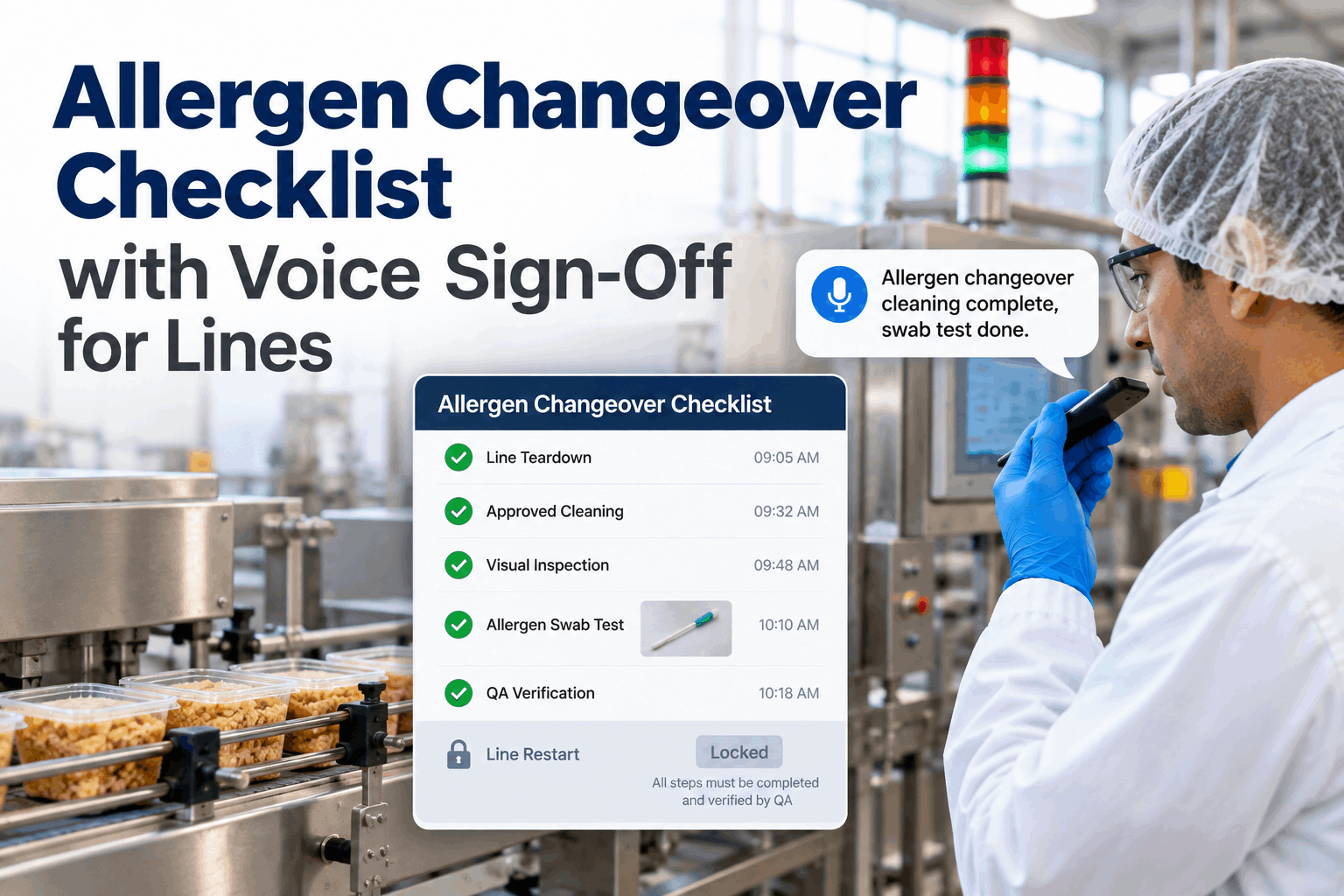
The line just ran a peanut product. Next is a peanut-free item for a customer whose label promises exactly that. Between them sit teardown, wash, inspection, swab and release. Skip one step and an undeclared allergen can reach a consumer. This checklist covers each step, with voice sign-off and a restart gate. Start with a changeover review.
Allergen Changeover Checklist with Voice Sign-Off for Lines
Crews confirm each changeover step by voice as they work, swab results attach to the record and QA verifies on mobile. The restart card stays locked until every gate passes, so no line restarts on a promise.
- A full allergen changeover checklist you can use today
- Which swab tests actually detect allergens
- How a restart gate stops early restarts
Why Allergen Changeovers Fail
The clean is usually fine. The proof that it happened is not.
Undeclared allergens are among the leading causes of food recalls in the United States and elsewhere. Many trace back to changeovers where a step was shortened, a hard-to-reach spot was missed or the line restarted before results were back. Paper checklists make this easy: boxes get ticked at the end, the swab result arrives later and nothing physically stops the restart, even when everyone means well. Our food safety team can show where your changeovers are exposed.
Rushed teardown
Guards and parts left in place, so residue hides behind them.
Missed harbourage points
Seams, scrapers and conveyor joints that the wash does not reach.
Wrong test
ATP passes, but allergen protein is still on the surface.
Early restart
The line starts before swab results and QA release are complete.
When ticking boxes and restarting the line are separate actions, pressure to restart wins. Connect the last checklist step to the restart itself, so the line cannot start until the record is complete. That takes the decision away from whoever is under the most time pressure.
The Allergen Changeover Checklist
Six stages, each with clear steps and a sign-off.
Use the checklist below as a template and adapt it to your equipment, products and allergen matrix. In iFactory, each item is confirmed by voice with the person and time recorded. Here you can tick items as you read and use it to check your own procedure. Review your current checklist in a checklist review.
Prepare
Tear down
Clean
Inspect
Verify
Release
This checklist is a general template. Your validated cleaning procedure, allergen matrix and customer requirements set the exact steps and limits.
Map the Hard-to-Clean Points on Each Line
Allergen residue hides in the same places on every changeover.
A generic checklist says "clean the line". A good one names the exact points where product collects on that line and tells the crew how to reach them. Build an inspection map for each line once, with photos, and use it for every changeover, on every shift. Questions on mapping go to our sanitation team.
Infeeds and chutes
Powder and paste build up where product falls or changes direction.
Scrapers, seals and hinges
Flexible parts trap residue in folds and pivot points.
Belt joints and rollers
Seams and undersides carry product back into the clean zone.
Frames and overheads
Dust and splash settle on surfaces above and beside the line.
Use past inspection failures and positive swabs to choose swab sites. The points that failed last month are the most likely to fail again, so they deserve a swab every time until they stay clean for several changeovers in a row.
Choosing the Right Swab Test
A clean surface is not the same as an allergen-free surface.
ATP swabs are fast and useful, but they measure organic residue, not allergen protein. A surface can pass ATP and still carry enough protein to cause a reaction in a sensitive consumer. Allergen-specific tests, such as lateral flow devices for a named allergen, or general protein swabs, give more direct evidence. Questions about test choice go to our support desk.
Validation proves the cleaning procedure can remove the allergen, usually with lab testing. Verification checks that it was done properly this time, usually with rapid tests at release. You need both, and they answer different questions. Revalidate when the product, equipment, detergent or procedure changes.
What a Locked Restart Protects
One recall can cost far more than years of careful changeovers. A restart gate turns the checklist from a record of what should happen into a control on what does happen.
How Voice Sign-Off and the Restart Gate Work
Hands stay on the job. The record builds itself.
Sanitation crews work with wet gloves, hoses and tools, so stopping to write is slow and messy, and the writing often waits until the end. With voice sign-off, each crew member speaks a short confirmation as they finish a step. Swab results are scanned or entered and attached to the same record. QA reviews everything on a phone, from anywhere in the plant, and releases the line. Plan the gate in a gate design session.
Voice confirm
"Line 2, teardown complete, guards off."
Attach results
Swab results and photos linked to each site.
Flag gaps
Missing steps or positive swabs block the next gate.
QA verifies
QA reviews the full record on mobile and signs.
Unlock restart
The restart card on the kanban board opens.
Every positive swab and re-clean is recorded against its site and line. Over a few weeks, the sites that fail most often stand out clearly. Those are the places to improve the procedure, change a part design or add training, rather than relying on the swab to catch the miss every time.
Allergen Changeover Mistakes to Avoid
Most failures come from pressure, not ignorance.
Teams know how to clean. Failures happen when time is short, the procedure is vague or nothing stops an early restart, especially on night shifts and weekends. A short rollout plan session helps build the right controls.
What works
- An allergen matrix that drives the run order
- A line-specific teardown and inspection map
- Allergen-specific swabs at release
- A restart that needs QA sign-off to unlock
What fails
- One generic checklist for every line
- Relying on ATP alone for allergen release
- Ticking boxes at the end of the shift
- Restarting while results are pending
The safest allergen changeover is the one you do not need. Running allergen-free products first and grouping products by allergen profile cuts the number of full changeovers, and leaves more time to do each one properly. Your allergen matrix should drive the production schedule, not the other way round.
How iFactory Runs Voice Checklists and Restart Gates
Voice Checklist plus Restart Gate, on your own network.
iFactory runs speech recognition and checklist rules on an on-prem AI server inside your plant. The Voice Checklist records each step with the person and time, attaches swab results and photos, and the Restart Gate keeps the line's restart card locked on the kanban board until every gate passes and QA signs. Fit questions go to our solutions team.
Voice sign-off
Each step confirmed by voice, with person and time recorded.
Line-specific checklists
Steps and inspection points set per line and allergen pair.
Swab results attached
Results linked to each site, with positives blocking release.
Mobile QA release
QA reviews steps, photos and results and signs from a phone.
Locked restart card
The kanban restart card stays locked until all gates pass.
Audit-ready records
Every changeover kept with steps, results and sign-offs.
Results depend on your cleaning procedures, test methods and how consistently the gate is used. We measure step completion, re-clean rates and changeover time on your own data during the pilot, rather than promising a general figure.
Turnkey AI: Delivered, Connected and Live in 6–12 Weeks
You do not build this. It arrives ready.
iFactory ships as a pre-configured NVIDIA AI server with the software pre-loaded, racked and ready. Rack it, plug in power and Ethernet, and the AI is live on your network. Our team handles cabling, network setup, PLC, SCADA and MES integration, headset setup, crew and QA training and 24×7 remote monitoring. Data stays on your network. For a scope matched to your plant, request a turnkey quote.
Ship, network and data
Server installed. Allergen matrix, lines and cleaning procedures loaded.
Model training and pilot
Voice model tuned to your crews and lines. Restart gate piloted on one line.
Go-live and training
Voice checklists and gates live across lines. Teams trained. 24×7 monitoring begins.
Frequently Asked Questions
What should an allergen changeover checklist include?
Preparation, teardown, cleaning, visual inspection, swab verification and QA release. Each stage should list the specific steps and sites for that line, with a sign-off before moving on to the next stage.
Is an ATP swab enough to release a line after an allergen run?
Usually not on its own. ATP measures general organic residue, not allergen protein. Allergen-specific tests, such as lateral flow devices for a named allergen, give more direct evidence for release. ATP is still useful as a quick first check of cleaning.
What is the difference between cleaning validation and verification?
Validation shows the cleaning procedure can remove the allergen, often with lab testing. Verification checks that each changeover was done properly, usually with rapid swabs and inspection before release.
How does voice sign-off work during sanitation?
Crew members speak short confirmations as they finish each step. The system records who and when, so hands stay free and the record is built during the work, not after it. Steps cannot be confirmed out of order, so nothing gets skipped by accident.
What is a restart gate?
It is a control that keeps the line's restart locked until every required step is confirmed, every swab passes and QA signs the release. In iFactory, it is shown as a locked restart card on the kanban board that only QA can open.
Why are allergen recalls so common?
Undeclared allergens caused 49.2% of 313 US food recalls in 2023, according to U.S. PIRG. Causes include cross-contact during changeovers, labelling errors and new major allergens such as sesame.
Should the first product after a changeover be held?
Many plants hold the first product, or the first few minutes of output, for label and allergen checks before releasing it. Whether you do depends on your risk assessment and customer requirements, and the checklist can include it as a release step.
Can the checklist differ between lines?
Yes, and it should. Each line has its own parts, harbourage points and swab sites. The template on this page is a starting point that each line adapts to its own equipment.
How do we start?
Start with the line that has the most allergen changeovers, where the gate protects the most product each week. A 6-week pilot loads your matrix and procedures, sets up voice sign-off and runs the restart gate on that line. To plan it, contact our team.
Never Restart on a Promise
In thirty minutes we look at your allergen matrix, your changeover procedure and how lines are released today. You keep the notes whether or not you go further with iFactory.
- 1Your allergen matrix and run order
- 2Current changeover checklist for one line
- 3Swab sites and test methods used
- 4Your cleaning validation records
- 5Any recent near miss or positive swab