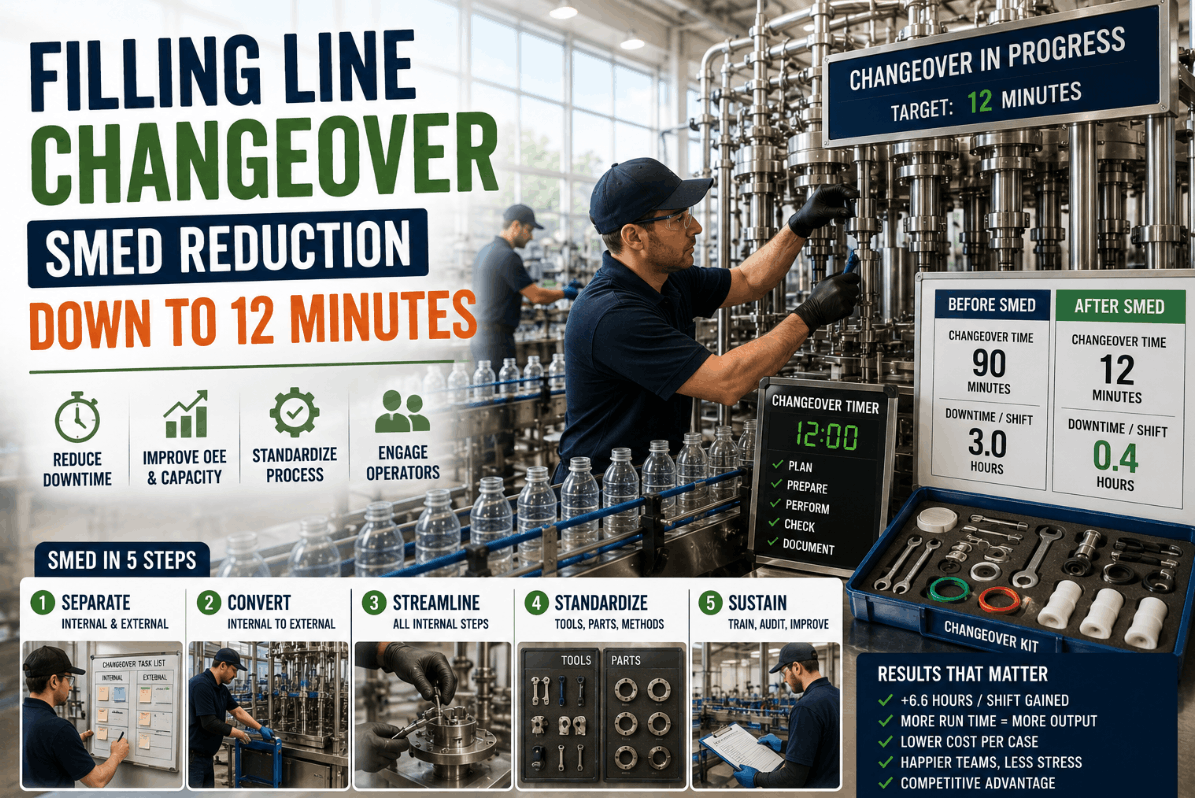
A single missed allergen residue at changeover is one of the fastest paths from a clean production schedule to a Class I recall. Peanut-to-baked-goods, milk-to-non-dairy, gluten-to-gluten-free — every high-to-low allergen transition on a shared line carries the same exposure: if the cleaning procedure was not validated, and the verification swab data is not captured and gated against a release decision, the plant is relying on hope rather than evidence. FSMA preventive controls, SQF Edition 9, and BRCGS Issue 9 all now expect a documented, repeatable allergen changeover program — not a supervisor's visual check and a sign-off sheet. This guide breaks down what a validated allergen changeover protocol actually requires, how ATP, protein, and allergen-specific swab data fit together, and how AI-vision and swab-gated release workflows are replacing paper logs as the evidentiary backbone of allergen control.
Is Your Changeover Protocol Validated, or Just Documented?
Connect ATP readings, allergen swab results, and changeover sign-off into one gated release workflow built for high-to-low allergen transitions.
Validation vs. Verification: The Distinction That Protects Your Plant
Validation and verification are not the same activity, and treating them as interchangeable is one of the most common gaps auditors find. Validation is the one-time (or periodic) study that proves a specific cleaning procedure — for a specific allergen, on a specific piece of equipment — actually removes the residue to below a defensible threshold. Verification is the routine check, after every changeover, that confirms the validated procedure was executed correctly that time. A plant can have a perfectly validated SSOP and still fail because nobody verified it was followed on a Tuesday night shift change. Manufacturers who Book a Demo of iFactory's changeover workflow consistently discover that their validation studies were sound, but their verification records were inconsistent, undocumented, or stored in formats no auditor could reconstruct on demand.
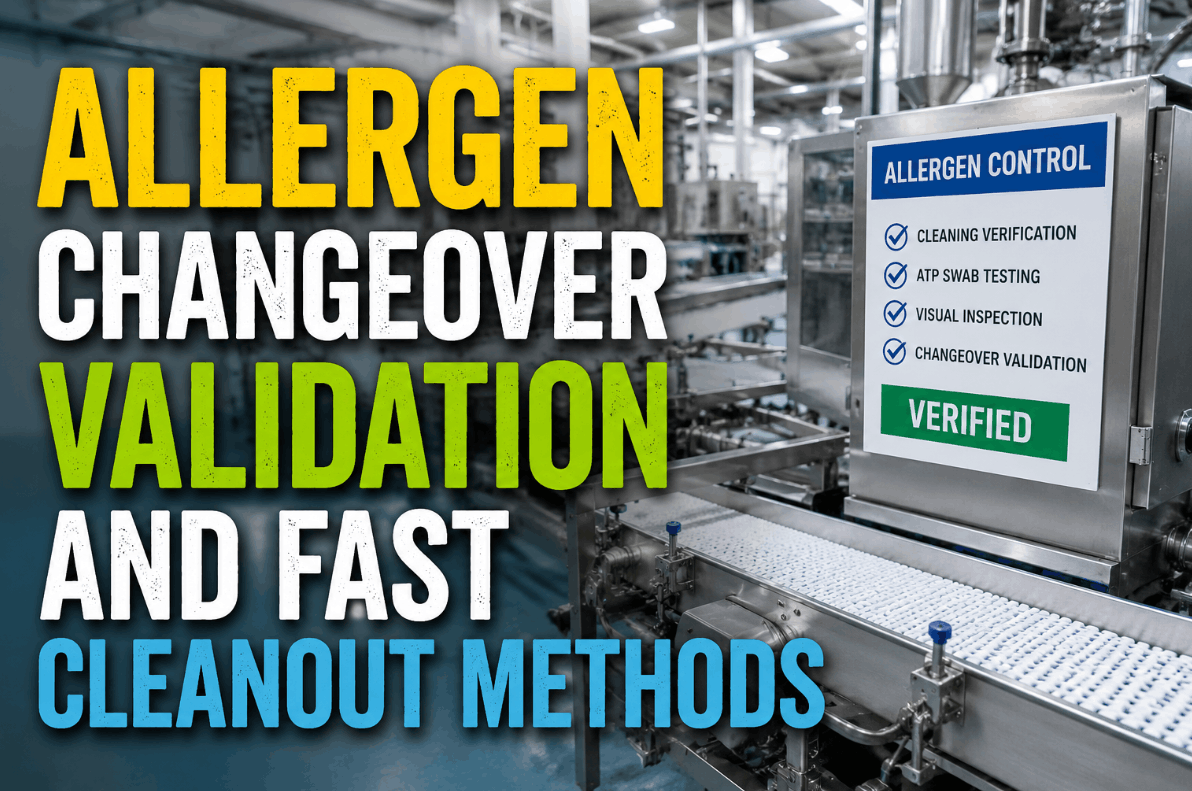
The three test methods used across both stages each answer a different question. ATP bioluminescence swabbing detects organic residue broadly and returns a result in seconds, but it does not identify allergen-specific protein — it is a fast confirmation that the surface was actually cleaned. Protein swabs narrow that signal toward protein residue specifically, a useful proxy when allergen-specific kits aren't warranted for every routine check. Allergen-specific lateral flow or ELISA test kits are the only methods that confirm the actual allergen of concern is below the kit's detection threshold, typically in the 10–100 ppm range depending on the assay. A defensible changeover program uses ATP for fast pass/fail screening at every changeover and reserves allergen-specific testing for validation studies, high-risk transitions, and any point where ATP results raise a flag.
ATP Bioluminescence Screening
Fast, broad-spectrum residue detection at every changeover. Confirms the surface was physically cleaned before allergen-specific testing or production release proceeds.
Allergen-Specific Swab Testing
Lateral flow or ELISA kits matched to the prior product's allergen — peanut, milk, gluten, tree nut, shellfish — confirm residue is below the kit's defined detection threshold.
Swab-Gated Production Release
Production cannot be authorized to resume until passing swab results are logged against the specific changeover event — removing reliance on a supervisor's memory or a paper sign-off.
Audit-Ready Documentation
Every changeover event — swab point, RLU or kit result, operator, timestamp, corrective action if failed — generates a single auditable record for FSMA, SQF, and BRCGS reviews.
Building a Defensible Allergen Changeover Validation Study
A validation study is what proves your cleaning procedure works before you start relying on it for daily verification. Skipping this step — and going straight to routine ATP swabbing on an unvalidated SSOP — is the gap that surfaces during a recall investigation, when it becomes clear nobody ever confirmed the procedure could actually clear the allergen in question on that equipment. Plants that Book a Demo of iFactory's validation tracking module consistently use the same five-stage sequence to build a study that will hold up under audit.
Map the High-Risk Allergen Pair and Equipment
Identify the specific high-to-low product transition — e.g., peanut butter cookie to plain shortbread — and the exact shared equipment: mixer bowl, pump housing, valve cavity, tubing interior, conveyor surfaces.
Define Sampling Points and Acceptance Criteria
Fix the exact swab locations — the same points every time, including crevices and tight spaces where allergen particles accumulate even after ATP passes — and set the pass/fail threshold for each method.
Run the Cleaning Procedure and Collect Multi-Method Evidence
Execute the SSOP exactly as written, then swab with ATP, protein, and allergen-specific ELISA kits at every defined point — ELISA is the gold standard for the formal validation result.
Confirm With First-Off Product Testing
Test the first unit of product run after the changeover for allergen residue — surface swabs confirm the equipment, but product testing confirms the procedure actually protected what customers receive.
Lock the Validated SSOP and Set the Verification Cadence
Once the procedure passes consistently, lock it as the validated SSOP and set the routine verification frequency — typically every changeover — with re-validation triggered by any repeat verification failure.
How FSMA, SQF, and BRCGS Each Define Allergen Verification Expectations
The three frameworks that govern most U.S. food plant audits each phrase allergen verification requirements differently, and a program built to satisfy only one will usually fall short on the others. The table below maps what each standard expects, so a single changeover workflow can be designed to clear all three at once rather than maintaining separate documentation paths.
| Standard | Core Requirement | Verification Frequency | Documentation Expectation | Priority Level |
|---|---|---|---|---|
| FSMA Preventive Controls | Monitor allergen preventive controls per food safety plan | Frequency defined in the plant's own food safety plan | Monitoring records tied to the written plan | Critical |
| SQF Edition 9 | Documented verification of cleaning effectiveness | After allergen changeovers, per documented program | Verification records reviewable at audit | Critical |
| BRCGS Issue 9 | Documented testing program for allergen removal | Defined testing schedule with trend review | Test results trended over time, not single events | Critical |
| Repeat Failure Response | Root cause investigation before resuming production | Triggered immediately on any verification failure | Corrective action and re-validation on file | High |
| Multi-Allergen Tracking | Trend analysis across allergens, lines, and shifts | Ongoing, reviewed at defined management intervals | Centralized trend reporting across all changeovers | Standard |
"Before connecting our ATP and allergen swab data to a gated release workflow, our changeover sign-offs were a binder in the QA office. After a BRCGS finding flagged inconsistent verification, we moved to swab-gated release through iFactory. We haven't had a single allergen-related hold escape detection since, and our last two audits closed with zero allergen findings."
Where Allergen Changeover Programs Break Down in Practice
Most plants pursuing improvements to their **allergen changeover program** encounter the same predictable set of gaps. Understanding these failure points before they surface during an audit — or worse, a customer complaint — is the difference between a defensible program and a paper exercise that collapses under scrutiny of the underlying **allergen control** evidence.
ATP and allergen swab results are logged in a separate system from the production release decision, so a failed swab doesn't automatically block the line from restarting.
Sampling locations shift from one changeover to the next, making it impossible to trend results over time or prove the same critical points are checked every cycle.
Routine ATP passes are treated as proof the SSOP works, when no formal validation study with allergen-specific ELISA testing was ever completed on that equipment.
Changeover sign-off sheets sit in binders, making it impossible to spot a recurring failure pattern at the same location until an auditor asks for a year's worth of records.
A failed swab requires someone to notice, walk over, and manually trigger re-cleaning — introducing delay and inconsistency exactly when fast escalation matters most.
Swab testing alone misses visible particulate residue in hard-to-reach areas that a camera-assisted inspection step would catch before swabbing even begins.
Closing these gaps requires more than a better spreadsheet — it requires a workflow where swab data, sampling points, and release authorization are structurally linked. Quality teams regularly Book a Demo to see how a gated changeover workflow closes these gaps without adding steps for the operator on the floor.
Where AI Vision Fits Into Fast, Defensible Cleanout Verification
One of the most useful additions to a swab-based **allergen cleanout verification** program is a visual inspection layer that catches what a swab alone cannot. Particulate residue — a stray peanut fragment in a conveyor seam, gluten dust in a mixer corner — can sit outside the exact points a swab plan samples. A camera-assisted inspection step, run before swabbing begins, gives the cleaning crew a fast visual confirmation pass and flags areas that need additional attention before the formal **allergen changeover validation** swabs are pulled — reducing the rate of avoidable swab failures and the rework that follows.
Key Capabilities of a Connected Allergen Changeover Workflow
Production release authorization stays locked until ATP and allergen swab results for that specific changeover event are entered and within limit.
A failing swab result automatically re-triggers the cleaning procedure and notifies the responsible supervisor — no manual escalation step required.
Swab locations are mapped once per equipment-allergen pair and repeated identically every changeover, enabling true trend analysis over time.
Every changeover record — swab results, timestamps, operator, corrective action — exports in a single audit-ready package for FSMA, SQF, and BRCGS review.
Build an Allergen Changeover Program That Holds Up Under Audit
Connect ATP, protein, and allergen-specific swab data into one gated release workflow — purpose-built for high-to-low allergen transitions in food manufacturing.
Allergen Changeover Validation — Common Questions Answered
What's the difference between ATP testing and allergen-specific swab testing?
ATP detects general organic residue fast but not the specific allergen; allergen-specific ELISA or lateral flow kits confirm the actual protein is below a defined threshold.
How often should allergen swabbing happen at changeover?
A practical baseline is swabbing after every allergen changeover; frequency can hold steady if results consistently pass, or increase immediately after any failure.
Can iFactory gate production release on swab results automatically?
Yes — release authorization stays locked until ATP and allergen swab results for that specific changeover are logged and within limit, with no manual override needed.
What happens when an allergen swab fails after ATP already passed?
It signals the cleaning protocol is insufficient for that allergen; production is held, corrective action is logged, and the procedure is retested before release.
Does this integrate with our existing ERP or QMS for documentation?
Yes — iFactory pushes changeover and swab records directly into your existing ERP or QMS, so every event has a single audit-ready record across systems.