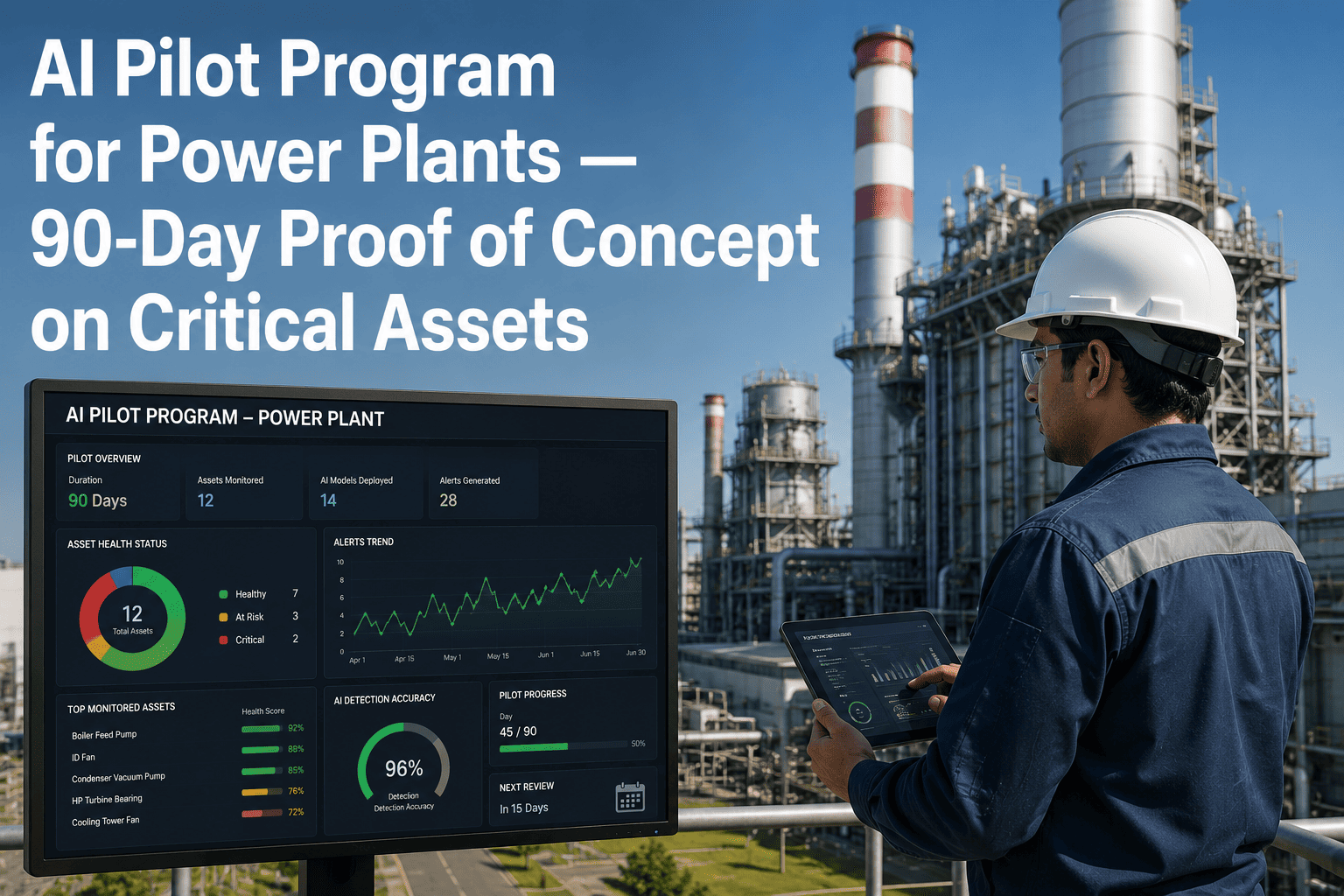
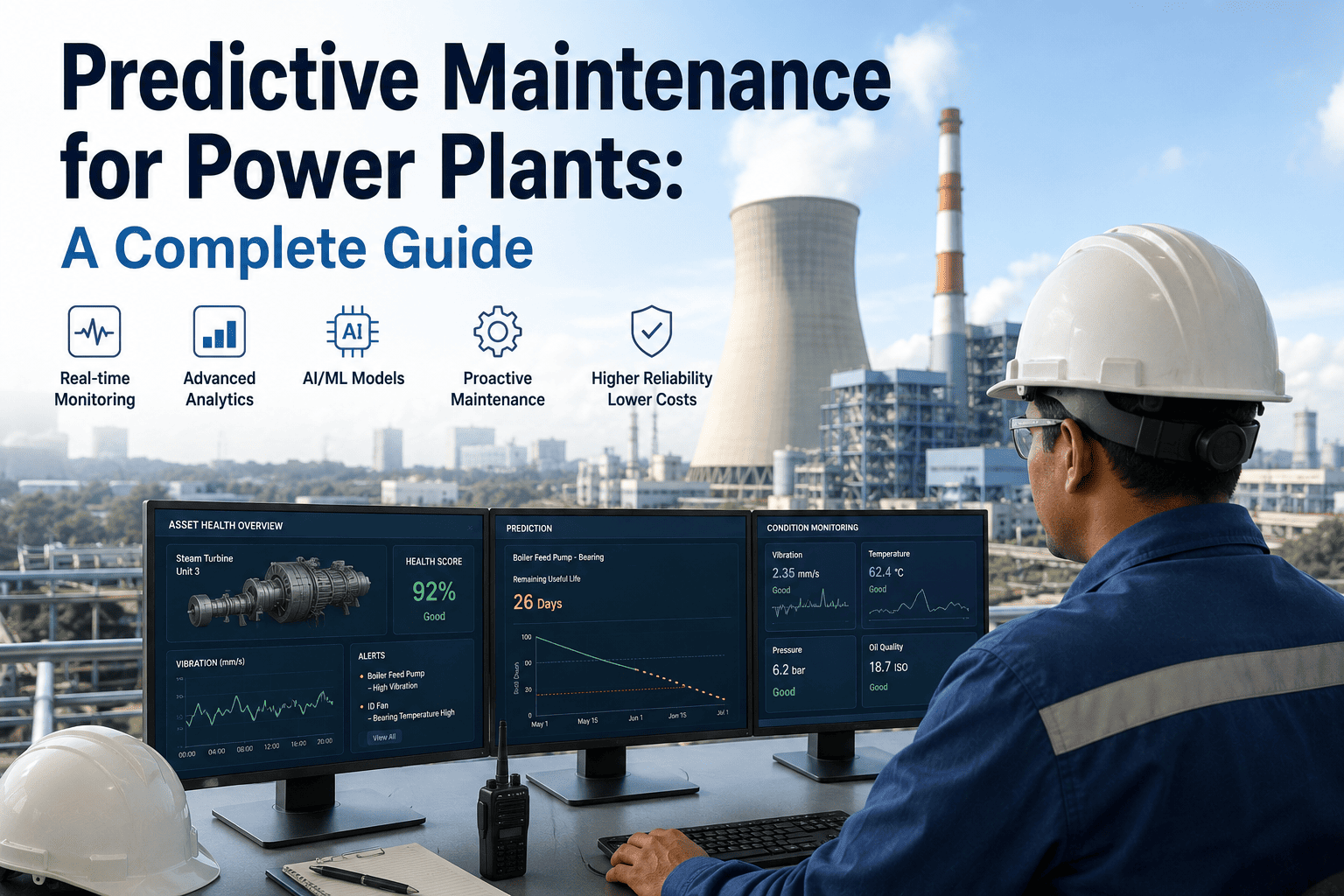
A plant manager sits in front of a capital request for AI predictive maintenance. The numbers look good — 35% reduction in forced outages, $1.2 million in annual avoided downtime per unit — but the board wants proof, not projections. They want to see it work on their turbines, their boilers, their pumps, in their operating conditions, before committing to a plant-wide rollout. This is the right instinct. An iFactory 90-day AI pilot is built for exactly that request: pick your 10-15 most critical assets, connect the sensors you already have, train the models on your data, and measure the detection accuracy against your own maintenance history. The proof comes from your plant, not a slide deck.
iFactory · Power Generation AI
90-Day AI Pilot: Prove Predictive Maintenance on Your Most Critical Assets Before You Commit to the Plant
Start with 10-15 high-value components — turbines, boilers, generators, critical pumps. Connect to your existing DCS and sensors. Validate detection accuracy against your own failure history. Build the ROI case your board actually trusts.
90 days
from connection to validated results
10-15
critical assets monitored in pilot
$1.2M+
annual value per 500 MW unit
On-prem
air-gapped, inside your security perimeter
Why a Pilot — Not a Full Deployment — Is the Right First Step
Every power plant is different. Your fuel mix, your operating regime, your equipment vintage, your DCS architecture, and your maintenance history all shape how AI performs on your floor. A vendor who promises plant-wide results without proving them on your assets first is asking you to bet seven figures on a slide deck. A 90-day pilot eliminates that bet: it proves the detection accuracy on your specific equipment, validates the integration with your DCS and CMMS, and produces the documented cost-avoidance numbers that turn a capital request into an approval.
What if the AI doesn't catch failures on our equipment?
You find out in 90 days on 10 assets — not after a $500k plant-wide rollout. The pilot is the proof; if it doesn't perform, you stop.
What if our DCS is legacy and hard to integrate?
The pilot proves the integration on your actual system — GE, Siemens, Emerson, ABB, Honeywell — via OPC-UA or Modbus. No rip-and-replace.
What if the board wants ROI numbers, not promises?
The pilot produces documented anomalies detected, failures predicted, and cost-avoidance calculated from your maintenance records. Real numbers, your plant.
What 90 Days Looks Like
The pilot follows a three-phase structure that moves from data connection to live prediction in a timeline measured in weeks, not quarters. Each phase has a signed milestone before proceeding, and zero generation impact at every stage — the AI layer is read-only and never writes to your control systems.
Validate asset hierarchy and tag mapping for pilot assets
Map DCS feeds via OPC-UA or Modbus — read-only connection
Deploy NVIDIA edge server inside your Electronic Security Perimeter
Ingest 60-90 days of historical data from historian for model training
Milestone: data flowing, baseline established, no generation impact
AI learns normal operating envelope for each pilot asset
Models run in shadow mode — generating alerts but not routing to operators
Engineering team validates alerts against actual maintenance events
False positive rate tuned below acceptable threshold
Milestone: detection accuracy validated, alert thresholds calibrated
Alerts go live — routing to dashboard, mobile, and CMMS work orders
Every anomaly scored with failure probability and recommended action
Cost-avoidance tracked against maintenance records and outage history
ROI report generated with engineering sign-off for leadership review
Milestone: documented results, board-ready ROI case, expansion plan
Which Assets to Put in the Pilot
Not every asset justifies predictive investment — but the assets that cause forced outages absolutely do. Turbines, boilers, and generators together account for 77% of all mechanical forced outages. A pilot that covers these three categories plus your highest-risk pumps covers the equipment responsible for 90% of your unplanned downtime spend. Start with 10-15 assets, prove the value, then expand.
Gas or steam turbines
43% of all equipment failures. Vibration, bearing temperature, and blade path monitoring predict failure 4-12 weeks ahead.
43%
Boiler tube systems
52% of forced outages in thermal plants. Corrosion, creep, and fatigue show signatures months before rupture.
52%
Generators
12% of equipment failures. Insulation degradation, winding faults, and rotor imbalance all trackable via condition monitoring.
12%
Feedwater and condensate pumps
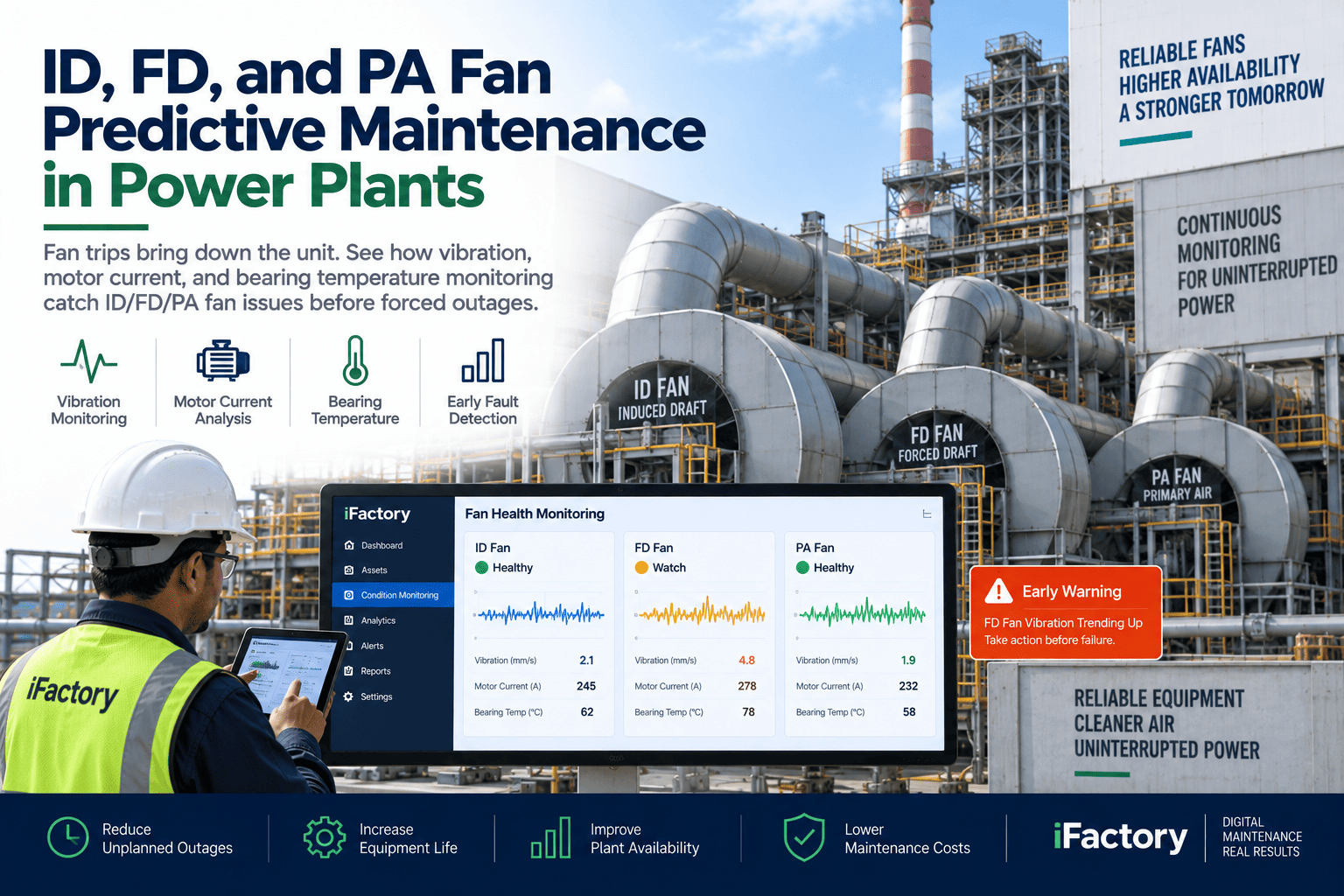
Cavitation, seal wear, and bearing degradation detectable 4-8 weeks ahead from vibration and motor current.
BOP
Main power transformers
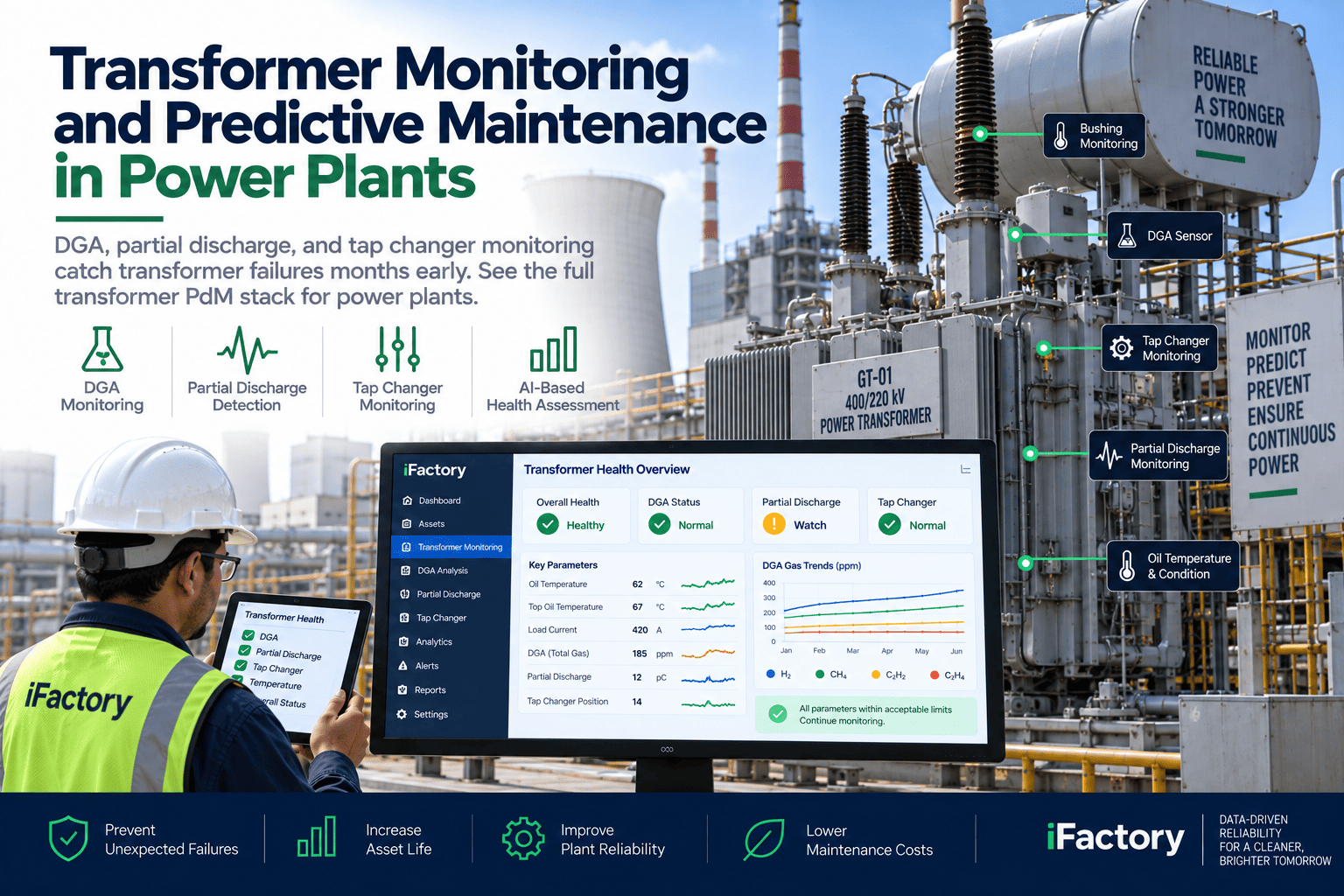
Dissolved gas analysis detects partial discharge and insulation breakdown with 92% accuracy before visible symptoms.
11%
The percentages represent each asset category's share of forced outages, based on NETL reporting data. Prioritizing by forced outage contribution delivers the fastest ROI from the pilot.
Not sure which assets to start with? Talk to a power plant AI specialist — we will build a prioritized pilot asset list from your outage history.
What the Pilot Proves to Your Board
A successful 90-day pilot delivers five things that a slide deck cannot — each documented from your own plant data, with engineering sign-off, in a format your leadership team can act on.
1
Detection accuracy
How many real anomalies the AI caught, validated against your maintenance records and operator observations. Industry benchmark: 90%+ for fault detection from the first weeks.
2
False positive rate
How many alerts were noise. A high false-positive rate erodes operator trust — the pilot tunes this before going live so your team gets actionable alerts, not alarm fatigue.
3
Lead time
How far in advance each developing failure was flagged. The interval between AI alert and actual event is the time your team gains to plan instead of react — typically 30-90 days.
4
Cost avoidance
Dollar value of forced outages that the AI would have prevented, calculated from your historical outage costs. A single avoided turbine emergency — $600k-$1.2M all-in — typically covers the pilot cost.
5
Expansion plan
A scoped proposal for scaling from pilot assets to plant-wide coverage, with projected ROI and timeline based on what the pilot actually measured — not vendor estimates.
The Math Behind a Single Avoided Outage
The economics of an AI pilot become obvious when you price a single forced outage. A turbine bearing failure that triggers an emergency shutdown at a 500 MW combined-cycle plant cascades into six separate cost categories — and the total routinely exceeds $1 million for a single event. Preventing even one of these events during the pilot period pays for the entire deployment.
Lost generation revenue
18 hrs downtime at $125,000/hr
$2,250,000
Emergency repair labor and parts
Expedited shipping, overtime crews
$85,000+
Replacement power purchases
Market rate during peak demand
Variable
Grid penalty fees
Capacity commitment shortfall
$175,000
Secondary equipment damage
Cascading failure to adjacent components
Risk
Total single-event exposure
$2.5M+
A 90-day pilot costs a fraction of a single forced outage. Most plants detect their first actionable anomaly within 30 days of live deployment.
What Does Not Change During the Pilot
Plant managers rightly worry about disruption. The pilot is designed so that nothing about your current operations changes while the AI layer proves itself alongside your existing systems.
Your DCS
AI connects read-only — it never writes to your control systems. Your operators keep their familiar interfaces.
Your CMMS
Work orders integrate via REST API with SAP PM, Maximo, Oracle, or Infor EAM. No CMMS replacement needed.
Your sensors
The AI trains on data from the vibration transducers, RTDs, thermocouples, and pressure transmitters you already have installed.
Your generation
Zero generation impact. Edge servers install in under four hours. Shadow mode runs invisibly before alerts go live.
Ready to scope the 90-day pilot for your plant? Book a demo and we will map the pilot to your specific asset hierarchy, DCS vendor, and outage history.
Frequently Asked Questions
How many assets should we include in the pilot?
Start with 10-15 of the assets that cause the most costly forced outages — typically gas or steam turbines, boiler tube sections, generators, and critical pumps. This covers the equipment responsible for 77% of mechanical outages and gives the model enough variety to prove its cross-asset detection capability.
What if we have never had a failure on the pilot assets during the 90 days?
The model validates against your historical data, not just real-time events. We run the trained model retrospectively against your past 12-24 months of sensor data to show which failures it would have predicted, with what lead time, and at what accuracy. The pilot does not depend on a failure happening during the trial period.
Does the AI require an on-site data science team?
No. The iFactory operations team monitors your predictive models and appliance infrastructure around the clock. If a model drifts or a data feed drops, we handle it before your next shift. Your reliability engineers validate alerts and make maintenance decisions — the data science is embedded in the platform.
What happens after the 90-day pilot?
You receive a documented ROI report with detection accuracy, false-positive rate, lead time, and cost-avoidance numbers from your own plant. If the results support expansion, the model pattern is already proven — scaling from pilot assets to plant-wide coverage is faster because the integration and baseline are already in place.
Is the deployment truly on-premise and air-gapped?
Yes. The NVIDIA edge server runs inside your Electronic Security Perimeter. All AI inference and data storage stay on your network — zero cloud dependency, full air-gap available. The architecture is designed to meet NERC CIP-005 through CIP-013 requirements by design. Your data never leaves your plant.
Prove it on your plant. Then decide.
Start a 90-Day AI Pilot on Your Most Critical Assets
Bring your asset list, your DCS architecture, and your outage history. We will scope the pilot, connect to your existing sensors, train models on your data, and deliver a board-ready ROI report in 90 days. Turnkey on-prem AI: pre-configured NVIDIA server, live in weeks, 1000+ industrial clients, 99.9% uptime.
90 days
to validated results
35-51%
reduction in forced outages
$0
generation impact during pilot
On-prem
air-gapped, NERC CIP ready