Acoustic Emission Monitoring for Power Plant Pressure Vessels & Piping — AI Crack Detection
By Jackson T on July 8, 2026
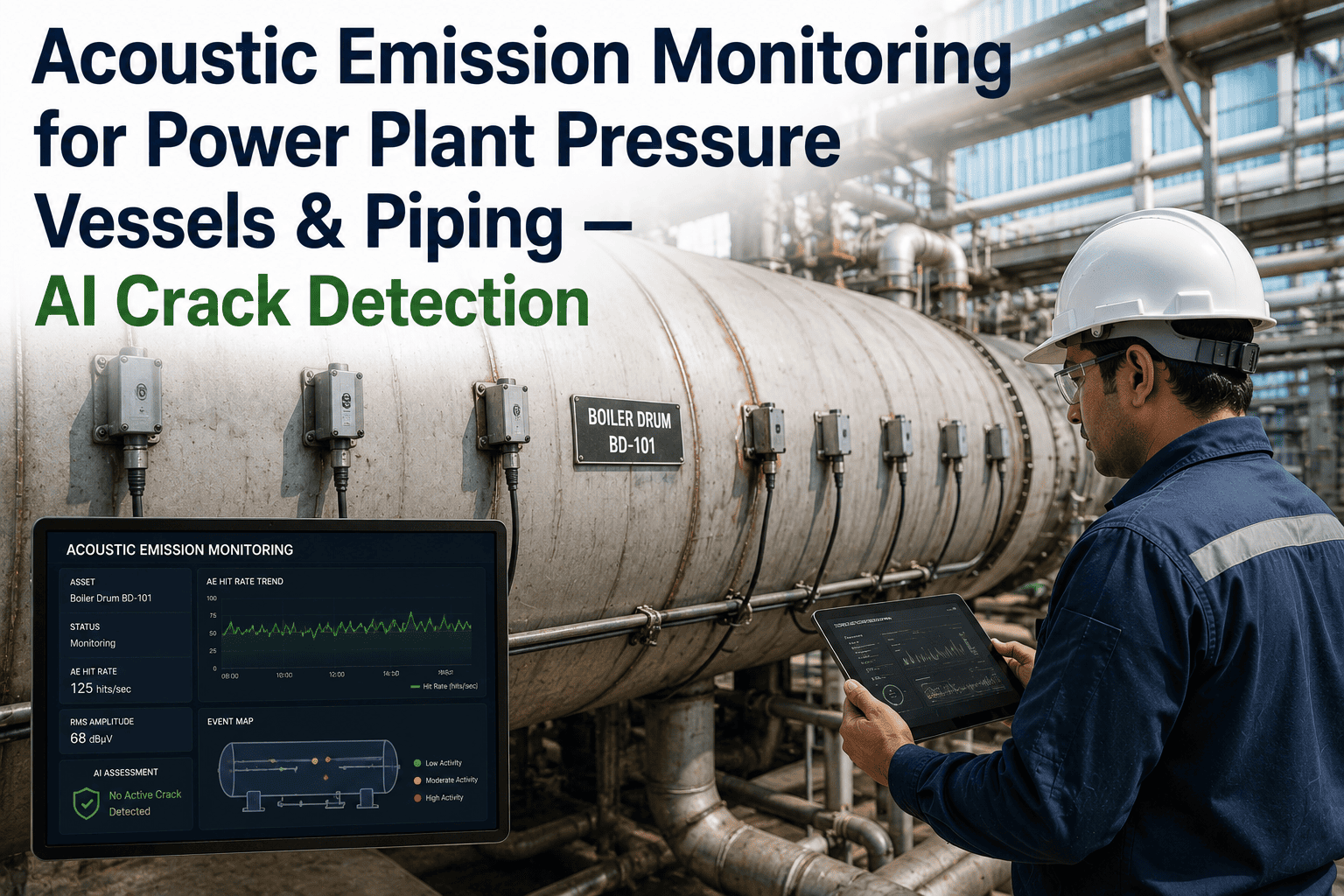
A crack is growing inside a superheater header right now, and nobody can see it. The header is under pressure, at temperature, doing its job — and inside the metal, a fatigue crack is propagating through the ligament between two tube stubs at a rate of fractions of a millimetre per month. No external inspection can see it until the next planned outage. No pressure gauge registers it until the crack is through-wall and steam is escaping. But the crack is not silent — every increment of growth releases a burst of elastic energy that travels through the steel as an ultrasonic stress wave. Acoustic emission sensors hear that wave. An iFactory on-prem AI layer classifies it — distinguishing active crack growth from mechanical noise, corrosion, and flow turbulence — and tells your reliability engineer exactly where the damage is developing, while the plant is still running.
iFactory · Power Plant AI
Hear Cracks Growing in Pressure Vessels and Piping — While the Plant Is Still Running
Acoustic emission sensors detect the ultrasonic stress waves released by active crack growth, corrosion, and micro-leaks in boiler drums, headers, and high-energy piping. On-prem AI classifies every signal and locates every source — no shutdown required.
of thermal forced outages from pressure part failures
24/7
monitoring during normal operation
14-30 d
advance warning before emergency
On-prem
AI classifies signals inside your network
The Problem AE Monitoring Solves
Pressure vessels and high-energy piping degrade through mechanisms that are invisible from the outside — fatigue cracking at weld toes, creep damage in headers operating above 540 degrees Celsius for decades, stress corrosion cracking at nozzle penetrations, and corrosion thinning behind refractory. Traditional inspection methods — ultrasonic thickness measurement, magnetic particle testing, dye penetrant — require a shutdown, scaffold access, and surface preparation. They give you a snapshot of one moment during an outage. Between outages, the metal is on its own. Acoustic emission monitoring fills that gap: it listens continuously during normal operation and detects active damage as it happens, not months later during a scheduled inspection.
Traditional NDE
Inspects during outage only. Finds existing damage at a single point in time. Requires shutdown, access, surface prep. Misses damage that initiates between outages.
Periodic snapshots
AE fills the gap
AE Monitoring + AI
Monitors during operation. Detects active damage as it grows. No shutdown required. Catches damage that initiates and propagates between outages.
Continuous surveillance
What the Sensors Hear
When metal under stress develops a crack, corrodes internally, or begins to leak — it emits elastic stress waves that propagate through the structure at ultrasonic frequencies. Piezoelectric AE sensors mounted on the surface of pressure vessels and piping convert these waves into electrical signals. The challenge is that a power plant is acoustically noisy: valve operations, flow turbulence, thermal expansion, and mechanical contact all produce signals. This is where AI classification becomes essential — the model learns to separate genuine crack growth from background noise, and to distinguish between failure mechanisms based on the waveform characteristics of each source type.
Active crack growth
High-frequency burst emissions with rapid rise time
Continuous low-amplitude emissions with broad frequency content
Trending — monitor rate and schedule UT verification
Micro-leak
Sustained high-frequency signal correlated with pressure
Urgent — steam escaping through crack or seal failure
Mechanical noise
Low-frequency, high-amplitude events from valves, flow, thermal expansion
Filtered — AI excludes from damage assessment
AI classification accuracy exceeds 90% for separating genuine damage signals from mechanical noise — eliminating the false alarms that erode operator trust in AE systems and turning raw waveform data into maintenance decisions.
Where to Deploy AE Sensors in a Power Plant
Not every surface needs acoustic coverage. The highest-value deployment targets are the components where crack growth leads to catastrophic failure, where access for conventional inspection is difficult or expensive, and where the consequences of a through-wall defect are measured in millions of dollars and weeks of downtime. These five locations account for the vast majority of pressure-part forced outages.
Boiler drum
High consequence
Longitudinal and circumferential seam welds, nozzle penetrations, ligament areas between tube stubs
Drum failure is catastrophic. Crack initiation at weld toes from thermal cycling and corrosion fatigue is the primary concern. 1-3 sensors per drumhead, additional sensors along seam welds.
Headers operate above 540 degrees Celsius for decades. Creep damage and creep-fatigue interaction at ligaments are the dominant failure mechanisms. Conventional inspection requires scaffold and surface prep during outage.
High-energy piping
High consequence
Main steam lines, hot reheat piping, circumferential welds, branch connections, hanger attachment welds
Piping operates at design conditions for the life of the plant. Creep and fatigue cracking at welds and stress concentrations are the primary risks. A rupture is a safety event, not just a maintenance event.
Stress corrosion cracking from dissolved oxygen and thermal shock. Shell failure can be catastrophic and deaerator cracking has caused fatalities in the industry.
HRSG pressure parts (combined-cycle)
Monitor
HP drum, superheater headers, attemperator connections, transition piece welds
Rapid cycling from daily start-stop operation accelerates fatigue cracking. HRSG components experience more thermal cycles in 5 years than traditional boiler parts see in 20.
Want to identify the highest-value AE deployment points in your plant? Talk to an AE specialist and we will map sensor locations to your specific asset hierarchy and outage history.
How AI Turns Waveforms into Maintenance Decisions
Raw acoustic emission data is a firehose — thousands of events per hour, each described by amplitude, frequency content, rise time, duration, energy, and source location. Without intelligent filtering, AE monitoring produces noise that operators ignore. The AI layer transforms this data through a three-stage pipeline that ends with an actionable work order, not a waveform chart.
Stage 1: Noise rejection
Mechanical noise from valves, flow, and thermal expansion is filtered using learned waveform signatures. Only events matching damage-type profiles pass through. Eliminates the false alarms that destroyed operator trust in earlier AE systems.
Stage 2: Source classification
Each qualified event is classified by mechanism — crack growth, corrosion, leak, or deformation — based on waveform characteristics that machine learning has linked to known failure modes. The model trains on your plant's specific acoustic environment.
Stage 3: Severity scoring and action
Classified events are scored by severity based on emission rate, energy trend, and source location. Critical scores auto-generate a CMMS work order with the predicted failure mechanism, affected asset, and recommended NDE follow-up — so your reliability engineer gets a decision, not a dataset.
AE Monitoring vs. Waiting for the Outage
The economics of acoustic emission monitoring become clear when you compare the cost of finding damage during operation to the cost of finding it as a through-wall defect during an emergency — or worse, missing it during the outage inspection entirely.
Found during emergency
Found by AE monitoring
Through-wall crack discovered when steam escapes
Active crack flagged when growth rate increases — weeks before through-wall
Emergency shutdown — $200,000+ per day in lost generation
Repair scheduled into next planned outage window
Damage extent unknown until scaffold erected and NDE completed
Source located by sensor triangulation — NDE targeted to exact zone
Secondary damage from operating with through-wall defect
No secondary damage — crack arrested before propagation to adjacent structures
Regulatory reporting, incident investigation, corrective action plan
Proactive maintenance documented — strengthens compliance record
Ready to add continuous AE monitoring to your pressure vessels and piping? Book a demo and we will scope the deployment for your most critical pressure boundaries.
Why On-Prem for AE Data
Acoustic emission monitoring generates high-frequency, high-volume waveform data — far more data per sensor than temperature or pressure instruments. Running the AI classification on-premise keeps the data inside your security perimeter, eliminates the latency of streaming waveforms to the cloud, and ensures the system keeps working even if the network drops.
Data volume
AE sensors generate continuous high-frequency waveform data. Local processing at the edge reduces the data to classified events and severity scores before it ever leaves the server — no bandwidth bottleneck.
Security
AE data maps the structural health of your most critical pressure boundaries — it is sensitive engineering intelligence. On-prem keeps it inside your Electronic Security Perimeter, meeting NERC CIP requirements by architecture.
Reliability
A pressure vessel monitoring system that depends on an internet connection has a single point of failure your plant cannot tolerate. On-prem AI keeps classification running 24/7 regardless of connectivity.
Frequently Asked Questions
Does AE monitoring replace conventional NDE during outages?
No — it is additive, not a replacement. AE monitoring provides continuous surveillance between outages and directs your outage NDE to the exact locations where active damage has been detected. This makes outage inspections faster and more targeted: instead of inspecting every weld, your NDE crew focuses on the specific zones that AE flagged, with the AI providing the expected damage mechanism and severity.
How many sensors are needed for a typical boiler?
A typical deployment uses 1-3 sensors per drumhead, 2-4 per header depending on length, and sensors at each major weld joint on high-energy piping. For a conventional boiler with two drums and four headers, a priority deployment is typically 14-20 sensors. HRSG applications may need fewer sensors but on more components due to the number of pressure parts.
Can AE sensors survive the temperature environment on a boiler?
Yes. High-temperature AE sensors and waveguides are designed specifically for continuous service on surfaces at operating temperature. Waveguides — metal rods welded to the vessel surface — transmit the stress wave from the hot surface to the sensor mounted at a cooler location. This is standard practice in power plant AE monitoring and has been field-proven for decades.
What standards govern AE monitoring on pressure vessels?
ASME Boiler and Pressure Vessel Code Section V, Articles 11 and 12 cover acoustic emission examination methods. ASTM E569 covers AE monitoring of structures during controlled stimulation. ASTM E650 covers sensor mounting. API 570 accepts AE testing to support in-service pressure vessel inspection. The iFactory platform logs all AE data in formats that support compliance documentation for these standards.
How quickly can AE monitoring be deployed on existing equipment?
Priority assets — key headers, drums, and high-energy piping — can have AE sensors operational within 30-90 days. Sensor installation on accessible surfaces can be done during operation without a shutdown. Turnkey on-prem deployment includes pre-configured NVIDIA AI server, sensor integration, model training on your plant's acoustic environment, and CMMS work order integration.
Your pressure vessels are talking. Start listening.
Deploy AI-Powered Acoustic Emission Monitoring on Your Critical Pressure Boundaries
Bring your asset list — drums, headers, high-energy piping. We will map the sensor locations, train the classification model on your plant's acoustic environment, and deliver continuous structural health monitoring without a single shutdown. Turnkey on-prem AI: pre-configured server, live in weeks, 1000+ industrial clients, 99.9% uptime.