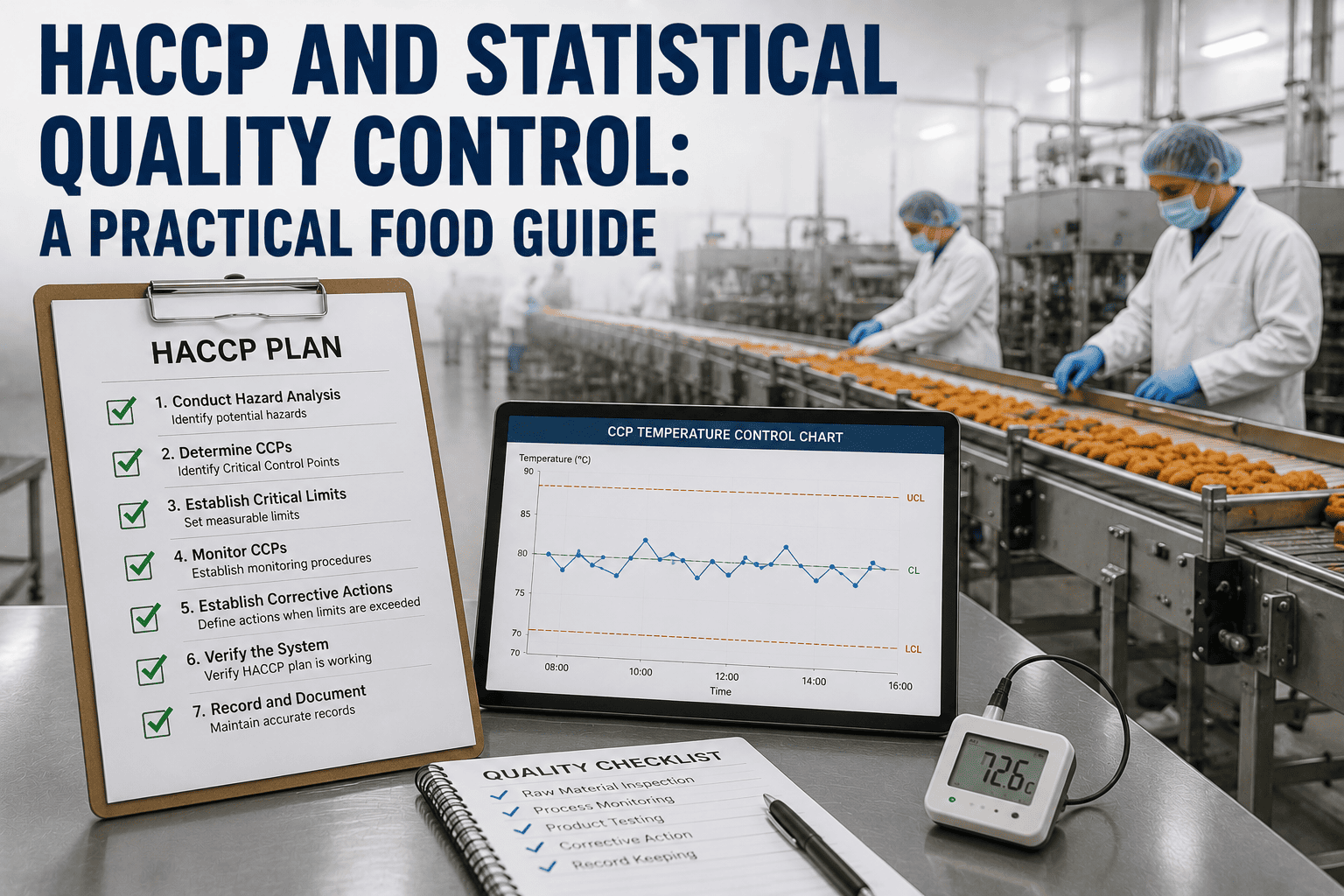
HACCP tells you which steps in the process are critical to food safety. It tells you what the critical limit is at each of those steps. What it does not tell you is that the cook temperature has been trending down for six shifts and will hit the critical limit sometime tomorrow. HACCP is a pass/fail architecture — it fires when the limit is crossed, not before. That is the exact gap statistical quality control was invented to fill. Every critical control point on a food safety plan produces a continuous stream of data: cook temperature, pH, chlorine concentration, cool-down time, fill weight, metal-detect rejects, seal integrity. HACCP checks whether each one is inside its limit. SQC watches how each one is behaving over time — the trend, the shift, the widening range — and fires when the pattern says a limit will be crossed in the near future. Codex Alimentarius, the FDA under FSMA, and USDA-FSIS all define what HACCP requires. Nobody defines whether the CCP is stable, capable, or drifting. That is the food safety layer that only SQC provides. iFactory HACCP + SQC is built to run the two together — every CCP monitored the way HACCP requires, and trended the way statistical control demands, in one auditable record.
iFactory HACCP + SQC
HACCP Tells You What to Control. SQC Tells You If You're Really In Control.
Every CCP monitored to Codex, FSMA, and USDA-FSIS requirements — with statistical process control layered on top so drift gets caught before the critical limit does.
7
HACCP principles, Codex
Trend
SQC adds prediction
FSMA
HARPC evidence built in
The Two Systems Answer Different Questions
HACCP and SQC are not competing frameworks — they answer different halves of the same food safety question. Confusing them is how plants end up "HACCP compliant" and yet still get product-safety incidents.
HACCP
"Is the CCP inside the critical limit right now?"
Defines which steps are food-safety critical
Sets a pass/fail limit at each CCP
Fires when the limit is crossed
Regulatory backbone — Codex, FSMA HARPC, FSIS
Requires corrective action after the fact
SQC
"Is the CCP behaving in a way that will stay inside the limit?"
Watches the trend, shift, and range at every CCP
Fires when the pattern says drift is coming
Warning band inside the critical limit
Adds capability, stability, and predictability
Corrective action before the CCP is out of control
The Seven HACCP Principles — And Where SQC Layers On
Codex Alimentarius defines HACCP as seven principles applied in sequence. SQC doesn't replace any of them — it makes principle 4 (Monitor) and principle 6 (Verify) genuinely predictive instead of purely reactive.
1
Conduct hazard analysis
Identify the biological, chemical, and physical hazards at every step from raw material to shelf.
2
Determine CCPs
Identify the steps where control is essential to prevent, eliminate, or reduce a hazard to acceptable levels.
3
Establish critical limits
Set measurable science-based thresholds — 165°F for poultry cook, pH under 4.6 for shelf-stability, specified chlorine ppm for sanitizer.
4
Monitor the CCP
Continuous or periodic measurement to assess whether the CCP is under control.
SQC layers here — trends every measurement, not just the last one
5
Establish corrective action
Predetermined action when a critical limit is crossed — including product disposition.
6
Verification procedures
Confirm the HACCP plan is working — periodic reviews, calibrations, audit checks.
SQC layers here — capability indices prove the CCP is genuinely under control
7
Record-keeping
Time-stamped documentation of monitoring, deviations, and corrective actions — the audit trail regulators require.
Common CCPs and Their SQC Companion Signals
Every CCP has a pass/fail limit set by HACCP. Every CCP also has an SQC signal that fires before that limit is at risk. This is what the pairing looks like across the CCPs that appear on almost every food safety plan.
| CCP |
HACCP critical limit |
SQC companion signal |
| Cook step (poultry) |
Core ≥ 165°F for ≥ 1 sec |
Trend of cook temp mean by cycle, warning band 168-165°F |
| Pasteurization |
Time-temp equivalent per PMO |
Hold-time distribution per batch, R-chart on temperature |
| Acidification / pH |
Finished pH ≤ 4.6 |
pH mean drift trend, warning at pH 4.4 |
| Cool-down time |
135°F to 41°F within 6 hours |
Per-batch cool curve vs. baseline envelope |
| Metal detection |
Zero contamination past detector |
Sensitivity check drift, reject-rate trend per shift |
| Fill weight (net content) |
Meets label + TNE tolerance |
Per-valve mean and σ trending, warning band above TNE line |
| Seal integrity |
Zero leakers, pull test ≥ spec |
Torque per head, sealer temperature trend, drift alerts |
| Allergen segregation |
Validated changeover cleaning |
Changeover time trend, verification sample results per SKU |
Want SQC signals mapped to your specific CCPs? Book a demo — bring your HACCP plan and we'll build the companion layer.
Why HACCP Alone Isn't Enough
HACCP is proven, mandated, and irreplaceable. But it has a structural weakness that everyone in food safety knows about and few programs actually close.
No advance warning
HACCP fires when the CCP crosses the critical limit. It doesn't tell you the trend has been sliding for two shifts. The alarm rings the moment product safety is at risk — not before.
Point-in-time monitoring
Manual HACCP checks capture the reading at that instant. The 4 hours between checks are inferred. A dip that resolves before the next check leaves no trace and no signal.
No capability index
HACCP verifies the plan is being followed. It doesn't verify the process is capable of holding the critical limit reliably. A CCP running at Cpk 0.7 is one bad shift away from a violation, and HACCP won't tell you.
Human-error prone
Manual HACCP monitoring depends on operators reading, recording, and reacting. Missed readings, transcription errors, and delayed reactions are documented failure modes.
Reactive corrective action
By the time HACCP fires, product produced under the deviation must be held, evaluated, and often destroyed. SQC's warning fires while the fix is still cheap.
Audit trail is patchy
Paper HACCP logs satisfy the letter of the record-keeping principle but not the spirit — inspectors want continuous evidence, not shift-summary check marks.
What Integrated HACCP + SQC Looks Like Live
The combined system runs both layers on the same measurement. Every reading is checked against the HACCP critical limit and against the SQC baseline in the same moment — with two separate signals for two separate purposes.
01
Measure the CCP
Cook temp, pH, chlorine, fill weight, seal torque — captured continuously from PLC, SCADA, or IoT sensor.
02
HACCP Limit Check
Every reading compared to the critical limit. A crossing triggers a HACCP deviation event with predefined corrective action.
03
SQC Rule Engine
The same reading enters the SQC engine. Western Electric and Nelson rules fire on drift, shift, and warning-band clusters.
04
Two-Track Action
HACCP violation triggers product hold and corrective action. SQC signal triggers investigation and preventive tuning before violation.
05
Auditable Record
Time-stamped log satisfies HACCP record-keeping, FSMA preventive controls, and audit trail — with capability trend built in.
What HACCP + SQC Together Deliver
Layering SQC on top of an existing HACCP program is one of the highest-leverage moves in food safety. Same instrumentation, same CCPs, same team — but the visibility, prediction, and audit posture all step up together.
Fewer
HACCP deviations
caught by SQC before crossing limits
Live
CCP capability
Cpk trended per CCP, per SKU
Continuous
Audit trail
satisfies FSMA HARPC and FSIS
Lower
Recall risk
by catching drift before deviation
Curious how many of your recent HACCP deviations SQC would have caught early? Talk to our food safety team — we'll replay your CCP data.
Frequently Asked Questions
Doesn't HACCP already give us enough food safety coverage?
HACCP gives you the framework — hazard analysis, critical control points, limits, monitoring, corrective action, verification, records. That's the regulatory backbone. What HACCP does not give you is advance warning. It fires when the CCP crosses the critical limit; it doesn't tell you the trend has been sliding for two shifts. SQC is the layer that adds the trend and the prediction — same CCPs, same limits, but you find out something is drifting while it's still cheap to fix.
Do we need to change our HACCP plan to add SQC?
No. Your HACCP plan stays exactly as it is — hazards, CCPs, critical limits, corrective actions, and records. SQC sits on top of the same measurements you're already taking. It adds trend visualization, capability indices, and warning-band signals to the CCPs you already monitor. Auditors see the HACCP program they expect plus a stronger monitoring and verification layer than the standard requires.
Which CCPs benefit most from SQC?
The ones with continuous or high-frequency measurements — cook temperature, pasteurization time-temp, pH, cool-down time, fill weight, seal torque, chlorine concentration. These are exactly the CCPs where a slow drift can develop between manual checks. Batch-based CCPs like allergen-changeover verification benefit less from SQC on the measurement itself but still gain from trend analysis on changeover time and verification results.
How does this help with FSMA and FSIS audits?
FSMA HARPC and FSIS both expect continuous, evidence-based monitoring and verification. HACCP paper logs meet the letter of the requirement; SQC-backed continuous records demonstrably exceed it. Inspectors see the CCP trending inside its control limits shift after shift, capability indices proving the process is genuinely stable, and every rule-fire and corrective action time-stamped in one record. The audit shifts from "prove you followed the plan" to "here is the plan running."
Can we see it running on our own CCPs before committing?
Yes. Bring your HACCP plan and one week of measurement data from 2-3 CCPs. We'll compute the baseline, apply the SQC rules, and show every drift signal that would have fired against actual production — with the HACCP critical limit and the SQC warning band plotted side by side. Book a demo and we'll walk it live.
Stop finding out at the limit.
See HACCP + SQC Running on Your Own CCPs
Bring your HACCP plan and one week of CCP data. We'll layer SQC on top of the same measurements, plot every critical limit and warning band together, and show the drifts that would have been caught days before your next scheduled verification check.
7 principles
HACCP intact