Food Plant Daily GMP Audit Checklist with Voice and Photos
By David Cook on October 22, 2026
Most food plants already walk the floor every morning. The trouble comes next. Findings land on a clipboard, photos sit on someone's phone and the beading pipe above the filler gets mentioned again tomorrow. A daily GMP audit checklist only protects product when each finding reaches the person who can fix it, with proof attached. This guide gives you the checklist, the reasoning behind each zone and a way to run it by voice and photo. See a full round in a short GMP audit demo.
GMP AUDIT MODULE · DAILY ROUNDS
Speak the Finding, Snap the Photo, Send It to the Right Team
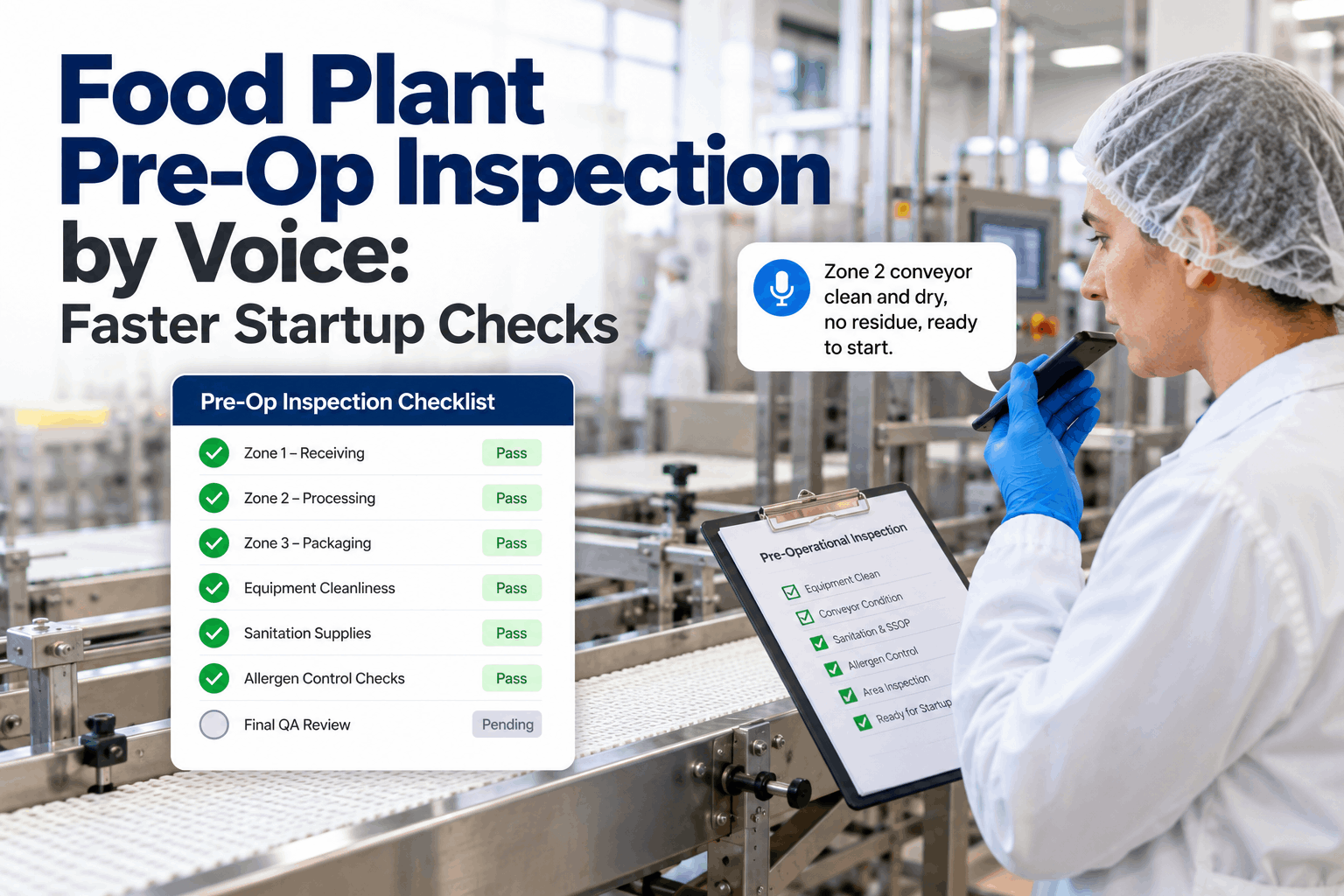
iFactory loads a checklist for each zone. Auditors speak findings and attach photos, AI suggests the category and severity for the auditor to confirm, and the corrective action lands on the owning department's kanban.
"Condensation beading on the chilled water line above filler two. Product is open."
CondensationMajorAI suggested
Confirmed by auditor · card raised on Maintenance kanban
INTERNAL AUDIT FOOD PROGRAMME
Where the Daily Walk Fits in Your Audit Ladder
A daily GMP walk is not a systems audit. It is a quick, practical look at conditions on the floor before and during production: people, surfaces, overheads, tools and chemicals. Above it sit risk-based hygiene and fabrication inspections, then internal audits of the food safety system, then the certification audit. The daily rung is the only one fast enough to stop a defect before product runs under it. Our support team can help you set the cadence for each rung.
Every shift or day
Daily GMP walkZone checklist, 15 to 30 minutes, run by QA or trained leads. Looks at conditions right now.
Risk-based, often monthly
Hygiene and fabrication inspectionDeeper look at building, equipment condition and cleaning standards in each area.
Planned through the year
Internal systems auditChecks that procedures, records and corrective actions work as written.
Yearly or as scheduled
Certification or customer auditExternal auditor samples records and watches the floor. Daily records are the evidence.
GOOD MANUFACTURING PRACTICES
The Rules Behind Each Zone of the Checklist
In the US, the baseline is 21 CFR Part 117 Subpart B, the current good manufacturing practice rules. It covers personnel, plant and grounds, sanitary operations, equipment and process controls. GFSI-benchmarked schemes such as BRCGS add more. BRCGS Food Safety Issue 9, for example, expects documented hygiene and fabrication inspections at a risk-based frequency and a register of glass, brittle plastic and ceramic items. Check the exact clause wording in your own scheme edition. Map your scheme to zone checklists in a checklist setup call.
117.10
PersonnelSuitable outer garments, hand washing, no unsecured jewellery, intact gloves, hair restraints, no eating or drinking where food is exposed.
117.20
Plant and groundsDrip or condensate from fixtures, ducts and pipes must not contaminate food. Shatter-resistant bulbs and fixtures over exposed food, or other protection.
117.35
Sanitary operationsFacilities kept clean and in repair. Cleaners and toxic materials identified, held and stored safely. No pests in any area of the plant.
117.40
EquipmentCleanable design, corrosion-resistant food-contact surfaces, seams smoothly bonded or kept free of food build-up.
117.80
Process controlsAdequate measures against metal or other extraneous material getting into food.
BRCGS
Scheme extrasGlass and brittle plastic register with risk-based checks, breakage procedure, and documented GMP inspections with corrective actions.
DAILY GMP AUDIT CHECKLIST TEMPLATE
The Daily GMP Audit Checklist, Zone by Zone
Use this as a starting point and trim it to your plant. Each item is written so that a yes means the condition is acceptable. Anything you can't tick becomes a finding with a photo. Codes help when you speak a finding, so "GB-3 fail" is enough for the system to know which line to mark. For a version loaded with your zones, lines and register IDs, contact our support team.
Personnel hygienePH
Glass and brittle plasticGB
Condensation and overheadsCO
HousekeepingHK
Foreign material controlsFM
Pest signsPS
ChemicalsCH
Maintenance-left itemsML
GLASS BRITTLE PLASTIC
Register Checks and What to Do When Something Breaks
A glass and brittle plastic register lists every item that could shatter in a product area, where it is and what it is made of. Each item gets a check frequency based on how likely it is to break and how likely a break is to reach product. High-risk items over open product are often checked at start-up every day. Record the result even when the item is fine, because the record is what proves the check happened. Walk through a register set-up in a short session.
Register entry · example
Item IDGB-Z2-014
LocationFiller 2, light above infeed
MaterialPolycarbonate diffuser
Over open productYes
Check frequencyDaily, at start-up
Last check07:44 · intact · photo kept
If a breakage is found
1Stop the line and report to the shift lead
2Isolate the area and hold product that may be exposed
3Clean up top-down with the breakage kit, then dispose
4Check footwear, tools and PPE of people in the area
5QA inspects and signs before restart
6Record the event, product decision and fix
CONDENSATION CONTROL
Four Places Condensate Forms Over Product
Condensate is one of the easiest findings to miss on a busy morning and one of the hardest to argue with in an audit, because 117.20 names it directly. It forms wherever warm, humid air meets a cold surface. The fix is often a maintenance job, such as insulation, a drip tray or a fan setting, which is why routing matters. Our support team can share a condensation map template.
Chilled water and glycol linesMissing or wet insulation lets lines sweat. Check joints and valves over fillers and conveyors.Owner: Maintenance
Evaporators and drain pansBlocked drains overflow. Defrost cycles can push melt water past the pan.Owner: Engineering
Ceilings above hot washdownSteam and hot water rise and settle on cold ceilings, then fall during the next run.Owner: Sanitation and Maintenance
Ducts and air handlersWet ducts after sanitation, or poor air balance, can drip at start-up.Owner: Facilities
One Sentence and a Photo Instead of a Paragraph Later
Auditors keep gloves on and eyes on the floor. They speak each finding, take the photo, check the suggested tags and move on. The finding is already on the right team's board before the round ends.
AuditorCable ties and a nut on the case erector frame. Night shift did a belt change. Photo taken.
iFactoryLogged as ML-2, maintenance-left item. Suggested severity: Major, near open cases. Confirm?
AuditorConfirm. Product is boxed, so make it Minor.
iFactoryChanged to Minor. Card on the Maintenance kanban with both photos and the work order link.
GMP INSPECTION APP
What One Finding Looks Like When It Is Recorded
A good finding answers five questions without a follow-up call: where, what, how bad, who owns it and what proves it. Voice capture fills the first two in the auditor's own words. The photo proves it. AI suggests the category and severity, and the auditor confirms or changes them, so a person always makes the final call. See how tags are suggested in a live walkthrough.
Finding F-1027Open
WhereZone 2 Filling, filler 2 infeed
Spoken as"Condensation beading on chilled line, product open"
Photos2 attached, time-stamped
CategoryCondensation · AI suggested, confirmed
SeverityMajor · confirmed by auditor
Immediate actionCover fitted, line lead told
OwnerMaintenance kanban
Close-outInsulation fixed, after photo, QA sign-off
SEVERITY AND ROUTING
Who Owns Each Kind of Finding
Findings stall when nobody knows whose job they are. Agree a default owner per category before go-live and routing becomes automatic. The levels below are an example. Your HACCP or food safety plan decides what counts as critical in your plant. Set your own routing with our GMP specialists.
Category
Example finding
Typical severity
Owning kanban
Expected response
Glass or brittle plastic
Cracked light diffuser over open product
Critical
QA, then Maintenance
Stop, isolate, breakage procedure now
Condensation
Beading on chilled line above filler
Major
Maintenance
Cover now, fix within the shift
Maintenance-left item
Nut and cable ties on case erector
Major or minor
Maintenance
Remove now, review job close-out
Personnel hygiene
Beard uncovered at mixing
Minor
Production
Correct on the spot, coach
Housekeeping
Standing water by drain 4
Minor
Sanitation
Clear before start-up
Pest signs
Rodent signs near dock door 2
Major
QA and pest contractor
Inspect, clean, extra monitoring
Chemicals
Unlabelled spray bottle at line 1
Minor
Sanitation
Remove, relabel, retrain
DAILY GMP AUDIT CHECKLIST EXAMPLES
A Morning's Findings on the Department Boards
This illustration shows how one morning round might look once findings are routed. It is an example, not a customer case. Each department sees its own cards with the photo and spoken note. Cards move from open to closed with an after photo, so QA can verify without walking back. See the boards with your own departments in a board demo.
Maintenance 3
Chilled line beadingZone 2 · Major · in progress
Nut on case erectorZone 3 · Minor · open
Loose guard fastenerZone 1 · Minor · open
Sanitation 2
Standing water, drain 4Zone 1 · Minor · closed
Unlabelled spray bottleZone 1 · Minor · closed
Production 1
Beard cover missingZone 1 · Minor · closed
QA 1
Pest sign at dock door 2Dock · Major · open
DAILY GMP AUDIT CHECKLIST BEST PRACTICES
Six Habits That Keep Daily Audits Useful
A daily audit loses value fast once it becomes box-ticking. These habits keep it sharp. Talk them through with our support team.
01
Walk before start-upCatch maintenance-left items and overnight condensation before product is exposed.
02
Rotate the auditorFresh eyes spot what the regular auditor has stopped seeing.
03
Look up as well as downOverheads, light covers and ceilings are where many findings hide.
04
Photo every findingA picture settles arguments and shows the fix was real.
05
Close with an after photoCards close only when the owner shows the fixed condition.
06
Review repeat findings weeklyThe same finding three times is a root cause, not a cleaning task.
DAILY GMP AUDIT CHECKLIST IMPLEMENTATION GUIDE
From Paper Round to Voice Round in Four Moves
Most plants start with one high-risk zone, such as filling or ready-to-eat packing, and add zones once auditors trust the tagging. Plan the first zone in a rollout call.
1Map zonesAreas, lines, register items and owners per category.
2Load checklistsOne zone template each, with item codes.
3Run side by sideVoice and paper for two weeks, then compare.
4Switch and reviewRetire paper, start weekly repeat-finding reviews.
TURNKEY AI DEPLOYMENT
GMP Audit Module, Voice Agent and AI Server in One Package
iFactory delivers the GMP Audit Module as a turnkey bundle. A pre-configured NVIDIA AI server ships racked and ready with the voice agent, photo tagging models and your zone templates pre-loaded, so findings are processed on site even where Wi-Fi is weak. You rack it, plug in power and Ethernet, and the AI is live. To scope it for your plant, request a turnkey quote.
What's Included
Pre-configured NVIDIA AI edge server, racked and ready
Zone checklist templates built from Part 117 and your scheme
Voice agent tuned to plant terms and item codes
Photo capture with AI category and severity suggestions
Department kanban boards with after-photo close-out
Glass and brittle plastic register with daily check lists
24×7 remote monitoring of software and hardware
Live in 6–12 weeks
Wk 1–4
Map and Load
Zones, register items and owners mapped, server installed, templates loaded.
Wk 5–8
Pilot Zone
Voice rounds in one zone alongside paper, tags tuned with QA.
Wk 9–12
All Zones Live
Remaining zones switched over, owners trained, weekly reviews running.
HOW iFACTORY FITS
Daily GMP Audits Built Around the People Who Fix Things
The GMP Audit Module is designed so that a finding takes seconds to record and reaches its owner without a meeting. Our support team can walk you through a pilot plan.
1
Zone templates. Each area gets its own checklist with item codes and register items.
2
Voice findings with photos. Auditors speak and snap, with no typing on the floor.
3
AI tags, human confirms. Category and severity are suggested, and the auditor has the final say.
4
Department kanban. Corrective actions land on the owning team's board and close with an after photo.
1000+
Industrial clients running iFactory
99.9%
Platform uptime across shifts
6-12 wks
From racked server to live GMP rounds
FREQUENTLY ASKED QUESTIONS
What QA and Plant Managers Ask About Daily GMP Audits
Is a daily GMP audit required by FDA?
Part 117 doesn't set a daily audit frequency. It sets the conditions you must maintain, such as no condensate contaminating food and no pests in any area. A daily walk is how most plants show they keep those conditions every day. GFSI-benchmarked schemes add documented inspections at a risk-based frequency.
How long should a daily GMP walk take?
Most zone walks take 15 to 30 minutes, depending on the area's size and risk. Voice capture shortens the write-up, not the looking.
How often should glass and brittle plastic be checked?
It depends on risk. Items with a high chance of breaking and a high chance of reaching product, such as light covers over open product, are commonly checked daily at start-up. Lower-risk items may be weekly or monthly. Record every check, including items found intact.
Does the AI decide how serious a finding is?
No. It suggests a category and severity from the spoken words and the photo. The auditor confirms or changes them before the finding is saved, and your food safety plan defines what each severity level means.
What happens to findings that repeat?
Repeat findings are grouped by zone and category for the weekly review. A condensation finding on the same line three times points to insulation or airflow, not to a missed wipe-down, and should become a root-cause action.
Can we use our existing checklist?
Yes. Your current paper list is split into zone templates with item codes. Gaps against Part 117 and your scheme are flagged during set-up. Our support team can review your current list with you.
Every Finding Seen, Owned and Closed
Load your zones, hand auditors a phone or headset and let each spoken finding become a routed, photo-backed action. The full system is delivered turnkey and goes live in 6 to 12 weeks.