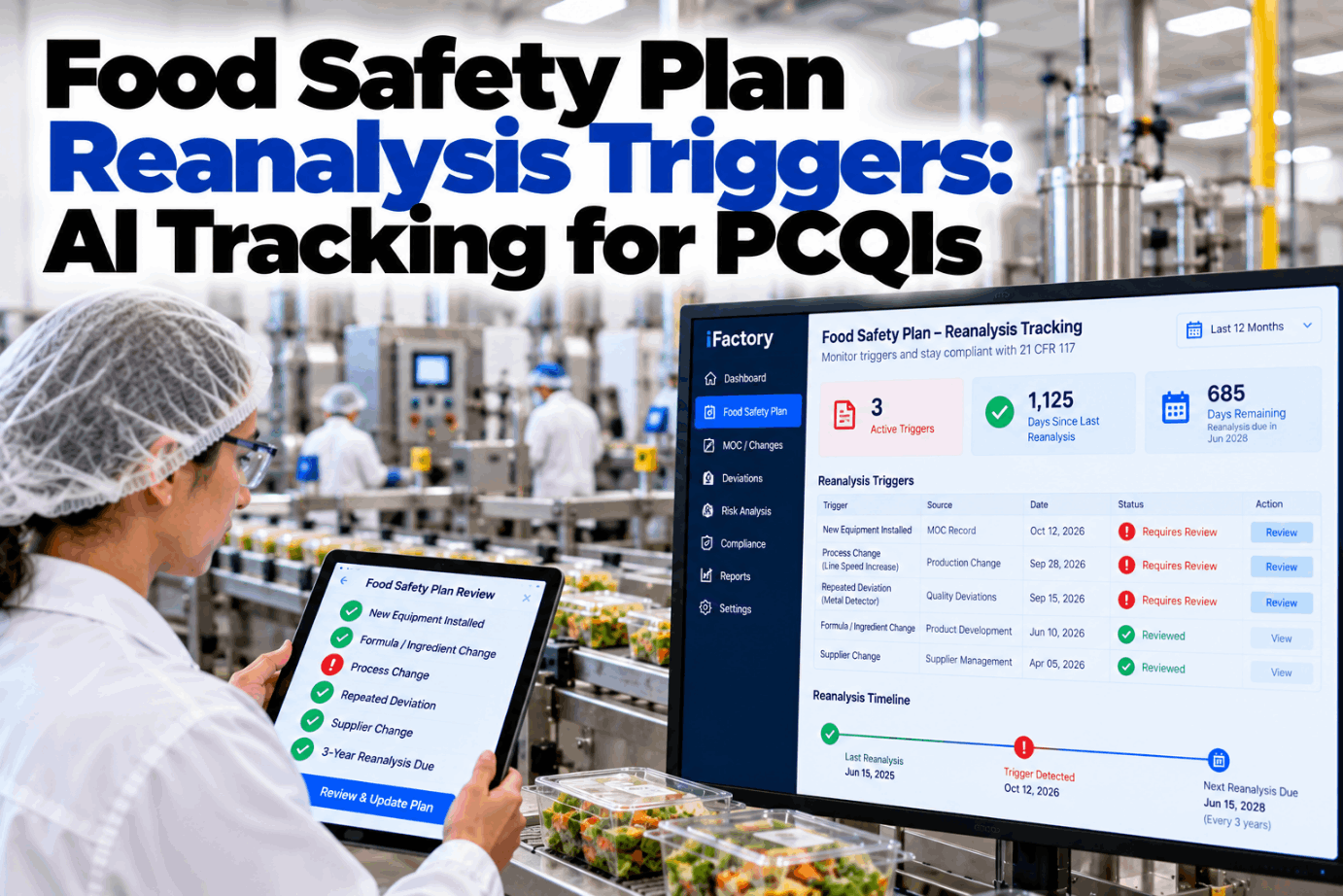
Most food safety plans are reanalyzed on schedule and then quietly fall behind the plant. A new spiral freezer goes in, a supplier changes, a CCP deviation repeats three times in a month, and nobody connects those events to the hazard analysis until an auditor does. Food safety plan reanalysis is easier when every change in the plant is checked against the plan as it happens. See how change records are linked to the plan and routed to your PCQI in a short compliance agent demo.
COMPLIANCE AGENT · FSMA PCHF
Know When Your Food Safety Plan Needs Reanalysis, Before the Auditor Asks
iFactory's Compliance Agent links MOC records, new equipment and repeated deviations to the sections of your food safety plan they touch. When a change meets a reanalysis trigger, it alerts the PCQI with the evidence attached.
Food safety plan · Plant 2PCQI review
Last full reanalysis Mar 2024 · next due by Mar 2027
3-year cycleMonth 31 of 36
MOCSpiral freezer 2 added to RTE lineLinked: step 9
DEVLine 3 metal detector check failed 3 times in 30 daysLinked: PC 4
SUPNew sesame-free bun supplier approvedLinked: allergen PC
WHAT 21 CFR 117.170 REQUIRES
One Calendar Trigger, Four Event Triggers
Under the preventive controls rule for human food, 21 CFR 117.170 asks for a full reanalysis of the food safety plan at least once every three years. It also asks for a reanalysis of the whole plan or the relevant part whenever certain events happen, and whenever FDA decides one is needed to respond to new hazards and science. The calendar trigger is easy to track. The event triggers are where plans fall behind. Check your own trigger list with our compliance support team.
117.170(a)
Every 3 years
Full reanalysis of the whole plan, at minimum
(b)(1)
Significant change in activitiesWhen it brings a reasonable potential for a new hazard or a significant increase in a known one
(b)(2)
New information about hazardsFor example new science, an outbreak or a recall tied to an ingredient you use
(b)(3)
An unanticipated food safety problemWhen appropriate, as part of the corrective action under 117.150(b)
(b)(4)
A control found ineffectiveA preventive control, a combination of them or the plan as a whole
PROCESS CHANGE TRIGGER
Where Reanalysis Triggers Start in a Plant
Triggers rarely arrive labelled. They sit in maintenance, engineering, purchasing and QA records that the PCQI does not see every day. The map below shows the usual sources and the part of the plan each one tends to touch. Connect your own record sources in a trigger mapping session.
Management of change
›
Process flow, hazard analysis, process controls
New or moved equipment
›
Sanitation controls, process controls, validation
New ingredient or supplier
›
Allergen controls, supply-chain program
Repeated deviations
›
Whether a control is still effective
Positive environmental results
›
Sanitation controls, zoning, hazard analysis
Complaints, recalls, new science
›
Hazard identification for the affected foods
FROM CHANGE TO DECISION
A Simple Decision Path for Every Change
Not every change needs a reanalysis, but every relevant change needs a decision that is written down. The path below follows the rule. If the plan is revised, the owner, operator or agent in charge signs and dates it again under 117.310. Walk through it on your own change log with our support team.
Change, event or new information logged
PCQI questionCould it introduce a new hazard, or significantly increase a known one?
No
Record the reasoningKeep the screening note with the change record
Yes
Reanalyze the relevant portionHazard analysis, controls and verification for the affected foods
Revise the plan, or document why no revision is needed117.170(d). Validate any added controls as appropriate
REANALYSIS TIMING
How Long You Have to Complete It
The rule ties timing to the change itself. Reanalysis, and validation of any added controls, should be done before the change is operative. Where you need production data to show that controls work as designed, it can run up to 90 calendar days after production of the food first begins. A longer, reasonable timeframe is possible only with a written justification from a PCQI. Plan your timing rules in a PCQI workflow review.
Default
Before the change is operativeReanalysis complete and new controls validated as appropriateIf needed
Within 90 calendar daysAfter production of the applicable food first beginsException
A reasonable timeframeOnly with a PCQI's written justification on file
Your PCQI Sees the Trigger the Day It Happens
iFactory reads MOC tickets, asset records and deviation logs, matches each one to the plan sections it touches and raises a PCQI task with the evidence. Nothing waits for the next three-year review.
QA office · PCQI and iFactory
PCQIWhat changed this month that touches the RTE plan?
iFactoryTwo items. MOC-0142 adds spiral freezer 2 after the cook step, and the metal detector check on line 3 failed three times.
PCQIDoes the freezer go live before month end?
iFactoryStart-up is booked for the 28th. A reanalysis task for step 9 is open and due before then.
PCQI RESPONSIBILITIES
What the Preventive Controls Qualified Individual Owns
Under 117.180, a PCQI must perform or oversee several tasks, and reanalysis is one of them. A PCQI qualifies through training at least equivalent to an FDA-recognized standardized curriculum, such as the FSPCA course, or through equivalent job experience, and training must be documented. Map these tasks to people at your site with our compliance support team.
HAZARD ANALYSIS REVISION
Before and After: One Line in the Hazard Analysis
A good reanalysis shows exactly what moved. This illustration follows the spiral freezer change through one step of the hazard analysis. It is an example of format, not a ruling on your process, and your PCQI decides the real outcome. See the same view on your own plan in a plan walkthrough.
BEFORE · Step 9, post-cook chilling
EquipmentBlast cell 1
HazardListeria recontamination of RTE product
ControlSanitation controls, zone 1 swabbing
VerificationEnvironmental monitoring, weekly
AFTER · Step 9 revised
EquipmentBlast cell 1 + spiral freezer 2
HazardSame hazard, new harbourage points in the spiral belt
ControlSanitation SOP added for the spiral
VerificationSwab sites added on spiral belt and frame
FOOD SAFETY PLAN REANALYSIS TEMPLATE
What a Reanalysis Record Should Hold
Reanalysis records are among the verification records required under 117.190. Like all plan records under 117.305, they should show the facility, the date and the person who did the work. Use the fields below as a starting template, and ask our support team for a blank copy.
FOOD SAFETY PLAN REANALYSIS FOR PLANT MANAGERS
Four Numbers Worth a Monthly Look
Plant managers don't need to read every hazard analysis, but they should know whether the plan keeps pace with the plant. These four measures show that at a glance, and each one comes straight from the trigger log. A rising count of open triggers usually means the PCQI is stretched, not that the plant is changing faster, so treat it as a staffing signal as well as a compliance one. Set your own targets with our compliance team.
Months to full reanalysisTime left on the 3-year cycle for each plan
Open triggersChanges waiting for a PCQI screening decision
Days to decisionFrom change logged to PCQI decision recorded
Changes live before reviewShould be zero unless a 90-day or justified path applies
FOOD SAFETY PLAN REANALYSIS BEST PRACTICES
Common Gaps and How to Close Them
Auditors often find the same few gaps around reanalysis. They rarely come from a lack of expertise. They come from records kept in different systems by different teams. Each gap below has a simple fix that rests on linking records rather than adding paperwork. Review your gaps with our support team.
GapMOC approved by engineering with no food safety screenFix: a PCQI screening step on every MOC that touches food contact or process flow
GapDeviations closed one by one, pattern never seenFix: repeat counts per control, with a review prompt at a set threshold
Gap"No change needed" decided but not writtenFix: a short reasoning note kept with every screened change
GapPlan revised but not signed againFix: owner sign-off task opened automatically on any plan revision
FOOD SAFETY PLAN REANALYSIS COST AND ROI
Sizing PCQI Time Spent Hunting for Triggers
The cost of a missed trigger is hard to price and should not be guessed. What you can measure is the time a PCQI spends searching other teams' records for changes. This worksheet uses assumed inputs only, to show the arithmetic. Run it with your own figures in a value review.
Record sources checked by hand4: MOC, assets, deviations, suppliers (assumed)
Minutes per source per week45, assumed
PCQI search time per week4 × 45 = 180 min = 3 h
Per year, at 48 working weeks3 × 48 = 144 h
Time saved is only part of it. The bigger gain is a decision recorded for every change, which is what an investigator will ask to see.
FOOD SAFETY PLAN REANALYSIS IMPLEMENTATION GUIDE
Getting Trigger Tracking Running
Start with the plan that changes most often, usually a ready-to-eat or allergen-heavy line. Connect the record sources one at a time so the PCQI can tune the screening rules as alerts arrive. Our compliance support team can help you choose the first plan.
Load the planProcess steps, hazards and preventive controls indexed by section
Connect recordsMOC, asset register, deviation log and supplier approvals
Set the rulesWhich changes need a PCQI screen, and repeat thresholds
Go livePCQI alerts, decision records and owner sign-off tasks
TURNKEY AI DEPLOYMENT
Compliance Agent and AI Server, Delivered Ready
iFactory delivers the Compliance Agent as a turnkey system. A pre-configured NVIDIA AI server ships racked and ready with the plan-linking models loaded, so your food safety records stay on site. You rack it, plug in power and Ethernet, and the AI is live. Scope it for your plants in a turnkey planning call.
What's Included
- Pre-configured NVIDIA AI server, racked and ready
- Food safety plan indexed by step, hazard and control
- Links to MOC, asset and deviation records
- Supplier and ingredient change tracking
- PCQI alerts with evidence attached
- Reanalysis records and 3-year cycle tracking
- 24×7 remote monitoring of models and hardware
Live in 6–12 weeks
Wk 1–4
Install and Index
Server racked, first food safety plan loaded and indexed.
Wk 5–8
Connect and Tune
Record sources linked, screening rules tuned with the PCQI.
Wk 9–12
Go-Live and Training
Alerts switched on, QA trained, monthly review started.
HOW iFACTORY FITS
A Compliance Agent That Watches the Plant for the Plan
iFactory does not write your hazard analysis. It makes sure the people who do never miss a change that matters. Our support team can show how it fits your QA routine.
1
Links MOC records. Every change ticket is matched to the plan steps and controls it touches.
2
Watches new equipment. Assets added or moved on food lines open a screening task.
3
Counts repeated deviations. Patterns against one control prompt an effectiveness review.
4
Alerts the PCQI. Triggers arrive with evidence, due dates and a decision record.
1000+
Industrial clients running iFactory
99.9%
Platform uptime for always-on compliance
6-12 wks
From racked server to live PCQI alerts
FREQUENTLY ASKED QUESTIONS
What QA Leaders Ask About Reanalysis Triggers
How often must a food safety plan be reanalyzed?
At least once every three years for the whole plan under 21 CFR 117.170(a). A reanalysis of the whole plan or the relevant part is also needed after a significant change, new hazard information, an unanticipated food safety problem where appropriate, or when a control proves ineffective.
Who has to do the reanalysis?
A preventive controls qualified individual must perform or oversee it. The PCQI can be an employee or an outside expert, and their training or qualifying experience must be documented.
Does every MOC need a full reanalysis?
No. Many changes have no food safety impact. What matters is that each relevant change is screened and the decision recorded. When a change could introduce a new hazard or significantly increase a known one, the relevant portion is reanalyzed.
Can a change go live before reanalysis is finished?
The default is to finish before the change is operative. Where production is needed to show controls work as designed, reanalysis can run up to 90 calendar days after production starts, or longer with a PCQI's written justification.
Does AI decide whether reanalysis is needed?
No. iFactory finds and links the triggers and gathers the evidence. The PCQI makes the decision, and the record shows who decided and why.
How do we start?
Load one food safety plan, connect your MOC and deviation records, and let the PCQI tune the screening rules for a few weeks. Then add equipment and supplier sources. Our
support team can plan that first step with you.
Keep the Plan in Step With the Plant
Link every change, every new asset and every repeated deviation to your food safety plan, and give your PCQI the trigger on day one. Delivered turnkey and live in 6 to 12 weeks.
Example trigger record · Plant 2
SourceMOC-0142, spiral freezer 2
Plan linkStep 9, sanitation controls
Trigger117.170(b)(1) significant change
DueBefore start-up on the 28th
PCQI alerted with evidence attached