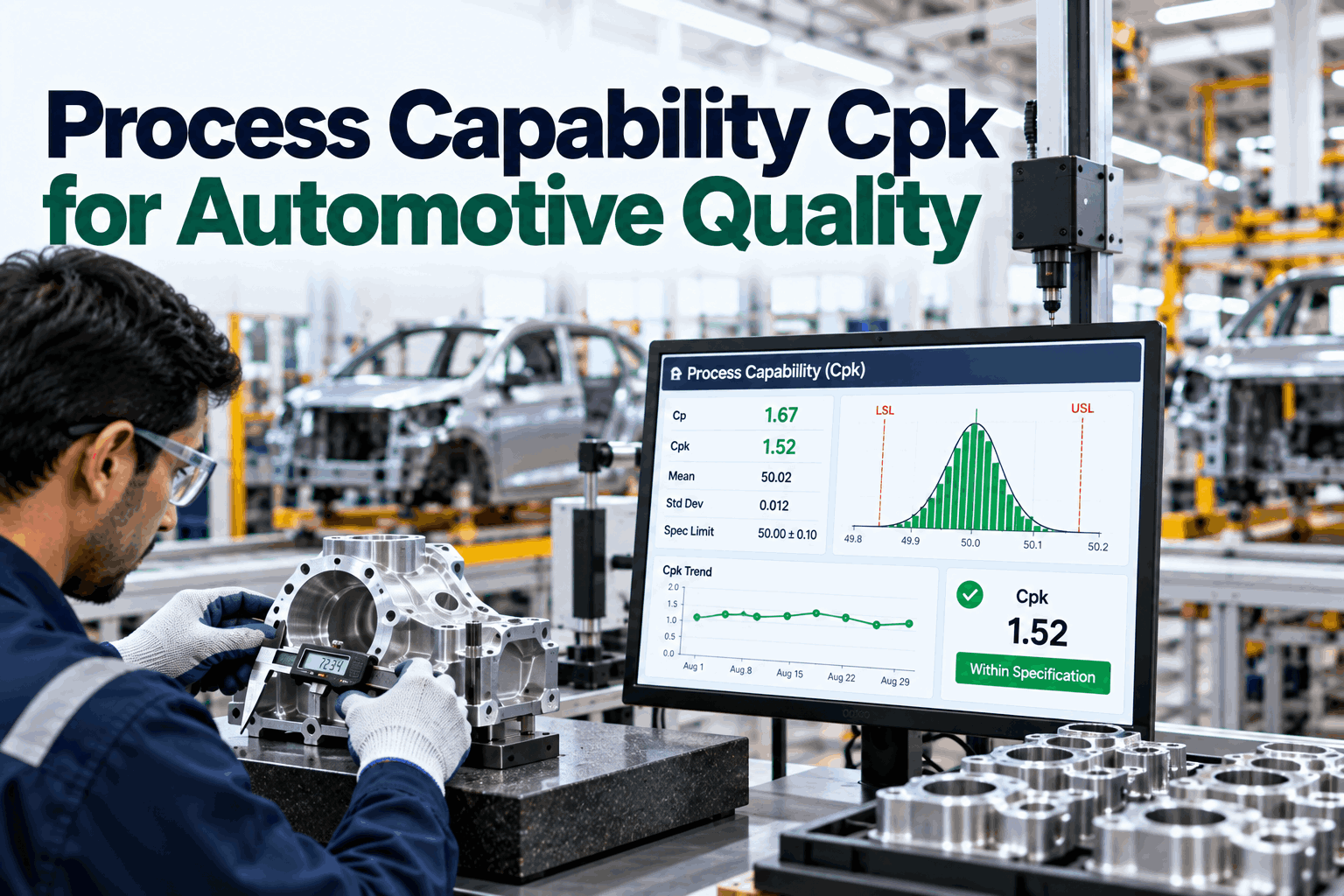
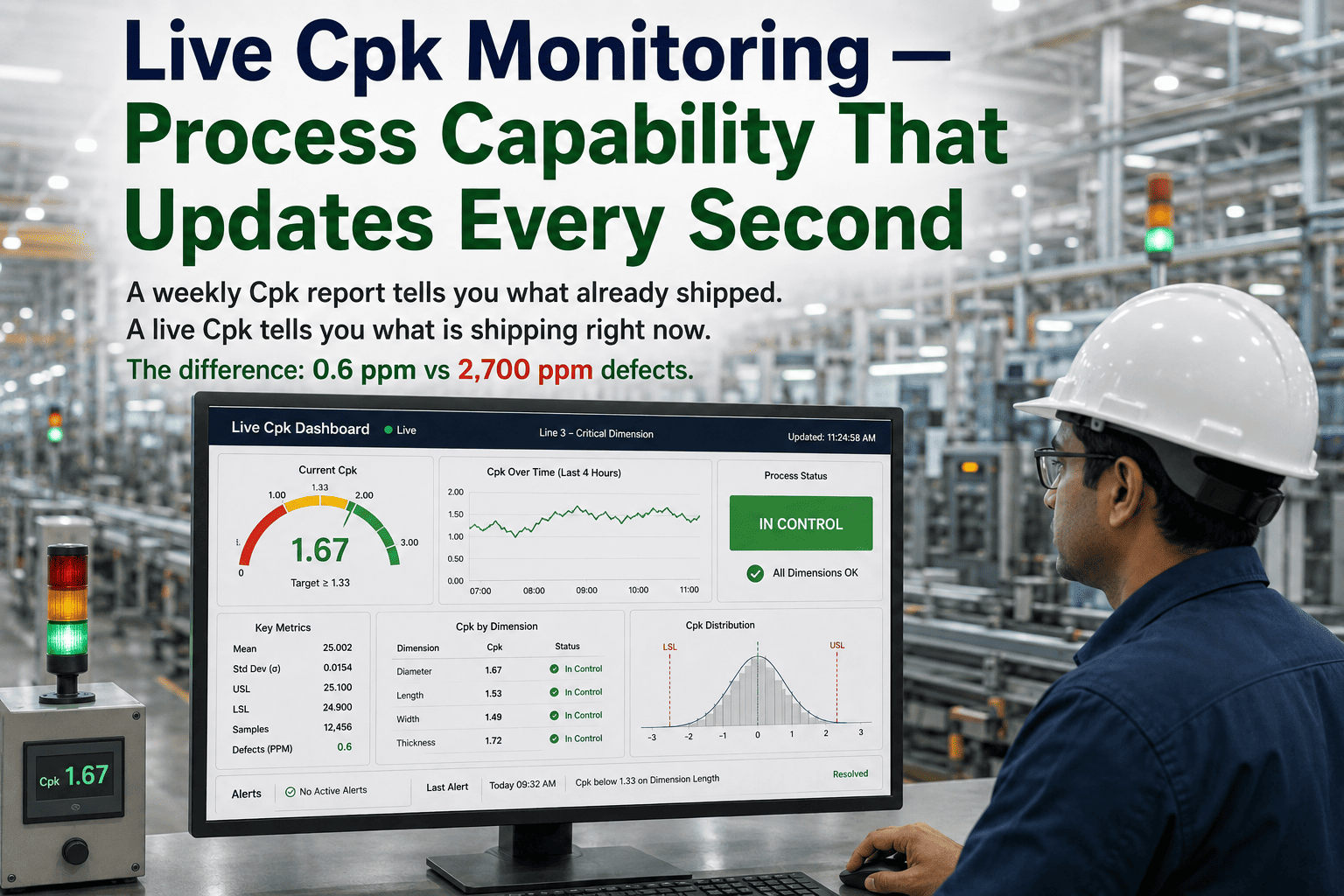
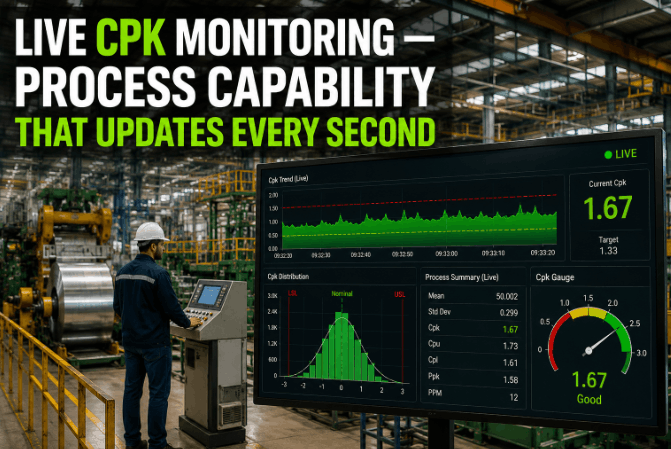
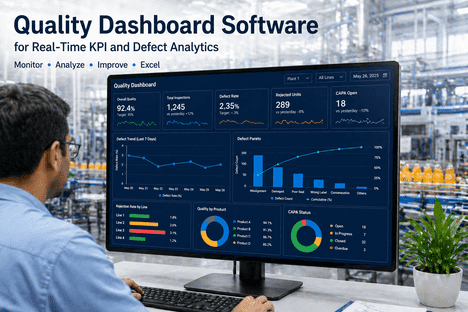
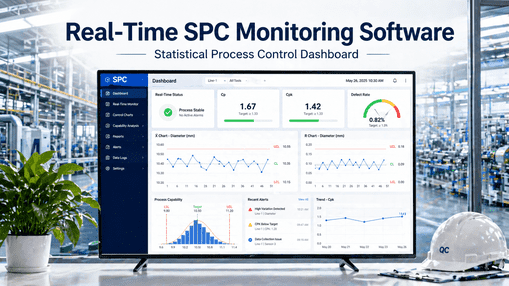
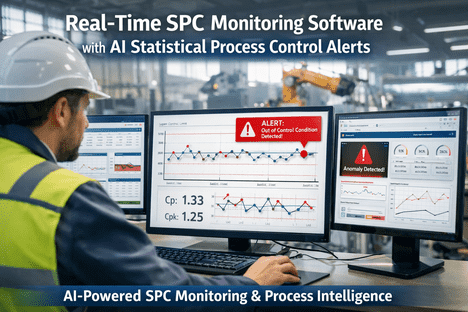
Cpk is the operational metric that matters more than Cp — it measures actual process performance against spec limits with drift and spread combined. Industry practice sets Cpk ≥ 1.33 as the working minimum for capable processes and ≥ 1.67 for critical characteristics; below 1.33 the process is not reliably making product to spec and below 1.00 it is producing scrap at rates any operations leader recognises immediately. The problem isn't understanding Cpk — it's acting on the trend before it crosses 1.00. On-prem AI reads live measurements, computes rolling Cpk, and fires containment and CAPA the moment Cpk crosses 1.33 downward — not after the scrap pile is already visible.
iFactory / Cp/Cpk capability triggers
Trigger Containment When Cpk Crosses 1.33 — Before the Scrap Pile Grows
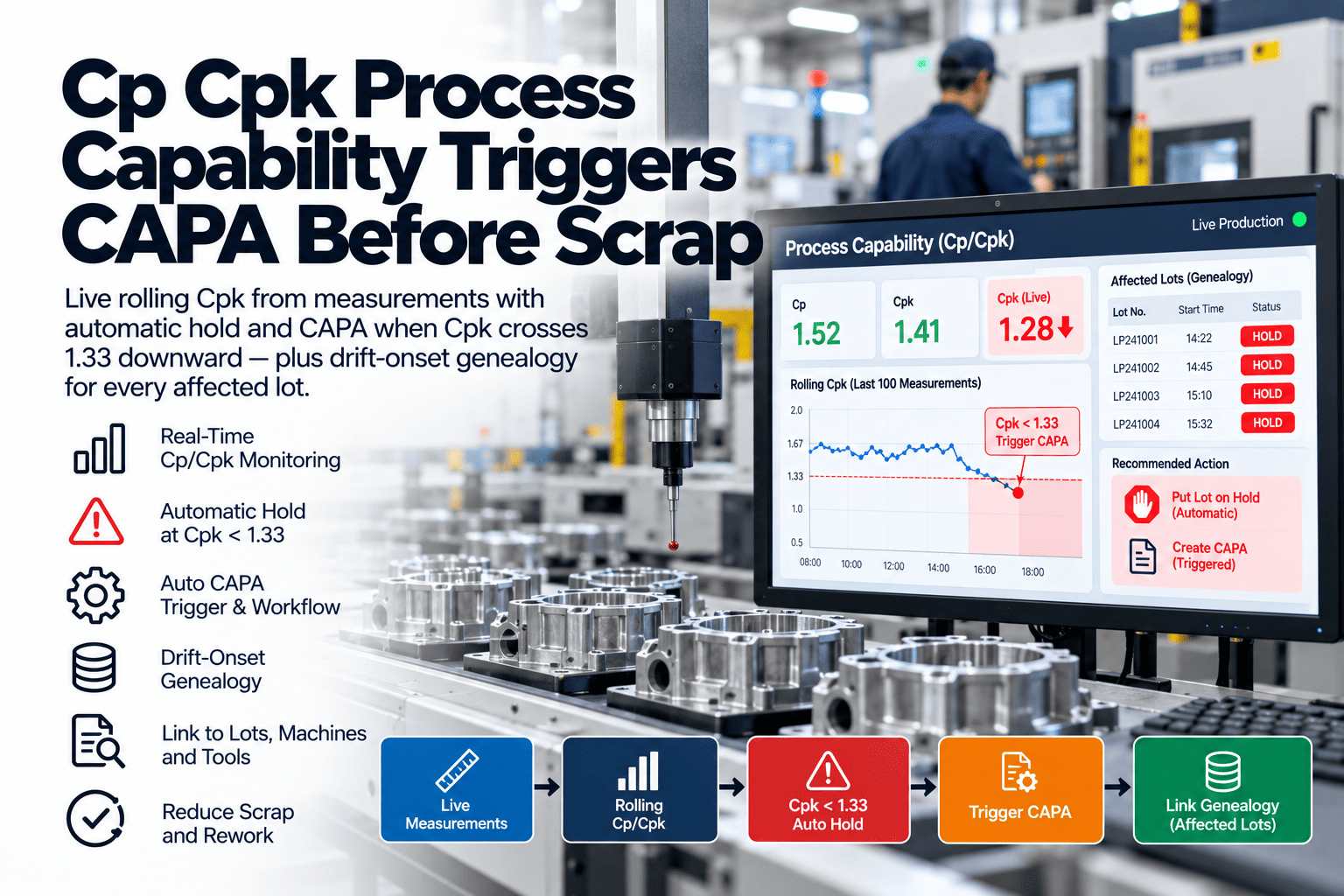
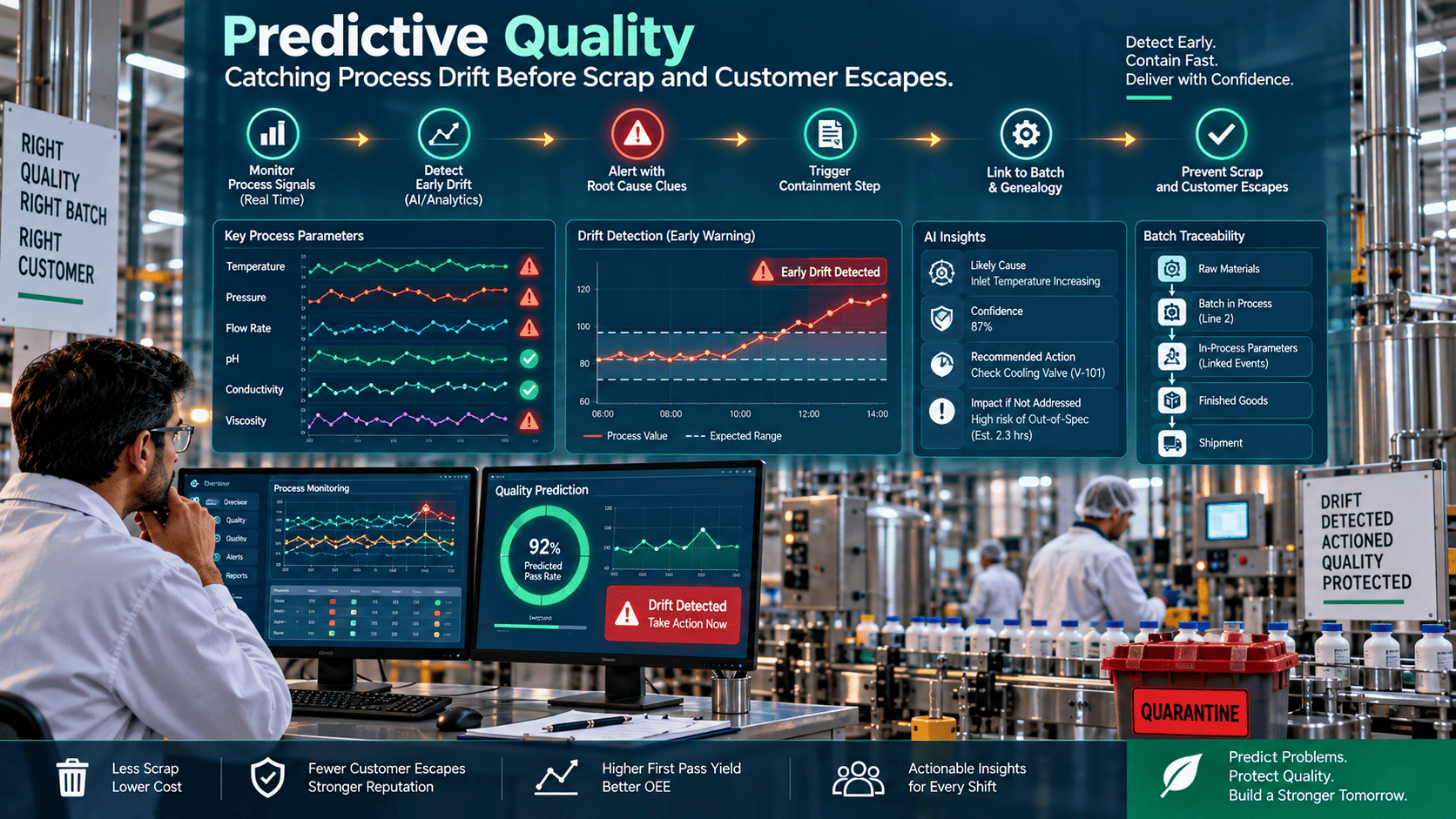
Live process capability computation with rolling Cpk trend, automatic hold and CAPA trigger when Cpk crosses 1.33 downward, and lot genealogy that surfaces every affected batch from the moment capability drifted — not from the moment scrap became visible.
Cpk 1.67 · target
Cpk 1.33 · action
Cpk 1.00 · scrap risk
Cpk crosses 1.33 · overlay fires hold + CAPA before Cpk 1.00 scrap zone
Rolling Cpk
live from measurements
1.33 crossing
fires hold + CAPA
Genealogy
from drift onset
The Problem in Process Capability Response
A typical discrete-manufacturing quality operation reports Cp and Cpk on a periodic PPAP or supplier report — quarterly, monthly at best. What lives between reports is a rolling process that drifts, tightens, drifts again, occasionally crosses the 1.33 threshold without anyone noticing until the next report interval. When the drift is caught, the review question is which lots were made during the low-capability window and where they went — an answer that requires walking through work-order records, gauge R&R data, and shipment history to reconstruct. Some of the affected lots have shipped; some are already in customer inventory; some have been used in downstream assemblies. Response is forensic instead of preventive.
Where Capability Drift Actually Escapes
Cp/Cpk failure modes are consistent across discrete manufacturing operations. Each is a specific attention gap between measurement reality and response.
Between-report drift
Cpk drops from 1.6 to 1.15 between monthly reports. Quarterly PPAP reporting cadence misses the drift entirely. Weeks of affected production before response.
Tool wear trend
Tool wear drives progressive Cpk decline. Operator sees dimensions moving but stays inside spec, so no reject fires. Cpk crosses 1.33 silently.
Setup shift after change
Fixture or tooling change shifts Cpk downward. First-piece inspection passes; capability trend takes 30-60 pieces to establish. Damage done before signal.
Multi-cavity confusion
One cavity of a multi-cavity mold degrades Cpk; aggregate report still passes. Cavity-level capability tracking not routine; escape multiplies.
What Good Looks Like in Capability Triggering
A working capability trigger holds four disciplines together — live rolling Cpk from measurements, threshold-crossing detection, immediate hold and CAPA, and drift-onset genealogy.
Rolling Cpk Live
Cpk computed continuously from live measurements — CMM, gauge, vision — with rolling window sized per part family. Not periodic snapshots; live rolling.
Continuous, not periodic
Threshold Crossing
Cpk crossing 1.33 downward triggers containment. Configurable per characteristic and per criticality — critical characteristics may trigger at 1.67. Explicit, not implicit.
Explicit threshold
Hold + CAPA Fire
Threshold crossing raises hold tag on affected work order (via MES) and opens CAPA record (via QMS) with capability context, gauge history, and operator notes attached. One event, one workflow.
Fire, not flag
Drift-Onset Genealogy
Every lot made from the moment Cpk began drifting to the moment of crossing surfaced with disposition status. Not forensic reconstruction — indexed genealogy from the trend itself.
From onset, not from crossing
How iFactory AI Fits
iFactory AI overlays your gauge and CMM data collection, MES, and QMS — computing rolling capability live, driving MES holds and QMS CAPA records on threshold crossing, and returning drift-onset genealogy in seconds.
Capability Engine
Overlay Layer
Live capability computation from measurement stream. Per-characteristic Cp, Cpk, Pp, Ppk with rolling window sized by part family production cadence. Cavity-level breakdown for multi-cavity tooling.
Threshold Trigger
Overlay Logic
Configurable Cpk thresholds per characteristic and criticality. Crossing detection with confirmation window (avoid single-outlier false fires). Trigger on directional crossing (downward), not level.
MES + QMS Actuator
Overlay + MES/QMS
Hold tag on affected work order in MES; CAPA record opened in QMS with capability context and gauge history. Standard MES and QMS workflows carry the response.
Drift Genealogy
Overlay + MES
Every part produced from drift onset to threshold crossing indexed with work order, cavity, lot, shipment. Disposition status queryable — in-house held, in-transit, at customer, in downstream assembly.
Ask your process engineer how quickly the last Cpk drift below 1.33 was caught — and how many parts were made during the drift window. If either answer is uncomfortable, capability triggering is the specific closure. Because Cpk reports on quarterly cadence are the wrong pace for a metric that changes hour-to-hour with tool wear and setup drift. Book a capability trigger review.
8-Week Capability Trigger Pilot on One Part Family
One part family with routine capability challenges, eight weeks. The pilot connects to gauge or CMM data, activates rolling Cpk, tests threshold triggers, and closes the first month of automated hold and CAPA response.
Weeks 1–2
Data Connect
Overlay connected to gauge or CMM data source. Part family characteristics identified with spec limits. Baseline current-state capability history and drift frequency.
Weeks 3–4
Rolling Cpk
Live rolling Cpk computation active. Historical Cpk trend visible. Threshold-crossing detection tuned against historical events to size confirmation window and reduce false fires.
Weeks 5–6
Hold + CAPA Fire
MES hold tag and QMS CAPA workflow connected. First threshold crossings drive automated response. Response accuracy measured against process engineer review.
Weeks 7–8
Drift Genealogy
Drift-onset genealogy active for triggered events. First-month report on cycle time, false-fire rate, parts saved from scrap. Rollout to remaining part families scoped.
Who Owns the KPI
Capability triggering crosses process engineering, quality, production, and supply. Each function owns a specific KPI or drift stays a periodic-report metric.
Process Engineer
Drift-onset-to-hold cycle
Owns the response outcome — time from Cpk beginning to drift to hold posting. Continuous computation cuts cycle from weeks to minutes.
Quality Manager
Escape rate through Cpk drift windows
Owns the escape outcome — parts shipped during drift windows before the next capability report. Trigger closes the between-report gap.
Production Lead
False-fire rate on triggers
Owns the operational discipline — false-fire rate on capability triggers must stay low enough that operators trust the trigger. Confirmation window tuning is the mechanism.
Tooling Engineer
Tool-wear-attributed capability drops
Owns the reliability outcome — capability drops attributed to tool wear addressed by planned tool intervention. Trigger data drives tool life planning.
FAQ
How does the overlay handle short-run production where n is too small for classical Cpk?
Short-run production with n < 30 measurements per lot isn't classical Cpk territory — instead, short-run SPC techniques (short-run Cpk with pooled data across part families, or Ppk with lot-by-lot performance) apply. The overlay supports classical Cpk (large-run production with settled distributions), short-run Cpk (with target-value coding across similar part families), and per-lot Ppk (for lot-by-lot performance where each lot is treated distinctly). Configuration per part family selects the appropriate technique with defensible mathematics. What the overlay doesn't do is compute classical Cpk on 5 measurements and report a false-precision number; what it does is apply the technique appropriate to the sample size available and be honest about the confidence interval.
What about attribute characteristics — pass/fail, presence/absence — where Cpk doesn't apply?
Attribute characteristics need different metrics: defect rate (p-chart), defect count (c-chart, u-chart), and process capability for attributes uses DPMO (defects per million opportunities) or fraction defective (p) rather than Cpk. The overlay applies attribute SPC (p-chart, np-chart, c-chart, u-chart) to attribute characteristics with the same rule engine (Nelson, Western Electric where they apply, plus attribute-specific rules like consecutive-nonzero and rate-of-change) and the same trigger workflow — threshold crossing fires containment and CAPA. Where a characteristic is variable but measured as attribute for practical reasons (go/no-go gauge), the workflow suggests upgrading to variable measurement for stronger detection where feasible.
Book a demo to see the attribute-vs-variable handling.
How does drift-onset genealogy actually work — you need to know when drift started to know which parts were affected?
Drift onset is detected retrospectively from the same rolling Cpk data that triggers the containment. When Cpk crosses 1.33 downward, the overlay looks backward through the rolling trend to identify the point where Cpk began its sustained decline — typically visible as an inflection in the trend. That inflection timestamp becomes the drift-onset marker. All parts produced from drift-onset to trigger-fire are within the drift window and eligible for review. Where the drift onset is ambiguous (gradual decline over weeks, no clear inflection), the workflow surfaces the ambiguity to the process engineer with the trend visible so the human judgement is made explicitly rather than by the algorithm alone. The genealogy is queryable regardless of confidence in the onset point; the disposition decision follows engineering judgement about which parts to include in review.
Stop reporting Cpk on cadences the process drifts faster than.
Fire Capability Triggers on One Part Family — Live
Bring one part family with recent capability drift issues, current Cpk reporting cadence, and the gauge or CMM data source. We'll walk what live rolling Cpk with 1.33 triggering would have caught, and demonstrate the drift-onset genealogy workflow.
1.33 crossing
threshold trigger