Food Plant Asset Criticality Ranking for Safety and Uptime

By Jackson T on October 19, 2026

food-plant-asset-criticality-ranking-safety-uptime

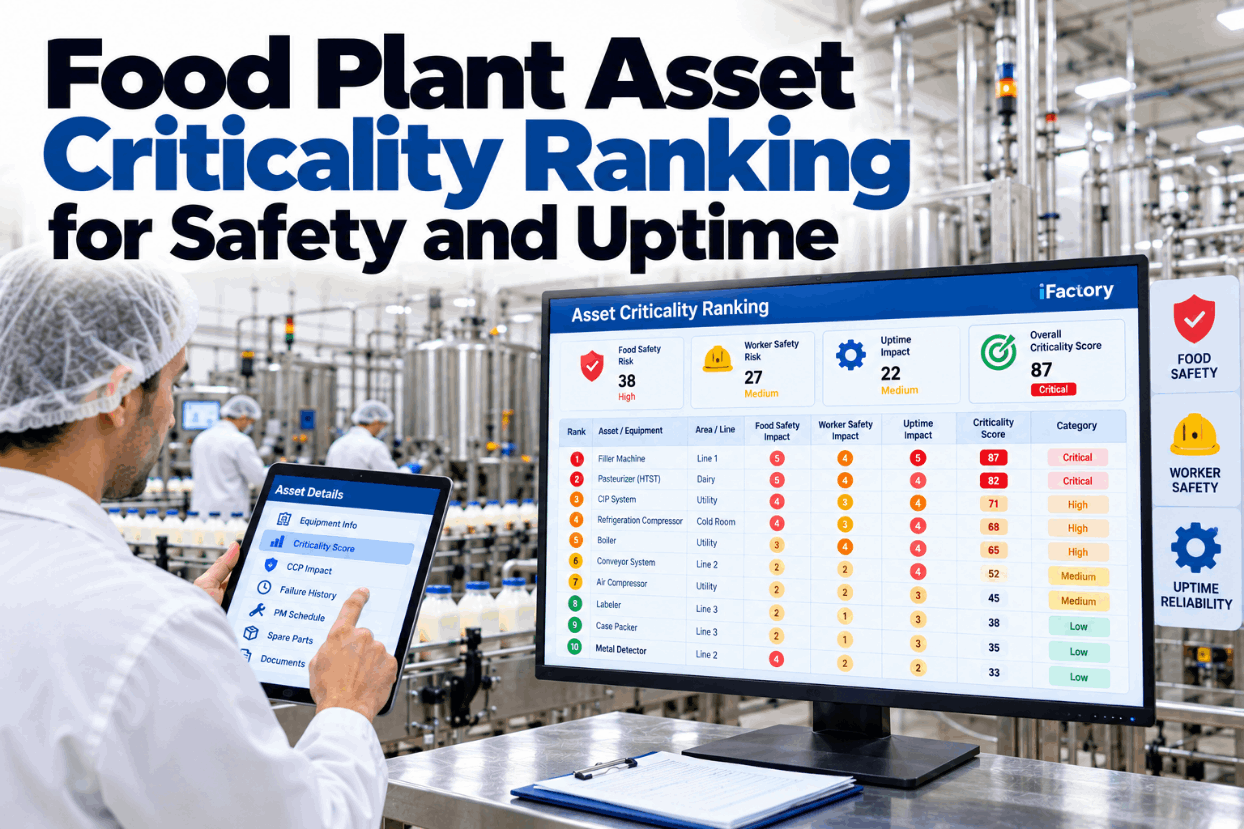
In a food plant, the asset that fails most often is rarely the one that can do the most harm. A case packer that jams every week costs output, but a pasteurizer flow diversion valve that fails once can put unsafe product into the market. A food plant asset criticality ranking puts both on one scale, weighs food safety, worker safety and uptime together, and turns the result into PM depth, spares and work order priority. See how scores are built and kept current in a short criticality scoring demo.

RELIABILITY · ASSET CRITICALITY

Rank Every Food Plant Asset by Safety Risk and Uptime

The iFactory Criticality Engine scores each asset with food-safety weighting and flags CCP equipment automatically from your HACCP plan. The score then sets PM depth, spares policy and work order priority, and it moves as failure data grows.

HTST-1 flow diversion valveCCP 2
Dairy line 1 · pasteurization step
Food safety5
Worker safety2
Production5
Repair and recovery3
Consequence 4.10 × likelihood 28.2 · Class A by CCP override
Daily valve check · spare actuator on site · P1 work orders
CRITICALITY MATRIX FOOD

Consequence Times Likelihood, on One Grid

The most common method is simple. Score how bad the worst credible failure would be (consequence) and how likely it is (likelihood), each on a 1 to 5 scale, then multiply. The highest possible score is 25. Reliability guides recommend scoring the worst credible failure mode, not the most likely one, because a criticality ranking is about the harm you can't afford. The grid below uses the class bands we use in the worked example later. Set your own bands with our reliability team.

Likelihood ↓ · Consequence →
1
2
3
4
5
5
5
10
15
20
25
4
4
8
12
16
20
3
3
6
9
12
15
2
2
4
6
8
10
1
1
2
3
4
5
Class A · 12 to 25 Class B · 6 to 11.9 Class C · under 6
RISK SCORING ASSETS

Four Consequence Criteria, Weighted for a Food Plant

A single consequence number hides too much. Weighted scoring splits it into criteria, scores each one against plain anchors, and adds them up using weights that total 100%. Leadership should agree the weights before anyone scores an asset, then lock them for the cycle, so no one can tune weights to lift a favourite machine. The weights below are an example for a food plant, with food safety on top. Agree yours in a scoring workshop.

Criterion
Weight
Score 1 · minor
Score 3 · moderate
Score 5 · severe
Food safety
35%
No product contact and no hazard control
Food-contact surface, or allergen or sanitation control relies on it
Is or monitors a CCP: pasteurizer, cook step, metal detector, chiller
Worker safety
20%
First-aid level risk at most
Guarded hazard, lockout needed for routine tasks
Failure could seriously injure: ammonia release, pressure, stored energy
Production impact
30%
Spare unit or buffer, no lost output
Slows a line, or one line stops for under a shift
Stops a bottleneck or the plant, or perishable product is lost
Repair and recovery
15%
Hours, parts on the shelf
A shift or more, parts in days
Long-lead parts, specialist repair or revalidation needed
Likelihood (multiplier)
1 to 5
Rare, no failures in years
About once a year
Several times a year
CCP EQUIPMENT

Why Food Safety Gets a Veto, Not Just a Weight

Weights alone can let a CCP asset sink into class B because it rarely fails. That is the wrong answer. Under FDA rules for human food (21 CFR 117), equipment must be maintained to protect against contamination and allergen cross-contact, instruments that measure or control conditions such as temperature must be accurate and maintained, and process monitoring instruments must be calibrated or checked for accuracy. So the ranking needs an override. Walk your HACCP plan through these steps with our food safety support.

Q1Is the asset a CCP, or does it monitor or control one?
YesClass A and CCP flag, whatever the score
Q2Does it support another preventive control, such as allergen or sanitation control?
YesFood safety score of 4 at minimum
Q3Could its failure add a hazard, such as metal fragments or non-food lubricant?
YesFood safety score of 3 at minimum
Q4None of the above?
Score1 or 2, ranked by other criteria
Use the same override for worker safety

Many reliability guides also move an asset to the top class when any single safety consequence scores 5. In a food plant that usually means ammonia refrigeration, boilers and steam, and high-energy equipment that needs lockout under OSHA 1910.147.

Scores That Know Which Assets Are CCPs

iFactory reads your HACCP plan and asset register, flags every CCP asset automatically and applies food-safety weighting. Each score then drives PM depth, spares and work order priority in your CMMS.

Reliability planner and iFactory
PlannerWhy did the line 2 filler move to class A?
iFactoryFour seal jaw failures this quarter raised likelihood from 3 to 4. The score went from 10.2 to 13.6. PM depth review is waiting for your approval.
PlannerWhich CCP assets are due for verification this week?
iFactoryThree: both packing line metal detectors and the HTST-1 diversion valve. All have open, scheduled work orders.
FOOD PLANT ASSET CRITICALITY RANKING EXAMPLES

A Worked Scoring Example With Four Assets

Here is the method applied to four typical assets, using the example weights above: food safety 35%, worker safety 20%, production 30%, repair 15%. Consequence is the weighted sum, risk is consequence times likelihood. These are illustrations, not plant data. Notice the case packer outscores the pasteurizer valve on raw risk, yet the valve still ranks higher because of the CCP override. Score your own assets in a guided session.

HTST flow diversion valveClass A
FS 5 · WS 2 · P 5 · R 31.75 + 0.40 + 1.50 + 0.45 = 4.104.10 × likelihood 2 = 8.2
Score alone says B. CCP override makes it A.
Packing line metal detectorClass A
FS 5 · WS 1 · P 3 · R 21.75 + 0.20 + 0.90 + 0.30 = 3.153.15 × likelihood 3 = 9.45
Physical hazard CCP. Override makes it A.
Case packer, line 2Class B
FS 1 · WS 2 · P 4 · R 20.35 + 0.40 + 1.20 + 0.30 = 2.252.25 × likelihood 4 = 9.0
Frequent jams, no food safety role. Stays B.
Pallet stretch wrapperClass C
FS 1 · WS 2 · P 2 · R 10.35 + 0.40 + 0.60 + 0.15 = 1.501.50 × likelihood 3 = 4.5
Low impact, quick to fix. Basic care only.
CRITICAL ASSET LIST

What Each Class Changes on the Floor

A ranking only matters if it changes how assets are looked after. The class should set how deep the PM goes, whether the asset gets a full reliability centered maintenance (RCM) or FMEA review, which spares sit on site and how fast a work order is answered. The policy below is a starting point to adapt. Map it to your CMMS with our support team.

ACritical
PM depthCondition-based plus time-based tasks, CCP verification on schedule
AnalysisFull RCM or FMEA of failure modes
SparesCritical spares on site with minimum stock
Work ordersP1, answered now; QA told if a CCP is affected
BImportant
PM depthTime-based PM at OEM or history-based intervals
AnalysisStreamlined review or task templates
SparesWear parts stocked, others on short lead time
Work ordersP2, within the shift or a day
CRun to failure
PM depthBasic inspection, cleaning and lubrication
AnalysisNone unless failures repeat
SparesBought when needed
Work ordersP3, planned into the schedule
FOOD PLANT ASSET CRITICALITY RANKING SOFTWARE

Scores That Move When the Failure Data Does

A paper ranking is right on the day it is made. After that, likelihood drifts as machines age, products change and repairs pile up. Software keeps the score honest by watching failure history, PM findings and downtime, then flagging assets whose likelihood has shifted. A person still approves the new class. See re-scoring on your own work order history in a live walkthrough.

Last quarter
Line 2 filler FS 3 · WS 2 · P 5 · R 3 = 3.40 3.40 × likelihood 3 = 10.2
Class B
4 seal jaw failures
This quarter
Line 2 filler FS 3 · WS 2 · P 5 · R 3 = 3.40 3.40 × likelihood 4 = 13.6
Class A, pending approval
FOOD PLANT ASSET CRITICALITY RANKING TEMPLATE

One Record per Asset, With the Evidence Behind It

Keep every score next to the reason for it. An auditor or a new planner should be able to see why an asset is class A without asking anyone. Fill in one record per asset, starting with the CCP list from your HACCP plan. Ask our support team for a blank version.

Asset ID and nameHTST-1 flow diversion valve
Line and areaDairy line 1, process room
HACCP linkCCP 2, pasteurization
Food safety score and reason5, controls a CCP
Worker safety score2, hot surfaces, guarded
Production score5, line stops without it
Repair score3, actuator lead time days
Likelihood and evidence2, one fault in 3 years
Weighted consequence4.10
Risk score8.2
Override appliedYes, CCP
ClassA
PM depthDaily check, monthly test
Spares policyActuator and seals on site
Work order priorityP1, QA notified
Owner and review dateReliability lead, quarterly
FOOD PLANT ASSET CRITICALITY RANKING BEST PRACTICES

Common Mistakes and What Works Better

Most failed rankings fail for the same reasons: one person scores alone, every asset ends up critical, or the list is never revisited. General reliability guidance suggests only a minority of assets, often around 10 to 20%, should land in the top class, or the class stops meaning anything. Check your draft ranking with our reliability engineers.

COMMON MISTAKES
  • Scoring the most likely failure instead of the worst credible one
  • Maintenance scores alone, without QA or production
  • Weights changed halfway to suit one asset
  • CCP assets scored like any other machine
  • Most of the plant ends up in class A
  • The list is made once and filed
BETTER PRACTICE
  • Score worst credible consequence, then real likelihood
  • Cross-functional team: maintenance, production, QA, EHS
  • Weights and anchors locked before scoring starts
  • CCP and serious safety overrides written into the rules
  • Class A kept to a small, defensible share
  • Reviewed after failures, changes and at least once a year
FOOD PLANT ASSET CRITICALITY RANKING IMPLEMENTATION GUIDE

Six Steps From Asset Register to Live Priorities

Start small. One line or one process room, scored properly, teaches the team more than a rushed plant-wide spreadsheet. Then roll the method out area by area. Plan your first area with our implementation team.

1
Clean the asset registerOne record per asset, in a clear hierarchy, linked to its line and area
2
Link the HACCP planTag every CCP and preventive control asset before scoring begins
3
Lock weights and anchorsLeadership and QA agree the criteria, weights and class bands
4
Score in short workshopsLine by line, with failure history on screen and QA in the room
5
Turn classes into rulesPM depth, spares and work order priority set by class in the CMMS
6
Review on a cycleRe-score after failures, product or process changes and at set intervals
TURNKEY AI DEPLOYMENT

The Criticality Engine, Delivered Ready to Run

iFactory ships as a turnkey package. A pre-configured NVIDIA AI server ships racked and ready, with the Criticality Engine pre-loaded and connectors for your CMMS, HACCP records and downtime data. You rack it, plug in power and Ethernet, and the AI is live. Your plant data stays on site. To scope it for your plant, book a turnkey planning call.

What's Included
  • Pre-configured NVIDIA AI server, racked and ready
  • Criticality Engine with food-safety weighting
  • Automatic CCP flags from your HACCP plan
  • Connectors for CMMS, work order and downtime data
  • Class rules for PM depth, spares and WO priority
  • Re-scoring alerts as failure data changes
  • 24×7 remote monitoring of models and hardware
Live in 6–12 weeks
Wk 1–4
Connect and Map

Server installed, asset register and HACCP plan linked, weights and bands agreed.

Wk 5–8
Score and Check

First areas scored with your team, CCP flags checked by QA, class rules set.

Wk 9–12
Go Live

Scores drive PM, spares and work orders, and re-scoring alerts switch on.

HOW iFACTORY FITS

Criticality Built Around Food Safety

Generic ranking tools treat a pasteurizer like any other pump. iFactory starts from your HACCP plan. Our support team can show how it fits your current CMMS.

1
Food-safety-weighted scoring. Food safety, worker safety, production and repair are scored on your anchors and weights.
2
CCP assets flagged automatically. Assets tied to a CCP or preventive control are flagged and moved to class A.
3
Scores drive the work. Class sets PM depth, spares policy and work order priority in the CMMS.
4
Kept current by AI. Failure history and downtime trigger re-scoring, with a person approving each change.
1000+
Industrial clients running iFactory
99.9%
Platform uptime for round-the-clock plants
6-12 wks
From racked server to live criticality scores
FREQUENTLY ASKED QUESTIONS

What Plant Managers Ask About Asset Criticality Ranking

What is a food plant asset criticality ranking?
It is a scored list of every asset, ranked by how much harm its failure could cause and how likely that failure is. In a food plant the harm includes food safety, worker safety, lost production and repair effort. The ranking puts assets into classes that set PM depth, spares and work order priority.
How should CCP equipment be ranked?
Assets that are, monitor or control a critical control point should sit in the top class regardless of their raw score. FDA rules in 21 CFR 117 require equipment to be maintained against contamination and process monitoring instruments to be calibrated or checked, so a rarely failing CCP asset still needs the deepest care.
Consequence times likelihood or weighted scoring?
Use both. Weighted scoring builds the consequence number from several criteria, so food safety and production are not lumped together. That consequence is then multiplied by likelihood to give the risk score. Overrides for CCPs and serious safety risks sit on top.
How does criticality link to RCM?
Criticality decides where deep analysis is worth the effort. Class A assets usually get a full RCM or FMEA review of their failure modes, class B assets get a lighter review or standard task templates, and class C assets are run to failure with basic care.
How often should scores be reviewed?
Review after a significant failure, a product or process change, or a new piece of equipment, and at least once a year for the whole list. Class A assets are often reviewed quarterly. Software can flag assets whose failure history suggests the likelihood has changed.
Where do we start?
Start with one line. Clean its asset records, tag the CCP assets from your HACCP plan, agree weights and anchors, then score in a short workshop with maintenance, production and QA. Our support team can help plan that first area.

Put Food Safety at the Top of Your Asset Priorities

Score every asset with food-safety weighting, flag CCP equipment automatically and let the class drive PM, spares and work orders. Delivered turnkey and live in 6 to 12 weeks.
Criticality summary · example plant
CCP assetsFlagged from the HACCP plan
ScoringFood-safety weighted
Class drivesPM depth, spares, WO priority
Re-scoringWhen failure data shifts
Every score linked to its evidence

Share This Story, Choose Your Platform!