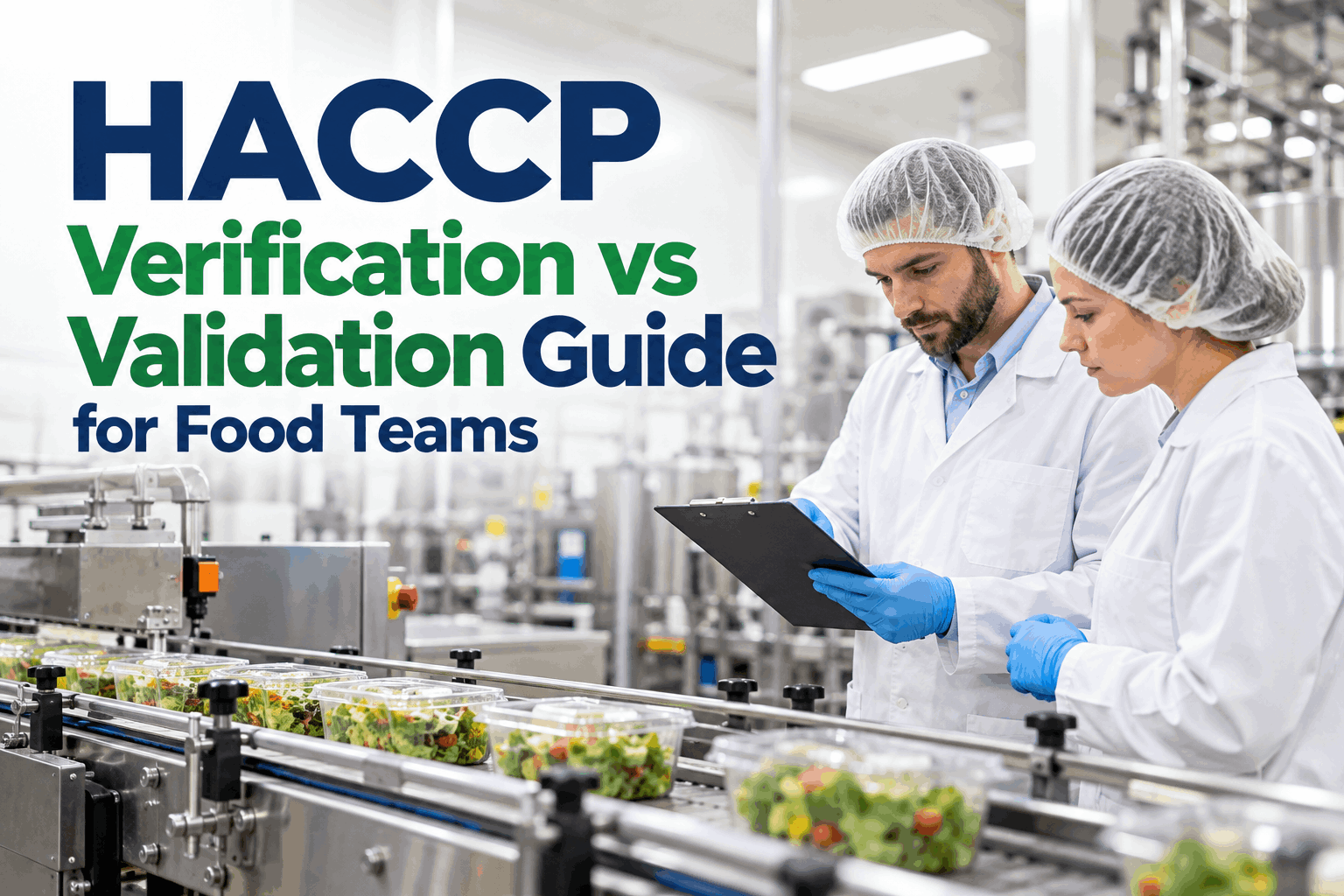
Validation and verification sound alike, and many HACCP records mix them up. Validation asks whether your plan can control the hazard at all. Verification asks whether the plan is being followed, day after day. Auditors check both, separately, and expect to find each in its own record. To see how your records hold up, book a HACCP records review.
HACCP Verification vs Validation: A Guide for Food Teams
Two different questions, two kinds of evidence, two schedules. Here is what each one means, what the US rules ask for, and how to keep the records straight so neither gets missed.
- Plain definitions, from Codex and the US rules
- One CCP, followed through every activity
- The documentation errors auditors find most
Will the plan work?
- QuestionCan this control, done right, control the hazard?
- EvidenceScience, studies, process authority data, in-plant trials
- WhenBefore use, at start-up, and after any change
- WhoA trained HACCP or preventive controls lead
Is the plan working?
- QuestionIs the plan being followed, and doing its job?
- EvidenceRecord review, calibration, observation, testing
- WhenOngoing, on a set schedule
- WhoQA staff, other than the person monitoring
Two Questions, Not One
Validation looks forward. Verification looks back.
Codex, the international food standards body, keeps the two apart. Validation means obtaining evidence that a control measure, if properly carried out, can control the hazard. Verification means using methods, procedures, tests and other checks, beyond monitoring, to show the control is working as intended. Our food safety support team can help you sort your own records into the right box.
Monitoring
Watching the CCP as it runs. Every batch, every check against the critical limit, recorded at the time.
Verification
Checking that monitoring happened, was right, and that the control is working, on a set schedule.
Validation
Proving the control can work at all, with science and in-plant evidence, before and after changes.
Reassessment
Stepping back to ask whether the whole plan is still right for today's plant, products and suppliers.
Same ideas, different words
If the answer to "what does this record prove?" is "the limit is the right limit", it is validation. If it is "we stayed within the limit, and checked that we did", it is monitoring and verification.
Validation: Proving the Plan Can Work
Two kinds of evidence: the science behind the limit, and proof it works in your plant.
FSIS guidance for meat and poultry splits validation into two parts. First, scientific or technical support for the design. Second, in-plant data showing the control performs as expected in your own plant. FDA's preventive controls rule asks for validation before the plan is used, and within 90 days of first production where needed. To plan a validation study, book a validation planning call.
Scientific support
- Published studies and peer-reviewed papers
- Regulatory guidance and process authority letters
- Pathogen modelling for your product and process
- Challenge studies, where nothing else fits
In-plant evidence
- Measurements from your own equipment
- Monitoring records from the start-up period
- Micro results for your product
- Proof the support matches your real process
When to validate again
Recipe change
New ingredients, pH, water activity or salt can change how a hazard behaves, even with the same cook.
Equipment change
A new oven, chiller or detector may not deliver what the old one did, whatever the label says.
Repeated deviations
A limit that keeps failing may not be the right limit, or the process may not be able to hold it.
New science
New data on a hazard can make old support out of date.
What a CCP validation file should hold
- The hazard. What is being controlled, and to what outcome.
- The support. Studies or guidance, with why they fit your process.
- The plant data. Start-up readings and results from your own line.
- The decision. Who reviewed it, when, and what they concluded.
- The triggers. What change would mean validating again.
A study done at 10 cm product depth does not support a 15 cm tray. The most common validation weakness is support that is real, but for a different product, size or piece of equipment.
One CCP, Every Activity
Here is one cooking CCP, followed through monitoring, verification, validation and reassessment. Each line is a different record, with a different owner and schedule.
Verification: Proving the Plan Is Working
Monitoring says what happened. Verification checks that monitoring can be trusted.
FSIS lists three core verification activities: calibrating monitoring instruments, directly observing monitoring and corrective actions, and reviewing records. FDA's rule adds product testing and environmental monitoring where they apply, and sets review of monitoring and corrective action records within 7 working days. If you want help building a schedule, our team can help.
A probe checked against another probe proves little. Use a certified reference thermometer, or an ice-point and boiling-point check where it fits, and write down which reference was used, its own calibration date, and the reading before any adjustment.
Good verification is
- Independent. Not done by the person who monitored.
- Scheduled. Written frequency for each activity.
- On time. Reviews done while action is still possible.
- Recorded. Who, when, what was found.
Weak verification is
- A signature with no real review
- Calibration "when someone remembers"
- Observation only on day shift
- Findings with no corrective action
Where HACCP Documentation Goes Wrong
Most HACCP findings are not about food safety failures. They are about records.
Paper logs leave room for blanks, late entries and missing signatures, especially on busy night shifts. Each one weakens your proof, even when the food was safe. Digital records that check entries as they are made close most of these gaps. To see where your records are weakest, book a documentation check.
Blanks and gaps
A missing reading looks the same as a missed check, to an auditor. There is no way to prove otherwise later.
Late entries
Readings written up at shift end, from memory, not at the time. Suspiciously neat logs are a warning sign.
Wrong limit on the form
The form shows an old critical limit after a plan change, so operators check against the wrong number.
No corrective action
A deviation is recorded, but not what was done about it, or what happened to the product.
Review without reading
A signature on every page, but the deviation on page 3 was missed, so nothing was done.
Mixed-up labels
Verification records filed as validation, or the other way round, so neither file is complete.
Quick fixes on paper
- Print the current critical limit on every form
- One line per reading, with time and initials
- A corrective action box beside every reading
- Review sign-off with a date, not just a name
Lasting fixes with digital records
- Readings taken straight from the sensor
- Limits pulled from the approved plan
- Deviations that cannot be closed without an action
- Reviews that show what was actually read
How iFactory Keeps Verification and Validation Straight
CCP data captured at the source, every record in the right place.
iFactory reads CCP values directly from probes, chillers and detectors, so monitoring records are complete and made at the time. It schedules verification tasks, flags overdue reviews and calibrations, and keeps validation evidence in its own file for each CCP. Questions on fit go to our support desk.
Capture
CCP readings taken straight from sensors, with time and batch.
Alert
A reading outside the limit raises a corrective action task at once, with the batch put on hold.
Schedule
Reviews, calibrations and observations, each with an owner and due date, and a reminder before it slips.
File
Validation studies and reassessments kept apart from daily verification, so auditors find each in one place.
Who does what in a food plant HACCP team
Monitors
Takes CCP readings and records them at the time, and acts at once on any deviation.
Verifies
Reviews records, calibrates, observes and samples, on a written schedule.
Validates
Owns the evidence that each control works, and leads reassessment.
Supports
Makes time and people available, and signs off reassessment and major plan changes.
This guide summarises USDA FSIS and FDA rules as we understand them. It is not legal advice. Your HACCP team and regulator decide what applies to your products and plant.
Turnkey AI: Delivered, Connected and Live in 6–12 Weeks
You do not build this. It arrives ready.
iFactory ships as a pre-configured NVIDIA AI server, racked and ready, with the software pre-loaded. Rack it, plug in power and Ethernet, and the AI is live on your network.
Our team handles cabling, network setup, PLC and SCADA integration, operator training and 24×7 remote monitoring. The server sits inside your own network, so food safety records stay on site. For a scope matched to your plant, request a turnkey quote.
Ship, network and data
Server installed. CCP sensors connected. HACCP plan, critical limits and verification schedules loaded.
Model training and pilot
Digital CCP records running on one line alongside paper. QA compares both, record by record.
Go-live and training
All CCPs live across the plant. QA and line staff trained. 24×7 remote monitoring begins.
Frequently Asked Questions
What is the difference between HACCP verification and validation?
Validation shows a control can work: that the critical limit, if met, controls the hazard. Verification shows the plan is working day to day: monitoring was done, instruments read true, and records were reviewed. You need both, kept as separate records.
Is reassessment the same as validation?
Not quite. Reassessment is a periodic review of the whole plan, at least yearly for USDA-inspected plants and at least every three years for FDA food safety plans. It may show that some controls need validating again, or that new hazards need adding to the plan.
Can the same person monitor and verify?
It is best not to. Verification is stronger when someone other than the person who took the reading reviews it. Small plants may have little choice, so document who did what, and have a second person spot-check from time to time.
What counts as validation evidence?
Scientific support, such as published studies, guidance or process authority letters, plus in-plant data showing the control performs as expected in your plant. The support must match your actual product and process, including size, equipment and recipe.
How often should HACCP records be reviewed?
Often enough to act on problems. FDA's preventive controls rule sets 7 working days for monitoring and corrective action records. Many plants review CCP records daily or each shift, so a problem is caught while product is still on site. FSIS plants also review records before shipping product.
Do sanitation and allergen controls need validation?
Under FDA's preventive controls rule, sanitation and allergen controls are among those that do not have to be validated. They still need verifying. HACCP plans under other rules, or customer and certification standards, may ask for more.
Can digital records replace paper HACCP logs?
Yes, as long as they hold the same information, are made at the time, and are signed by the right person. Run both side by side at first, then retire paper once QA and your auditor are satisfied. To talk through your records, contact our team.
Get Your HACCP Records Audit-Ready
In thirty minutes we go through one of your HACCP plans, sort its records into validation, monitoring and verification, and point out the gaps an auditor is most likely to find. You keep the notes whether or not you go further with iFactory.
- 1One HACCP or food safety plan
- 2A week of CCP monitoring records
- 3Your verification schedule
- 4Validation evidence for one CCP
- 5Your last audit findings