The most consequential barrier to deploying generative AI in U.S. manufacturing is not model capability — it is data sovereignty. Process recipes, SPC datasets, PLC configurations, MES production records, and SAP order histories represent the operational intellectual property of a plant. Sending that data to a cloud-hosted AI model is not a technology risk conversation; it is a legal, compliance, and competitive intelligence conversation that most Plant CIOs are not prepared to have with their board or their customers. iFactory's Plant Copilot resolves this barrier at the architecture level: a large language model deployed on an NVIDIA edge server inside your facility perimeter, air-gapped from external networks, trained to understand your specific process context — so engineers and operators can ask plain-language questions about SPC trends, recipe deviations, PLC alarms, MES throughput, and production orders without a single byte of operational data leaving the fence. To see how Plant Copilot maps to your existing plant data infrastructure, Book a Demo with our industrial AI architecture team.
Plant Copilot — AI That Knows Your Plant and Never Leaves Your Fence.
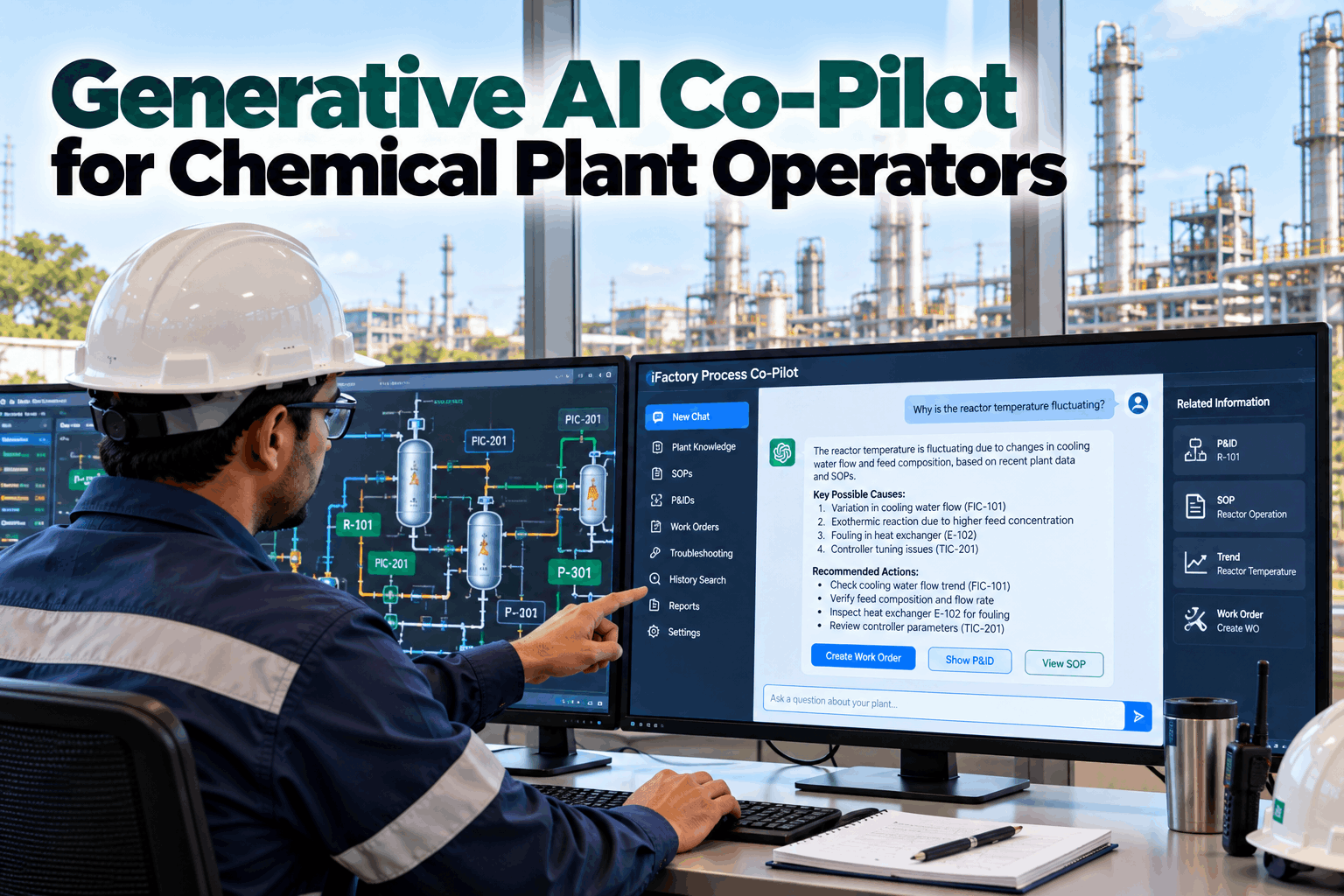
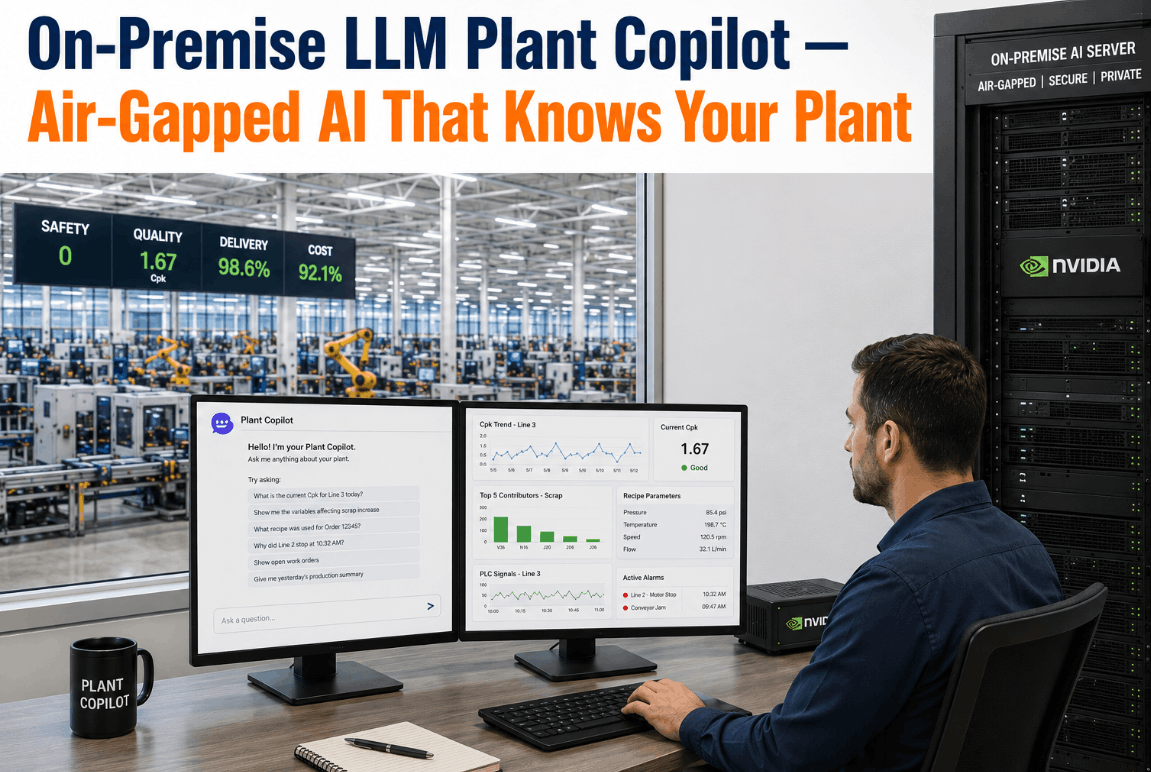
iFactory's Plant Copilot runs on an NVIDIA edge server inside your facility. It connects to your SPC, recipes, PLCs, MES, and SAP — and answers operational questions in plain English, with zero cloud dependency and zero data egress.
Why Cloud-Based AI Is the Wrong Architecture for the Plant Floor
Cloud-based generative AI platforms are built for general-purpose enterprise use — not for the operational specificity, data sensitivity, and network reliability requirements of a discrete or process manufacturing environment. When a shift engineer asks a cloud AI model why the Cpk on a bore diameter dropped three points on the second shift, the model doesn't know what a bore diameter is in your context, what your process parameters are, what your recipe specifies, or what your SPC data showed at 2:00 AM. It generates a plausible-sounding answer drawn from general manufacturing knowledge — which is not the same as knowing your plant. Beyond the intelligence gap, the data architecture creates a structural compliance risk: recipe parameters, process control data, and production order records transmitted to a third-party cloud model are, in most supply chain contracts, proprietary operational data subject to confidentiality obligations that cloud AI usage agreements do not satisfy.
iFactory's Plant Copilot is architected specifically to solve both problems simultaneously. The model runs entirely on-premises, on a certified NVIDIA edge computing platform, connected directly to your plant's data sources through secure local APIs. No query, no process parameter, no recipe value, and no production record ever transits an external network. The model's intelligence is specific to your plant because it is trained and contextualized on your plant's actual data — not on generic manufacturing documentation. Reliability engineers, process engineers, and shift supervisors interact with it through a natural language interface that understands the operational vocabulary of your facility. Book a Demo to see a live demonstration on a representative plant data environment.
Data Sovereignty Risk
Cloud AI models receive your process recipes, SPC trends, and MES records as query inputs — creating undisclosed data egress that may violate customer confidentiality agreements and ITAR/EAR controls on defense-adjacent manufacturing.
No Plant-Specific Context
General-purpose LLMs have no knowledge of your recipe parameters, PLC logic, SPC baselines, or production history. Their answers are statistically plausible but operationally disconnected from your actual process conditions.
Network Dependency
Cloud AI requires continuous internet connectivity. Plant floor operations — particularly in classified, remote, or high-EMI environments — cannot accept a critical operational intelligence tool that fails when connectivity is lost.
Compliance Architecture
ITAR, CMMC, ISO 27001, and customer-specific data handling requirements are incompatible with cloud LLM architectures. On-premises deployment eliminates the compliance review cycle that blocks cloud AI adoption in regulated manufacturing.
How Plant Copilot Is Built: NVIDIA Edge, Air-Gap, and Plant-Aware Intelligence
Plant Copilot is not a chatbot with a manufacturing skin. It is a plant-contextualized large language model — purpose-built, fine-tuned, and grounded in your facility's operational data — running on dedicated NVIDIA edge hardware inside your facility. Understanding the architecture is essential for CIOs evaluating deployment feasibility and security posture.
Layer 1 — NVIDIA Edge Server Infrastructure
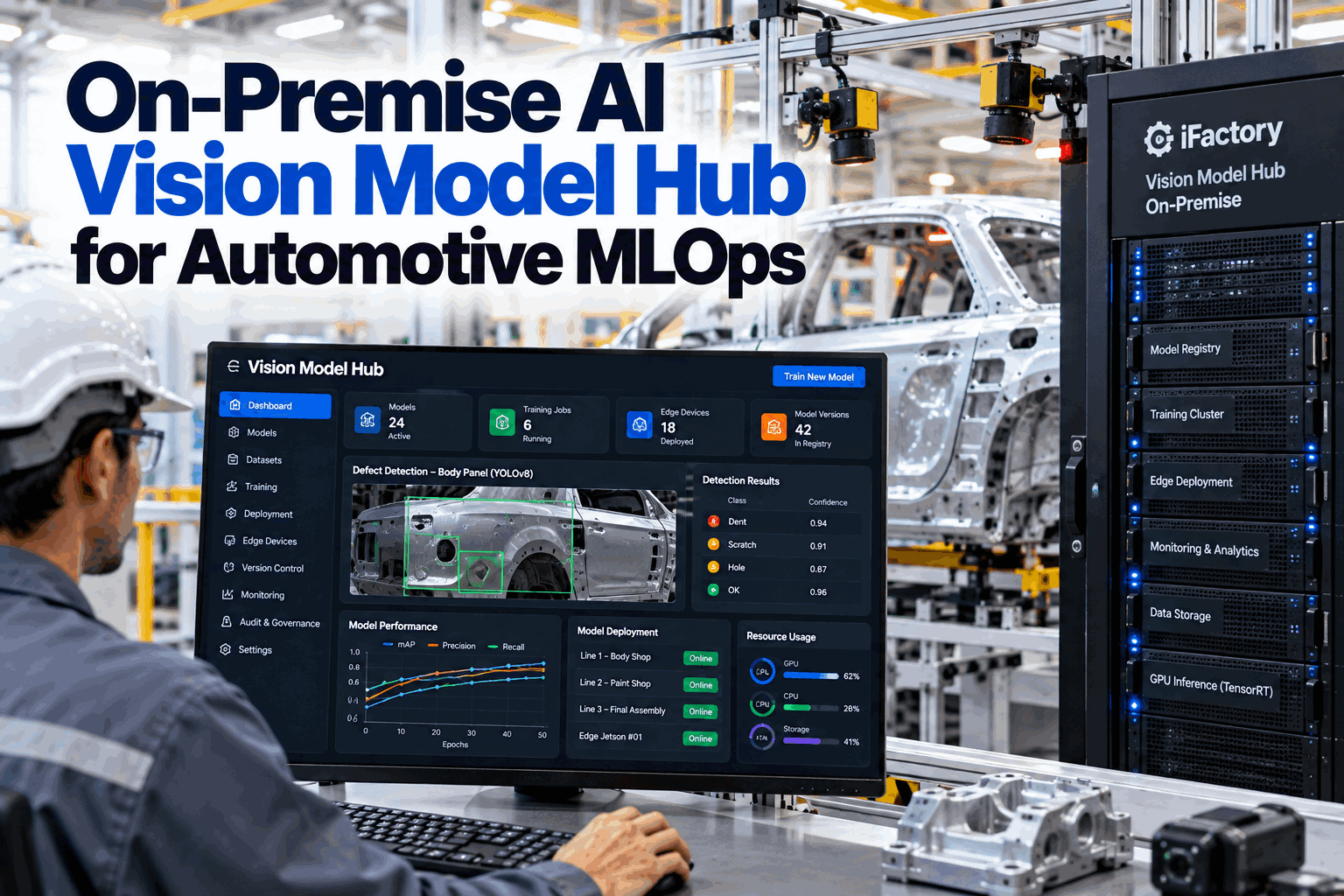
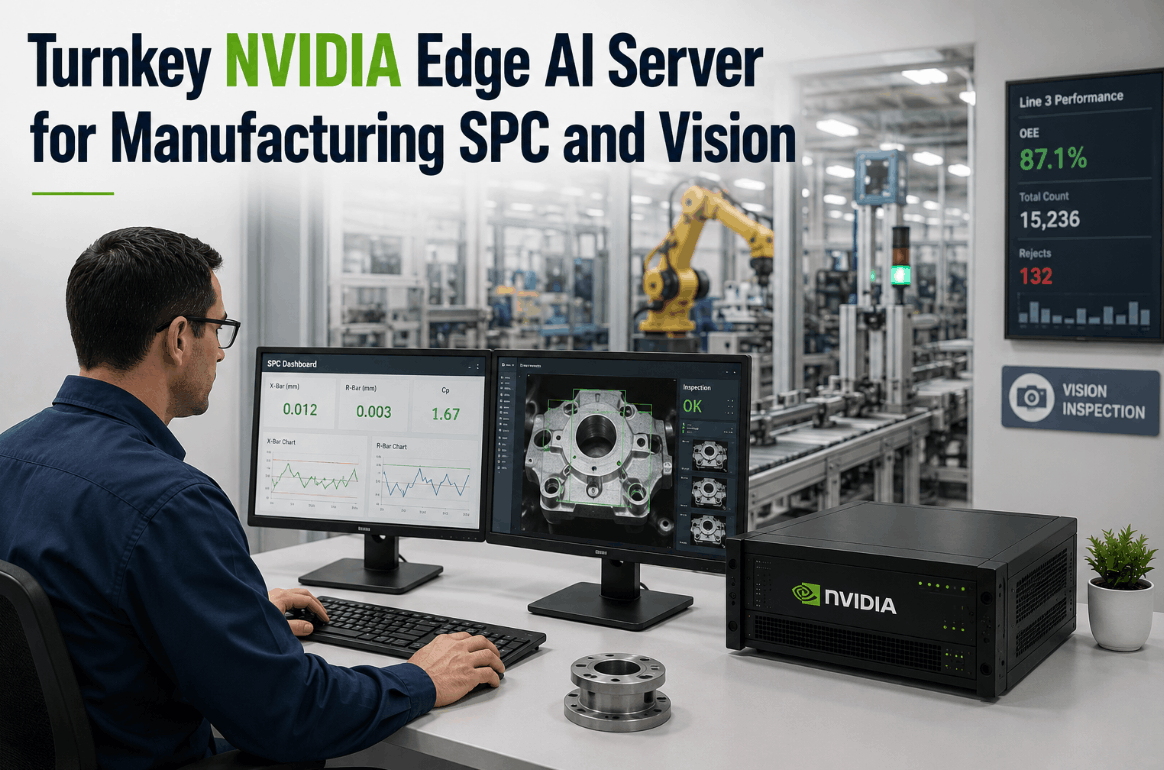
Plant Copilot runs on NVIDIA-certified edge compute platforms — typically NVIDIA L40S or A100 servers in a rack-mount form factor — deployed within the plant's secure network perimeter. The hardware is sized to the inference load of the facility: a single-site mid-volume plant typically requires one inference node; multi-line or multi-process facilities are configured with redundant nodes. Power, cooling, and physical security requirements are assessed during the pre-deployment architecture review and are compatible with standard industrial server room specifications.
Layer 2 — Air-Gapped Data Integration
The model connects to plant data sources through local, encrypted API connections — never through external cloud intermediaries. iFactory's integration layer supports OPC-UA for PLC and SCADA data, OSIsoft PI and standard historians for SPC and process parameter data, REST APIs for MES and SAP systems, and direct database connections to LIMS and quality management platforms. All data remains within the plant's local network. The model's knowledge is continuously updated from these live sources through an on-premises retrieval-augmented generation (RAG) architecture — meaning the Copilot always answers from current plant data, not a static snapshot taken at deployment time. Book a Demo to see the integration architecture mapped to your specific data environment.
Layer 3 — Plant-Aware Model Contextualization
The model is contextualized to your plant through a structured onboarding process that ingests your process documentation, recipe libraries, equipment hierarchy, alarm codebooks, and historical SPC data. The result is a model that knows the difference between your Grade A and Grade B heat treatment specifications, understands which alarms on Line 3 are process-critical versus nuisance, and can answer questions about specific production orders by referencing the actual MES record — not a generic manufacturing template.
What Plant Copilot Answers — Real Operational Questions, Real Plant Data
The operational value of Plant Copilot is most immediately visible in the questions it eliminates from the daily workflow of process engineers, reliability engineers, quality leads, and shift supervisors — questions that currently require pulling data from three systems, cross-referencing a recipe document, and waiting for a subject matter expert to be available. The table below maps representative user roles to the queries Plant Copilot handles in real time from local plant data.
| User Role | Representative Query | Data Sources Used | Time Saved vs. Manual |
|---|---|---|---|
| Process Engineer | "Why did Cpk on bore diameter drop on second shift — what changed in the recipe or process parameters?" | SPC historian, Recipe DB, MES shift log | 45–90 min → <30 sec |
| Reliability Engineer | "Which assets on Line 4 have generated more than 3 repeat alarms in the last 14 days?" | PLC/SCADA alarm log, CMMS | 2–4 hrs → <30 sec |
| Quality Lead | "Show me all production orders from this week where in-process inspection failed on the first attempt." | MES, LIMS, QMS records | 1–3 hrs → <30 sec |
| Shift Supervisor | "What is the current OEE on Line 2 versus the shift target, and what is the primary availability loss today?" | MES production counters, downtime log | 15–30 min → <30 sec |
| Maintenance Technician | "What is the correct torque specification and last service record for the hydraulic cylinder on Press 7?" | CMMS, equipment docs, SAP PM | 20–40 min → <30 sec |
| Plant CIO | "Summarize this week's top 5 quality deviations, affected orders, and current corrective action status." | QMS, MES, CAPA records, SAP | Half-day prep → <30 sec |
These time savings compound across hundreds of daily queries from a plant workforce of 50–500 people. A conservative estimate of 20 queries per day at an average of 30 minutes saved per query represents 10 hours of recovered engineering and supervisory time per day — per facility. Book a Demo to model the specific time recovery for your plant's user population and query volume.
CIO-Level Security: Air-Gap, Role-Based Access, and Audit Logging
For Plant CIOs responsible for securing operational technology environments against both external threats and internal data leakage, the security architecture of an AI system is as important as its functional capability. Plant Copilot is designed to meet the security requirements of the most demanding manufacturing environments — including defense supply chain facilities subject to CMMC Level 2 compliance and chemical manufacturers operating under EPA Risk Management Program controls.
Air-Gap Network Isolation
Architecture: Zero external connectivity
- No outbound internet connections required or permitted
- Operates fully on plant OT/IT network segments
- Compatible with ISA/IEC 62443 network segmentation
- No cloud licensing dependencies or heartbeat calls
Role-Based Query Permissions
Architecture: RBAC integrated with Active Directory
- User roles mapped to permitted data source access
- Operators cannot query executive financial or order data
- Managers see aggregated views; engineers see raw data
- AD/LDAP integration — no separate identity management
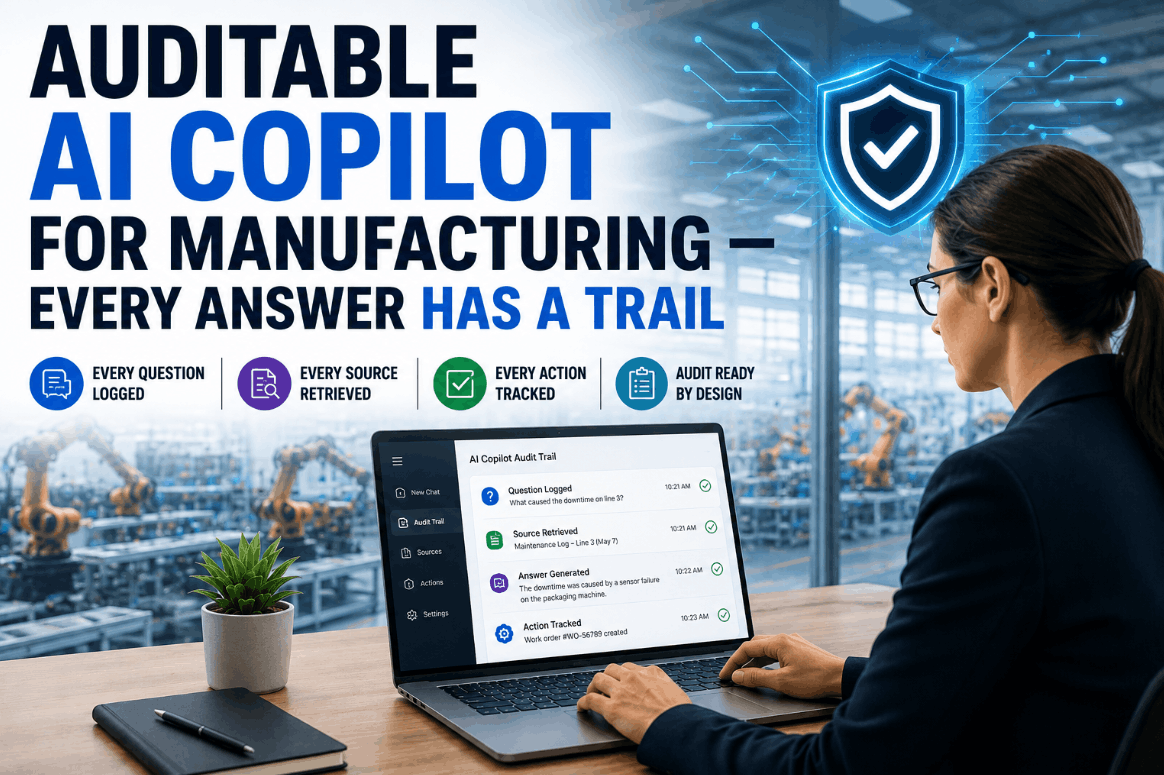
Complete Query Audit Trail
Architecture: Immutable on-premises log store
- Every query, every data source accessed, every response logged
- Tamper-evident log storage on local secure media
- Exportable audit reports for compliance reviews
- Anomaly detection on unusual query patterns
"We evaluated four AI platforms before selecting iFactory's Plant Copilot. Every other vendor's architecture required our process recipes and SPC data to transit their cloud infrastructure — which our legal team and our largest OEM customer's supplier quality agreement both prohibited. iFactory's on-premise architecture was the only one that satisfied both our IT security policy and our customer's data handling requirements without any special exceptions or carve-outs. The deployment took six weeks. Within the first month, our process engineers were resolving shift-level quality deviations in under two minutes that previously required pulling data from three systems and waiting for the process technologist to be available. The Copilot knows our plant — it knows our grades, our recipes, our equipment, and our alarm vocabulary. That specificity is what makes it operationally useful, not just technically impressive."
On-Premise Plant Copilot — Frequently Asked Questions
What happens to Plant Copilot's functionality if the plant's internet connection goes down?
Nothing changes — Plant Copilot runs entirely on local NVIDIA edge hardware and local plant data sources, with no dependency on external connectivity for any operational function, including model inference, data retrieval, and user authentication.
How does Plant Copilot stay current with changing recipes, new production orders, and updated SPC baselines?
The on-premises RAG architecture continuously indexes live data from connected sources — when a recipe is updated in your process management system or a new production order is created in SAP, the Copilot reflects that change in its next query responses without manual model retraining.
What NVIDIA hardware is required, and does it need dedicated rack space?
A standard single-site deployment runs on one NVIDIA L40S or equivalent edge server in a 2U rack-mount form factor, requiring standard 208V industrial power and a temperature-controlled server room; a pre-deployment infrastructure assessment confirms exact hardware requirements for your facility's query load and data volume.
Can Plant Copilot be deployed across multiple facilities with data kept separate between sites?
Yes — iFactory supports both single-site isolated deployments and multi-site architectures where each facility maintains its own local model instance with site-specific data isolation, plus optional aggregated reporting at the enterprise level through a secure on-premises data exchange.
How long does the plant context onboarding take, and what is required from the plant's engineering team?
Plant context onboarding typically requires 2–3 weeks and involves providing structured access to process documentation, equipment hierarchy data, recipe libraries, and historical SPC records; iFactory's integration engineers lead the process and require approximately 8–12 hours of plant engineering team time across the onboarding period.
The Plant CIO's Path to Generative AI: Start On-Premises, Not in the Cloud
The conversation about AI in manufacturing has been dominated by cloud platforms that offer general-purpose intelligence at the cost of operational specificity and data control. For Plant CIOs who have been waiting for a viable path to generative AI that satisfies their security posture, their compliance obligations, and their customers' data handling requirements, iFactory's Plant Copilot represents a fundamentally different architectural approach: AI that lives inside your fence, knows your plant, and answers the questions your engineers are actually asking — without exposing your operational IP to external systems that have no business holding it. The operational efficiency gains from Plant Copilot are measurable and immediate: engineering time recovered from manual data retrieval, shift-level quality resolution accelerated from hours to seconds, and maintenance knowledge preserved and made accessible to every technician on every shift. The compliance benefits are structural and permanent: an AI architecture that satisfies ITAR, CMMC, ISO 27001, and customer data handling requirements by design. Book a Demo with iFactory's industrial AI team to see Plant Copilot operating on a representative plant data environment and assess deployment feasibility for your facility.
Deploy an AI That Knows Your Plant — Without Sending Your Data Outside Your Fence.
iFactory's Plant Copilot runs on NVIDIA edge hardware inside your facility, connected to your SPC, recipes, PLCs, MES, and SAP — answering operational questions in real time with complete air-gap security and zero cloud dependency.