In a modern NFC juice plant, the decanter centrifuge is one of the most consequential machines on the floor — yet it is also one of the most under-tuned. The three variables that govern every separation outcome — differential speed, weir plate setting, and bowl speed — are often set at commissioning and left untouched regardless of seasonal fruit variation, incoming pulp load, or whether that day's run is targeting premium clarified juice or high-value washed pulp recovery. The result is yield losses of 2–5% per shift, clarity failures that trigger rework or customer rejections, and pulp streams that carry entrained juice worth more than the pulp itself. This guide walks U.S. juice processing engineers through the practical tuning logic for each control variable, how those variables interact, and how iFactory's process analytics platform gives your operations team the real-time sensor visibility to hold separation targets shift after shift without relying on manual grab samples. Book a Demo to see how iFactory deploys centrifuge process analytics on your juice line.
2–5%
Juice yield loss per shift from untuned decanter differential speed and weir settings
94%
Separation target hit-rate achieved when bowl speed, differential, and weir are co-optimized with real-time analytics
3 Variables
Bowl speed, differential speed, and weir setting — the complete tuning triad for juice yield and clarity control
<3.5%
False alert rate on iFactory centrifuge process monitoring — so your operators act on real deviation, not noise
How Decanter Centrifuges Work in Juice Processing — And Where Yield Disappears
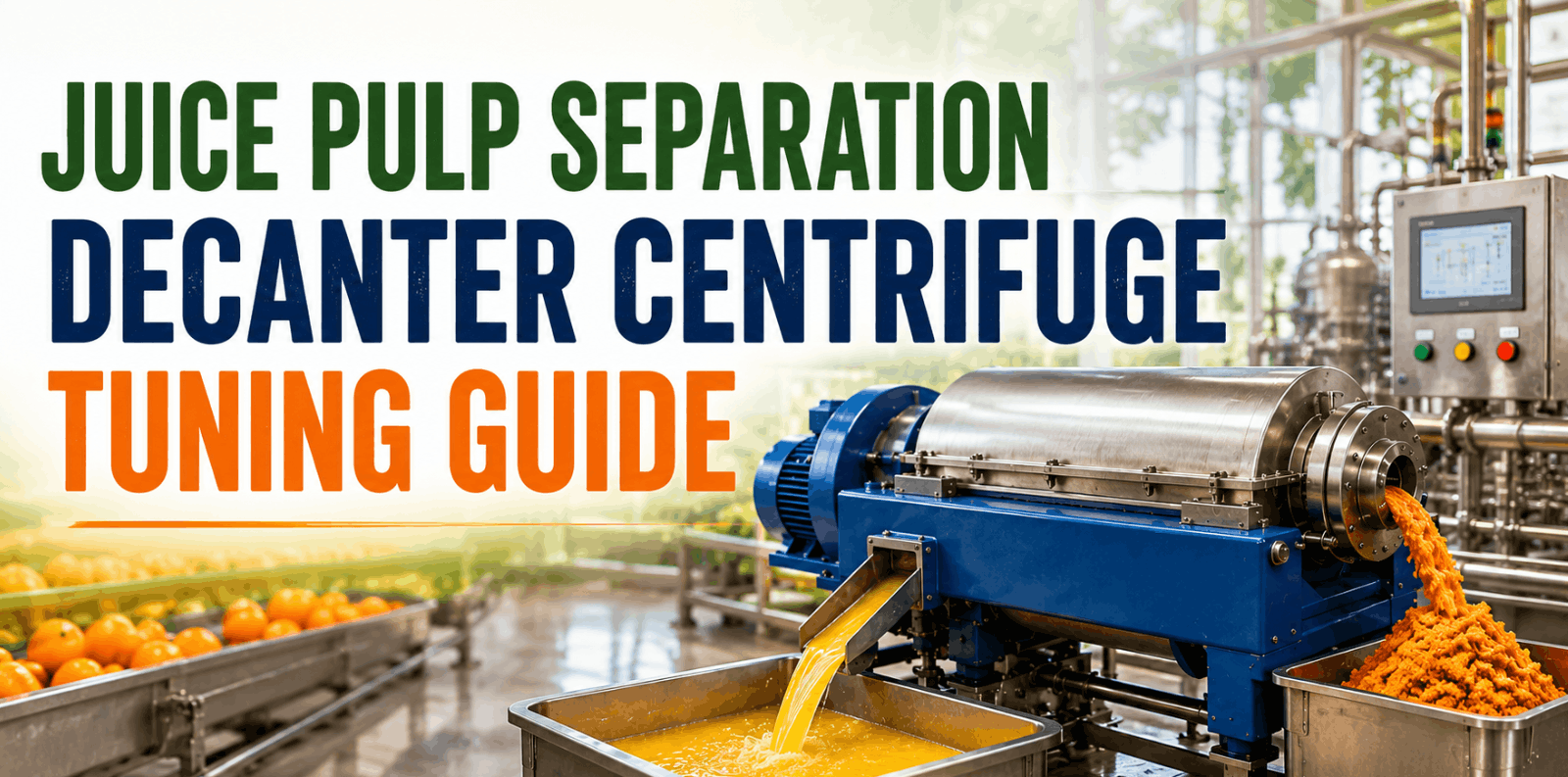
A decanter centrifuge in a juice application operates by spinning a horizontal bowl at high G-force — typically 1,800 to 4,000 x g — causing denser pulp solids to sediment against the bowl wall while clarified juice migrates inward and exits over the weir plates at the liquid end. A screw conveyor (scroll) inside the bowl rotates at a slightly different speed than the bowl itself. That speed difference — the differential speed — determines how quickly settled pulp is pushed toward the solids discharge port at the conical end of the bowl.
In citrus and NFC juice applications, this mechanism is doing two jobs simultaneously: separating the maximum volume of juice from the pulp cake, and delivering a pulp stream with the correct moisture, texture, and residual-juice content for either pulp-wash recovery or disposal. When any of the three primary tuning parameters drifts — bowl speed, differential speed, or weir height — one of those jobs starts to fail. Yield suffers or clarity drops. The challenge for production teams is that the cause-and-effect relationship between each variable and each outcome is not linear, and fruit variation across the season shifts the baseline continuously. Book a Demo with iFactory to see real-time centrifuge parameter monitoring in action on a juice line.
Bowl Speed Governs Centrifugal Force and Sedimentation Rate
Higher bowl RPM generates greater G-force, accelerating pulp sedimentation and improving the clarity of the juice phase. However, excessive bowl speed increases mechanical wear, energy consumption, and the risk of fine pulp particles being driven into the clarified juice stream if the pond depth is not matched correctly.
Differential Speed Sets Pulp Retention Time and Cake Dryness
Lower differential speed means the scroll moves pulp toward discharge more slowly — increasing residence time under centrifugal force and producing a drier, more dewatered pulp cake. Higher differential speed moves pulp out faster, reducing retention time and leaving more entrained juice in the solids stream — the primary driver of unrecovered yield loss.
Weir Height Controls Pond Depth and Juice Retention Time
Raising the weir plates increases the pond depth — the depth of the liquid layer inside the bowl — which extends the time juice spends under centrifugal force. This improves clarification and reduces fine-solids carryover into the juice stream. Lowering weir plates reduces pond depth, shortening the beach zone and accelerating throughput but risking haze and pulp carryover.
Feed Rate and Pulp Load Drive Tuning Frequency
Incoming citrus juice varies in pulp content based on fruit variety, maturity, extraction pressure, and finisher screen condition. As solids load increases, the decanter scroll torque rises, and the established differential speed may no longer be sufficient to clear pulp efficiently — leading to bowl flooding and sharp drops in both yield and clarity simultaneously.
CTA 1 — after first major section
Hitting Your Juice Yield and Clarity Targets Every Shift Requires More Than Commissioning Settings
iFactory's process analytics platform monitors decanter bowl speed, differential torque, pond depth, and centrate turbidity in real time — alerting your operators when any parameter starts to drift from the yield and clarity targets your team set, before the next grab sample confirms the loss.
The Tuning Triad: How to Adjust Bowl Speed, Differential Speed, and Weir Setting for Your Target
Each juice plant runs different fruit, different finisher screen conditions, and different product specifications — NFC premium, cloudy juice, pulp wash recovery, or concentrate feed. The following tuning logic represents proven field practice for decanter centrifuges in citrus and tropical fruit juice applications. iFactory's analytics platform captures the real-time sensor signals that make these adjustments data-driven rather than operator-dependent.
01
Bowl Speed: Set the G-Force Baseline for Your Product Class
For NFC and clarified juice applications, bowl speed is typically set to achieve 1,800–3,200 x g depending on fruit type and desired clarity. Higher bowl speeds produce clearer juice but increase energy consumption and fine-solids migration risk. For pulp-wash recovery operations where the solids stream carries commercial value, a lower G-force setting balances dewatering against pulp cell integrity. Bowl speed is your highest-impact and least-frequently-adjusted variable — set it based on product class, then tune the other two parameters around it.
02
Differential Speed: Balance Retention Time Against Yield Recovery
This is the most operationally sensitive parameter for juice yield. Lower differential speed (2–5 RPM in most juice decanters) extends the time pulp spends in the bowl under centrifugal compaction — draining more entrained juice back into the liquid pool before the solids discharge. Higher differential speeds (8–15 RPM) move pulp out faster, reducing scroll torque and preventing bowl flooding at high incoming solids loads, but at the cost of wetter pulp and higher juice-in-solids losses. On VFD-controlled decanters, target scroll torque in the 40–70% range as the primary indicator that differential speed is correctly matched to current pulp load.
03
Weir Setting: Tune Pond Depth for the Clarity Target
Raising the weir plates increases pond volume, extends liquid retention time, and improves clarification — critical for NFC premium and concentrate-feed applications where low turbidity and consistent cloud are product specifications. Lowering weir plates shortens the pond, increases the dry-beach zone length, and produces a drier solids discharge at the expense of centrate clarity. In practice, weir changes require the decanter to be stopped on most machines, so the correct weir height must be set before a production run based on target product spec — and verified during startup by turbidity measurement before the run is confirmed.
04
Feed Rate Management: The Input That Destabilizes All Three Parameters
Decanter performance is designed for a feed rate range — typically specified in liters per hour at a defined solids concentration. When feed rate spikes above the design envelope (common during high-yield fruit seasons or when upstream finisher screens are partially blinded), the scroll can no longer clear solids fast enough, the bowl floods, and both yield and clarity degrade simultaneously. iFactory monitors feed rate and scroll torque in real time, alerting operators to load surges before bowl flooding occurs rather than after the next turbidity grab sample confirms the event.
05
Pulp Wash Circuit Integration: Recovering Juice from the Solids Stream
In operations running a pulp-wash stage downstream of the primary decanter, the moisture content of the decanted pulp cake directly determines how much dilution water is needed in the wash circuit and how much juice is recoverable. A 1% reduction in pulp moisture at the decanter discharge can recover thousands of liters of saleable juice per shift across a high-throughput line. iFactory's mass balance tracking links decanter differential speed settings to downstream pulp-wash yield, giving process engineers the data to set the correct retention time for each incoming fruit batch rather than defaulting to fixed parameters.
Decanter Tuning Parameter Matrix: Target vs. Outcome Reference
The table below consolidates the directional effect of each tuning adjustment on the four primary separation outcomes in juice processing. Use this as a field reference when incoming fruit variation requires parameter correction. For continuous data-driven tuning, Book a Demo with iFactory to see real-time centrifuge monitoring in your plant environment.
How iFactory Process Analytics Stabilizes Decanter Performance Across the Citrus Season
The tuning principles above are well-understood by experienced process engineers — the challenge is that fruit variation across the season, operator shift changeovers, and the absence of real-time turbidity or torque data make consistent application nearly impossible on conventionally instrumented lines. iFactory closes this gap by connecting directly to your decanter's PLC, VFD outputs, and inline process sensors to build a continuous picture of centrifuge state versus target.
Real-Time
Scroll Torque and Differential Speed Monitoring
iFactory tracks scroll torque as the primary indicator of solids loading — alerting operators when torque trends toward overload before bowl flooding or yield loss occurs.
Shift-Level
Juice-in-Solids Mass Balance Tracking
By combining decanter feed rate, centrate flow, and solids discharge data, iFactory calculates juice-in-solids loss per shift — the most important yield KPI most plants currently cannot measure continuously.
Automated
Clarity Deviation Alerts Before Rework
Inline turbidity signals feed into iFactory's analytics layer, triggering operator alerts when centrate clarity drifts from target — giving the team time to correct weir or differential settings before a full shift of off-spec juice is produced.
Seasonal
Fruit Variation Baseline Adjustment
iFactory builds parameter baselines by product run and fruit origin — so when early-season fruit with higher pulp load arrives, the recommended parameter adjustments are data-driven against your plant's actual historical separation performance, not generic OEM starting points.
CMMS
Predictive Maintenance Integration
Decanter bearing vibration, gearbox temperature, and scroll wear indicators are monitored in parallel with process parameters — allowing predictive maintenance alerts to be generated alongside process deviation alerts in the same unified dashboard.
Full
OPC-UA and PLC Integration Within 7 Days
iFactory connects to existing Alfa Laval, Flottweg, GEA Westfalia, and ANDRITZ decanter control systems via OPC-UA, Modbus TCP, and REST APIs — no hardware replacement required, and full integration completed within one week of deployment kickoff.
2–5%
Yield Recovery Opportunity
Juice volume recoverable per shift when differential speed is optimized against actual pulp load
7 Days
Platform Integration
iFactory connected to your decanter control system and live parameter monitoring activated
94%
Separation Target Hit-Rate
Yield and clarity targets met per shift when real-time parameter monitoring replaces manual grab sampling
<3.5%
False Alert Rate
Multi-parameter cross-validation before any deviation alert reaches the operator console
Expert Review: What a 2% Yield Recovery Means at Production Scale
We had been running the same differential speed setting since our Flottweg decanter was commissioned three seasons ago. It was a perfectly reasonable starting point for early-season Florida Valencia fruit — but by mid-season, when pulp loads climb and fruit moisture changes, that same setting was leaving juice in the solids stream we were not measuring. When iFactory connected to our PLC and started tracking juice-in-solids continuously, we found we were losing just over 2.3% yield on high-pulp days. We corrected the differential speed and verified weir height against the real-time torque signal. That 2.3% recovery, across our full campaign volume, was more revenue than the entire platform cost in a single season. The clarity data also gave our QA team confidence to reduce the frequency of manual turbidity grabs — freeing up lab capacity for other checks during peak production.
Process Engineering Manager
NFC Citrus Juice Processing Facility, Central Florida
Conclusion: Decanter Tuning Is a Continuous Process, Not a Commissioning Event
The three variables that control juice yield and clarity in a decanter centrifuge — bowl speed, differential speed, and weir height — are not set-and-forget parameters. Seasonal fruit variation, incoming pulp load shifts, upstream finisher condition, and product specification changes all require these parameters to move. The difference between a juice plant running at 97% yield recovery and one running at 93% is almost always found in whether these adjustments are being made based on real data or left at historical defaults.
iFactory's process analytics platform gives juice processing teams the continuous sensor visibility — scroll torque, feed rate, centrate turbidity, and mass balance — to make these adjustments proactively rather than reactively. The platform connects to existing decanter control systems in under a week, requires no hardware replacement, and begins producing actionable parameter deviation alerts from the first shift of live operation. For any NFC or juice concentrate operation running high-value fruit campaigns, the yield recovery from optimized decanter tuning covers the analytics investment within a single season.
Final CTA
Stop Leaving Juice in the Solids Stream. Get Real-Time Decanter Analytics on Your Line in 7 Days.
iFactory connects to your decanter centrifuge control system, monitors differential speed, scroll torque, centrate clarity, and feed rate continuously, and alerts your operators when any parameter drifts from your yield and clarity targets — before the next grab sample confirms the loss.
Real-Time Torque & Speed Monitoring
Centrate Clarity Deviation Alerts
Shift-Level Yield Mass Balance
7-Day PLC Integration
OPC-UA & Modbus Native
Frequently Asked Questions
Q: What is the most common cause of juice yield loss in a decanter centrifuge?
The most common cause is differential speed set too high for the incoming pulp load, which moves solids toward discharge before sufficient juice has drained from the cake under centrifugal force — leaving recoverable juice in the solids stream rather than the centrate.
Q: How often should weir plate settings be adjusted during a citrus processing campaign?
Weir settings should be reviewed at least at each major fruit variety transition and whenever inline turbidity indicates a consistent clarity shift — most facilities require two to four weir adjustments per campaign season as fruit maturity and pulp character change.
Q: What sensor signals does iFactory monitor on a juice decanter centrifuge?
iFactory monitors scroll torque, bowl and differential speed (via VFD output), feed rate, centrate turbidity (where inline sensors are installed), gearbox temperature, and bearing vibration — providing both process performance and mechanical health signals in a unified dashboard.
Q: Can iFactory connect to existing decanter control systems without hardware replacement?
Yes — iFactory integrates via OPC-UA, Modbus TCP, and REST APIs to Alfa Laval, Flottweg, GEA Westfalia, and ANDRITZ decanter controllers, completing full connection within seven days of deployment without requiring any changes to existing PLC or control hardware.
Q: How does iFactory help during pulp wash recovery operations downstream of the decanter?
iFactory tracks pulp moisture at the decanter discharge (calculated from mass balance data) and links it to downstream wash-circuit yield — giving process engineers the data to optimize differential speed for pulp cake moisture rather than relying on fixed settings that ignore fruit-to-fruit variation.