Wafer Fab Real-Time SPC — Yield-Critical Parameters at Tool Level
By Henry Green on June 9, 2026
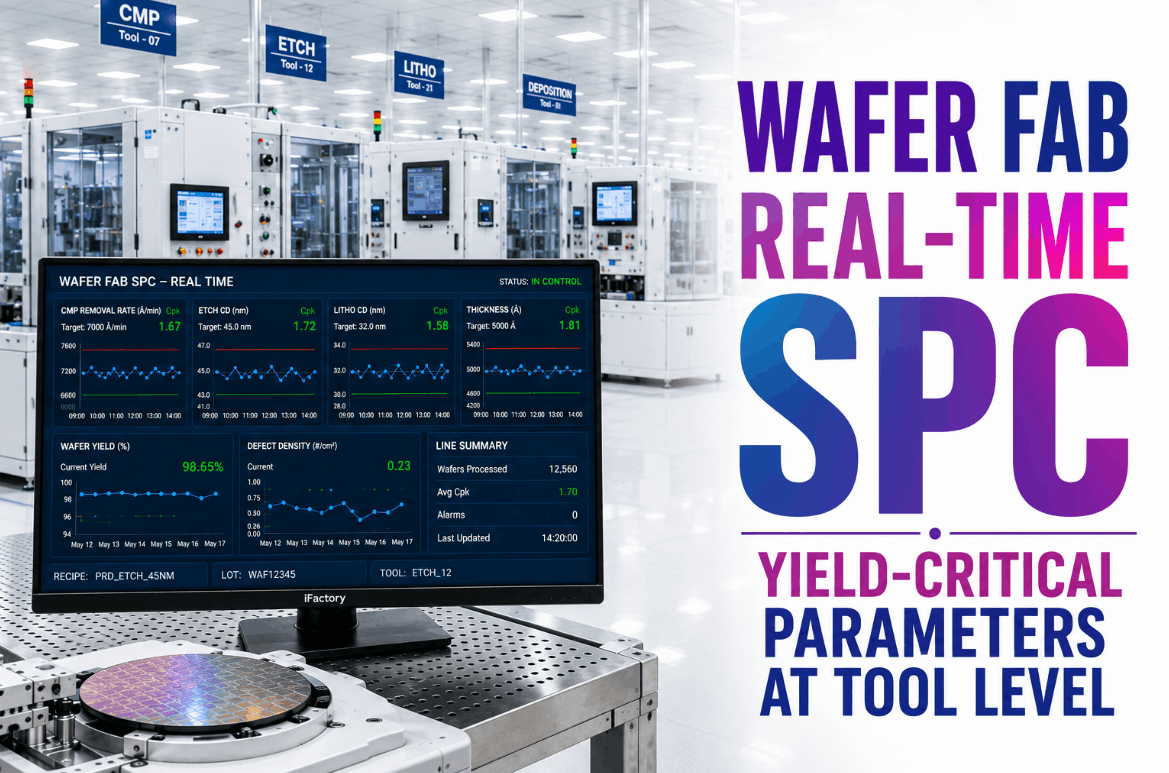
In a high-output wafer fab, real-time SPC is not a quality initiative — it is the yield engine. Every recipe step across CMP, etch, lithography, and deposition runs within tolerance windows measured in angstroms and nanometers, where a single Cpk excursion at the tool level can translate into thousands of wafers scrapped or downgraded before the shift ends. Most fabs today are still running SPC on sampled data pulled hours after the fact, making process engineers reactive rather than predictive. When your SPC system cannot deliver continuous capability per recipe step across every tool in the bay, you are not controlling your process — you are auditing it. Fabs that want to close this gap begin by scheduling time to Book a Demo with iFactory to see how tool-level connectors for CMP, etch, litho, and deposition deliver live Cpk tracking that drives yield where it matters most.
WAFER FAB YIELD INTELLIGENCE
Real-Time SPC at the Tool Level — CMP, Etch, Litho, Deposition
iFactory connects to your fab's tool-level data streams and runs continuous Cpk per recipe step — so process engineers see yield-critical excursions at the moment they occur, not at end-of-lot review.
68%of fab yield loss is traceable to tool-level process excursions caught too late
4–8 hrAverage SPC data lag in fabs relying on end-of-lot sampling rather than live tool feeds
+31%Yield improvement achieved through continuous Cpk monitoring at CMP and etch tools
<90 siFactory SPC alert latency from tool event to process engineer notification
Why Tool-Level SPC Is the Defining Factor in Wafer Fab Yield
The Gap Between Bay-Level Monitoring and Actual Process Control
Most fab SPC implementations are built around wafer-level metrology pulled at the end of a process module — after the lot has already run. By the time a Cpk excursion at a CMP tool shows up in the SPC chart, the next 25 wafers in the queue have already been processed under the same out-of-control condition. This is the core structural problem with sampling-based SPC in a high-throughput fab: the data latency is longer than the process interval. iFactory's tool-level connectors eliminate this latency by pulling data directly from tool endpoints — Applied Materials, Lam Research, ASML, KLA — and running continuous capability calculations per recipe step, per chamber, per tool. Process engineers who want to see this in action against their specific tool set typically start by scheduling time to Book a Demo with iFactory's fab engineering team.
The economic case is direct: in advanced logic or memory fabs, a 1% yield improvement on a 25K WSPM line is worth tens of millions of dollars annually. The fastest path to that improvement is closing the feedback loop between tool-level process data and real-time SPC — ensuring that every Cpk trend, chamber-to-chamber offset, or drift in critical dimension (CD) is surfaced to the process engineer before it propagates across a full lot.
The Four Process Modules Where Tool-Level SPC Drives the Most Yield
CMP, Etch, Lithography, and Deposition — Covered Per Recipe Step
01
CMP — Removal Rate, Uniformity, and Within-Wafer Cpk
CMP removal rate drift is one of the highest-impact yield loss sources in both logic and memory fabs. iFactory connects to CMP tool endpoints and tracks removal rate, WIWNU (within-wafer non-uniformity), and post-CMP thickness in real time, with Cpk calculated per platen, per pad lot, and per recipe. Slurry flow excursions and pad conditioning anomalies are flagged immediately — before the next wafer hits the platen.
02
Etch — CD Control, Selectivity, and Chamber-to-Chamber Matching
Etch process SPC must operate at the chamber level, not the tool level, because chamber-to-chamber variation is the dominant source of CD spread in multi-chamber etch systems. iFactory's etch connector monitors etch rate, critical dimension (CD), selectivity, and endpoint signal per chamber per recipe step, with automated chamber-matching alerts when individual chamber Cpk diverges beyond configurable thresholds. Book a Demo to see live etch SPC on a multi-chamber Lam or TEL system.
03
Lithography — CD Uniformity, Overlay, and Focus Monitoring
Lithography is the yield-defining module in any advanced node fab. iFactory integrates with ASML and Canon scanner data streams to run continuous SPC on CD uniformity, overlay error, focus/dose control, and stepper lens aberration signatures. Recipe-level Cpk tracking across the reticle set allows process engineers to identify scanner drift and lot-to-lot CD shifts before they produce measurable overlay failures or parametric yield impact.
04
Deposition — Film Thickness, Uniformity, and Stress Monitoring
CVD, PVD, and ALD deposition processes require continuous SPC on film thickness, deposition rate, uniformity (1-sigma), and film stress across all chambers. iFactory's deposition connector pulls data from Applied Materials, Novellus, and ASM tools, running Cpk per recipe and per chamber with automated alerting on chamber qualification drift, precursor flow excursions, and susceptor temperature variation that precede out-of-spec film growth.
Tool-Level SPC Coverage: Parameters, Chart Types, and Cpk Targets
Every Yield-Critical Measurement Tracked Continuously in iFactory
Process Module
Key SPC Parameter
Chart Type
Cpk Target
Yield Impact if OOC
CMP
Removal Rate (Å/min)
Xbar-R / Individuals
≥ 1.33
Dishing, erosion, topography failure
CMP
Post-CMP Thickness (Å)
Xbar-R
≥ 1.33
Interconnect resistance variation
Etch
Critical Dimension (nm)
Xbar-S
≥ 1.67
Parametric yield loss, shorts/opens
Etch
Etch Rate (Å/min)
Individuals / MR
≥ 1.33
Profile deviation, selectivity loss
Lithography
CD Uniformity (3σ, nm)
Xbar-R
≥ 1.67
Patterning failure, DIBL, Vt shift
Lithography
Overlay Error (nm)
Individuals
≥ 1.33
Layer-to-layer misalignment, shorts
Deposition
Film Thickness (Å)
Xbar-R
≥ 1.33
Step coverage, void formation
Deposition
Film Uniformity (1σ, %)
Xbar-S
≥ 1.33
Resistance variation, capacitance shift
How iFactory's Wafer Fab SPC Architecture Works
From Tool Endpoint to Live Cpk in Under 90 Seconds
iFactory's wafer fab SPC platform is built around a tool-level connector framework that eliminates the data aggregation delays inherent in MES-mediated SPC systems. Rather than waiting for lot completion to trigger a SPC calculation, iFactory pulls data directly from tool endpoints at the wafer or sub-lot level and runs capability analysis per recipe step in the SPC engine. The workflow below shows how process data moves from tool to engineer action in iFactory's architecture.
Step 01
Tool-Level Data Acquisition via Native Connectors
iFactory connects directly to tool endpoints (Applied Materials, Lam, ASML, KLA, TEL, ASM) via SECS/GEM, EDA/Interface A, or REST API. Wafer-level process data is ingested per recipe step without requiring MES intermediation, eliminating the 4–8 hour SPC data lag common in sampling-based systems.
Step 02
Continuous Cpk Calculation Per Recipe and Chamber
As each wafer completes a recipe step, iFactory calculates Cpk and Ppk for every monitored parameter against the configured control limits for that recipe. Chamber-to-chamber and tool-to-tool matching indices are computed simultaneously, giving process engineers immediate visibility into capability divergence across the tool fleet.
Step 03
Automated Western Electric Rule Detection and Alerting
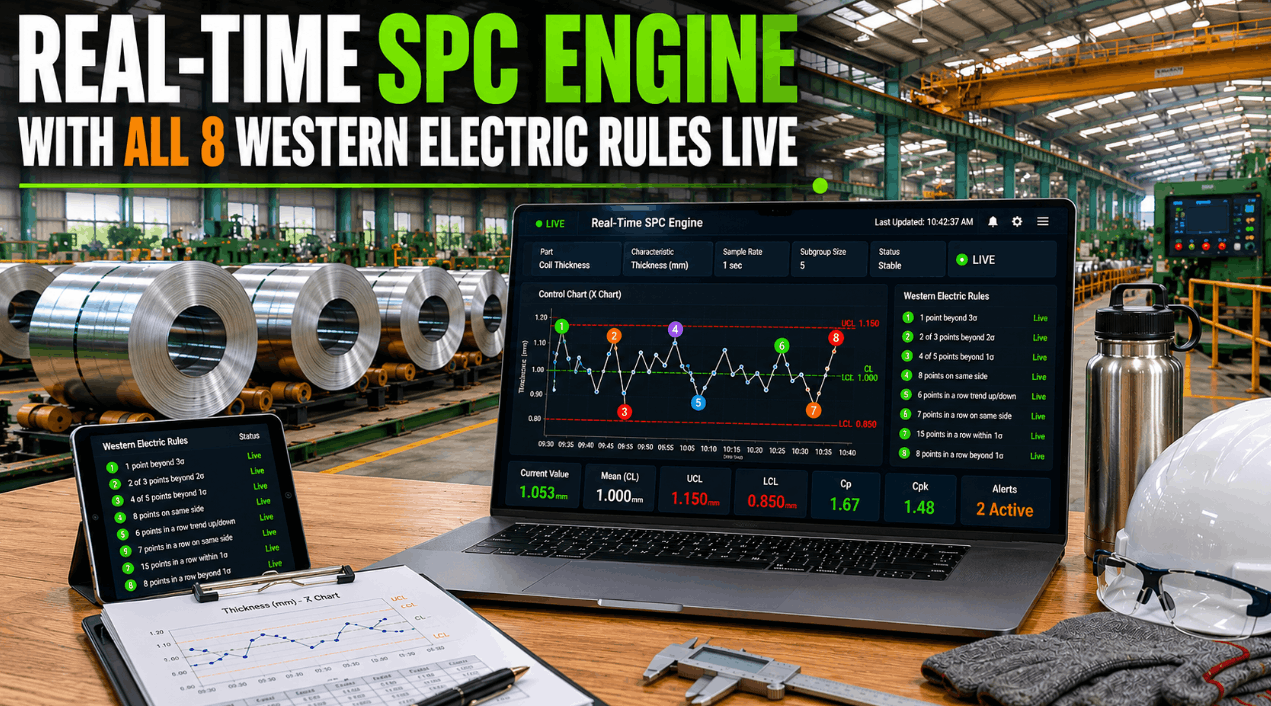
All eight Western Electric Rules are applied to every active control chart in real time. When a rule violation is detected — a single point beyond 3σ, two of three points beyond 2σ, or a run of seven points trending — an alert is sent to the responsible process engineer within 90 seconds of the triggering wafer completing the process step.
Step 04
Recipe-Level SPC Dashboards and Lot Disposition Support
Process engineers access a unified SPC dashboard showing real-time control charts, Cpk trends, and out-of-control event timelines per tool, per chamber, and per recipe. Lot disposition recommendations are generated automatically when sustained Cpk degradation is detected, enabling proactive hold decisions before further processing commits the lot to additional value-add steps. Book a Demo to walk through the disposition workflow for your specific process modules.
Step 05
Yield Correlation and Root Cause Traceability
iFactory links SPC excursion events to downstream electrical test and wafer sort data, enabling correlation analysis between tool-level process deviations and parametric yield outcomes. This closes the feedback loop between process control and yield engineering, accelerating root cause identification and corrective action cycle times across the fab.
"We were running SPC on lot-level averages pulled from our MES, which meant our etch process engineers were seeing excursions 6 to 8 hours after they occurred. By the time a Cpk alert fired, we'd already processed 40 wafers under the out-of-control condition. iFactory's chamber-level connector changed everything — we now see CDE and CD uniformity violations in under two minutes and have reduced our etch-related yield excursions by 34% in six months. It's what real-time process control is supposed to look like."
Principal Process Engineer, Etch Module300mm Logic Fab, U.S. Semiconductor Manufacturer
Measurable Yield and Capability Outcomes
What Fabs Achieve With Continuous Tool-Level SPC
+31% Yield Improvement
Driven by closing the SPC data latency gap between tool event and engineer response across CMP and etch modules. Fewer lots process beyond excursion before corrective action is taken.
<90 sec Alert Latency
Tool-level data acquisition and real-time SPC calculation deliver out-of-control alerts within 90 seconds of the triggering wafer completing its recipe step, compared to 4–8 hours with MES-based sampling SPC.
–34% Etch Yield Excursions
Chamber-level SPC with automated matching alerts reduces the frequency and impact of chamber-to-chamber CD divergence events in multi-chamber etch systems, a primary driver of parametric yield loss.
Cpk >1.67 Sustained
Continuous capability tracking at lithography and etch tools sustains Cpk above 1.67 targets on CD-critical process steps, directly supporting advanced node design rule compliance and parametric yield stability.
Frequently Asked Questions
Which fab tools and equipment interfaces does iFactory support?
iFactory connects to Applied Materials, Lam Research, ASML, KLA, TEL, and ASM platforms via SECS/GEM, EDA/Interface A, and REST API, with custom connector support for legacy equipment not covered by standard protocols.
How does continuous Cpk per recipe step differ from lot-level SPC?
Lot-level SPC calculates capability after a lot completes, introducing hours of latency. iFactory's per-recipe Cpk runs after each wafer, giving engineers an out-of-control signal before the next wafer processes under the same condition.
Can iFactory detect chamber-to-chamber matching issues across multi-chamber etch tools?
Yes. iFactory calculates individual chamber Cpk and a chamber-matching index per recipe step, automatically alerting when any chamber's capability diverges beyond the configured matching threshold relative to the tool baseline.
Does iFactory support overlay and focus SPC for lithography modules?
Yes. The lithography connector ingests scanner exposure data and inline metrology results, running continuous SPC on overlay error, CD uniformity, and focus/dose signatures per reticle and per recipe step.
How long does it take to deploy iFactory's SPC platform across a wafer fab?
Most fabs achieve live SPC across their priority process modules within 6–10 weeks, beginning with the highest-yield-impact tools and expanding coverage as the initial deployment validates data quality and alert thresholds.
Wafer fab yield management has always been a data problem — the fabs that win at yield are the ones that close the feedback loop between tool-level process data and engineer action fastest. Sampling-based SPC with multi-hour data lag is no longer a viable strategy in a high-throughput advanced node environment. iFactory's tool-level connectors and continuous Cpk engine give process engineers the real-time visibility they need to act on excursions before they propagate into yield loss. If your team is running SPC on lot-level data and ready to make the shift to genuine tool-level process control, the most effective next step is to Book a Demo and see the platform running against your specific process modules and tool set.
CLOSE THE YIELD FEEDBACK LOOP
Deploy Tool-Level SPC Across Your Wafer Fab — CMP, Etch, Litho, Deposition
iFactory's fab connector framework streams tool-level process data into continuous, per-recipe Cpk monitoring — delivering out-of-control alerts in under 90 seconds and giving process engineers the real-time visibility that drives yield improvement at scale.