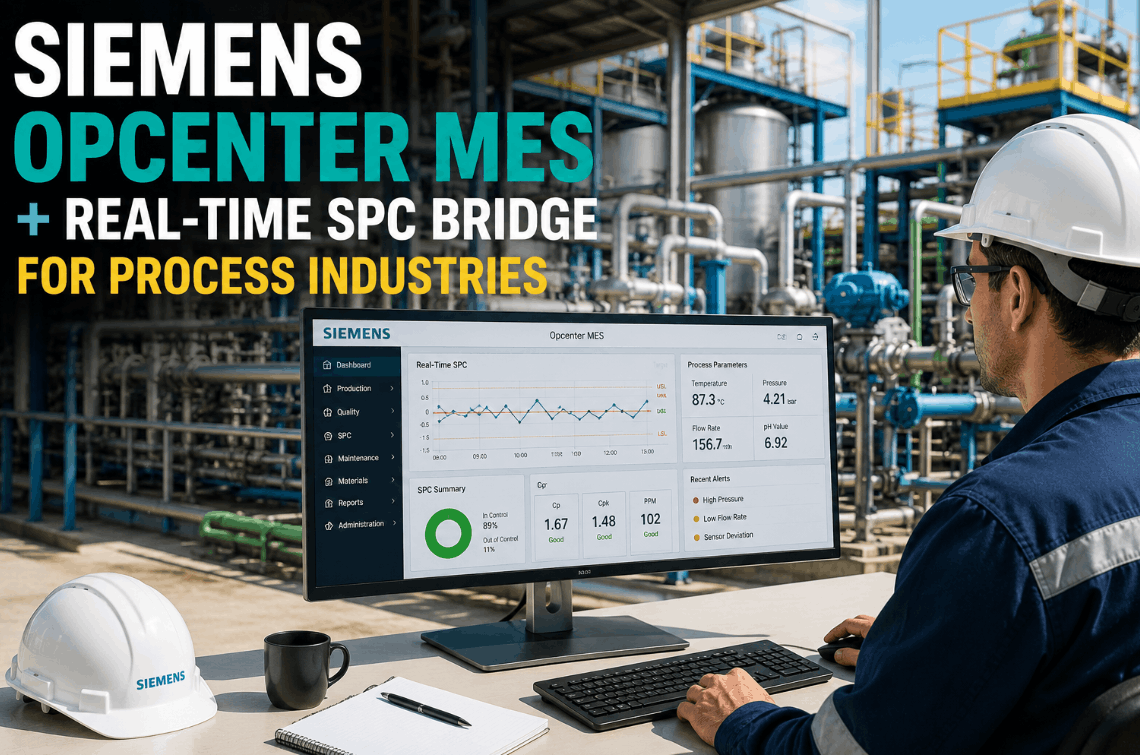
Bridging Siemens Opcenter Execution Discrete to a real-time statistical process control engine is one of the most technically demanding integration problems in discrete and process manufacturing. Opcenter generates the production context — work order, operation, resource, material lot — that makes SPC data actionable. But Opcenter alone does not run continuous control charts or compute Cpk in real time. The gap between MES execution data and live SPC intelligence is where process escapes occur: a shifting X-bar that would have triggered an assignable cause investigation sits invisible in the historian while defective parts continue to ship. iFactory's Siemens Opcenter Execution Discrete v2310 SP2 connector closes this gap through a multi-protocol bridge — REST, SOAP, IDoc inbox, MSMQ outbound, and OPC-UA PLC bridge — that feeds live control charts and Cpk calculations in seconds. Book a Demo to see the bridge architecture against your Opcenter environment.
Why Opcenter MES Data Alone Is Not Enough for Real-Time SPC
Siemens Opcenter Execution Discrete is an exceptionally capable MES platform — it manages work order dispatch, operation tracking, material genealogy, and equipment assignments with precision that few competing platforms match. What it does not do is run a continuous SPC engine against the measurement data it collects. Control charts in Opcenter are typically configured as static reports pulled on a scheduled basis, not as live monitoring tools that respond to process shifts as they happen. The practical consequence for a Quality Director is that Western Electric rule violations, CUSUM signals, and Cpk degradation are discovered after the production run, not during it.
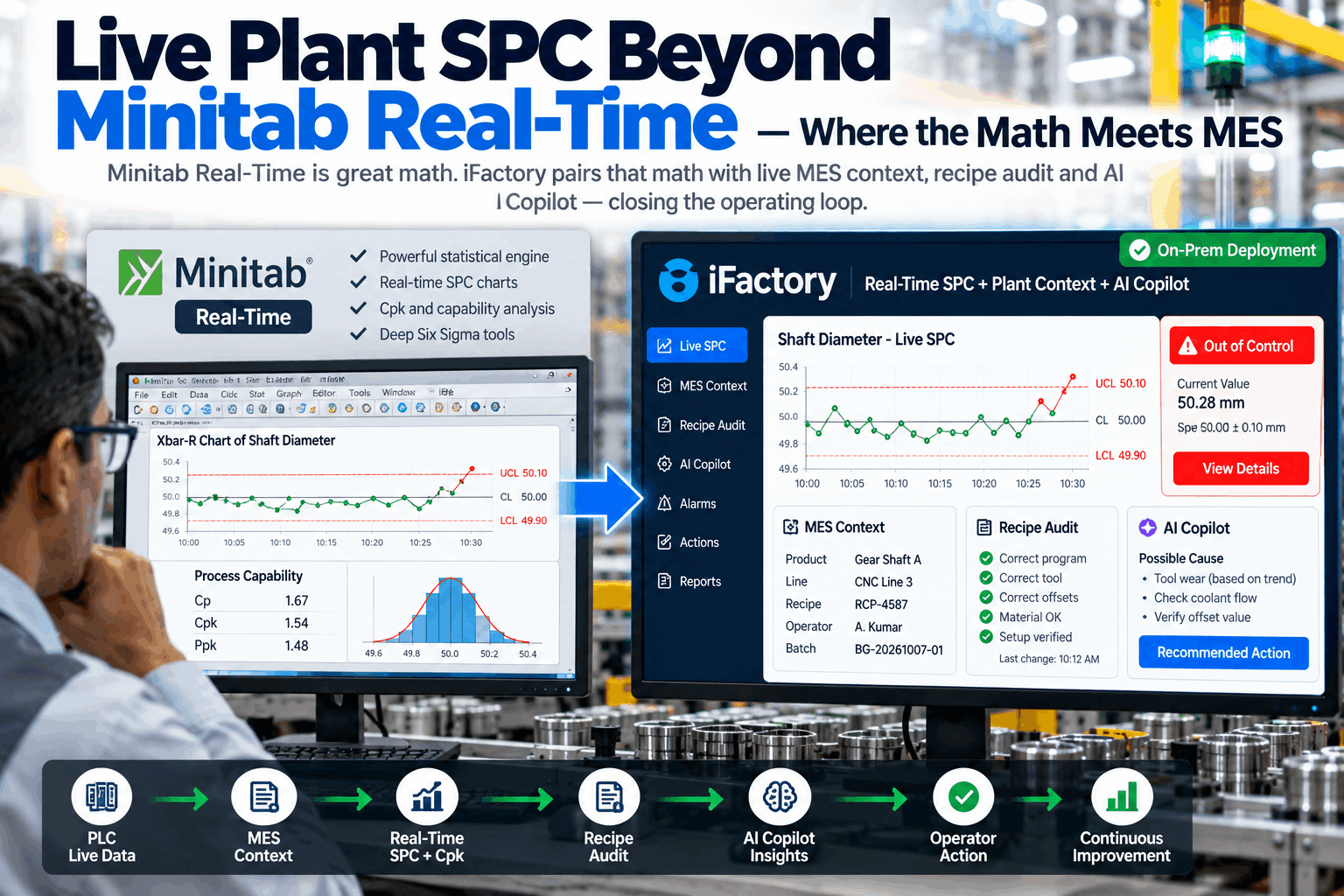
iFactory's MES SPC bridge addresses this by consuming the Opcenter data stream in real time — using REST and SOAP APIs for transactional MES data, the IDoc inbox for SAP-originated quality inspection lots, MSMQ for outbound event messaging, and OPC-UA for direct PLC measurement feeds — and running a continuous SPC engine against that combined data stream. The result is live control charts with automatic rule violation detection, real-time Cpk and Ppk computation, and automated out-of-control alerts delivered to the Quality Director dashboard within seconds of the measurement event.
The Six-Protocol Bridge Architecture: How iFactory Connects to Opcenter Execution Discrete
A production-grade MES SPC bridge for Siemens Opcenter cannot rely on a single protocol. Different data types flow through different channels — transactional MES operations through REST and SOAP, SAP quality inspection lots through IDoc, asynchronous event messaging through MSMQ, direct equipment measurement data through OPC-UA, and outbound quality event delivery through Webhooks. iFactory's connector handles all six channels simultaneously, normalizing the data into a unified SPC data model before feeding the control chart engine.
Real-time work order status, operation completions, material lot assignments, and quality results pulled via Opcenter's REST API at configurable polling intervals or webhook-triggered on event. Provides the production context that makes SPC data traceable to order, operation, and resource.
SOAP web services support older Opcenter and Camstar-era integrations still running in many facilities. iFactory maintains a SOAP adapter alongside the REST connector, allowing plants running mixed Opcenter versions to bridge both interface generations without a parallel integration project.
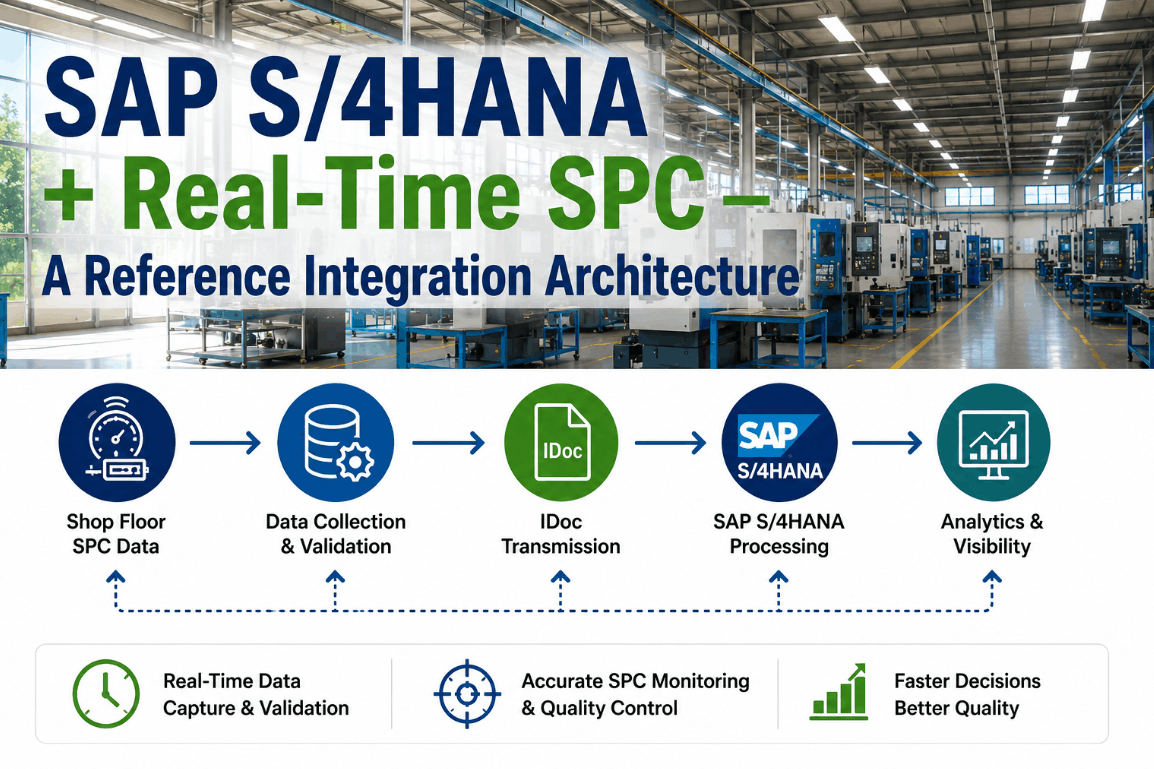
SAP QM inspection lots and inspection results delivered via IDoc are consumed directly by iFactory's IDoc inbox processor. This allows SAP-originated inspection data — including characteristic measurements from Results Recording (QE01) — to feed the SPC engine without a separate middleware layer.
Opcenter's MSMQ outbound messaging delivers asynchronous event notifications — operation completions, container moves, SPC violations — to iFactory's MSMQ worker service. This provides a reliable, guaranteed-delivery channel for high-volume production event streams without blocking the Opcenter application layer.
For measurement data collected directly at the equipment — CMM readings, gauge outputs, inline sensor values — iFactory's OPC-UA bridge reads process values directly from the PLC or measurement system, bypassing the MES data collection cycle entirely. This delivers the lowest possible latency between measurement event and control chart update.
iFactory's webhook engine pushes SPC signal events — Western Electric rule violations, Cpk threshold breaches, assignable cause alerts — to any configured HTTP endpoint in real time. This allows downstream systems such as CMMS, MES, ERP, or notification platforms to receive quality event payloads without polling the SPC platform, closing the loop between the analytics layer and the action layer across your manufacturing tech stack.
What Real-Time SPC Intelligence Looks Like in an Opcenter-Connected Environment
Real-time SPC is not simply faster reporting — it changes the quality management model from detection-after-production to intervention-during-production. When a Quality Director sees a control chart signal while the work order is still open, the intervention options are fundamentally different from a post-hoc investigation. iFactory's SPC engine translates the Opcenter data stream into actionable quality intelligence across five dimensions.
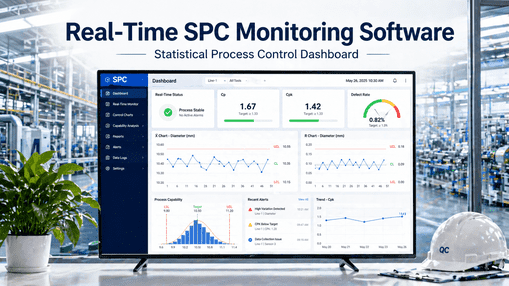
Control charts updated in real time as Opcenter posts measurement results. Subgroup boundaries, center lines, and control limits calculated from the current production run baseline, not from a static historical average. Western Electric rules evaluated on every new data point; violations highlighted immediately on the Quality Director dashboard with the specific rule triggered and the time of the signal.
Cpk computed on a rolling sample window — configurable from last 25 to last 100 measurements — with a trend line projecting the Cpk trajectory based on current process drift rate. When projected Cpk is trending below the minimum acceptable threshold, the Quality Director receives an advance alert before the actual Cpk breach occurs, enabling intervention while parts are still in-process.
Control chart signal triggers an automatic investigation workflow in iFactory — the quality engineer receives a structured notification with the chart, the specific rule violated, the Opcenter work order context, and a digital form for cause investigation and corrective action entry. Closed investigations are linked to the control chart signal event in the audit record, creating a complete quality response trail.
iFactory correlates SPC signals across multiple characteristics on the same Opcenter work order — identifying when simultaneous shifts in two or more characteristics point to a common cause, such as a tooling change, material lot change, or environmental factor. This correlation layer reduces the investigation time required to identify root cause by surfacing the pattern, not just the individual signal.
SPC data from the Opcenter bridge is automatically structured into PPAP-ready format — control charts, capability studies, measurement system analysis data — organized by part number, characteristic, and Opcenter work center. Control plan updates triggered by sustained Cpk degradation are generated automatically and routed to the quality engineer for review, keeping the control plan current with actual process performance.
Deployment Architecture: What Changes in Your Opcenter Environment
MES architects and Quality Directors evaluating a bridge deployment need to understand the infrastructure footprint and the impact on the existing Opcenter environment. iFactory's bridge is designed as a non-invasive integration — it reads from Opcenter without modifying its data model, writes only to iFactory's own SPC data store, and requires no changes to existing Opcenter configurations or MSMQ queue definitions beyond enabling the outbound messaging feature. Book a Demo to review the architecture diagram with your Opcenter version and topology.
| Deployment Component | Location | Opcenter Impact | Installation Requirement |
|---|---|---|---|
| iFactory Bridge Service | Windows Server (on-premise or VM) | None — read-only API calls to Opcenter REST/SOAP | Windows Server 2019/2022/2025; .NET 8 runtime |
| MSMQ Worker Service | Same server or dedicated Windows node | Opcenter MSMQ outbound messaging must be enabled | MSMQ Windows feature enabled; 12 queue names configured |
| OPC-UA Client | Bridge server; connects to PLC OPC-UA server | None — bypasses Opcenter for direct PLC measurement reads | OPC-UA server enabled on PLC or measurement system |
| IDoc Processor | Bridge server; RFC-connected to SAP | None — IDoc posting from SAP QM unchanged | SAP RFC connection credentials; ALE partner profile |
| SPC Analytics Engine | iFactory cloud or on-premise; Quality Director dashboard | None — independent of Opcenter data model | Browser-based dashboard; no client installation required |
Expert Perspective: What a Real-Time MES SPC Bridge Changes for Quality Directors
The most important shift that a real-time MES SPC bridge produces is not technical — it is organizational. When Quality Directors and process engineers see control charts updating while production is running, the question changes from "what happened" to "what is happening." That changes the entire quality response model. Instead of a post-shift investigation that produces a corrective action for next week's production, you get a mid-run intervention that saves the current order. In 18 years of quality engineering in process and discrete manufacturing, I have seen more customer escapes caused by batch-processed SPC that identified out-of-control conditions six hours after the fact than by any other single failure in the quality management system. The latency between measurement event and control chart signal is not a technical detail — it is the primary driver of how many defective parts ship before the process is corrected. A bridge that feeds live SPC from Opcenter in seconds changes that equation fundamentally, and the ROI calculation is straightforward: one prevented customer escape covers the integration cost many times over.
Conclusion: Real-Time SPC Is Not a Reporting Enhancement — It Is a Quality Architecture Decision
The bridge between Siemens Opcenter Execution Discrete and a real-time SPC engine is not a reporting enhancement — it is a decision about whether your quality management system operates in detection mode or prevention mode. Detection mode discovers out-of-control processes after production and investigates escapes. Prevention mode identifies process shifts during production and intervenes before defects ship.
iFactory's Opcenter v2310 SP2 connector, with its five-protocol bridge architecture, delivers the data infrastructure for prevention mode: live control charts, real-time Cpk, automated investigation workflows, and PPAP-ready documentation — all fed from the Opcenter execution layer without touching its data model. Book a Demo and see live SPC running against an Opcenter data stream.
Frequently Asked Questions
The certified connector targets Opcenter Execution Discrete v2310 SP2 and supports the REST API, SOAP services, and MSMQ outbound available in that release. Legacy Camstar-era SOAP interfaces from earlier versions are also supported via the SOAP adapter, enabling bridge deployment in mixed-version environments.
No. iFactory reads exclusively through published REST and SOAP APIs — no direct database connections, no schema modifications, no stored procedure changes. The only Opcenter configuration change required is enabling the MSMQ outbound messaging feature if not already active.
Both modes are supported and configurable per characteristic: trial control limits can be seeded from historical Opcenter data, or recalculated dynamically from the current production run as data accumulates. Frozen control limits from a validated baseline period are also supported for regulated manufacturing environments.
Yes. iFactory's bridge handles concurrent data streams from multiple work centers, resources, and work orders in the same Opcenter instance — each with independent control charts, capability indices, and alert thresholds configured per characteristic and resource.
A standard deployment covering REST + MSMQ channels, up to 50 characteristics, and Quality Director dashboard configuration runs 6 to 10 weeks — including Opcenter API validation, SPC chart configuration, and control limit baseline establishment from historical production data.