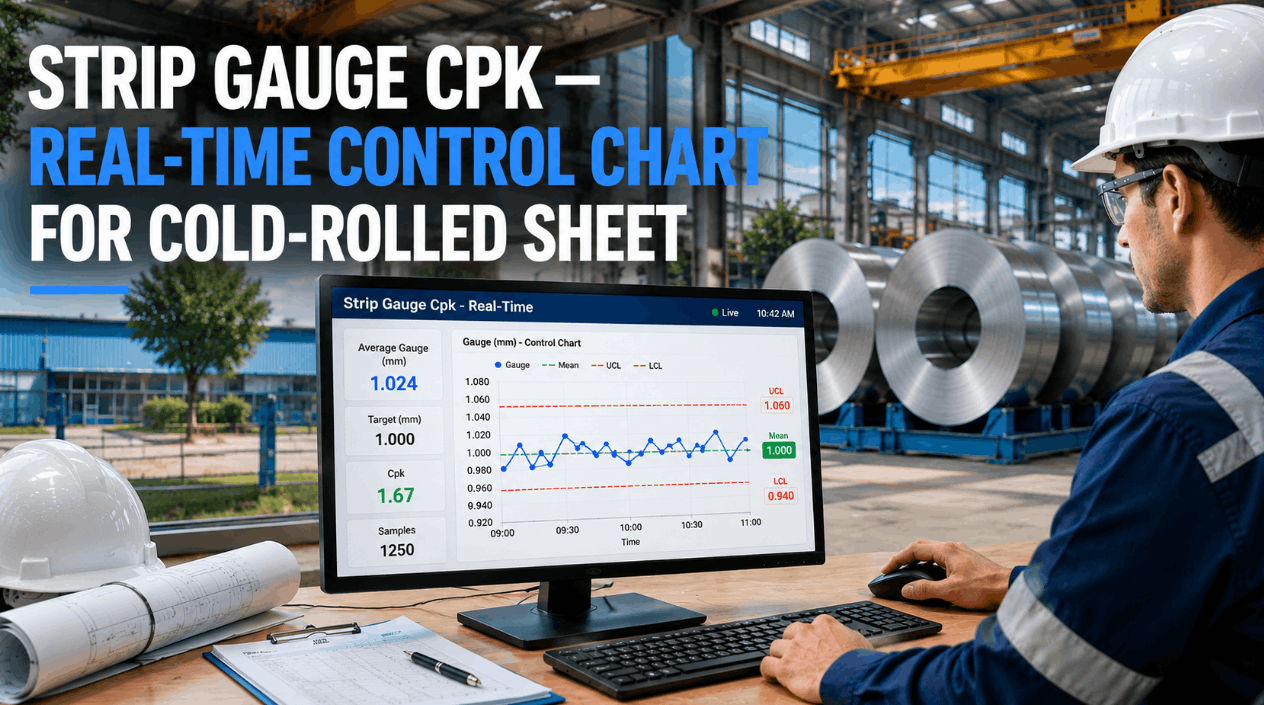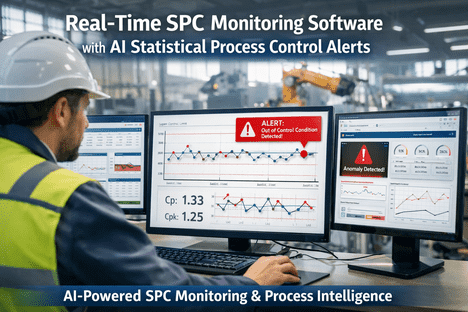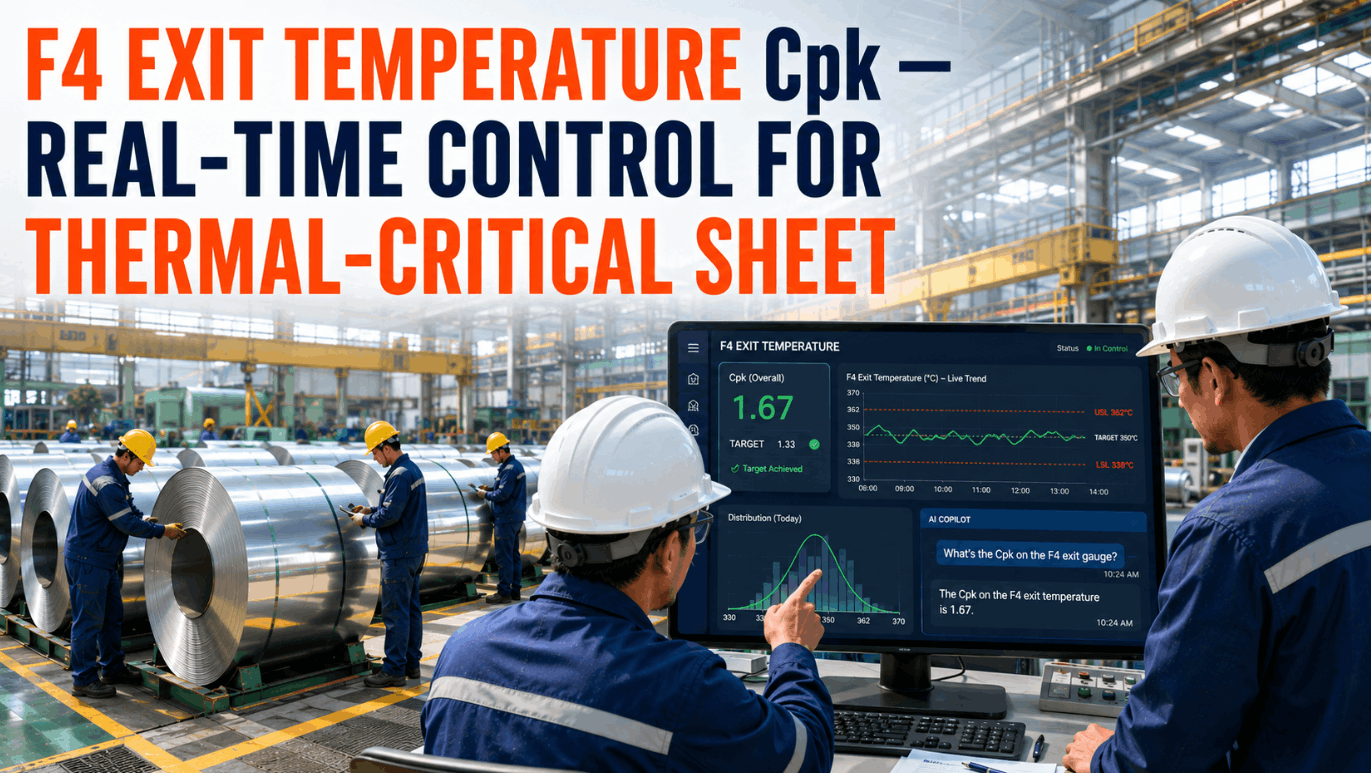
In cold mill and continuous annealing operations, the F4 exit temperature is one of the most consequential thermal control points on the line. Holding the exit band at 338–362 °C with a sustained Cpk of 1.67 is not a stretch target — it is the threshold that separates consistent mechanical property development from coil-to-coil hardness scatter, surface finish variability, and downstream formability complaints. For annealing process engineers running high-strength, dual-phase, or interstitial-free grades, a drift of even 8–10 °C from the target band can shift yield strength by 15–25 MPa and push flatness index outside acceptable limits before a single manual sample reaches the lab. iFactory's live SPC platform monitors F4 exit temperature in real time, tracks Cpk continuously, predicts drift before it exits the control band, and puts the answer to "What is the Cpk on the F4 exit gauge right now?" into a single AI Copilot chat response — no dashboard navigation, no report pull, no delay. Book a Demo to see the live F4 temperature SPC in action.
Why F4 Exit Temperature Is the Thermal Fulcrum of Annealing Quality
The F4 exit gauge sits at the point where thermal history translates directly into metallurgical outcome. By the time strip passes F4, its recrystallization state, grain size distribution, and interstitial carbon profile are largely set. A temperature 12 °C above the upper control limit accelerates grain growth beyond the target size range for drawing-quality grades. A temperature 10 °C below the lower limit leaves partial recrystallization incomplete — producing a mixed microstructure that passes visual inspection but fails elongation testing at the stamping press. The control challenge is compounded by the thermal inertia of the furnace system: by the time a conventional thermocouple reading trips a manual alarm, 40–80 meters of strip have already passed through the zone at the off-target temperature. Real-time SPC with drift prediction — not alarm-based reaction — is the only approach that contains the thermal excursion before it becomes a metallurgical escape.
iFactory Live SPC: What Real-Time F4 Temperature Monitoring Actually Delivers
iFactory's live SPC platform ingests F4 exit temperature readings at scan rates from 1–10 Hz depending on pyrometer or thermocouple infrastructure, applies EWMA (exponentially weighted moving average) smoothing to suppress noise without masking genuine drift, and calculates Cpk on a rolling 30-minute window that updates every scan cycle. The control chart renders in the process engineer's browser or mobile device with no manual refresh. When the rolling Cpk falls below 1.45, an amber alert triggers. When it falls below 1.33, a red alert fires and Plant Copilot drafts a process deviation notification with the current mean, sigma, Cpk, and recommended corrective parameter adjustment. Book a Demo to walk through the live F4 SPC configuration for your annealing line.
- F4 temperature plotted in real time with UCL, LCL, and target centre line displayed at all times
- EWMA smoothing with configurable λ parameter — balances noise rejection against drift detection sensitivity
- Rolling Cpk displayed as live numeric above the chart — no manual calculation, no report delay
- Historical overlay: compare current shift performance against the same grade's prior coil thermal history
- Trend velocity analysis detects temperature moving toward control limit before it arrives
- Prediction horizon configurable from 5 to 30 minutes — matched to furnace thermal response time
- Alert fires when projected temperature will breach UCL or LCL within the prediction window
- Estimated time-to-breach displayed in alert so process engineer can assess urgency without opening dashboard
- Ask "What is the Cpk on the F4 exit gauge?" — Plant Copilot returns current Cpk, mean, sigma, and trend direction instantly
- Follow-up queries supported: "How long has it been above target?" "What was the Cpk on the last DP780 coil?"
- No dashboard navigation — answers delivered in the chat interface used for shift handover and quality reviews
- Copilot response includes confidence level and sample count used for the Cpk calculation
- Every F4 alert, Cpk excursion, and corrective action is auto-logged with timestamp, coil ID, and operator response
- Lot traceability: every coil produced during a thermal excursion window is flagged for enhanced mechanical property verification
- Shift-end report auto-generates with F4 temperature summary, Cpk trend, and any excursion events for QA review
- All records audit-ready for IATF 16949, PPAP thermal history requirements, and customer-specific quality plans
F4 Temperature Cpk: Control Thresholds and What Each Level Means
Process capability at the F4 exit gauge is not a single target — it is a tiered performance ladder. Each Cpk level carries specific implications for mechanical property consistency, customer complaint exposure, and what corrective action the process engineer needs to take. iFactory's live SPC displays Cpk against this tiered framework continuously, so process engineers and quality leads share the same real-time picture without any manual reporting cycle.
| Cpk Level | F4 Temperature Sigma | Metallurgical Risk | iFactory Status | Recommended Action |
|---|---|---|---|---|
| ≥ 1.67 | σ ≤ 2.4 °C | Negligible — full recrystallization achieved consistently across coil width and length | Green — Target | Monitor; no intervention required |
| 1.45 – 1.67 | σ 2.4–2.8 °C | Low — occasional edge-zone temperature variation; within spec but narrowing margin | Amber — Watch | Review furnace zone power trend; verify pyrometer calibration |
| 1.33 – 1.45 | σ 2.8–3.0 °C | Moderate — increased risk of mechanical property scatter on tight-tolerance grades (DP, BH series) | Amber Alert | Adjust zone setpoints; initiate furnace inspection if drift is progressive |
| 1.00 – 1.33 | σ 3.0–4.0 °C | High — process excursions probable; coils at risk of failing Rp0.2 or A80 customer requirements | Red Alert | Immediate furnace parameter correction; affected coils flagged for enhanced test |
| < 1.00 | σ > 4.0 °C | Critical — systematic thermal instability; high probability of mechanical property non-conformance | Critical — Hold | Production hold on affected grade; full mechanical property verification before release |
Common F4 Temperature Drift Causes — and How iFactory Identifies Each
F4 exit temperature drift rarely appears without a traceable upstream cause. iFactory cross-references the thermal trend data with furnace zone telemetry, line speed signals, and coil dimension data to narrow the probable cause before the process engineer needs to investigate manually. The cause-identification capability is what separates iFactory's F4 SPC from a standalone temperature chart: the alert tells you what is happening, and the AI Copilot context tells you why. Book a Demo to see how drift cause identification works on a live annealing line dataset.
Expert Perspective: What Annealing Process Engineers Need From F4 Temperature SPC
The following reflects the practical perspective of annealing process engineers who have implemented real-time thermal SPC in continuous annealing and batch bell-furnace operations across flat-rolled steel and aluminum sheet production.
In a busy annealing operation, process engineers are managing multiple furnace zones, grade transitions, and speed events simultaneously. The F4 Cpk needs to be available as a glanceable number — not buried in a quality system report that requires three navigation steps to open. iFactory's approach of surfacing Cpk in the live chart header and answering Cpk queries via AI Copilot chat reflects how process engineers actually work during a shift: they want confirmation that the number is still good, or an immediate alert if it is not. The shift handover note should contain "F4 Cpk was 1.71 across the DP780 campaign" — not "please check the quality system for F4 performance."
Furnace systems have significant thermal inertia — a corrective setpoint change takes 8–15 minutes to propagate through to the F4 exit reading depending on furnace length and strip speed. An alarm that fires when the temperature has already breached the control limit gives the process engineer approximately zero corrective lead time. The only practical approach is drift prediction: detecting that the temperature is trending toward the limit 10–20 minutes before breach, so the engineer can adjust zone setpoints while the strip is still within the control band. iFactory's configurable prediction horizon — matched to each line's thermal response time — is the feature that converts F4 SPC from a records tool into an actual process control tool.
Conclusion: Real-Time Cpk Visibility Is the Difference Between Control and Containment
The F4 exit temperature band is narrow by design — 24 °C for most thermal-critical grades — because the metallurgical consequence of excursion is immediate and not recoverable within the current coil. Sustaining Cpk 1.67 at this control point requires three things that conventional thermocouple monitoring and end-of-shift reporting cannot provide: live trend visibility at the control chart level, drift prediction before the limit is breached, and instant Cpk access without navigating a quality system. iFactory delivers all three — live SPC at scan frequency, AI-driven drift prediction matched to furnace thermal response time, and Plant Copilot that answers "What is the Cpk on the F4 exit gauge?" in a single chat response. For annealing process engineers managing thermal-critical grades under customer-specific Cpk requirements, that capability is not a convenience — it is the foundation of consistent mechanical property delivery. Book a Demo to configure F4 live SPC for your annealing line.