Yield and Energy AI for the Chemical Process Engineer
By Larry Eilson on June 1, 2026
You already know where your yield gap is hiding — you just can't prove it fast enough to act on it. The reactor runs two degrees conservative because the last time someone pushed it, a batch went off-spec and the post-mortem took a week. The lab result for purity lands four hours after the decision window has closed. The APC scheme holds setpoints beautifully but it was tuned on fixed equations that never accounted for the catalyst aging underneath it, so it quietly leaves throughput on the table every shift. None of this is a knowledge problem; it is a tooling problem. The plant historian has twelve months of one-second data sitting in PI or PHD that contains the answer, and you have neither the time nor the platform to mine it between alarms. iFactory's Process Engineer Suite is built for the person actually turning the valves and writing the reports — not a dashboard for the boardroom. Soft sensors that give you lab values in real time, anomaly detection that flags the excursion before the sample confirms it, hybrid models that respect your first-principles constraints instead of fighting them, and AI optimization that closes the yield gap the conservative operating envelope is protecting. Turnkey, on-premise, your data never leaving the plant. This page is the working tour.
Process Engineer Suite · Yield & Energy AI
The AI Toolkit for the Engineer Turning the Valves
Soft sensors, anomaly detection, hybrid models, and closed-loop optimization built for hands-on process engineers — not another executive dashboard. Close the yield gap your conservative envelope is protecting, on-premise.
The yield gap is not incompetence; it is rational caution. Reactions are nonlinear, feed quality drifts batch to batch, and an off-spec excursion is expensive and visible while a few tenths of a percent of foregone yield is invisible. So you back off the envelope. Traditional APC, built on fixed multivariable equations, can't model the nonlinear behavior or the catalyst aging underneath, so it reinforces that conservatism rather than challenging it. The gap between how the plant runs and how it could run is measured in decimal points that compound into millions a year.
Traditional APC holds the conservative line (and sags as the catalyst ages). AI optimization learns the nonlinear envelope from your own data and walks the process up toward optimal — safely, continuously, not just when your best operator is on shift.
Four Tools, One Suite
The Suite is four capabilities a process engineer actually uses, working off the same plant-data foundation. None of them require you to become a data scientist — they require you to keep being a process engineer, with better instruments.
01
Soft Sensors
Infer the lab values you wait hours for — purity, viscosity, melt index, density, composition — in real time from the temperatures, flows, and pressures you already measure. No new analyzer, no sampling lag.
Stop steering on a 4-hour-old lab result
02
Anomaly Detection
The model learns each unit's normal behavior across thousands of signals and flags the excursion as it begins — before the sample confirms it, while a feed-ratio or temperature nudge still saves the batch.
See the deviation before the downgrade cascade
03
Hybrid Models
Grey-box models fuse your first-principles knowledge with ML on plant data. Physics keeps the model honest where data is thin; ML captures the nonlinearity physics alone misses. Build enriched models without deep AI expertise.
Your constraints respected, not fought
04
Closed-Loop Optimization
AI learns from operational history and delivers continuous setpoint updates that adapt as feed and catalyst change — closing the yield gap and trimming energy without waiting for an expert to be on shift.
Peak operation every shift, not the good ones
Want to see a soft sensor built on your own historian tags? Book a 30-minute working session and we'll stand one up on a sample of your data.
Soft Sensor — Lab Value Without the Lab Wait
This is the tool engineers reach for first, because the pain is daily. You make a control decision now; the lab tells you whether it was right four hours from now. A soft sensor closes that loop — inferring the quality variable continuously from measurements you already have, so you steer on a live number instead of a stale one.
Pure ML Guesses Past the Edge. Hybrid Models Don't.
Every process engineer's first, correct objection to a pure data-driven model: it cannot extrapolate beyond its training data, and a chemical plant lives at its edges during grade changes, upsets, and new feedstocks. That is exactly why the Suite uses hybrid models. First-principles physics anchors the model where data is sparse; ML adds the nonlinear behavior the equations miss. You get accuracy without the black-box risk.
Concern
Pure Black-Box ML
iFactory Hybrid (Grey-Box)
Extrapolation past training data
Unreliable, can guess nonsense
Physics constrains it where data is thin
Nonlinear reactor behavior
Captured, but unexplainable
Captured and tied to known mechanisms
Catalyst aging / long-term drift
Needs constant retraining
Modeled as a first-principles term
Trust on the unit
Engineers won't act on a black box
Explainable, respects your constraints
Build effort
Needs a data-science team
Built by process engineers, no deep AI skill
It Runs on the Data You Already Have
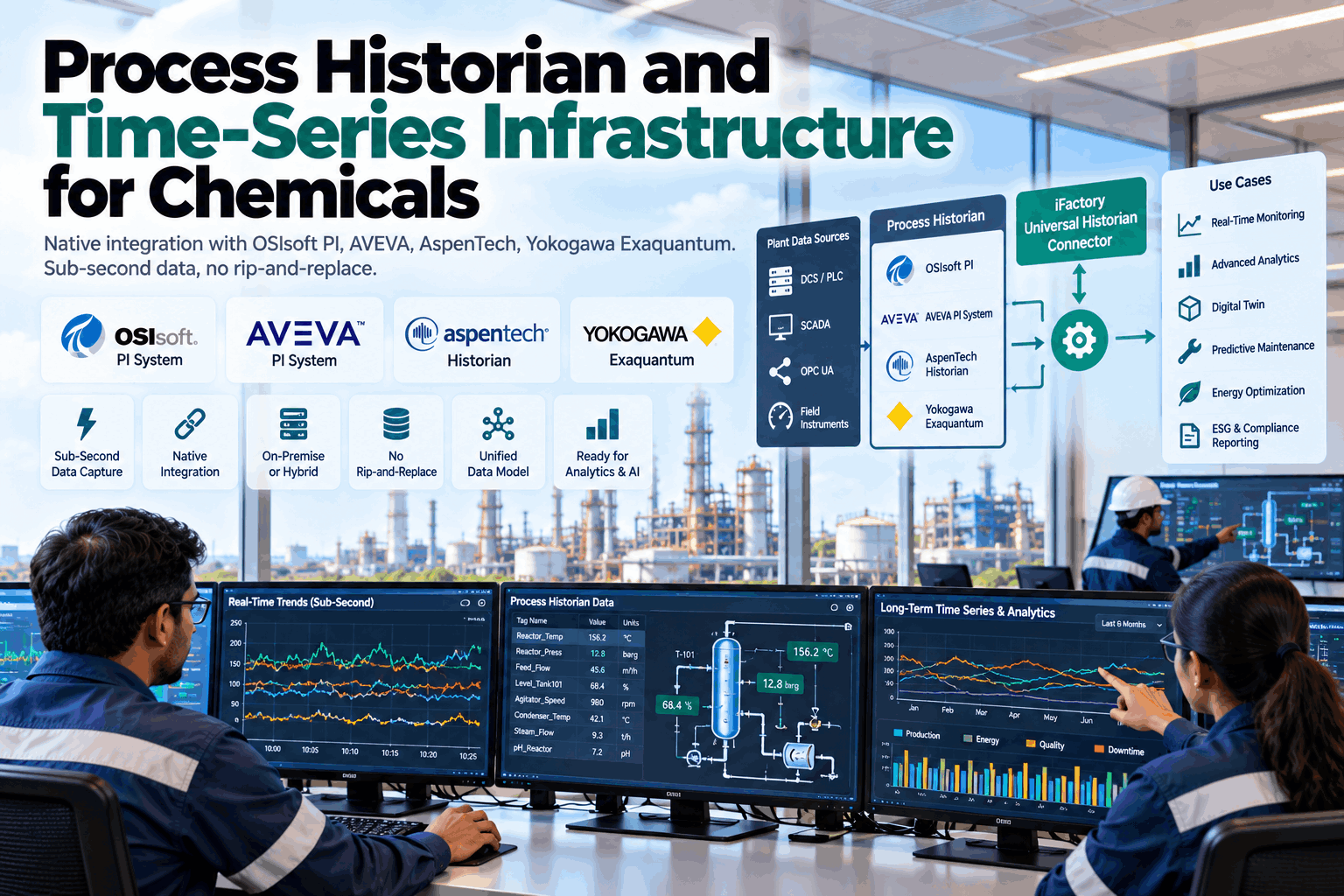
The most common worry — "we'd need to instrument the plant first" — is usually wrong. The foundation is your existing process historian: roughly twelve months of timestamped data at one-second to one-minute resolution for temperatures, pressures, flows, and compositions. Most plants already have OSIsoft PI or Honeywell PHD holding exactly this. The real gap is data quality and connectivity, not missing sensors.
12 mo
Historian data, the typical foundation
1s-1min
Resolution the models train on
PI / PHD
Historians most plants already run
On-prem
Models run air-gapped in your plant
From Conservative Envelope to Closed Loop
A representative continuous unit ran two degrees below its real ceiling because a past excursion had spooked the team, and its APC scheme had drifted as the catalyst aged. A soft sensor gave the engineer a live purity reading, anomaly detection caught excursions early, and a hybrid model let optimization walk the setpoints up safely. The yield gap the team had been protecting turned out to be worth pursuing.
Before · Manual & Cautious
Quality feedbackLab, ~4h lag
Operating point2° conservative
ControlFixed APC, drifting
Yield gapKnown, unactioned
Best yield only when the best operator was on shift.
Engineer Suite
After · AI-Assisted
Quality feedbackSoft sensor, live
Operating pointAt the safe optimum
ControlClosed-loop, adaptive
Yield lift5-8%
Peak operation every shift, energy trimmed alongside.
What the Suite Puts in Your Hands
5-8%
Yield increase, closed-loop optimization
Live
Quality values, no lab or analyzer lag
Early
Excursions caught before the sample
Energy
Trimmed as setpoints reach optimum
Frequently Asked Questions
How is this different from the APC we already run?
Traditional APC uses fixed multivariable equations to hold setpoints — it's excellent at regulation but it can't model the nonlinear behavior of a real reactor or the catalyst aging underneath it, so operators run conservatively to stay safe. The Suite's AI learns from your plant's actual operating history and adapts as feed quality and catalyst condition change, discovering optimization opportunities the static models can't see. It builds on APC rather than replacing it: APC keeps the process stable, AI walks it toward optimal. Book a demo to see it on your unit.
What is a soft sensor and how accurate is it?
A soft sensor infers a hard-to-measure quality — purity, viscosity, melt flow index, density, composition — in real time from process variables you already measure, like temperatures, feed rates, and pressures. It replaces or supplements a lab sample or an expensive online analyzer, eliminating the hours of sampling lag that close your decision window. Like any sensor it needs calibration and periodic maintenance to hold accuracy, which is built into the workflow rather than left to chance. Ask support which of your quality variables are good soft-sensor candidates.
Why hybrid models instead of pure machine learning?
Pure data-driven models have a hard limit: they can't reliably extrapolate beyond their training data — and a chemical plant operates at its edges during grade transitions, upsets, and new feedstocks, exactly where you most need a trustworthy answer. Hybrid grey-box models combine first-principles physics, which stays valid outside the training range, with ML that captures the nonlinearity the equations miss. The result is both more accurate and more trustworthy on the unit, because it respects the engineering constraints you already know to be true.
Do we need to instrument the plant or buy new analyzers first?
Usually not. The foundation is your existing process historian — about twelve months of timestamped data at one-second to one-minute resolution for key temperatures, pressures, flows, and compositions. Most plants already run OSIsoft PI or Honeywell PHD holding precisely this. The typical gap is data quality and connectivity, not missing instrumentation, so the first step is connecting and cleaning what you already generate rather than a capital sensor project.
Is closed-loop AI control proven, or still experimental?
It's proven in production. A landmark deployment ran a reinforcement-learning controller autonomously for 35 days in a full-scale chemical plant, maintaining product quality, yield, and energy efficiency while handling disturbances that were previously managed manually. Plants using closed-loop AI optimization report yield increases in the 5 to 8% range. The Suite is designed for staged adoption — open-loop advisory first, so your engineers build trust, then closed-loop where it's warranted — and it runs on-premise and air-gapped so your operating data never leaves the plant.
The Yield Gap Is in Your Historian Right Now
Put a Soft Sensor and a Hybrid Model on Your Own Data
Book a 30-minute working session with a process-AI specialist. Bring a sample of historian tags from one unit and we'll stand up a soft sensor, show anomaly detection on a real excursion, and model the yield and energy gap your conservative envelope is protecting — on-premise, your data staying in your plant.