AI Coil Yield Optimization & Blank Nesting for Stamping | iFactoryAi
By Josh Brook on May 30, 2026
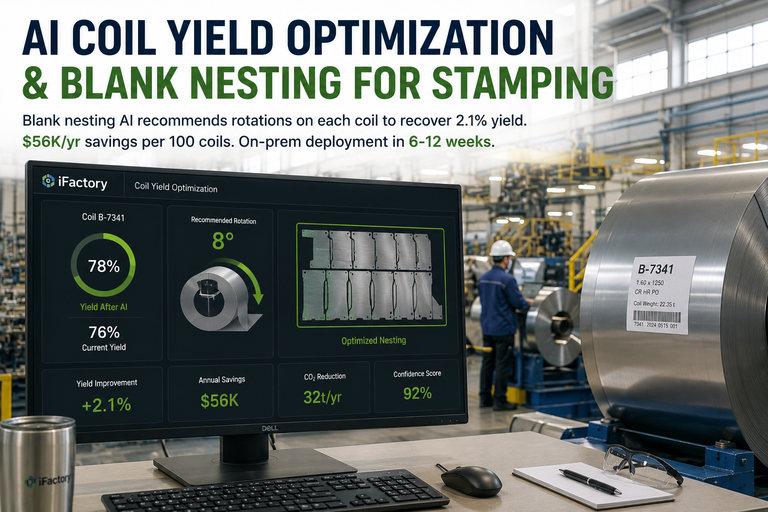
On a stamping line, material is roughly a third of the part's cost — and most of the waste is decided before the press ever strokes, in how blanks are laid out on the coil. A nesting layout that wastes two percent of strip width does not look like much on one blank. Scaled across a coil, across a run, across a year, it is one of the largest recoverable losses in the plant — and it is usually invisible, because the line is hitting its numbers and nobody is questioning a layout that has run "fine" for years. iFactory's coil yield AI questions it. It analyzes each coil, tests rotations a human planner would not try, and surfaces a specific recommendation: rotate the blank eight degrees, recover 2.1% yield, save $56,000 a year per hundred coils. A coil yield optimization platform turns that invisible loss into a number on a screen and a rotation on the line.
iFactory Coil Yield AI
AI Coil Yield Optimization & Blank Nesting for Stamping
AI recommends the blank rotation on each coil that recovers material a planner would miss — 2.1% yield, $56K a year per 100 coils, with a confidence score on every recommendation.
The reason coil yield matters out of proportion to its size is leverage. Material is the dominant cost in a stamped part, design-stage layout decisions influence up to 80% of total manufacturing cost, and stamping runs in the millions. A two-to-three percent gain in material usage per blank looks trivial on a single part — but scaled across a high-volume run, the effect on total spend is enormous. The waste is locked in at the nesting layout, and once a part is in mass production, that layout quietly bleeds money every stroke.
Static Nesting
Set Once, Bleeds Forever
Layout fixed at design, rarely revisited once the part is in production
Rule-based tools leave material between blanks a human won't re-optimize
Rotations that recover strip width go untested because the line "runs fine"
The loss is invisible — no alert ever fires on a layout that's merely suboptimal
AI Coil Yield
Tested Per Coil, Recovered
Each coil analyzed for the rotation that packs blanks tightest
AI tests layout variations a rule-based system or planner would miss
A specific rotation and yield gain surfaced, with a confidence score
The recovered percentage shows as dollars and CO2, coil by coil
What the Recommendation Looks Like
The output is not a vague "improve your nesting." It is a concrete, actionable card per coil — the current utilization, the recommended rotation, the recovered yield, and what it is worth in money and carbon, with a confidence score so the planner knows how much to trust it. This is a real recommendation from the engine.
Coil B-7341
92% confidence
Current
76%
Optimized
78%
Recommended action
Rotate blank 8°
+2.1%
Yield recovered
$56K/yr
Per 100 coils
32t/yr
CO2 avoided
How a Rotation Recovers Material
The intuition is simple once you see it. Blanks have irregular geometry; the angle they sit at on the strip decides how tightly they tessellate and how much skeleton scrap falls between them. A few degrees of rotation can let the next row nest into the gaps of the last — reclaiming strip width that was being thrown away as offal. The AI searches that rotation space, respecting grain direction and forming constraints, to find the densest legal packing.
Blank Rotation: Before and After on the Coil
Loose nest — wide offal between rows is scrap on every stroke
Existing rule-based nesting is good — but it converges on heuristics, not on the best layout for this specific coil, grade, and order mix. AI nesting learns from historical production data and continuously tests layout variations, finding combinations a human or rule-based system would miss. It is not replacing the planner's judgment; it is searching a space too large for anyone to explore by hand, on every coil, every time.
Per-Coil, Not Generic
Optimizes the actual coil width, grade, and order in front of you — not a one-time design-stage layout frozen years ago.
Searches Rotation Space
Tests angles and arrangements a planner has neither the time nor the tooling to try, pushing density toward the theoretical max.
Respects Constraints
Honors grain direction, formability, and gripping-area needs, so the recommended nest is one you can actually run.
Learns Over Time
Improves from production history, so recommendations sharpen as the engine sees more of your coils and parts.
Want to see the engine find recoverable yield on one of your real coils? Book a 30-minute walkthrough and we'll run a live nesting analysis on your blank and coil spec.
Material Saved Is Carbon Saved
Yield recovery is not only a cost story — it is a sustainability one, and increasingly a customer requirement. Scrap metal may be recyclable, but recycling is not free: it takes transport, handling, and energy. Cutting scrap at the source means fewer raw coils purchased and less energy spent reprocessing offal — which is why the same 2.1% recovery on coil B-7341 shows up as 32 tonnes of CO2 avoided a year. With OEMs now tracking sustainability across their supply chains, that number matters on the scorecard as well as the P&L.
~30%
Of part cost is material
making yield the highest-leverage cost lever in stamping
80%
Of cost set at design
nesting decisions lock in most of the total manufacturing cost
32t
CO2 avoided per year
fewer coils bought, less scrap reprocessed, on B-7341 alone
Scorecard
OEM sustainability
supply-chain carbon now tracked by automotive customers
How It Deploys
The engine runs where your data and your dies are — on-premise, inside your plant, with no coil data leaving the building. Deployment follows the same pragmatic path as the rest of the iFactory platform: connected, piloted, and live in weeks, not a multi-year integration program.
From Coil Spec to Recovered Yield
1
Ingest
Coil & Blank
Blank geometry, coil width and grade, grain and forming constraints
2
Optimize
Search Layouts
AI tests rotations and arrangements for the densest legal nest
3
Recommend
Scored Action
A specific rotation, yield gain, dollar and CO2 value, with confidence
4
Deploy
On-Prem Live
Runs in-plant, data stays local, live in 6 to 12 weeks
Frequently Asked Questions
Is 2.1% really worth the effort?
At stamping volumes, yes — decisively. Material is around a third of part cost and runs span millions of strokes, so a two-to-three percent yield gain compounds into very large annual savings. The engine quantifies it per coil: on coil B-7341, the 2.1% recovery works out to $56,000 a year per hundred coils. That's recurring margin from a change that costs only a rotation.
How is this different from the nesting software we already have?
Rule-based nesting converges on good heuristics but stops there, often leaving material between blanks that a static system won't re-optimize. The AI learns from historical production and continuously tests layout variations to find combinations a human or rule-based tool would miss — and it does this per coil on the actual width, grade, and order, rather than freezing a single design-stage layout.
Will it recommend nests we can't actually run?
No — the optimization respects the constraints that make a nest manufacturable: grain direction, formability, and the gripping area the forming step needs. The recommended rotation is a legal, runnable layout, and each recommendation carries a confidence score so your planner knows how strongly the engine backs it before changing the line.
What does the confidence score mean?
It's the engine's assessment of how reliable a given recommendation is, given the coil, the geometry, and what it has learned from history — 92% on coil B-7341, for example. It lets the team triage: act on high-confidence recommendations immediately, and review lower-confidence ones before committing. It keeps a human in the loop rather than asking you to trust a black box.
Does our coil data leave the plant?
No. The engine deploys on-premise, so blank geometry, coil specs, and production data stay inside your facility — important for the proprietary part and tooling data stamping plants protect. Deployment runs 6 to 12 weeks: ingest your coil and blank data, pilot on real coils, then go live in-plant.
The Yield Is on the Coil. Go Get It.
See the AI Recover Yield on Your Own Coil — in 30 Minutes
Bring a blank and a coil spec you run in volume. We'll run the nesting engine live, show the recommended rotation and the recovered percentage, and put a dollar and CO2 figure on it — then walk the on-prem, 6-to-12-week path to live.

-—-live-spc-for-tier-1-oem-programs.png)