The PFMEA is supposed to be a living document. In most plants it is a spreadsheet that stopped breathing the day it was approved. Roughly 60% of organizations still build FMEAs in spreadsheets, engineers lose around ten hours a week hunting for the right version, and the Occurrence and Detection ratings inside stay frozen as educated guesses — long after the line has told a different story. That gap is where risk hides: the failure mode nobody added, the rating nobody updated, the control plan that drifted out of sync. AI-driven FMEA closes it by reading live production data, suggesting the failure modes you haven't documented yet, and auto-versioning every PFMEA change into an IATF 16949 risk-based audit trail — all on-prem, inside your firewall.
iFactory AI Risk Management
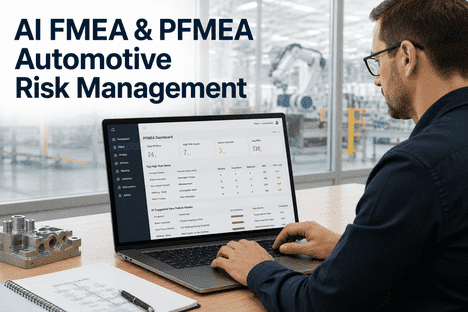
AI FMEA & PFMEA That Learns From Your Line
AI suggests new failure modes from live production data, keeps Occurrence and Detection grounded in reality, and auto-versions every PFMEA update into an IATF 16949 audit trail — running on-prem.
60%
still FMEA in spreadsheets
~10 hrs
a week lost searching docs
AP
AIAG-VDA, not just RPN
On-prem
inside your firewall
Why a Static PFMEA Quietly Goes Wrong
A PFMEA is only as good as the day it was last honestly updated. Without real failure data from the floor feeding back into it, the ratings stay theoretical, new failure modes never get captured, and the document an auditor opens no longer matches the process actually running. The risk is not that the FMEA is missing — it is that everyone trusts one that has quietly gone stale.
Frozen
Ratings
Occurrence and Detection scores remain educated guesses because no real failure frequency from the shop floor ever flows back in.
Tribal
Knowledge
The engineer who knows which lots and conditions trigger defects keeps it in her head — and it walks out the door when she does.
Disconnected
Documents
PFMEAs, DFMEAs, control plans, and MSAs don't talk to each other, so a change in one silently leaves the others wrong.
Lost
Revisions
Manual version tracking means digging for the right edition years later — exactly when an auditor asks for it.
AI Suggests the Failure Modes You Missed
The hardest part of FMEA is naming a failure mode before it has hurt you. iFactory analyzes patterns across live inspection, process, and quality data, then surfaces candidate failure modes, causes, and effects you have not yet documented — turning tribal knowledge and real production reality into structured FMEA content instead of theoretical assumptions.
Mode Suggestions From Data
AI recognizes patterns in production and inspection results and proposes failure modes, causes, and effects for the team to review.
Data-Grounded S-O-D
Occurrence and Detection ratings update from actual failure frequency and detection performance, not static handbook tables.
Human-in-the-Loop
Every suggestion is a recommendation your cross-functional team accepts, edits, or rejects — the engineers stay in control.
Captures Tribal Knowledge
Patterns experienced engineers carry in their heads get documented as reusable FMEA content before that expertise leaves.
Want to see what AI surfaces in your own process data? Book a demo and we'll run suggestions against one of your live PFMEAs.
Built on the AIAG-VDA 7-Step and Action Priority
The 2019 AIAG-VDA handbook replaced the misleading Risk Priority Number with Action Priority — High, Medium, or Low — because two risks with the same RPN could carry very different customer impact. AP always weights Severity highest, so a safety-critical failure never hides behind a low number. iFactory is built around the 7-step method and the mandatory AP table.
Legacy RPN scoring
False Security in a Number
Different risks share an identical RPN
Low occurrence masks high-severity danger
Unclear which action to take first
Inconsistent ranking across teams
iFactory Action Priority
Severity-First, Consistent
High / Medium / Low from the AP table
Safety-critical risks always escalated
Clear, documented order of action
Justification required for accepted risk
Every Change Auto-Versioned for the Audit
In automotive quality, a change to the PFMEA should ripple to the control plan, the process flow, and the records that prove it. iFactory captures every edit as a versioned, time-stamped entry, so the revision history an IATF 16949 auditor expects is built automatically — and a change in one document prompts a review of the linked ones, instead of leaving them silently out of date.
Automatic Version Control
Every PFMEA edit recorded as a time-stamped revision with author and rationale — no more hunting for the right edition years later.
Risk-Based Audit Trail
A transparent, traceable record of AP decisions and actions, the kind that strengthens audit readiness under IATF 16949.
Linked APQP Documents
PFMEA, DFMEA, control plans, and MSAs connected horizontally, so a change in one triggers review of the rest.
Actions Tracked to Closure
Recommended actions carry owners and due dates and are tracked until done, so they stop being suggestions that never land.
On-Prem AI, Inside Your Firewall
FMEA content is some of the most sensitive intellectual property a Tier 1 owns — process know-how, failure history, supplier detail. The iFactory AI runs on a pre-configured edge server on-premise, with all processing inside your firewall and no external egress required to operate. Rack it, connect power and Ethernet, and the analysis is live — data residency satisfied by architecture, not by promise.
1
Rack the AI server
A pre-configured edge AI server slots into your plant, shipped pre-validated with the risk-management software pre-loaded.
2
Connect production data
Read-only links to line, inspection, and quality data let the AI learn your real failure patterns and baselines.
3
Suggestions go live
The model proposes failure modes and updates ratings on-prem — your IP never leaves the building.
What an AI-Driven FMEA Delivers
A PFMEA that learns from the line converts directly into earlier risk detection, less wasted engineering time, and audits you walk into with the trail already built. These reflect outcomes manufacturers report after moving from static spreadsheets to a connected, data-driven FMEA.
Living
Not static
ratings and modes update from real production data
Hours
Reclaimed
engineers stop losing time hunting for the right version
Earlier
Risk caught
new failure modes surfaced before they reach the customer
Audit
Ready
versioned AP decisions and a traceable risk-based trail
Curious how current your PFMEAs really are? Talk to our risk team and benchmark them against a data-driven FMEA.
Frequently Asked Questions
How does AI actually suggest new failure modes?
It analyzes patterns across your live production, inspection, and quality data and proposes candidate failure modes, causes, and effects that your current PFMEA hasn't captured. This grounds the document in actual production reality rather than theoretical assumptions, and it surfaces the tribal knowledge experienced engineers carry. Every suggestion is a recommendation your cross-functional team reviews and approves — the engineers stay in control.
Does it use RPN or the AIAG-VDA Action Priority method?
It's built around the AIAG-VDA 7-step approach and the Action Priority table, which is mandatory for new FMEAs. AP categorizes risk as High, Medium, or Low and always weights Severity highest, so a safety-critical failure with low occurrence is never buried behind a low RPN. AP decisions are documented and traceable, which is exactly what strengthens audit readiness.
How does auto-versioning help with IATF 16949 audits?
Every PFMEA edit is captured as a time-stamped revision with author and rationale, so the revision history an auditor expects is built automatically instead of reconstructed from scattered files. Because PFMEA, DFMEA, control plans, and MSAs are linked, a change in one prompts review of the others — keeping your APQP package consistent and your risk-based audit trail transparent.
Will our FMEA data leave the plant?
No. The AI runs on a pre-configured edge server on-premise, with all processing inside your firewall and no external egress required to operate. FMEA content is sensitive intellectual property for a Tier 1 supplier, so it stays local — data residency and IT governance are satisfied by the architecture itself.
Can it work with our existing FMEAs?
Yes. FMEA is most effective on existing, "brownfield" processes where historical failure data already exists, and that's where AI adds the most value. The fastest way to see fit is a demo on one of your live PFMEAs — we'll show what the AI surfaces, how AP scoring applies, and how versioning builds the audit trail. Book a slot and bring one process you'd like reviewed.
Make Your PFMEA Live Again.
See AI FMEA on Your Own Process
Bring one live PFMEA. We'll show AI suggesting failure modes from your production data, Action Priority scoring applied the AIAG-VDA way, and every change auto-versioned into an IATF 16949 risk-based audit trail — all running on-prem, inside your firewall.
On-prem
inside your firewall