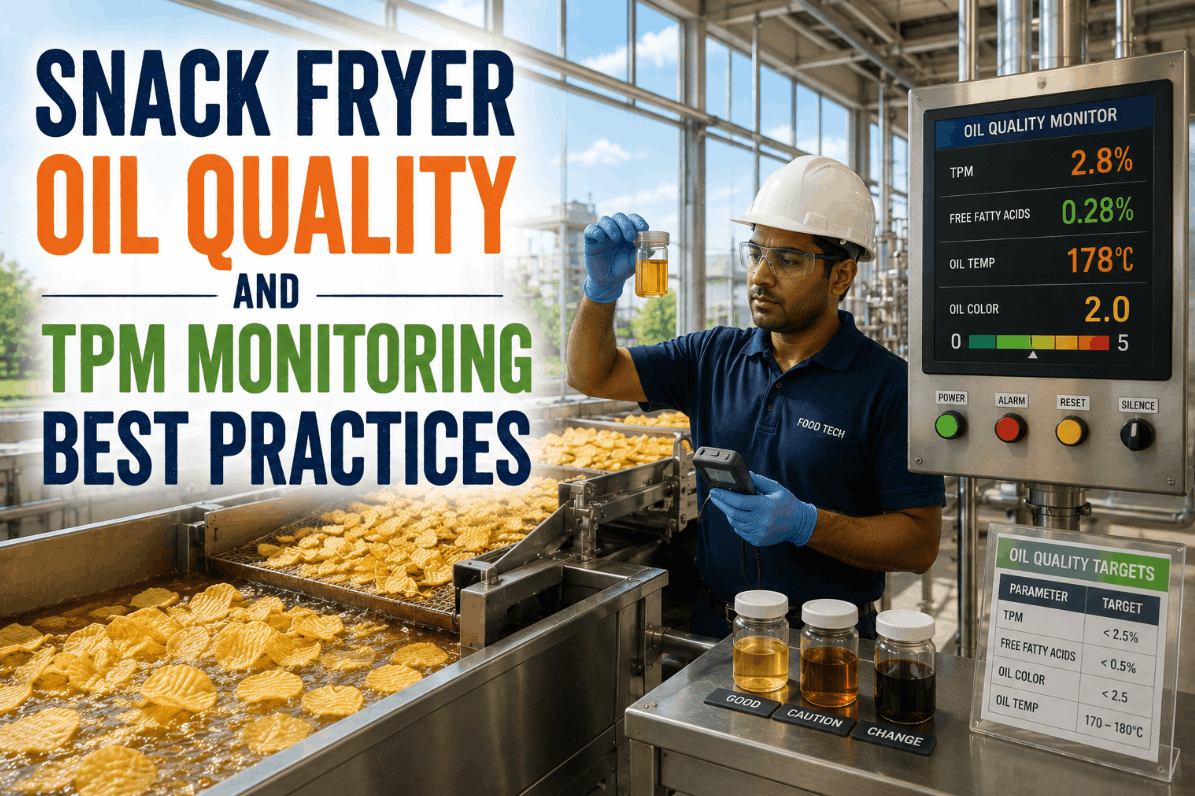
Every snack fryer is running a slow-motion quality degradation experiment — and the oil is the medium. From the moment fresh oil enters the fryer bath, heat, moisture from product, and dissolved food particles begin breaking down intact triglycerides into polar compounds: free fatty acids, oxidized aldehydes, polymers, and decomposition by-products that accumulate shift by shift, batch by batch, invisible to the naked eye until the damage shows up in off-flavors, darkened chip color, or a failed sensory panel. The snack manufacturers running the tightest oil costs and the most consistent product texture are not necessarily the ones changing oil most frequently — they are the ones who know precisely when to change it, based on continuous, measurable indicators rather than operator judgment calls or fixed-hour intervals. Fryer oil quality monitoring — covering TPM, free fatty acids, color drift, oil turnover rate, and filtration effectiveness simultaneously — is the process control layer that converts raw fryer data into oil change decisions that protect product quality without wasting usable oil capacity. This guide covers the full methodology for industrial snack fryer oil management and how iFactory AI's platform delivers automated, continuous quality intelligence across your frying operation.
Why Oil Quality Management Is the Most Underinstrumented Process in Snack Manufacturing
In most snack plants, fryer oil management is governed by a combination of fixed-interval schedules, operator color checks, and periodic lab samples that arrive days after the batch has shipped. None of these methods catch oil degradation at the moment it begins affecting product. The fixed-interval approach wastes oil — consistently changing it before its useful life is exhausted. The color check misses degradation entirely in high-oleic or palm-based oils, where visually acceptable-looking oil can be chemically far beyond its safe operating window. The periodic lab sample is a historical record, not a process control tool.
The core problem is that oil degradation in a snack fryer is not a single event — it is a continuous chemical process involving three simultaneous reactions: oxidation, hydrolysis, and polymerization. Each reaction produces different degradation markers, and each marker tells a different part of the quality story. TPM captures the cumulative load of all polar degradation compounds. Free fatty acids signal hydrolytic breakdown specifically. Color drift reflects both oxidation products and char particle contamination. Tracking any one of these in isolation produces an incomplete picture. Tracking all of them continuously, correlated against oil turnover rate and filtration cycle performance, produces the decision intelligence that responsible fryer oil management actually requires. Book a Demo to see how iFactory connects these data streams across your entire frying line.
- Oil changed on fixed hours or visual cue — usable oil discarded or degraded oil left running too long
- FFA and TPM measured by periodic lab sample — results arrive after product has shipped
- Color darkening used as primary discard indicator — misses chemically degraded light-colored oils
- Filtration effectiveness unmeasured — clogged filters allow char particle recirculation
- Oil turnover rate untracked — fryer operating outside equilibrium range without detection
- Off-flavor complaints traced back to oil condition only after sensory failure or customer complaint
- TPM, FFA, and color tracked continuously — oil change triggered by actual degradation state
- Real-time quality alerts before the affected batch moves downstream to packaging
- Degradation trajectory modeled per fryer — predicted end-of-life calculated at shift start
- Filtration cycle performance quantified — clogged filter or bypass detected automatically
- Oil turnover rate monitored against equilibrium threshold — fryer performance benchmarked by SKU
- Off-flavor risk flagged from oil chemistry data before sensory impact reaches the product
The Three Degradation Markers That Define Fryer Oil Quality
Effective fryer oil management in a snack plant requires monitoring three distinct chemical signals simultaneously — each measuring a different degradation pathway, each with its own threshold, and each capable of triggering a quality failure that the others would not catch alone. iFactory's fryer oil analytics tracks all three continuously, linking each marker's trend to product quality outcomes at the final inspection stage.
Oil Turnover Rate and Filtration: The Two Variables That Determine How Fast Oil Degrades
Two operational variables have a larger effect on fryer oil degradation rate than any other controllable parameter in the snack plant: oil turnover rate and filtration cycle effectiveness. Most plants track neither with any precision — and the result is oil quality variability that appears to be a chemistry problem but is actually a process control problem.
Predictive Oil Change Scheduling: How iFactory Converts Sensor Data Into Action
The difference between reactive oil management and predictive oil management is not equipment — it is data integration. Most snack plants already have temperature sensors, oil level meters, and some form of quality testing in place. What they do not have is a system that connects these data streams, models degradation trajectories, and converts the combined signal into a scheduled action before the quality limit is reached. That is precisely what iFactory's fryer oil analytics module is built to deliver.
| Monitoring Parameter | iFactory Data Source | Quality Risk Detected | Alert Lead Time | Product Impact if Missed |
|---|---|---|---|---|
| TPM Level | Inline dielectric sensor / integrated meter feed | Cumulative degradation approaching discard threshold | 4–8 hours | Off-flavor transfer, increased oil absorption, texture softening |
| Free Fatty Acid Content | Automated titration system or lab integration | Hydrolytic breakdown exceeding safe flavor threshold | 2–6 hours | Rancid or soapy off-notes, reduced shelf life, oxidation acceleration |
| Oil Color Drift Rate | Inline spectrophotometer or periodic measurement feed | Filtration failure or abnormal char accumulation | 1–4 hours | Dark chip color, visual nonconformance, customer complaint |
| Oil Turnover Rate | Fresh oil addition meter + bath volume model | Equilibrium deterioration — degradation rate accelerating | Per shift | Quality consistency loss across batches within a shift |
| Filtration ΔP Trend | Filter differential pressure transmitter | Filter media loading reducing particle removal effectiveness | 2–8 hours | Accelerated TPM and FFA rise from recirculating char particles |
| Fryer Zone Temperature Variance | Zone thermocouple array via L2 historian | Localized overtemperature driving accelerated oxidation | 30–90 min | Localized dark spots, texture variation, increased FFA in affected zone |
When these six data streams are analyzed in combination rather than independently, iFactory generates a composite oil quality score for each fryer that accounts for both the current degradation state and the rate at which it is changing. A fryer at 18% TPM with a rapid degradation trajectory may need an oil change in four hours. A fryer at the same TPM with a stable, slow trajectory may safely run another full shift. The composite model captures this distinction — and schedules the oil change accordingly, Book a Demo to see the fryer quality dashboard in a live snack plant environment.
Expert Perspective: What Real-Time Oil Quality Monitoring Changes on the Production Floor
We were changing fryer oil on a 48-hour fixed interval across all three of our continuous fryers. When we deployed iFactory's oil quality monitoring, the first thing the data showed us was that we had been changing oil on Fryer 2 an average of 11 hours early — we were discarding oil that still had usable life in it, every single cycle, because our interval was set conservatively to cover the worst-case scenario. On Fryer 3, the opposite was true: TPM was exceeding 26% on high-volume shifts before the 48-hour mark, and we had no visibility into that at all. Two sensory complaints we had attributed to seasoning had actually been fryer oil events. Once we moved to data-driven change scheduling on all three fryers, our oil cost dropped 19% in the first quarter, and we haven't had a fryer-related sensory complaint since. The payback was under two months.
Frequently Asked Questions: Snack Fryer Oil Quality and TPM Monitoring
iFactory connects to your fryer's existing temperature sensors, oil level meters, and filtration system — no dedicated TPM hardware is required to begin, though inline dielectric sensors can be added to unlock continuous TPM estimation. Integration with your L2 historian or SCADA is typically completed within one week.
Yes — iFactory maintains separate degradation models for each oil type and product SKU combination, accounting for the substantially different baseline color, oxidative stability, and FFA accumulation rates between high-oleic sunflower, palm, and canola frying oils.
iFactory connects fryer oil quality records to batch-level sensory, color, and texture inspection data — building a correlation model that identifies which oil quality thresholds predict product nonconformance for each specific snack product, enabling proactive intervention before inspection failures occur.
iFactory automatically logs all fryer oil quality measurements, alert events, and oil change actions with timestamps — generating a continuous, audit-ready record that satisfies HACCP critical control point documentation requirements and supports FDA and GFSI audit preparation without additional manual data entry.
Most snack plants reach full cost recovery within 2 to 6 months, driven primarily by oil cost reduction from eliminating premature changes — with secondary savings from reduced off-spec product and fewer fryer maintenance events caused by degraded oil fouling heating surfaces.
Conclusion: The Oil Quality Intelligence Layer Your Snack Fryer Doesn't Have Yet
The gap between what a snack fryer's oil is actually doing and what the production team believes it is doing is, in most plants, measured in hours of undetected degradation per shift — with consequences that show up as off-flavor complaints, inconsistent chip color, reduced shelf life, and oil costs that run higher than they need to because no one knows precisely when the oil's useful life ends. These are not equipment problems. They are data problems, and they are entirely solvable with the sensor infrastructure most snack plants already have in place, once that data is collected, connected, and analyzed at the resolution that continuous quality monitoring makes possible.
iFactory AI's snack fryer oil analytics platform brings TPM trending, FFA monitoring, color drift detection, and oil turnover rate analysis together into a single, real-time quality intelligence layer that turns every fryer into a managed, predictable process — not a degradation event waiting to be discovered at the sensory panel. The first step is understanding what your current fryer data is already telling you. Book a Demo and let iFactory show you where your oil quality control gaps are, before the next off-flavor complaint does it for you.