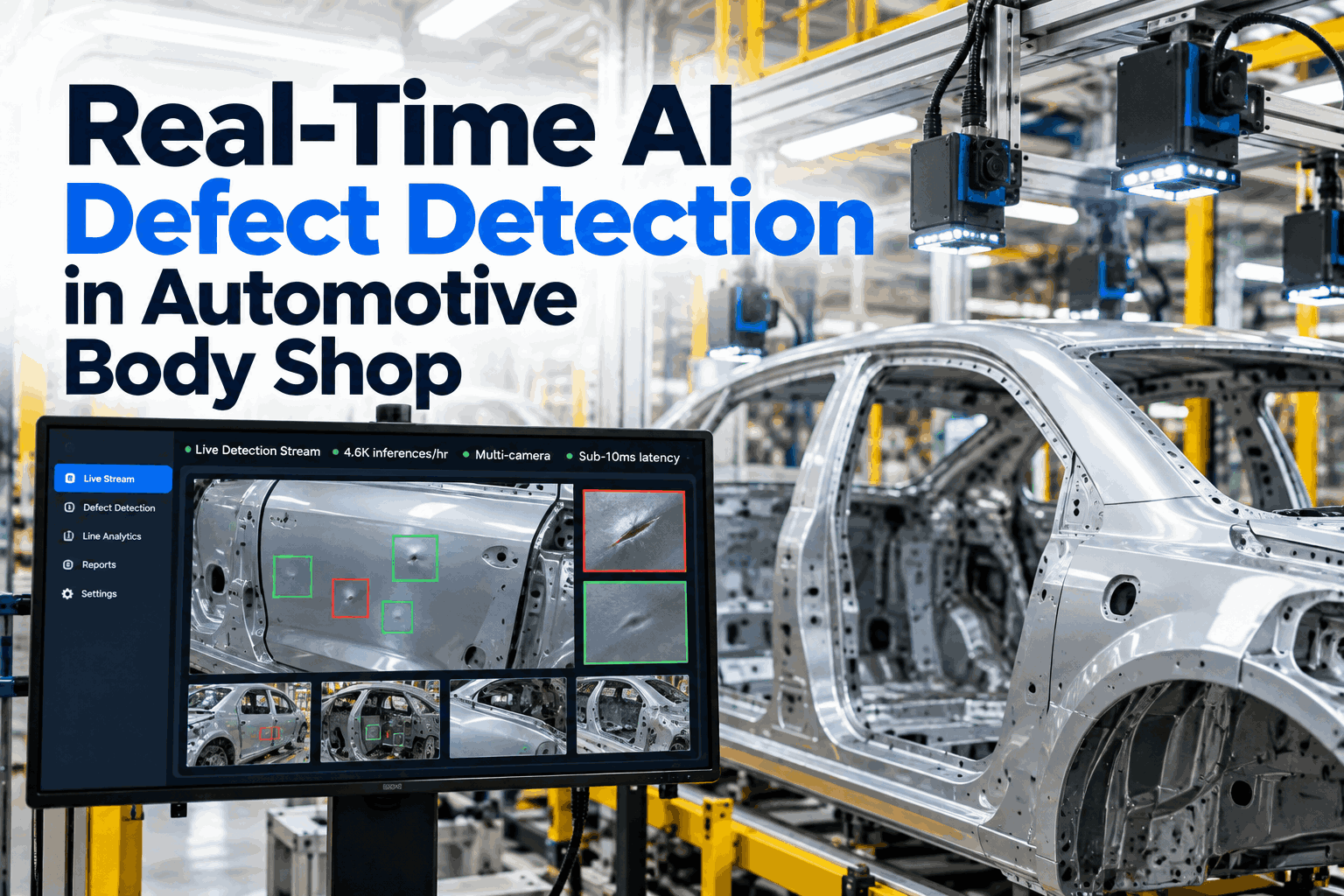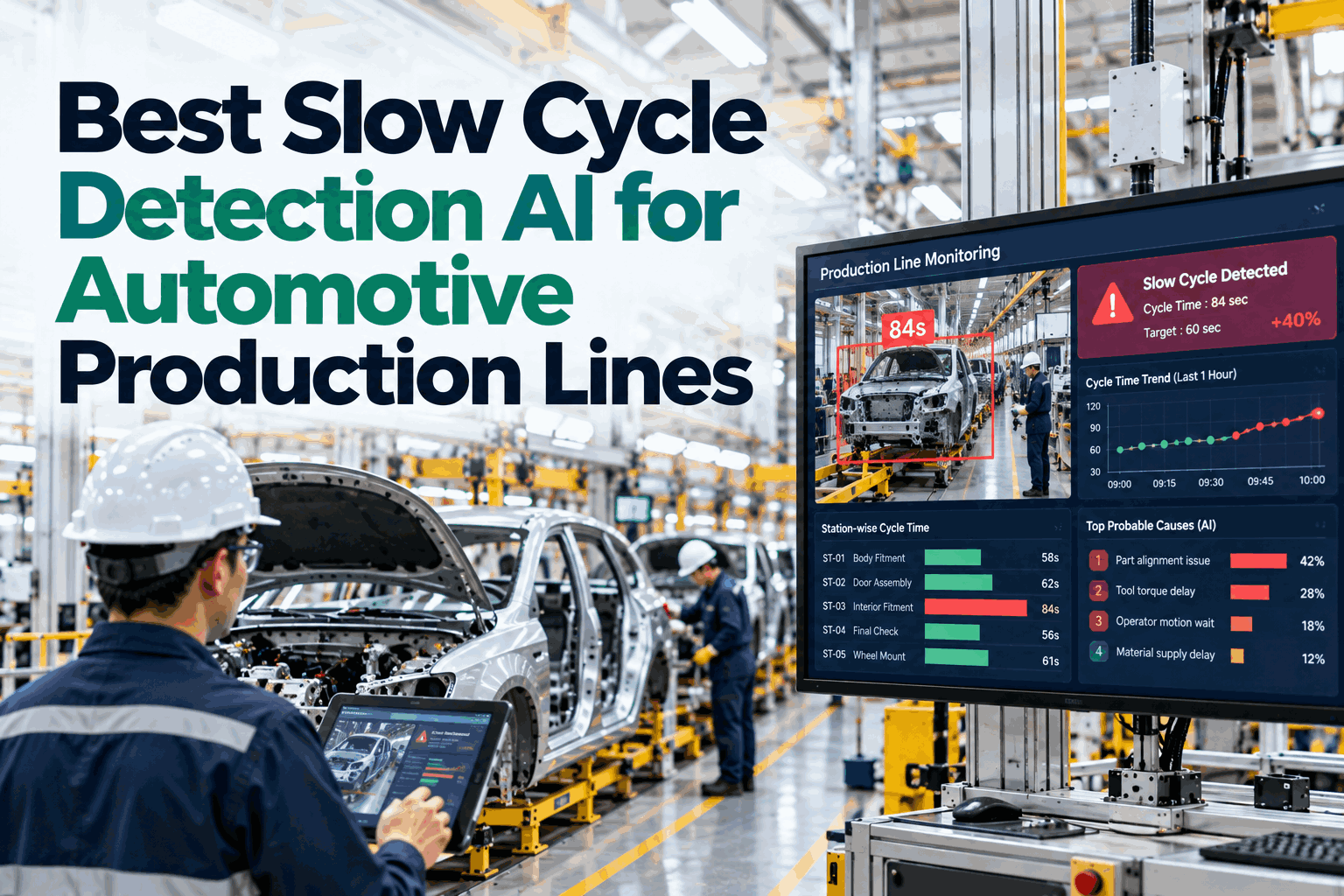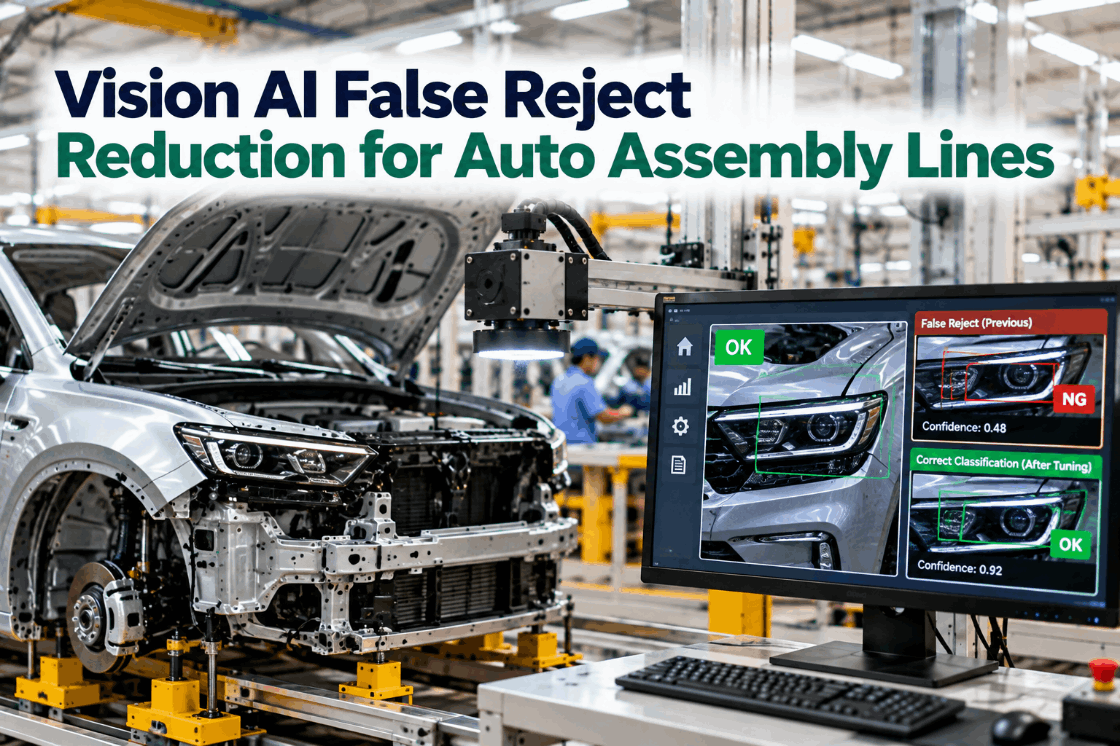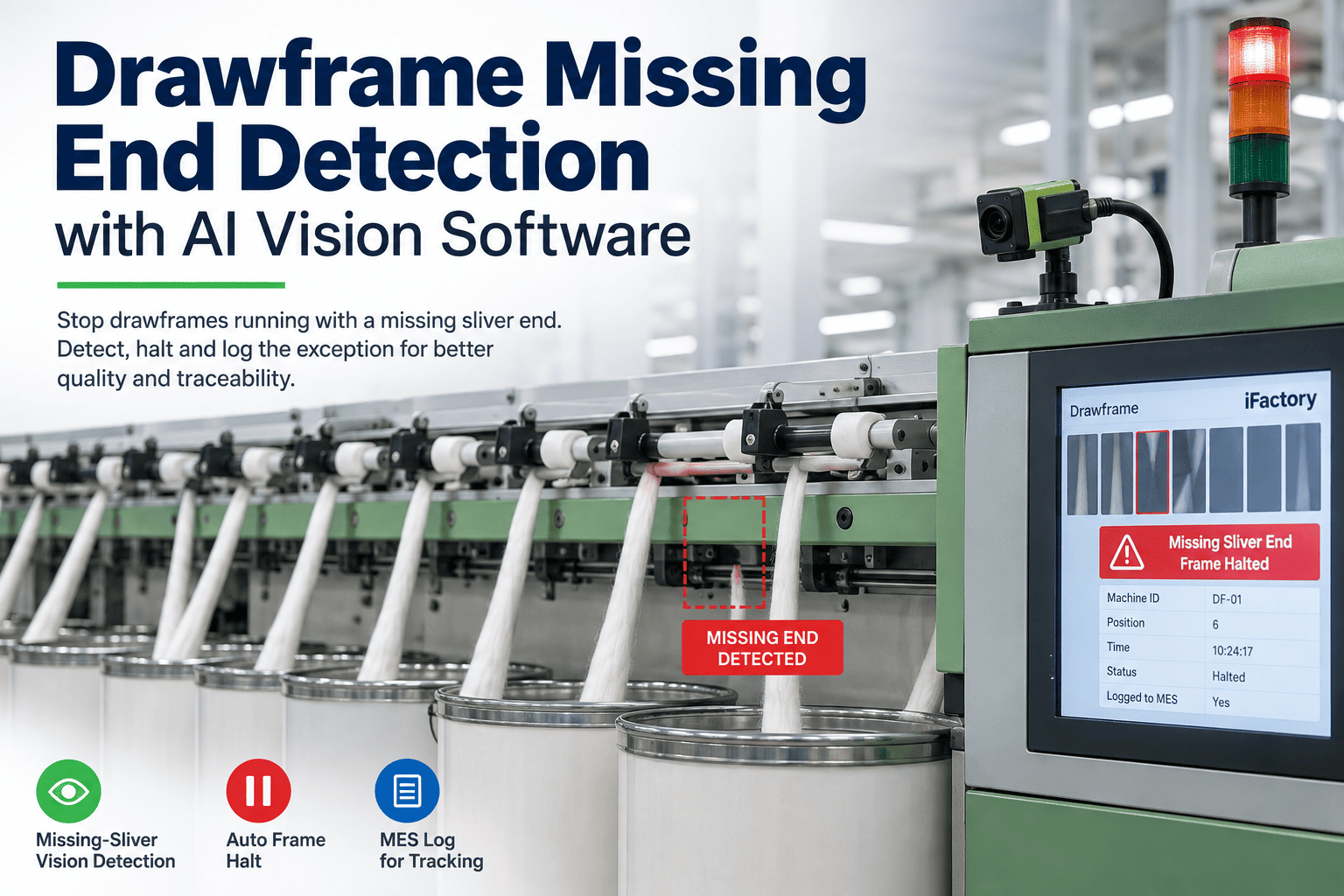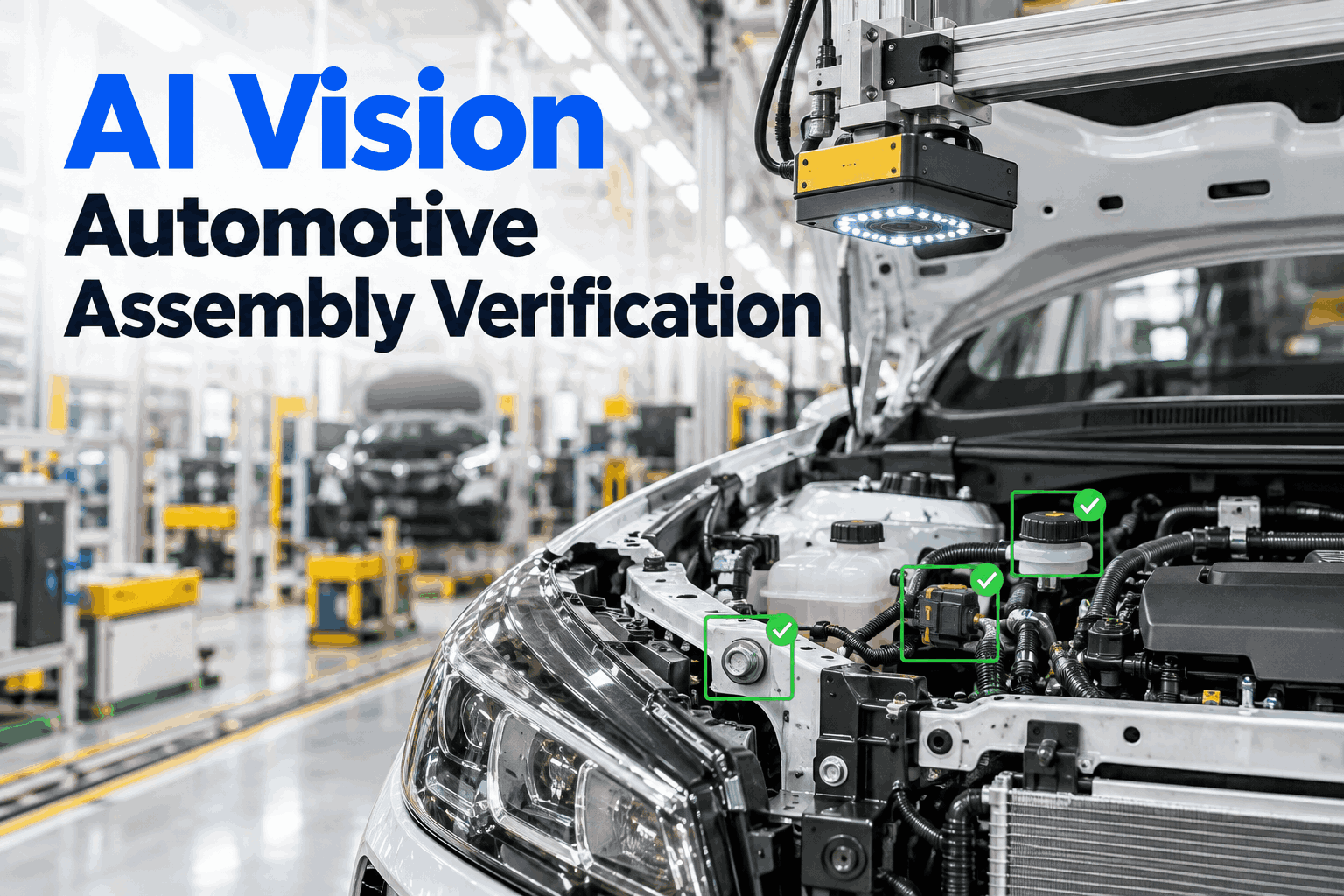
A missing clip, an unmarked bolt or a half-seated connector takes seconds to miss on the line and can cost a fortune in the field. AI vision checks every unit at the station, against the right build for that vehicle, before it moves on. To see it on one of your stations, book an assembly vision session.
AI Vision for Automotive Assembly Verification
Check part presence, torque marks, connector seating and the right component for every variant, on every unit, at takt. Stop escapes at the station that made them, not at end of line or in the field.
- The four checks AI vision does best on an assembly line
- What a camera can prove, and what still needs a tool or test
- How to plan, prove and scale a first station
Every point is checked on every unit. One miss holds the unit at the station, with the image and the point shown to the operator.
Why Assembly Escapes Still Happen
It is not a skill problem. It is a volume problem.
An operator may fit hundreds of parts a shift, at takt, across several variants. Even a very good inspector catches most defects, not all of them. Studies of human visual inspection put the typical hit rate at around four in five. Sampling and end-of-line checks find some of the rest, but by then the unit has moved on and the fix costs more. Our vision support team can help you find where escapes start on your line.
Repetition
The same check, hundreds of times a shift. Attention fades, however careful people are.
Variants
Mixed-model lines change the right part from one unit to the next, sometimes with only a colour or label telling them apart.
Hidden spots
Clips and connectors behind panels are hard to see once the next part goes on, and nobody checks them again.
Late checks
End-of-line audits find problems after several more units have been built the same way, so one miss becomes a batch.
Clips and fixings
Dozens of small clips per panel, many hidden once the trim goes on.
Connectors
Half-seated plugs that pass a glance but fail on the road.
Fasteners and brackets
Missing torque marks and brackets on underbody stations.
Busbars and covers
Many repeated points per pack, where one miss can matter a lot.
A missing clip found at the station takes seconds to fit. Found at end of line, it may mean removing a panel. Found by a customer, it becomes a warranty claim or worse.
What AI Vision Can Verify, and What It Cannot
A camera proves what it can see. Be clear about the rest.
AI vision is very good at presence, position, orientation and the right part. It cannot measure torque or test a circuit. The strongest stations pair vision with the tools that can, so every risk has one clear check. To map checks to your station, book a station mapping call.
Part presence
The most common escape, and the easiest win for vision. Start here on most stations.
Right variant
The right trim, colour or bracket for this vehicle's build order, checked unit by unit.
Torque mark
Proof the fastening step happened, alongside the tool's own torque and angle record.
Connector seating
Visible gaps and open locks, caught before the harness is covered by trim or carpet.
Shiny chrome, black connectors on black harness tape, and points hidden by a hand or tool are the classic hard cases. Fix them with lighting, a second camera angle or a better trigger moment before blaming the model.
What One Escape Costs, by Where It Is Found
The same missing part costs more at every step it travels. Here is the ladder, using the per-vehicle figures in Atlas Copco's rework study.
Planning a Verification Station
Good results start with the camera, the light and the takt, not the model.
Most failed vision projects fail on set-up, not on AI. Lighting changes, a camera knocked out of place or a point that is half hidden will undo the best model. A camera that cannot see the point clearly, every time, will never be reliable, however good the model. Plan the station first, then train. For help with a station plan, our engineers can help.
Station checklist
- View. Every point visible from one or more fixed cameras.
- Light. Steady lighting, shielded from sunlight and shadows.
- Timing. Check before the next part hides the point.
- Takt. Image, decision and signal inside the station's cycle.
- Trigger. A clear signal that the unit is in position.
Pick the first station well
- High escape history or warranty link
- Many small parts, clips or connectors
- Points clearly visible at one moment
- A team keen to own the result
Models learn from examples. Capture good units across shifts, variants and lighting, plus real or staged faults for each point: missing, misplaced and wrong part. A few hundred well-chosen images per check often beat thousands of near-identical ones.
On a mixed-model line, the station must know which vehicle is in front of it. Feed the build order or vehicle ID to the vision system, so it checks against the right parts list for that unit, not a single reference.
From Detection to Error-Proofing
A camera that only reports is an audit. A camera that holds the unit is poka-yoke.
Real error-proofing means a failed check stops the unit from moving on until it is fixed and re-checked. Choose how strongly to act for each check, based on the risk of a miss. That needs a signal to the line: an andon, a hold on the conveyor or an interlock on the next step. To plan the line signals for your station, book an integration planning call.
Detect
Camera captures the unit and checks every point.
Show
Operator sees the image with the failed point marked, so nobody has to guess what is wrong.
Hold
Line signal holds the unit at the station until it passes.
Fix and re-check
Part fitted, camera checks again, then the unit is released.
Record
Image, result and fix stored against the vehicle ID for traceability.
Learn
Repeat misses flagged to engineering as a design or process issue to fix at the source.
Four ways to act on a failed check
Alert
Light and sound at the station. Lightest touch, but it still relies on the operator acting.
Conveyor stop
The unit cannot leave the station until it passes a re-check.
Next step blocked
The next tool or station will not start on a failed unit.
Traceability
Result logged to MES against the vehicle, for every unit.
How iFactory Vision Object Detection Verifies Assembly
Trained on your parts, running at the station, linked to your line.
iFactory's Vision Object Detection runs on an edge device next to the station, so decisions arrive inside takt. Models are trained on images of your own parts and variants, and checked by your quality team before going live. Results go to the line through standard industrial signals, and every image is stored against the vehicle. Your team can review, relabel and retrain without writing code. Questions on fit go to our support desk.
Capture
Fixed cameras at the station, triggered when the unit is in position, so every image is taken the same way.
Train
Models trained on your parts, including good and faulty examples of each point.
Decide
Every point judged on the edge device, against the build order for that unit.
Act
Pass or hold sent to the line, image and result kept for traceability.
What the line team sees
- Pass or hold for every unit, at the station
- The image with the failed point marked
- A re-check once the fix is made
What quality and engineering see
- Misses by point, variant, shift and station
- Images stored against each vehicle ID
- Repeat misses flagged as process issues
Detection rates depend on the station, the parts and the lighting. We measure them during the pilot on your own units, against your own audit, rather than quoting a general figure.
Turnkey AI: Delivered, Connected and Live in 6–12 Weeks
You do not build this. It arrives ready.
iFactory ships as a pre-configured NVIDIA AI server, racked and ready, with the software pre-loaded. Rack it, plug in power and Ethernet, and the AI is live on your network.
Our team handles cabling, network setup, PLC and SCADA integration, operator training and 24×7 remote monitoring. The server sits inside your own network, so images and production data stay on site. For a scope matched to your plant, request a turnkey quote.
Ship, network and data
Server and cameras installed at the pilot station. Build signal connected. Images collected.
Model training and pilot
Models trained on your parts and run alongside your current checks. Results compared point by point.
Go-live and training
Line hold switched on once results match your audit. Operators and quality staff trained. 24×7 remote monitoring begins.
Frequently Asked Questions
What is AI vision assembly verification?
Cameras and AI models at an assembly station check every unit for the right parts, fitted the right way. They look for missing parts, wrong variants, missing torque marks and connectors that are not fully seated, and can hold the unit until it is fixed. Each result is stored with the vehicle ID, so you can trace any unit later.
Can AI vision verify fastener torque?
Not directly. A camera can confirm that a torque mark is present and in the right place, which shows the fastening step happened. The torque value itself comes from the nutrunner's record. The two together give the strongest proof, and vision catches the cases where a fastener was skipped altogether.
How does AI vision check connector seating?
It looks for visible signs of full engagement, such as no gap between halves and a closed lock or CPA. It cannot test the electrical contact inside, so keep your end-of-line electrical test for that.
How is this different from traditional machine vision?
Rule-based machine vision works well when parts and lighting never change. Deep learning models cope better with variation in colour, reflections, position and variants, and are easier to retrain when a part changes. Many stations use both: simple rules where they work, deep learning where they struggle.
Does it work on mixed-model lines?
Yes, if the station receives the build order or vehicle ID. The system then checks each unit against the parts list for that variant, rather than one fixed reference. New variants are added by training on a small set of images of the new parts.
Will it slow the line down?
It should not. Decisions are made on an edge device at the station, inside the station's cycle time. Camera trigger and decision timing are tested during the pilot before the line hold is switched on, so the line never waits on the camera.
What does a 6-week pilot involve?
One station, chosen for its escape history and how clearly its points can be seen. Cameras installed, models trained on your parts, then run alongside your current checks so results can be compared fairly. To plan a pilot station, contact our team.
Stop the Next Escape at the Station
In thirty minutes we look at your escape and warranty data, pick the station most likely to pay back first, and sketch the checks a camera could take on there. You keep the plan whether or not you go further with iFactory.
- 1Recent escapes and where they were found
- 2Warranty claims linked to assembly
- 3Photos of your most error-prone station
- 4How the line sends build order or vehicle ID
- 5Station cycle time and takt