A drawframe running with one sliver end missing at the back is a shift-long invisible cost. The autoleveller keeps compensating and the machine keeps running, so no operator alarm goes off. Every metre of delivered sliver is under-count, every downstream card of that lot is compromised, and no one on the floor knows about it until the yarn clearer starts cutting for count deviation two days later at the winder. By then the source drawframe head is anonymous and the bill for the wasted mix falls on the spinner’s P&L, not on the shift that let the end break go.
iFactory / Drawframe missing-end detection
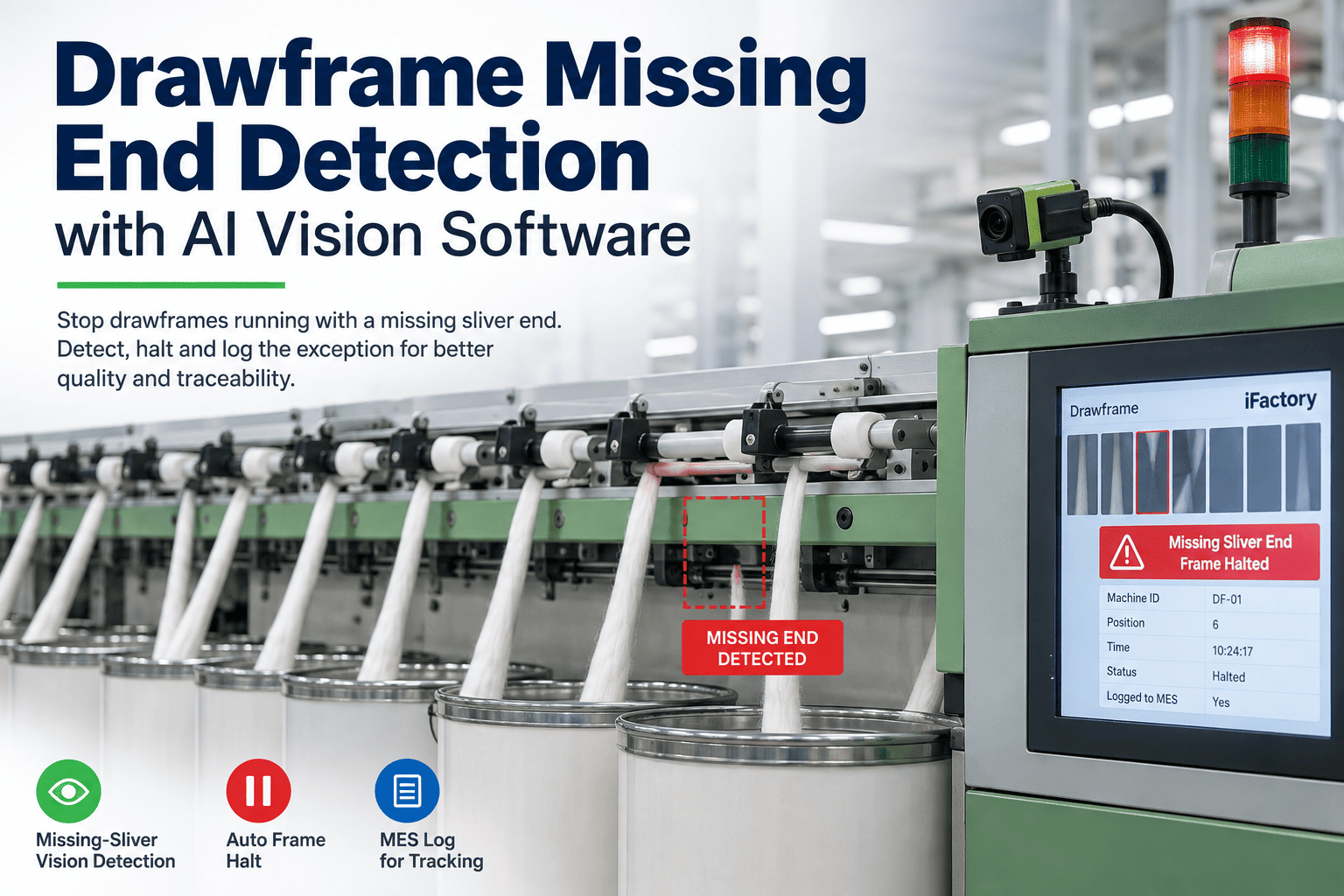
Halt the Drawframe the Moment a Back-End Sliver Is Missing
A camera at the creel back of every drawframe head that sees when one of the six or eight ends has broken or run out, halts the machine before the autoleveller runs blind, and writes the exception into the MES for the shift.
Planned
6 ends → on-count
→
Missing 1
5 ends → 16.7% light
12–17%
count deficit / one missing end
700–2000 m
fine yarn affected per event
The Problem on the Line
A drawframe doubles six or eight slivers into one at the delivery — that’s the doubling that gives it its evenness. If a single sliver breaks at the back of the creel and the operator doesn’t catch it inside a few seconds, the drawframe keeps running on five ends instead of six. The autoleveller sees a light input and compensates with more draft up to its range, hiding the count deficit. The delivered sliver is off-count for the rest of the can, and every downstream card of that lot inherits the drift. It only surfaces at the ring frame or the winder’s Uster Quantum days later.
What Escapes Into the System of Record Today
A shift supervisor knows missing-end events happen. What the mill does not have is a record on the drawframe head that connects a specific delivery interval to the missing-end event and marks the can that carried the deficit.
Paper
Operator marks a stoppage on the shift sheet — "MEB run 8 min" — that doesn't name which head, which delivery interval, or which can was affected.
WhatsApp
Line supervisor pings the QA lead: "drawframe 3 back end broke, cleared it, running now" — no timestamp, no can ID, no tie to the mix.
Winder-only data
Two days later the winder's Uster Quantum logs elevated count-deviation cuts on a specific package family. The winder record shows the outcome; it does not know which drawframe head, which can, or which interval caused it.
Nowhere at all
The affected can was already fed to the next passage. The out-of-count sliver is now doubled with clean sliver at the next stage — the deficit is diluted but not gone, and no digital record ties any of it back to the source drawframe head.
What the Camera or Agent Actually Sees
A vision agent at the creel back of each drawframe head watches the six or eight slivers entering the drafting zone. It does not need to measure fibre — it needs to see whether each sliver end is present and being fed. The moment one is missing, the drawframe halts and the event is logged.
End Presence
Each of the 6 or 8 sliver ends monitored at the entry to the creel — presence, position in the guide, and continuity of feed.
Read: per-end presence
Break vs Empty
Distinguishes a fresh sliver break (fibre still visible upstream) from an emptied can (guide empty and can run-out signal).
Read: cause classification
Which Head
Which specific drawframe machine, which delivery head (front or back), and which of the numbered ends — enough to trace to the can genealogy.
Read: head + end ID
Halt Signal
Sends the halt signal to the drawframe control before the autoleveller enters its compensation range, so the deficit does not enter the delivered sliver.
Signal: to machine PLC
What Gets Written Back
Halting the machine is the safety action. The value lives in what gets written to the MES — the exception record that names the head, the interval, the can, and the mix — so the downstream trace exists when the winder Quantum starts cutting.
Exception Event
Spinning MES
Timestamped exception on the specific drawframe head with cause (break / empty), which numbered end, the operator ID, and the shift.
Can Batch Flag
MES Batch Genealogy
The can being filled at the moment of the event flagged as "quality-affected" so the next passage inherits the flag and the record is not lost at can change.
Downtime Reason
Spinning MES / OEE
Correct downtime reason code posted against the drawframe head instead of "other stop" — the OEE report and the missing-end frequency line up on the same event.
Count-Deviation Trace
MES + Winder
When the winder logs a count-deviation cut, the exception log is joined by mix and interval so the source drawframe head is named, not guessed.
Take one shift of winder count-deviation cuts on any single yarn count. If none of them can be traced back to a specific drawframe head and a specific interval, the source is invisible. Book a line assessment — we'll audit one week of drawframe stoppages against winder cuts.
12-Week Pilot Shape on One Station
One drawframe machine, both delivery heads, one yarn count. The pilot is scoped to prove one thing: that halt + MES write-back on the drawframe head connects to fewer winder count-deviation cuts in the same window.
Weeks 1–2
Baseline Capture
Camera on the creel back of one drawframe. Two weeks of read-only detection. Baseline: how many missing-end events per shift, per head, at your actual sliver break rate?
Weeks 3–4
Classifier Tuning
Break vs empty-can classification tuned against your specific sliver hank and creel geometry. False-halt rate targeted below your operator's manual stop rate.
Weeks 5–8
Halt + MES Live
Halt signal into the drawframe PLC and exception event write into the MES switched on. Can-batch quality flag active. Downtime reason code posted.
Weeks 9–12
Downstream Match
Winder count-deviation cuts on the pilot mix mapped back to drawframe exceptions. First time the mill can name the drawframe head behind a Quantum cut.
Who Owns the KPI
A missing-end program lives between drawing production and quality. Both sides need to own a specific number on the KPI board, or the halt discipline decays inside a month.
Drawing Sup.
Missing-end events per shift per head
Owns the drawframe stoppage response and the operator training — a rising events-per-head number means creel or sliver-supply issues to fix upstream.
Quality Head
Winder cuts traced to a drawframe event
Owns the loop-close on count-deviation cuts. Every Quantum count cut should either trace to a drawframe exception, or the vision agent missed one.
Maintenance / Can Yard
Empty-can vs break event ratio
Owns the upstream — a rising empty-can share means can-yard timing needs attention; a rising break share means creel guides or sliver quality.
Production / GM
OEE loss to missing-end downtime
Owns the OEE number now that missing-end stops are correctly coded, not buried in "other stop" — the true cost of the failure mode is visible for the first time.
FAQ
Won't the drawframe already stop on a break — why do we need vision?
Most drawframes have a stop-motion on the delivery side that catches a delivery break, and some newer machines have back-end break stop-motions too. The gap is that the mechanical stop-motion at the back is often set to tolerate a slack sliver and can miss a clean break where the end runs cleanly out of the guide, and it does not distinguish break from empty-can. More importantly, even where the machine stops, the event never reaches the MES with head, cause, and can — which is the piece that makes the downstream trace possible. The vision agent is the record layer, not just a redundant stop.
How fast does the halt actually happen?
Fast enough to matter. From frame-capture to halt signal at the PLC is on the order of a hundred milliseconds; the drawframe braking distance at 800 m/min supply speed is another second or two. That combined window is inside the autoleveller's effective compensation range for the sliver length that would enter the can. The rest of the value is not the halt speed — it is the record that connects the head to the can and the can to the yarn count.
Does it need integration with our specific MES or spinning-machine brand?
The halt signal goes into the drawframe PLC via a standard I/O interface — Rieter, Trützschler, Toyota drawframes all accept an external stop-input. The MES write-back is via the API your MES exposes; the common spinning MES platforms (Uster, Loepfe, Rieter SPIDERweb, and mill-specific MES) are supported. The pilot is scoped around the specific machine and MES you run, not around a reference architecture.
Stop letting one broken end at the creel cost a shift of yarn.
See Halt + MES Write-Back on One Drawframe Head
Bring one drawframe and one week of winder count-deviation cuts on that mix. We'll show the vision agent at the creel back, the halt into the PLC, and the exception event that would have named the source head.