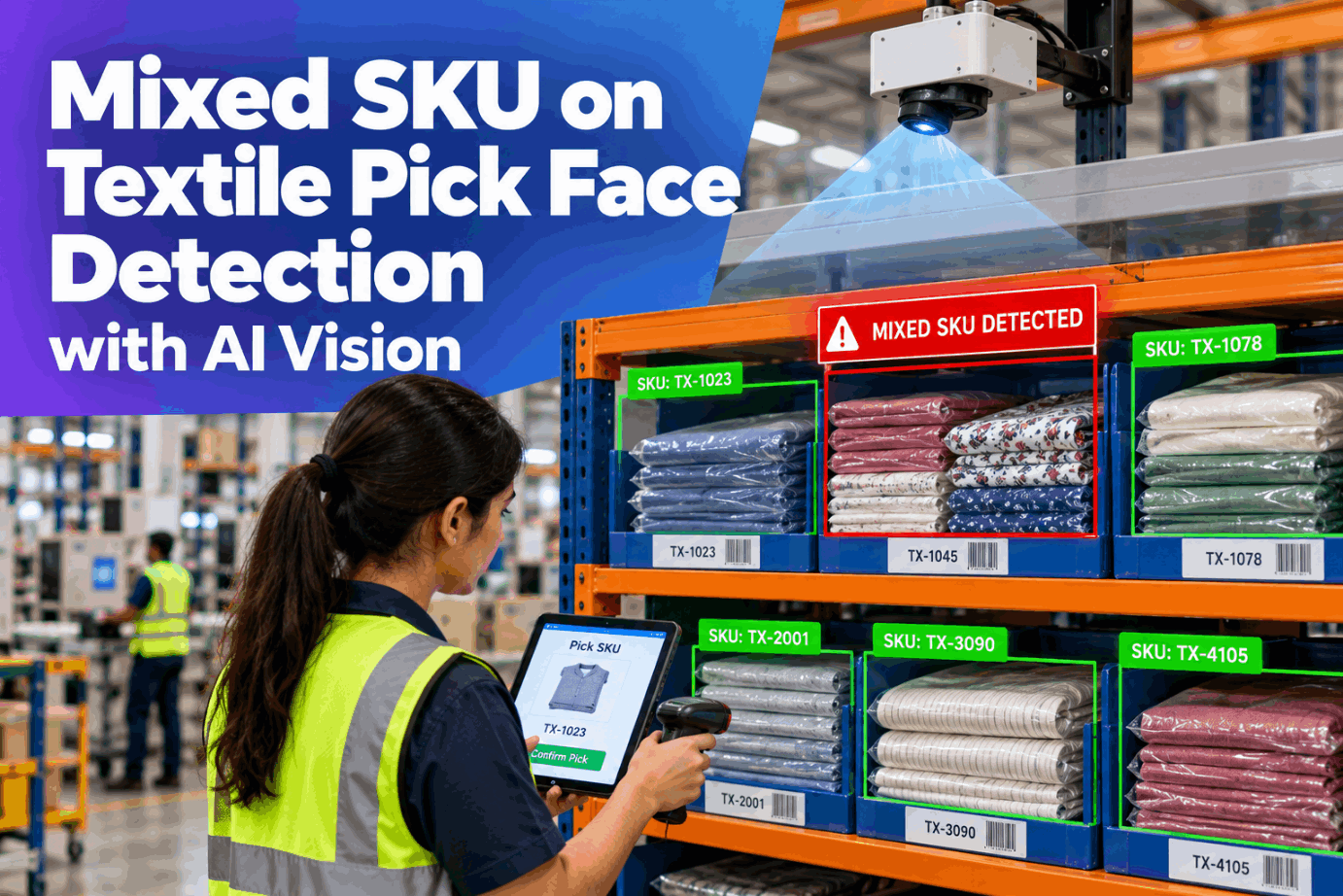
Mixed SKU on Textile Pick Face Detection with AI Vision

By Jackson T on October 29, 2026

mixed-sku-textile-pick-face-vision-detection

In a textile DC, a pick face rarely goes wrong in a dramatic way. A replenishment case of size L lands in the size M bin, a returned shirt goes back one slot over, and every picker after that trusts the location label. The WMS still shows one clean SKU, so the error surfaces later as a customer return or a count variance. Per-bin vision reads catch the mixed face before the next wave picks from it, and you can watch a bin read run in a 30-minute pick face demo.

TEXTILE DC AI · PICK FACE CONTROL

Catch Mixed SKUs on the Pick Face Before Pickers Ship Them

iFactory reads every bin on the face, matching label, barcode and hangtag text plus colour and pattern cues against your slotting master. When a bin holds two SKUs, the location goes on hold and open pick tasks for it are blocked until a counter clears it.

Aisle 14 · Bay 0612 bins read
Face scan 06:42 · polo style 4410 · checked against slotting master
14-06-A1PL-4410-NV-S
14-06-A2PL-4410-NV-M
14-06-A3PL-4410-NV-L
14-06-B1PL-4410-NV-XL
14-06-B2PL-4410-WH-M
14-06-B3PL-4410-WH-L
14-06-C1PL-4410-HG-S
14-06-C2PL-4410-HG-MPL-4410-HG-LPick task 4471 blocked
14-06-C3PL-4410-HG-L
14-06-D1PL-4410-ST-M
14-06-D2PL-4410-ST-L
14-06-D3PL-4410-ST-XL
11 of 12 faces match · C2 on hold, size L labels read in an M bin
MIXED SKU PICK FACE

Five Ways a Clean Pick Face Turns Mixed

Mixed faces are almost never theft or system failure. They come from ordinary handling at speed, where one wrong placement looks fine to the next person who walks past. Apparel and home textiles make it worse, because a style can run to dozens of colour and size variants that sit side by side and look nearly the same once folded. One warehouse guide notes that count mismatches often stem from incorrect putaway or mislabeled cartons rather than true shrinkage. Walk through your own handling points with our DC support team.

Replenishment putaway
One bin offA case comes down from reserve and goes into the neighbouring bin, often the next size of the same style.
Returns put back
Close enoughA returned unit is refolded, sometimes without its bag label, and placed by eye into a bin that looks right.
Lookalike variants
Ivory or white?Close colourways and adjacent sizes are hard to tell apart under aisle lighting, by people and by cameras.
Carton breakdown
Prepack split wrongA ratio prepack is opened at the face and its sizes end up in one bin instead of their own slots.
Re-slot leftovers
Old SKU stays behindA seasonal re-slot moves the main stock but leaves a few units of the previous SKU at the back of the bin.
DC VISION SYSTEM LIMITS

What the Camera Reads, and What It Cannot Tell Apart

Here is the honest part. Two polos of the same style and colour that differ only in size look the same when folded or polybagged. No model can reliably tell a folded M from a folded L by shape alone. So iFactory does not try to guess size from appearance. It reads printed identifiers, such as the barcode, size sticker, bag label or hangtag text, and uses colour and pattern only as supporting cues. Every read is then compared with the slotting record in your WMS. See how reads and cues combine in a bin-level walkthrough.

The camera can read
  • Barcodes on polybags, hangtags and inner cartons where they face the camera
  • Size stickers, bag print and hangtag text by OCR
  • Colour and print against a reference image of each SKU
  • Pack form: folded, hung, bagged or still in a carton
The camera cannot be sure of
  • Size, when no label or barcode is visible
  • Very close shades, such as ivory against off-white
  • Units hidden behind the front of a deep bin
  • Quantity on hand, which stays a count task
How the rule layer closes the gap

A bin with no readable identifier is marked unverified, never clean. Colour or pattern alone can raise a soft flag but cannot block a task. A block needs a decoded identifier that conflicts with the slotting master, so pickers are not stopped on a guess.

PICK FACE AUDIT SIGNALS

The Per-Bin Read Against the Slotting Master

Each signal carries a different weight. A decoded GTIN is close to proof, because each colour and size variant normally has its own code. Colour is useful for spotting a stranger in the bin, but weak for telling close shades apart. The matrix shows how each signal is used. Weights are tuned to your labelling, so share sample bin photos with our vision support team.

Signal
What vision reads
Checked against
Weight on its own
Barcode on bag or hangtag
Decoded UPC or GTIN digits where the code faces out
GTIN of the SKU slotted to the bin
Can block alone
Size sticker or bag print
OCR of size text such as M, L or 32/34
Size attribute of the slotted SKU
Can block when legible
Hangtag style number
OCR of the style and colour code
Style and colourway in the master
Confirms style, not size
Colour cue
Dominant colour against the SKU reference image
Colourway of the slotted SKU
Soft flag only
Pattern cue
Stripe, check or print against the reference
Pattern of the slotted SKU
Soft flag only
Pack form
Folded, hung, bagged or cased
Expected unit of measure for the bin
Supporting evidence

A Held Bin With the Evidence Attached

Ops leads don't want a dashboard alert. They want to know which bin, which SKUs, what was read and what happened to the pick. iFactory answers in plain words and shows the bin image behind each hold.

Pick face exceptions · Ops lead and iFactory
Ops leadWhy is 14-06-C2 on hold?
iFactoryTwo size labels read on the face: HG-M, which is slotted there, and HG-L on three units. Last putaway into C2 was replenishment task R-88213 at 05:58.
Ops leadAre pickers stuck?
iFactoryNo. Pick task 4471 is blocked at C2 and your WMS rule sends it to reserve 31-02-D4. A count task for C2 is open.
PICK FACE COMPLIANCE WORKFLOW

From Mixed Read to Blocked Task in One Pass

The block only helps if it lands before the next picker arrives. Reads are taken after each putaway or replenishment into a bay, and on a fixed schedule for slow faces. A confirmed conflict puts the location on hold through your WMS integration, so open tasks for that bin stop rather than shipping the wrong size. Most WMS platforms offer some form of location hold or lock, and iFactory uses the one yours already has. Plan the hold rules in a WMS integration session.

1ReadBin imaged after a putaway, replenishment or scheduled pass
2CompareIdentifiers and cues checked against the slotting master
3Hold and blockLocation held, open pick tasks for the bin stopped
4Re-routeYour WMS rule sends picks to reserve or another face
5ClearCounter removes strangers, confirms, releases the bin
CYCLE COUNT INTERACTION

Four Face States and What Each One Triggers

Vision checks identity, not quantity, so it does not replace the cycle count. What it changes is where counters spend their time. Instead of counting bins on a calendar and hoping to hit the mixed ones, the count list is pointed at faces the camera has flagged. Every adjustment then carries a cause, putaway, returns or breakdown, so the same mistake is fixed upstream. Ask our operations team how this fits your count programme.

Matched
All reads agreeNo task. The bin is logged as verified for identity at that time.
Unverified
Nothing readableNo block. A scan check is added to the next pass through the aisle.
Suspect
Colour or print differsSoft flag. A counter checks the bin within the shift.
Mixed
Two identifiers readHold, block open picks and raise a priority location count.
MIXED FACE EXCEPTION RECORD

What Every Held Location Keeps on File

A hold is only useful later if the record explains it. Each mixed face produces one record that links the image, the reads and the last tasks that touched the bin, so a supervisor can see whether the cause was a replenishment, a returns put-back or a breakdown. Request a sample exception export in a short demo call.

LocationBin code, aisle, bay and level
Slotted SKUFrom the WMS slotting master
SKUs readEvery identifier decoded, with count of units
Bin imageTime-stamped, with read boxes marked
Last putawayTask ID, time and user
Last returns put-backTask ID and time, if any
Tasks blockedPick task IDs stopped while held
Cleared byCounter, time and cause code
TEXTILE PICK FACE CONTROL EXAMPLES

Three Mixed Faces, Three Different Fixes

These are illustrations, not customer cases. They show how the cause found in the record points to a different fix each time, which is the real value of a held bin over a silent mis-pick. Talk through faces like these with our slotting specialists.

Duvet cover · ivory in a white bin
Suspect, then mixedColour raises a soft flag. The bag label read confirms the ivory SKU. Fix: stop slotting ivory and white of one style side by side.
Denim · 32/32 in the 32/34 bin
Mixed on the size labelFolded jeans look identical. The waist and inseam sticker gives it away. Fix: returns put-back needs a scan to the bin label.
Bath towels · prepack opened
Three sizes in one binA ratio carton was emptied into the hand towel slot. Fix: prepacks are broken down at a station, not at the face.
DC PICK ACCURACY COST WORKSHEET

Size the Cost of Mixed Faces With Your Own Numbers

We don't quote mis-pick rates, because they vary too much between DCs. Every input below is assumed, and the worksheet does nothing more than multiply them. Put your own count and returns figures in their place, or build it with us in a pick accuracy review.

Mixed faces found per week25, assumed
Picks from each face before it is found8, assumed
Share of those picks that ship the wrong item1 in 4, assumed
Wrong items shipped per week25 × 8 × 0.25 = 50
Cost per wrong item: return, reship, handling$18, assumed
Cost per week, then per year50 × $18 = $900 · $900 × 52 = $46,800

Catching a face after two picks instead of eight cuts the middle line to a quarter on the same assumptions. Customer goodwill and chargebacks are left out on purpose. Include them only where your records back up a number.

TURNKEY AI DEPLOYMENT

Aisle Cameras, WMS Link and Edge Server, Delivered Ready

iFactory delivers per-bin vision as one package. Cameras are placed to cover your fastest pick faces, and a pre-configured NVIDIA AI server ships racked and ready with the read and compare models loaded, and bin images never leave the building. You rack it, plug in power and Ethernet, and the AI is live. Our deployment team can survey your first aisles.

What's Included
  • Pre-configured NVIDIA AI edge server, racked and ready
  • Aisle cameras sized to your bay and bin layout
  • Barcode, OCR and colour models trained on your SKUs
  • Slotting master sync with your WMS
  • Location hold and pick-task block integration
  • Exception records with bin images and cause codes
  • 24×7 remote monitoring of models and hardware
Live in 6–12 weeks
Wk 1–4
Survey and Install

Pilot aisles chosen, cameras mounted, server racked and the slotting master connected.

Wk 5–8
Read in Shadow

Reads compared with counter checks, with no holds placed while weights are tuned.

Wk 9–12
Holds Switched On

Location holds and pick blocks go live, counters trained, count list linked.

HOW iFACTORY FITS

Built for Textile DCs Where Variants Look Alike

iFactory sits between the aisle and your WMS. It doesn't replace slotting, counting or picking logic. It gives them a check they didn't have. Book a pilot planning call to see where it fits first.

1
Reads every bin. Barcodes, size labels and hangtag text are read per bin, with colour and print as cues.
2
Compares with slotting. Each read is checked against the SKU your WMS expects in that location.
3
Blocks mixed faces. A conflicting identifier holds the bin and stops open pick tasks for it.
4
Aims your counts. Flagged faces go to the top of the count list with the cause on record.
1000+
Industrial clients running iFactory
99.9%
Platform uptime through peak season
6-12 wks
From racked server to live bin holds
FREQUENTLY ASKED QUESTIONS

What Textile DC Operations Leads Ask About Mixed Faces

Can the camera tell a size M from a size L?
Only through printed identifiers. Folded or bagged garments of one style usually look identical across sizes, so iFactory reads the barcode, size sticker, bag print or hangtag. If none is visible, the bin is marked unverified and gets a scan check, rather than being passed or blocked on a guess.
What does the system compare each bin against?
The slotting master in your WMS: which SKU, colourway and size is assigned to each location. A read that conflicts with that assignment is a mixed face. You can watch the comparison screen and the bin image together when you book a 30-minute session.
How does a pick task actually get blocked?
iFactory sets a hold on the location through your WMS integration, and the WMS stops or re-routes open tasks for it using its own rules. The exact behaviour depends on what your WMS supports, so our integration support team maps it during the survey.
Does this replace cycle counting?
No. Vision checks what is in a bin, not how many units are there. It makes counting more targeted by sending flagged faces to the top of the count list, and every adjustment records whether the cause was putaway, returns or carton breakdown.
What about hanging garments and deep shelving?
Hanging stock often shows hangtags well, which helps reads. Deep bins are harder, because units behind the front row are not visible, so camera angle and bin depth are assessed per aisle. Bring a few bin photos and see them read on a live call.
Where should a textile DC start?
Start with the aisles that hold styles with many lookalike sizes and colourways, and the ones fed by returns. Run reads in shadow for a few weeks, compare them with counter checks, then switch on holds. To plan a pilot around your busiest faces, walk through it with our team.

Stop the Wrong Size Before It Is Picked

Read every bin against your slotting master, hold mixed faces and block their pick tasks, with the evidence on file. Delivered as one turnkey package, it is live on your aisles within 6 to 12 weeks.


Example shift summary · Aisles 12 to 16
Bins readAfter every putaway and on schedule
Compared withWMS slotting master
Mixed facesHeld, open picks blocked
Unverified binsAdded to the next scan pass
Every hold linked to its image and cause

Share This Story, Choose Your Platform!