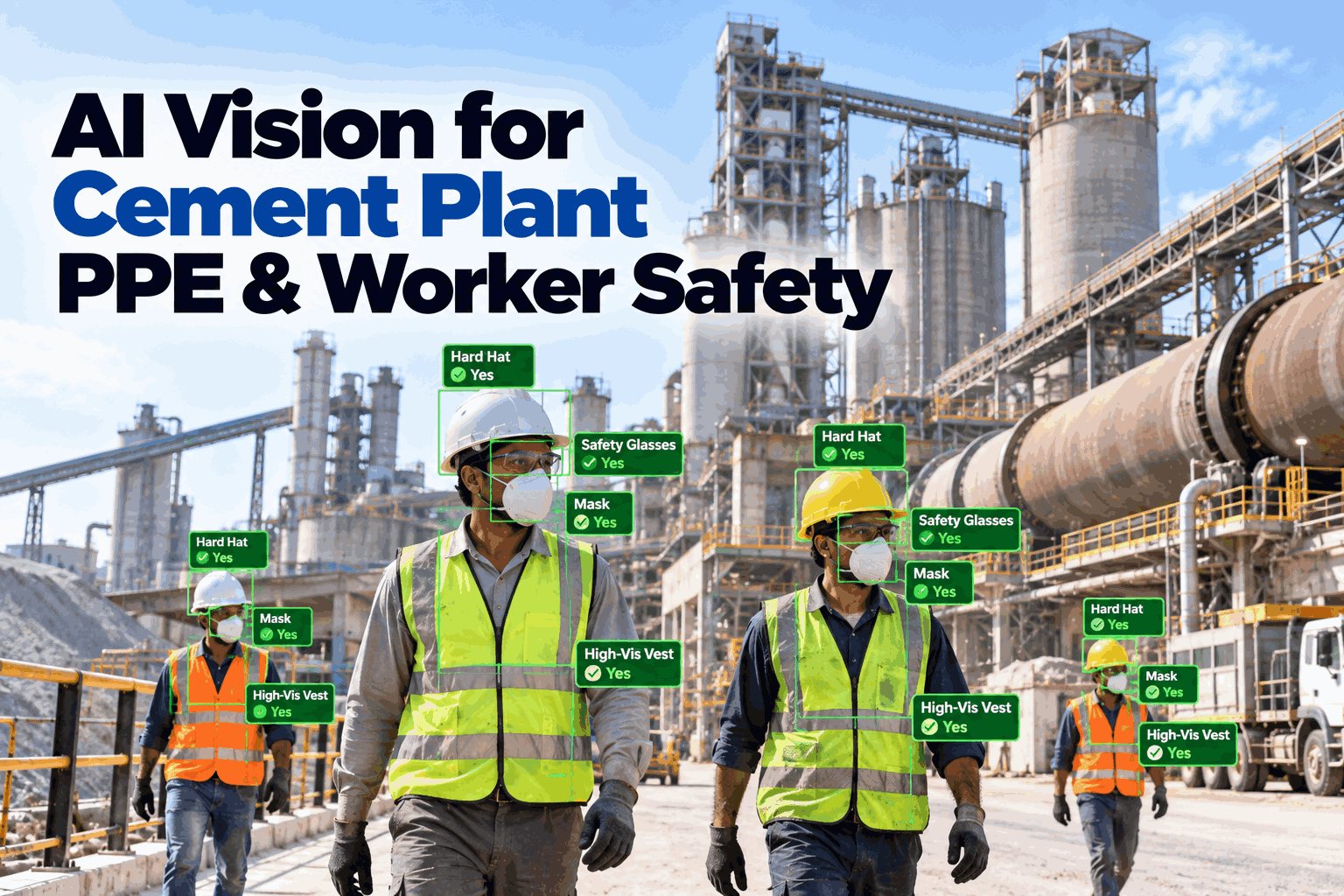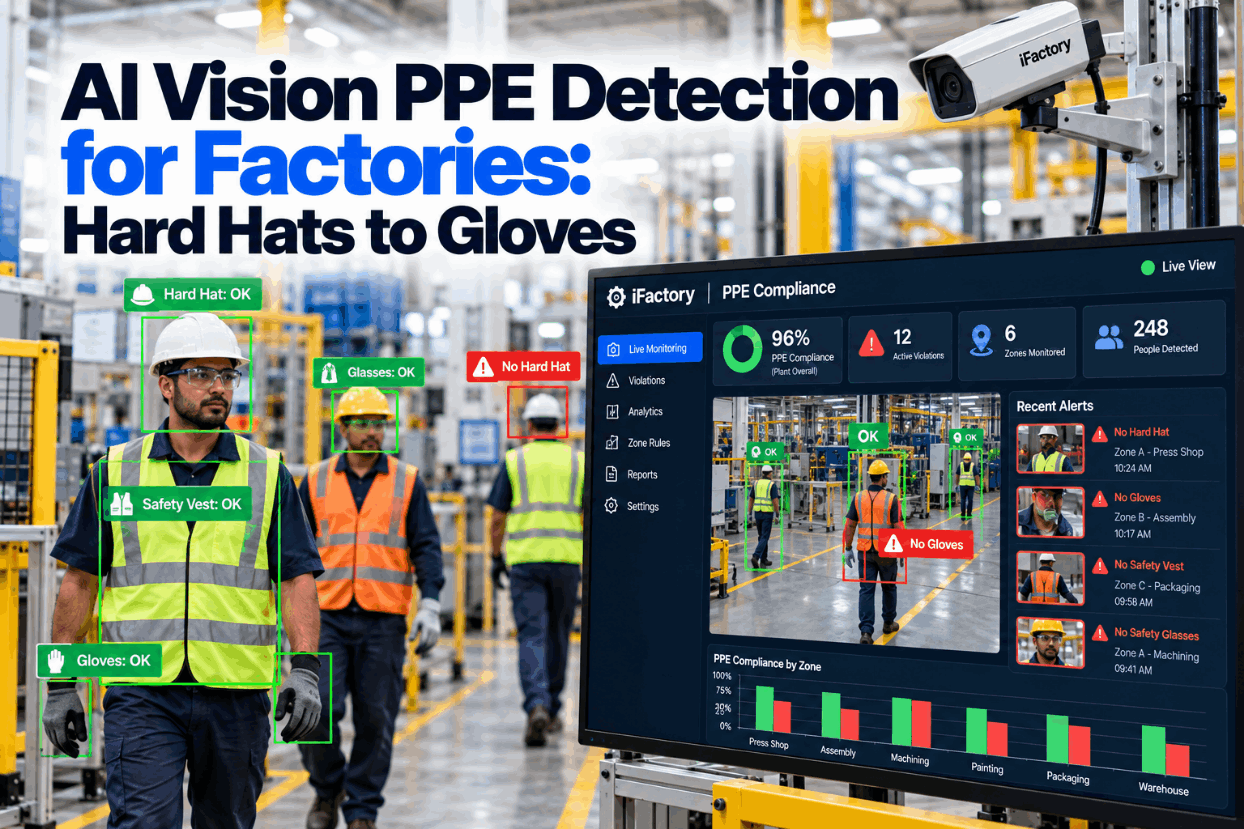
A contractor walks onto the press line without safety glasses. The camera above the aisle saw it, but nobody watches forty feeds at once, and the supervisor finds out at the weekly audit, if at all. This guide shows how AI vision PPE detection checks hard hats, glasses, vests, gloves and hearing protection by zone. See it on a live camera feed.
AI Vision PPE Detection for Factories: Hard Hats to Gloves
Existing CCTV feeds are analyzed on an on-site server. Each zone has its own PPE rules, alerts reach the area supervisor in seconds and compliance trends are shown by shift without naming individuals.
- Why audits miss most PPE gaps
- How zone rules follow your hazard assessment
- How to keep alerts useful and workers on side
Why PPE Audits Miss Most Gaps
Spot checks see minutes. Cameras see the shift.
OSHA 1910.132 requires a written hazard assessment and the right PPE for each hazard, and eye and face protection featured in OSHA’s FY2025 list of most-cited standards. Yet most plants still check compliance with a clipboard walk once or twice a week. People behave differently when the auditor is in sight, and a weekly report cannot correct today’s habits. Our vision engineers can review your current audit data.
Sampling gap
An audit covers a few minutes per area, per week.
Observer effect
People comply when the auditor is visible.
Late feedback
A weekly report cannot change today’s behavior.
No zone logic
One rule for the whole plant causes false alarms.
What AI Vision Checks, Zone by Zone
Rules follow the hazard assessment, not the camera.
A hard hat rule that makes sense under an overhead crane is noise in a packing hall. AI vision works best when each camera zone carries exactly the PPE your hazard assessment requires there, and nothing more. Map your zones in a zone mapping session.
Small items need close-range cameras or entry gate checks rather than wide ceiling views. Set higher confidence thresholds for them and treat early results as coaching data until accuracy is proven on your floor.
How Detection Works on Existing Cameras
Five steps, all on your own server.
Most plants already have enough cameras. The vision model runs on the on-prem server, finds each person in the frame, checks the PPE required in that zone and confirms the gap over several frames before alerting. Nothing is streamed off site. Questions about camera fit go to our support desk.
Stream
RTSP feeds from existing CCTV.
Find people
Each person tracked in the zone.
Check PPE
Zone rules applied per person.
Confirm
Gap held over several frames.
Alert
Supervisor notified with a blurred clip.
Turn Camera Feeds into PPE Compliance
Start with the zones where a missing item could cause the worst injury. Most pilots cover eight to twelve cameras.
Privacy and Worker Trust
Coach behavior. Do not watch people.
PPE detection only works if workers see it as a safety tool, not surveillance. The safest designs blur faces, report trends by zone and shift rather than by name, and are agreed with worker representatives before the first camera goes live. Agree the ground rules in a privacy workshop.
Built in by default
- Faces blurred in every stored clip
- Trends by zone and shift, not by person
- Video processed on-site only
- Clips kept for a short, agreed period
Agree before go-live
- Which zones and PPE are monitored
- Who can view clips and why
- How alerts are used in coaching
- How workers can raise concerns
Alert Design That Supervisors Will Use
Too many alerts and people stop looking.
The fastest way to kill a vision project is to send every detection to a phone. Good alert design groups events, confirms them and sends each one to the person who can act. Our vision team tunes these rules with you during the pilot.
Persistence
A gap must last several seconds before it counts.
Area owner
Alerts go to the supervisor of that zone only.
One event
One alert per person per event, not per frame.
Repeats
Repeat gaps at the same gate go to the coordinator.
Shift report
Supervisors get one short list at shift end.
Conditions
Missing PPE stock or broken dispensers raised as jobs.
Measuring PPE Compliance
Three numbers that show real change.
Take a baseline in the first two weeks, before alerts are switched on, then track the same numbers weekly. This shows whether alerts are changing behavior or just adding noise. Agree the measures in a pilot planning call.
Compliance by zone and shift
The share of person-time in each zone with the required PPE, before and after alerts.
Repeat gap locations
Gates and areas where gaps keep happening, which usually point to a condition to fix.
Alert precision
The share of alerts supervisors confirm as real. Low precision means rules need tuning.
Repeated glove gaps at one station often mean the gloves are wrong for the task or the dispenser is empty. Fixing that does more than another reminder.
PPE Vision Mistakes to Avoid
Vision is a tool, not a policy.
Most problems with PPE detection come from rollout choices, not the model. A short readiness check covers camera angles, zone rules and the privacy agreement before go-live.
What works
- Zone rules from the hazard assessment
- Faces blurred and trends anonymized
- Alerts to the area supervisor only
- Gaps traced back to conditions
What fails
- One rule for every camera
- Alerts sent to everyone
- Using clips to discipline individuals
- Ignoring empty PPE stations
How iFactory Runs AI Vision PPE Detection
AI Vision on a turnkey NVIDIA server.
iFactory analyzes your existing CCTV feeds on an on-prem AI server inside the plant. PPE rules are set per zone, alerts go to supervisors in seconds and anonymized compliance trends are shown by shift. Fit questions go to our solutions team.
Zone rules
PPE requirements set per camera zone from your hazard assessment.
Existing cameras
Standard RTSP feeds, no new cameras for most zones.
Real-time alerts
Confirmed gaps sent to the area supervisor with a blurred clip.
Shift trends
Compliance by zone and shift, without names.
Gate checks
Close-range checks for gloves, respirators and hearing protection.
Privacy by design
Face blurring, short retention and on-site processing.
Accuracy depends on camera angle, lighting, distance and the PPE item. We measure detection precision and compliance trends on your own feeds during the pilot, rather than promising a general figure.
Turnkey AI: Delivered, Connected and Live in 6–12 Weeks
You do not build this. It arrives ready.
iFactory ships as a pre-configured NVIDIA AI server with the software pre-loaded, racked and ready. Rack it, plug in power and Ethernet, and the AI is live on your network. Our team handles cabling, network setup, PLC, SCADA and CMMS integration, camera onboarding and zone mapping, operator training and 24×7 remote monitoring. Data stays on your network. For a scope matched to your plant, request a turnkey quote.
Ship, network and data
Server installed. Camera feeds connected. Zones and hazard assessment loaded.
Model tuning and pilot
PPE rules tuned per zone. Alerts run beside supervisors in one area.
Go-live and training
Live across agreed zones. Supervisors trained. 24×7 monitoring begins.
Frequently Asked Questions
What is AI vision PPE detection?
It is software that analyzes camera video to check whether people in a zone are wearing the PPE that zone requires, and alerts a supervisor when they are not.
Do we need new cameras?
Usually not for hard hats and vests. Small items like gloves and earplugs may need close-range cameras at zone entry points.
Does video leave our plant?
No. Video is processed on an on-prem server inside your network.
Will workers be identified?
By default, faces are blurred and trends are reported by zone and shift, not by name.
Can it handle different rules in different areas?
Yes. Each camera zone carries its own PPE rules based on your hazard assessment.
How accurate is it?
It depends on angle, lighting and the item. Hard hats and vests are detected more reliably than gloves or earplugs, which is why we measure accuracy on your own cameras first.
How do we start?
Pick two or three high-risk zones with good camera views and run a short pilot. To plan it, contact our team.
Check PPE Compliance on Every Shift
In thirty minutes we look at your camera layout, hazard assessment and where PPE gaps cause the most risk. You keep the notes either way.
- 1A camera list with locations
- 2Your written PPE hazard assessment
- 3A plant map with zones
- 4Your last PPE audit results
- 5One incident where PPE was missing