A gowning deviation in a Grade A aseptic fill zone carries one of the highest contamination risk profiles in pharmaceutical manufacturing. A glove not double-checked, a visor raised to speak, a technician entering through the wrong airlock sequence — these aren't disciplinary events. They're contamination vectors that, if not detected in real time, become batch rejection events, investigation reports, and potential regulatory findings. Manual gowning audits run on spot-check schedules. CCTV footage is reviewed after something goes wrong, not before. The gap between the deviation and its detection is where the contamination risk lives — and it's a gap that is entirely closeable with AI vision monitoring running continuously across every zone. iFactory Vision Compliance Monitoring is built for exactly that — every zone, every gowning element, every behaviour, live.
iFactory Vision Compliance Monitoring — Pharmaceutical
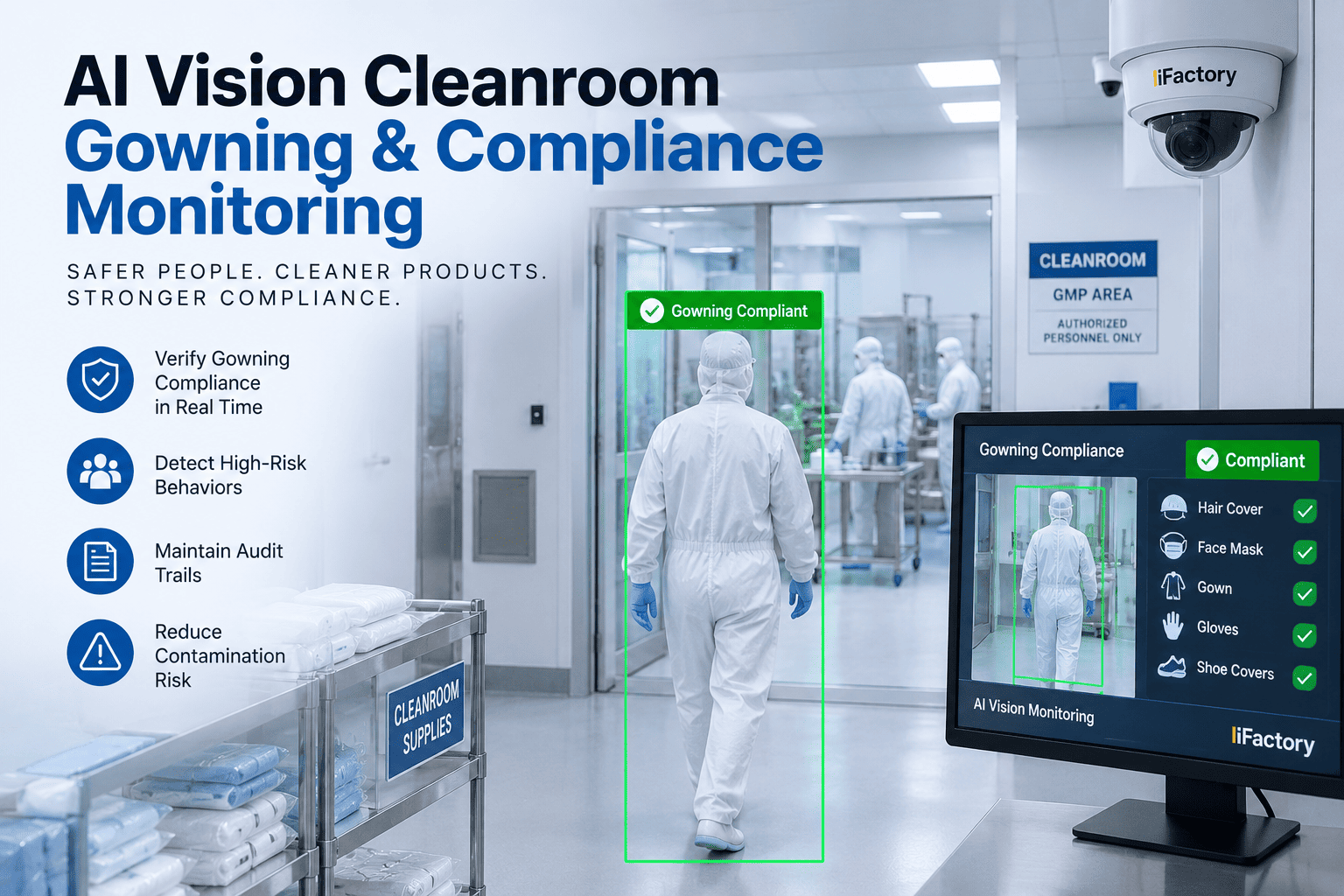
AI Vision Cleanroom Gowning & Compliance — Live Across Every Zone
Gowning compliance, behaviour monitoring, and contamination risk detection running continuously across aseptic and controlled zones — with an audit trail that closes investigation gaps before an inspector opens one.
Continuous
monitoring — not spot checks scheduled by shift
Real-time
alert on gowning deviation before zone is contaminated
Full trail
timestamped video log per person, per zone, per batch
GMP-ready
audit reports aligned to EU GMP Annex 1 and FDA 21 CFR
Why Manual Gowning Audits Leave Compliance Gaps
Manual gowning audits and retrospective CCTV review are not monitoring — they are sampling. They tell you what was observed in the moments someone was looking. They do not tell you what happened between observations. In an aseptic manufacturing environment, those gaps are the highest-risk periods in the production day.
01
Spot-check frequency
Gowning audits run once or twice per shift. The other 22 hours of a 24-hour operation are unobserved. Behaviour that passes inspection may not be the behaviour that runs the rest of the time.
02
Observer effect
Compliance improves when an auditor is present. That's not a monitoring result — it's a performance. AI vision monitors the same way whether an auditor is in the room or not.
03
Retrospective CCTV review
Footage is reviewed after a contamination event or batch rejection. By the time the deviation is found on tape, the affected product may already be at the fill-finish stage or beyond.
04
Incomplete audit trail
Manual logs record who was audited and when. They do not capture what each person was doing between audit points — leaving the investigation trail incomplete when a contamination event is traced back.
05
Multi-zone coverage gap
One QA person cannot simultaneously monitor a Grade A filling zone, a Grade B background, and the adjacent Grade C preparation area. AI vision covers every zone simultaneously, continuously.
The Live Compliance Dashboard — What Every Zone Should Show
Plant-wide cleanroom compliance visibility means every zone reporting gowning status, behaviour flags, and personnel count live — with deviations surfaced before they become contamination events. This is what a multi-zone monitoring dashboard looks like across a sterile manufacturing facility.
Grade A — Fill Zone 1
Aseptic fill / isolator
Compliant
Personnel in zone2authorised: max 3
Gowning statusFullall elements verified
Behaviour flags0last 4 hours
Airlock compliance100%this shift
Grade B — Background
Aseptic preparation area
Deviation
Gowning flagVisorraised — 14:22:07
Alert statusSentsupervisor notified
Personnel in zone4authorised: max 5
Behaviour flags1this shift
Grade C — Preparation
Component prep / washing
Compliant
Personnel in zone6authorised: max 8
Gowning statusFullall elements verified
Behaviour flags0last 8 hours
Airlock compliance100%this shift
Gowning Airlock — Entry
Grade B / C change area
OOC — sequence breach
Sequence breachDetectedwrong entry order — 14:51
Gowning incompleteGlovessecond pair not applied
Alert sent14:51:03QA + supervisor
Video clipSavedinvestigation record
What AI Vision Monitors — Every Gowning Element, Every Behaviour
Cleanroom compliance is not a single checklist item — it is a continuous state across multiple gowning elements, movement behaviours, and zone protocols. AI vision monitors each one independently and simultaneously, across every zone, without fatigue or observer-effect distortion.
Gowning — PPE elements
Full gowning verification on entry
Coverall, hood, face mask, visor, gloves (inner and outer), overshoes — each element verified present and correctly applied at the airlock before the person is logged as compliant to enter the zone. Missing or misapplied elements trigger an alert before entry completes.
Gowning — in-zone integrity
Continuous gowning integrity in the zone
Gowning can degrade after entry — visors raised to speak, gloves removed, masks lowered. AI vision monitors each person's gowning state continuously while they are in the zone, not only at the point of entry.
Behaviour — zone protocols
Airlock sequence and zone boundary compliance
Correct airlock entry and exit sequences, dwell times, and inter-zone movement rules are monitored in real time. Sequence breaches — both doors open simultaneously, wrong-direction entry, skipped sanitisation steps — are flagged immediately.
Behaviour — contamination risk
High-risk behaviour detection
Touching non-sterile surfaces, leaning over open product containers, reaching across classified zones, and non-ergonomic handling postures are monitored as contamination risk behaviours — flagged in real time, logged with clip and timestamp.
Occupancy — zone limits
Personnel count and dwell time per zone
Maximum occupancy per zone is enforced in real time. Dwell time per person is tracked against standard operating procedures. Excess occupancy and unauthorised extended dwell trigger alerts before environmental monitoring counts are affected.
Audit — investigation trail
Timestamped video record per deviation event
Every detected deviation — gowning element, behaviour, sequence breach — is saved as a timestamped video clip linked to the person, zone, batch, and shift. The investigation trail is complete before the QA review starts, not assembled from memory and manual logs after the fact.
ZONES COVERED
Cleanroom Classification Coverage — Grade A Through Grade D
Each ISO classification and EU GMP grade carries different monitoring requirements. The contamination consequence of a deviation in a Grade A aseptic zone is orders of magnitude greater than in a Grade D corridor — and the monitoring intensity should reflect that. iFactory Vision Compliance Monitoring is configured per zone class, not as a single standard across the facility.
Grade A / ISO 5
Aseptic fill, isolator, LAF workstation
Continuous gowning integrity monitoring
Immediate alert on any element deviation
Every behaviour logged with clip
Airlock sequence enforced — no bypass
Personnel count: max 2–3, enforced live
Grade B / ISO 7
Aseptic background, preparation
Gowning verification on entry + in-zone monitoring
Behaviour and movement monitoring
Airlock compliance tracked
Deviation alert within 5 seconds of detection
Dwell time tracked per person
Grade C / ISO 8
Washing, component prep, secondary gowning
Gowning verification on entry
Occupancy monitoring and limit enforcement
Zone boundary crossing tracked
Shift-level compliance summary generated
Audit report export on demand
Grade D / ISO 8+
Corridor, material transfer, ancillary
Entry gowning check
Material transfer protocol monitoring
Zone boundary compliance
Personnel authorisation cross-check
Traffic pattern and flow analysis
Want to see how monitoring intensity maps to your zone classification? Book a demo — bring your facility layout and we'll walk through zone-by-zone configuration live.
How AI Vision Compliance Monitoring Works — From Camera to Audit Trail
The distance between a camera on a cleanroom ceiling and a complete, audit-ready investigation trail is five operational steps. Each one closes a gap that manual monitoring leaves open.
01
Continuous Capture
Ceiling-mounted cameras monitor all zones continuously — no scheduled check intervals. Edge processing runs the AI model locally inside the cleanroom boundary, no images leave the facility network.
02
Gowning Detection
AI model identifies each gowning element — coverall, hood, visor, mask, gloves, overshoes — and verifies presence and correct application in real time. Each element tracked independently.
03
Behaviour Analysis
Movement, posture, zone boundary activity, airlock sequences, and contamination-risk behaviours analysed continuously. Deviations from defined SOPs flagged by type and severity.
04
Alert & Escalation
Deviation alert routed by severity and zone — immediate on-screen for Grade A, supervisor push for Grade B/C, shift summary for Grade D. Every alert includes zone, person, time, and video clip.
05
Audit Trail
Every event — compliant entry, deviation, alert response — stored with batch, shift, zone, and video. Audit report generated on demand. Investigation starts with a complete record, not a manual reconstruction.
Regulatory Alignment — What the Monitoring Record Closes
Compliance monitoring in pharmaceutical manufacturing is not a quality initiative — it is a regulatory requirement. The audit trail generated by AI vision monitoring directly addresses the documentation expectations of the major regulatory frameworks governing aseptic manufacturing.
EU GMP Annex 1 (2023)
Section 4.3: personnel training and behaviour monitoring
Section 4.6: contamination risk from personnel activities
Section 4.36: gowning qualification and ongoing compliance
Contamination Control Strategy (CCS) documentation
FDA 21 CFR Part 211
§211.28: personnel hygiene and gowning requirements
§211.68: automatic equipment monitoring requirements
§211.192: production record review and investigation support
Data integrity for electronic monitoring records (21 CFR Part 11)
ICH Q10 Pharmaceutical Quality System
Continual improvement — proactive monitoring vs reactive investigation
CAPA system support — root cause evidence from monitoring record
Change management — compliance impact of facility or procedure changes
Senior management review — facility compliance trend reporting
WHO GMP / PIC/S
Aseptic manufacturing personnel discipline requirements
Environmental monitoring programme — personnel as contamination source
Qualification of monitoring systems and audit trail integrity
Inspection readiness — complete contemporaneous monitoring record
Want to see how the monitoring record maps to your specific regulatory framework? Talk to our pharma compliance team — we'll walk through the Annex 1 and 21 CFR documentation requirements against your facility.
What AI Vision Compliance Monitoring Delivers
The value of continuous AI vision monitoring is not the camera footage — it's the shift from reactive investigation to proactive detection. These are the operational and regulatory outcomes facilities see after moving from manual spot-check audits to live monitoring across every zone.
Continuous
Zone coverage
vs spot-check audits once or twice per shift
<5 sec
Deviation to alert
before the person moves further into the zone
Complete
Investigation trail
video clip + metadata — no manual reconstruction
Annex 1
Audit-ready
reports aligned to EU GMP, FDA 21 CFR, and ICH Q10
Frequently Asked Questions
Does the system identify individual people in the cleanroom?
The system can operate in two modes. In person-linked mode, it associates each monitoring record with an authorised person ID — linked from gowning room entry badge scan or biometric — so every deviation record carries a person tag for investigation purposes. In aggregate mode, it monitors gowning compliance and zone behaviour without individual identification, logging events by zone, time, and gowning element rather than by person. Which mode is deployed depends on your regulatory requirements and local data protection framework. Both modes produce a complete audit trail — they differ in how events are attributed.
How does it handle the varied gowning requirements across different zone classifications?
Each zone has its own monitoring profile — the set of gowning elements required, the behaviour SOPs that apply, the occupancy limits, and the alert severity thresholds. Grade A monitoring verifies all seven standard elements (coverall, hood, visor, mask, inner gloves, outer gloves, overshoes) and flags any deviation immediately. Grade C monitoring may verify coverall, hood, and gloves only, with a lower alert priority. The zone profiles are configured to match your existing SOPs — the AI doesn't redefine your gowning standard, it monitors against it.
Does image processing happen inside our facility, or does data leave the network?
All AI inference runs on edge hardware installed inside the cleanroom infrastructure — no images, video frames, or person data are transmitted to a cloud server or external network. The monitoring result (a compliance flag, a deviation event, a zone count) is what passes to the dashboard and audit log. This architecture satisfies the data sovereignty and GxP data integrity requirements of most pharmaceutical manufacturers without requiring additional data processing agreements.
How is the system qualified for GMP use?
iFactory Vision Compliance Monitoring ships with an IQ/OQ/PQ qualification package aligned to GAMP 5 Category 4 (configured product). The qualification documentation covers installation verification, detection rate performance qualification against your gowning SOPs, and process qualification across your zone classification set. The system's audit trail is built to 21 CFR Part 11 requirements — timestamped, access-controlled, tamper-evident, and exportable for regulatory submission.
Can we see it running on our facility layout before committing?
Yes. Bring your facility floor plan, zone classification map, and existing gowning SOPs. We'll design the camera coverage plan per zone, show you the monitoring profile for each classification, and run a demonstration on reference cleanroom footage that matches your gowning standard and zone layout. Book a demo and we'll walk through your facility configuration live.
Stop investigating deviations after the batch is closed.
See Live Cleanroom Compliance Monitoring on Your Facility
Bring your facility layout, zone classification map, and gowning SOPs. We'll design zone-by-zone camera coverage, show you the gowning and behaviour monitoring profiles for each classification, and walk through the audit trail format against your regulatory requirements.