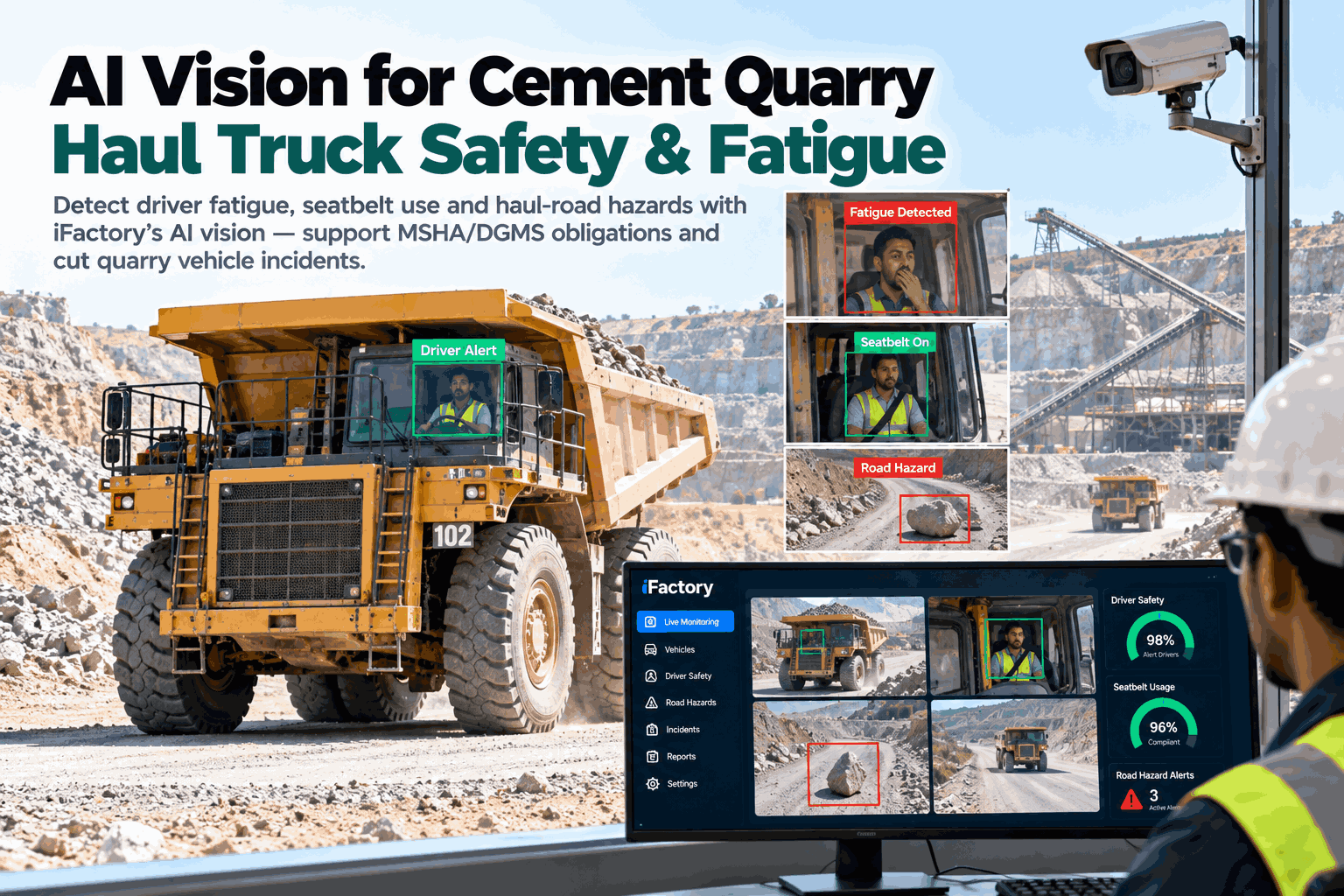
Haul trucks run long, repetitive shifts on steep roads, often at night, and a few seconds of lost attention is enough for a serious incident. iFactory's AI Vision and Safety Analytics watch for fatigue, seatbelt use and hazards on the haul road, and raise the alarm while there is still time to act. To see it on your own quarry, book a quarry safety review.
AI Vision for Cement Quarry Haul Truck Safety and Fatigue
In-cab and haul road cameras that spot fatigue, seatbelt use and road hazards in real time, alert the driver and the control room, and keep a record that supports MSHA and DGMS duties.
- Where haul truck incidents start, through the whole haul cycle
- What the cameras watch for, and who gets alerted
- Privacy and trust built in from the start
People and light vehicles near the shovel. Truck spotting and position.
Speed, spacing and spillage. Seatbelt on before moving.
Reversing to the edge. Berm in place. People nearby.
The quietest leg, and where tired drivers drift. Eyes and head watched closely.
Hours since the last break. Long waits and short naps in the cab.
Stages 3 and 4 are highlighted because they combine the highest consequences with the least demanding driving, a common pattern for fatigue.
Where Haul Truck Incidents Start
Most serious haul truck incidents begin with something a camera can see.
A driver's eyes closing on a downgrade. A seatbelt left off for a short trip. A loose rock on a ramp at night. None of these is rare, and each one usually happens many times, quietly, before the day it finally ends badly. Catching them early, and every time, is the whole point. Our support team can map these hazards to your quarry layout.
For every serious incident, there are usually many smaller events that nobody reported: a nod-off that came to nothing, a seatbelt left off for one load. Counting them is the clearest picture a quarry can have of where the next incident will come from.
Leading indicators worth tracking
- Fatigue events per 1,000 driving hours
- Share of moving time with seatbelt on
- Road hazards found, and time to clear them
- Time from alert to supervisor response
Why they beat incident counts
- They move every week, not once a year
- They show where risk is building
- They reward fixing causes, not luck
- They give drivers something to improve
How the AI Vision Works
Two kinds of camera: one on the driver, one on the road.
An in-cab camera faces the driver and watches for signs of fatigue, distraction and a missing seatbelt. Cameras on the trucks and at fixed points such as ramps, the crusher and dump edges watch the road and the people around it. All video is analysed on a server at the quarry itself, so nothing has to travel off site to raise an alert. To see the alerts in action, book a live demo.
See
Cameras pick up eyes, head position, seatbelt, road and people.
Judge
The model checks how long it lasted and how risky the moment was.
Alert the driver
A sound or seat vibration in the cab, within a second or two.
Escalate
Repeats or serious events go to the control room or supervisor.
Record
A short clip and the facts, kept for review and coaching.
Learn
Patterns by shift, route and hour shown to safety managers.
Drivers stop listening to a system that buzzes for every blink. Alerts here depend on how long the sign lasts and what the truck is doing, so a long eye closure on a steep downgrade counts for far more than a quick glance while parked.
Many quarries already fit proximity warning or collision avoidance systems to their trucks. Those systems sense nearby vehicles and people. Driver-facing vision watches the driver. The two cover different risks and work well together.
One Night Shift, Counted
A shift that looks quiet on paper often holds several close calls. Here is what the cameras recorded on one illustrative night.
Supporting MSHA and DGMS Obligations
The rules already ask for seatbelts, rest and safe roads. The cameras help show they happen.
Both US and Indian mine safety rules place clear duties on quarry operators around haul trucks. The platform does not replace those duties, and it does not certify compliance. It gives managers a running record of what happened on the haul road, shift by shift, which makes the duties easier to meet and much easier to show to an inspector. Ask our compliance specialists how it fits your safety programme.
United States, MSHA
- Seatbelts must be provided and worn in haulage trucks, under 30 CFR 56.14131
- Mines must have written safety programmes for surface mobile equipment, under MSHA's newer rule
- Those programmes must identify hazards and risks, with miners' input
- Powered haulage has been a long-running MSHA safety focus
India, DGMS
- No more than 5 hours of continuous work before a rest, under the Mines Act
- All heavy earth-moving machinery operators to wear seatbelts
- Haul road gradient no steeper than 1 in 16
- Machines kept in good order with safety features working
From 30 CFR 56.14131, MSHA's surface mobile equipment rule page and DGMS Safety Alert 17/2024. Check current rules and your own permits with your safety and legal teams.
Many cement quarries rely on contractor haulage. Their trucks and drivers carry the same risks and often the same legal duties. Fitting cameras to contractor fleets, with the contractor's agreement, keeps one standard across the whole haul road.
Fatigue: Treat the Cause, Not Just the Alarm
A fatigue alert saves a moment. Fatigue patterns fix the roster.
An in-cab alert can wake a driver in time, but the real gain comes from asking why so many alerts happen at 4 a.m., or on one route, or in the last two hours of a long shift. The platform shows those patterns so managers can change the work itself, not just react to each alert as it comes. To look at your own shift patterns, book a fatigue review.
By hour
Fatigue events plotted across the shift. Most quarries see a clear peak in the hours before dawn.
By route
Long, easy, downhill legs often show more events than the hard ones do.
By roster
Events tend to rise after runs of night shifts or short breaks between shifts.
Changes that often help
- Rest breaks timed to the pre-dawn low
- Rotating drivers off long, monotonous routes
- Fewer consecutive night shifts
- A rest bay that is quick to reach
What to avoid
- Using alerts mainly to discipline drivers
- Ignoring repeated alerts from one driver
- Treating fewer alerts as proof without checking cameras work
- Changing rosters without asking the drivers
Privacy, Trust and Where It Runs
Drivers need to trust the camera before it can keep them safe.
A camera facing a driver for a whole shift is a big ask, and drivers are right to ask how it will be used. The platform is designed to make it a fair arrangement. Video is analysed on a server at the quarry, only short clips around events are kept, and access is limited by role. We recommend agreeing the rules with drivers and their representatives before go-live. Our integration team can walk your safety and IT leads through the set-up.
How privacy is protected
- Video analysed on site, never sent to the cloud
- Only short clips around events are kept
- Clips seen only by the roles you approve
- Retention periods set by your policy
What it connects to
- In-cab and forward cameras on each truck
- Fixed cameras at ramps, crusher and dump edges
- Fleet or dispatch systems, for truck and route
- Shift rosters, for hours since the last break
One system, three views
- Driver. In-cab alerts, and their own record for coaching.
- Control room. Live events by truck, with location.
- Safety manager. Patterns by shift, route and hour.
Alerts support people. Decisions stay with supervisors.
Turnkey AI: Delivered, Connected and Live in 6–12 Weeks
You do not build this. It arrives ready.
iFactory ships as a pre-configured NVIDIA AI server, racked and ready, with the software pre-loaded. Rack it, plug in power and Ethernet, and the AI is live on your network.
Our team handles cabling, network setup, PLC and SCADA integration, operator training and 24×7 remote monitoring. The server sits inside your own network, so camera footage and driver data stay on site. For a scope matched to your quarry, request a turnkey quote.
Ship, network and data
Server installed. Cameras fitted to pilot trucks and key road points. Privacy rules agreed with drivers.
Model training and pilot
Alerts tuned to your trucks, roads and lighting. Drivers and supervisors give feedback on every alert type.
Go-live and training
Whole fleet added. Drivers, control room and safety staff trained. 24×7 remote monitoring begins.
Frequently Asked Questions
How does AI detect driver fatigue?
An in-cab camera watches the driver's eyes and head. Long eye closures, nodding and repeated yawning are signs of fatigue. The system weighs how long each lasts and what the truck is doing at the time, then alerts the driver and, if it repeats, a supervisor.
Does it work at night and in dust?
In-cab cameras use infrared light, so they work in the dark and through most sunglasses. Road cameras are placed and tuned for your lighting and dust. Performance is checked during the pilot, on your own roads and at your own times of day, before the fleet goes live.
Does it help with MSHA or DGMS compliance?
It supports it. It records seatbelt use, driving hours and road hazards, which helps meet duties on seatbelts, rest and safe roads, and helps show what was done. It does not replace your safety programme or certify compliance.
What about driver privacy?
Video is analysed on site and only short clips around events are kept. Who can see them, and for how long, is set by your own policy and local law. We recommend agreeing these rules with drivers and their representatives before go-live, and writing them down.
Will drivers be disciplined for every alert?
That is your decision, but we advise against using alerts mainly for discipline. Quarries that use alerts mainly for coaching and roster changes tend to get better results and more trust from drivers than those that use them mainly for discipline.
Can it work with our existing cameras?
Fixed cameras already on site can often be used for road and dump edge monitoring. In-cab fatigue detection usually needs a driver-facing infrared camera, fitted to each truck during the pilot. Fitting takes a few hours per truck and is planned around the shift pattern, so the fleet keeps running.
How long does it take to go live?
Six to twelve weeks from delivery for a first group of trucks. We need a place for the server, network coverage on the haul roads or at the truck park, and time with drivers and supervisors. To check your set-up first, contact our team.
Bring Your Last Year of Haul Road Incidents
In thirty minutes we look at your incidents and near misses, where and when they happened, and which ones cameras would have caught early. You keep the review whether or not you go further with iFactory.
- 1Haul road incidents and near misses for a year
- 2A map of the quarry and its haul routes
- 3Your truck fleet: makes, models and number
- 4Your shift roster and break pattern
- 5Your current safety programme for mobile equipment