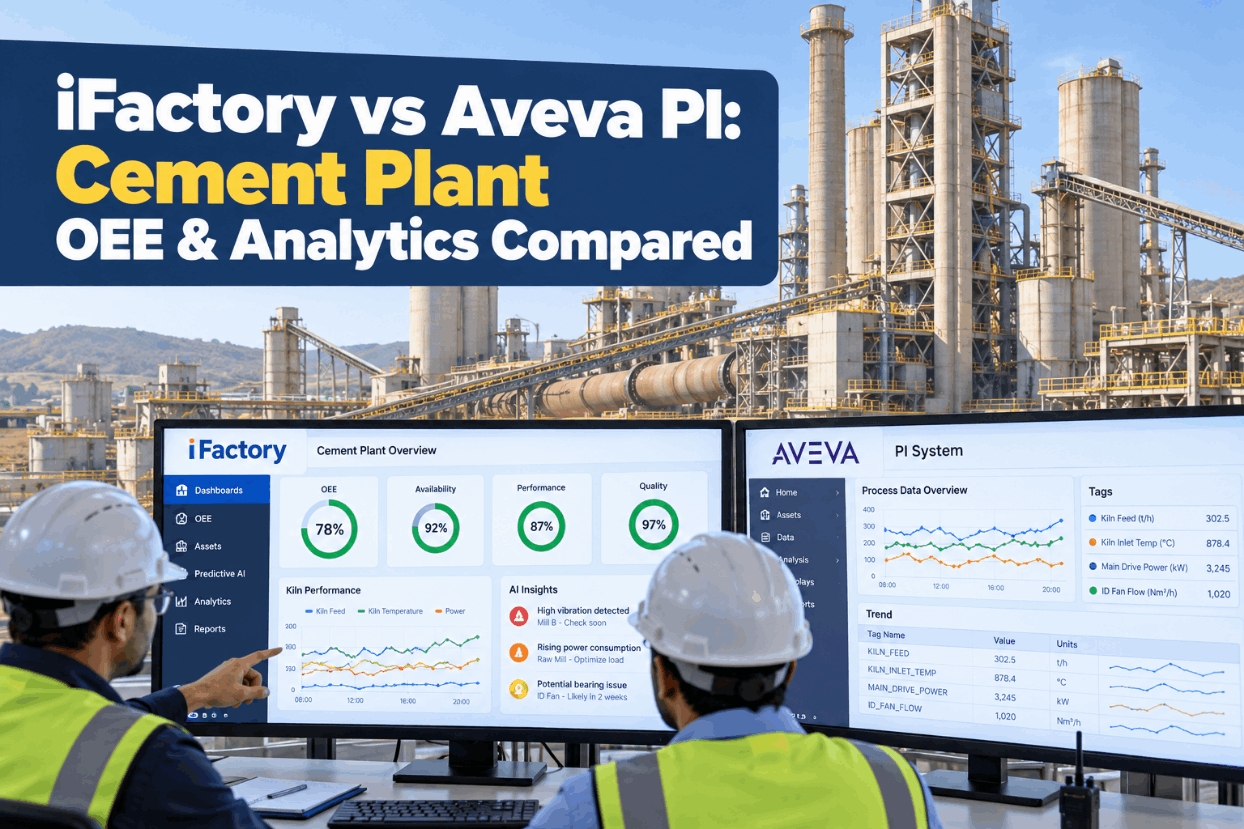
iFactory vs Aveva PI: Cement Plant OEE & Analytics Compared

By David Cook on October 28, 2026

ifactory-vs-aveva-pi-cement-oee-analytics

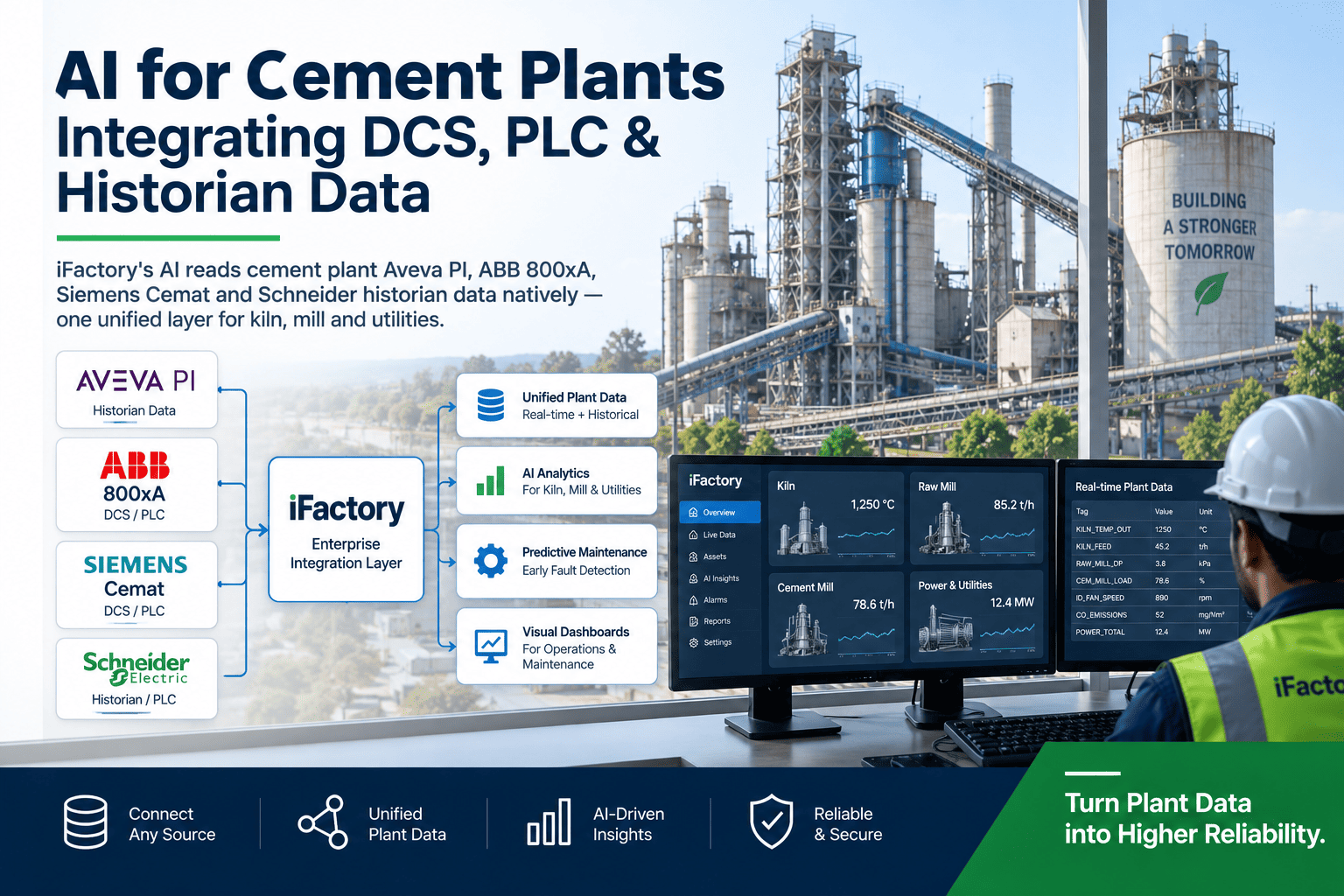
Cement producers that already run AVEVA PI System often face a fair question when AI analytics comes up: replace the historian, or build on it? For most plants the honest answer is neither extreme. PI is a proven data foundation, and iFactory is an OEE analytics and AI platform that can read the tags PI already holds. This guide compares the two on stated criteria for kilns, mills and quarries, shows where each one fits and is open about where PI alone is the better call. To see both working together on cement data, book a 30-minute walkthrough.

COMPARISON GUIDE · CEMENT OEE AND ANALYTICS

iFactory vs AVEVA PI System for Cement OEE and Analytics

AVEVA PI System collects, stores and adds context to plant data. iFactory turns that data into OEE losses and asset warnings on a turnkey on-site AI server. They do different jobs, and in many cement plants they run side by side.

iFactory
OEE analytics and AI platform
Turnkey on-site AI server Live in 6–12 weeks Prebuilt cement use cases Reads your existing PI tags
VS
AVEVA PI System
Operations data infrastructure
Enterprise data historian Asset Framework models PI Vision displays Large partner ecosystem
WHERE EACH ONE SITS

Two Products, Two Different Jobs in the Data Path

The clearest way to compare them is to follow one kiln signal from sensor to decision. PI System's job is to collect that signal, keep its history and serve it with context. AVEVA describes PI Server as an operations data store with Asset Framework for asset models, event frames for periods of interest, built-in analytics and notifications. iFactory's job starts after that point: turning the signal into OEE losses, failure warnings and a clear next step for a person. Our integration team can map this path for your own plant.

1Sensors and DCSKiln drive current, shell scanner zones, mill vibration, crusher powerYour control layer
2PI Data ArchiveTime-series history for every collected tagAVEVA PI System
3Asset FrameworkTags grouped by kiln, mill and crusher, with templatesAVEVA PI System
4OEE and AI modelsReads PI tags, works out losses and asset riskiFactory
5ActionShift alert, work request or note for the next reviewYour people
IFACTORY VS AVEVA PI CEMENT

Side by Side on Stated Criteria

This matrix compares what each product is and what it asks of the plant. It gives no scores and no competitor prices. AVEVA facts come from AVEVA's own product material. Where something is not public, the right move is to ask the vendor, and the last column suggests the question. Bring this list to a side-by-side review call.

Criterion
iFactory
AVEVA PI System
Question to ask
What it is
OEE analytics and AI platform for operations and reliability
Operations data infrastructure: PI Server, Asset Framework, event frames, PI Vision, PI Integrators
Which layer are we actually short of?
Deployment model
Turnkey on-premise NVIDIA AI server, racked and ready; live in 6–12 weeks
PI Server on-premises, with a containerised option for private cloud; links to AVEVA CONNECT for cloud scale
Where must data and models live?
Prebuilt cement content
Cement use cases for kilns, mills, crushers and vision, mapped to your tags in the pilot
General-purpose platform; cement asset models are built in AF templates by your team or a partner
Which cement references can we call?
AI and ML approach
Models run on the on-site server against live tags; alerts go to named people
Streaming calculations, analytics and notifications; PI Integrator for Business Analytics shapes data for outside BI and ML tools
Who builds and maintains the models?
OEE
OEE analytics is a core module
Usually built on AF and event frames, or with partner apps that read PI
Who owns the OEE logic after go-live?
Integration
Reads tags from PI, PLC and SCADA; sends work requests to CMMS and ERP
Hundreds of interfaces, connectors and adapters, in AVEVA's words; PI Web API for apps
Which tags and which APIs are in scope?
Needs from the plant
Rack space, power, Ethernet, read access to tags, one pilot owner
Server infrastructure, AF modelling skills, display builders, licences on AVEVA's terms
How many internal hours per month?
Pricing
Quoted per scope
Not public in a comparable form; ask the vendor
Price the same scope in writing
CEMENT PLANT AI OEE

Three Ways Cement Plants Get OEE From Their Data

OEE for a kiln or a cement mill is less about the formula and more about the states behind it: running, stopped, reduced feed or waiting on material. PI holds those signals well. The open question is who turns them into availability, performance and quality losses. AVEVA's own conference sessions show plants doing this with Asset Framework, event frames and partner tools, such as a shift log app that reads PI event frames so crews can confirm OEE data. Review your current OEE setup with our support engineers.

Build on PI
AF templates, event frames and PI VisionYour team or integrator defines kiln states, loss reasons and displays. Full control, with ongoing modelling work to keep it accurate.
Partner app on PI
A third-party OEE or shift tool reads PIOften quicker to start. Adds another licence, another vendor and another set of screens for crews.
iFactory on PI
OEE analytics reading your PI tagsKiln and mill states are mapped during the pilot, with AI warnings on top. PI stays the system of record.
Agree the loss rules before comparing any tool

Kilns run long campaigns, so planned refractory stops, feed cuts and coal mill trips can swing OEE sharply. Decide which stops count as planned, and how reduced-rate running is booked, before you judge any product's numbers.

Keep PI. Add the AI Layer on Top.

iFactory reads kiln and mill tags from your existing PI System, works out OEE losses and flags asset risk on a turnkey on-site server. PI remains your historian and system of record.

Morning review · Plant manager and iFactory
Plant managerKiln 2 OEE fell this week. Is it the kiln or upstream?
iFactoryMostly upstream. Two raw mill stops cut kiln feed, and that time is booked as reduced-rate running on Kiln 2.
Plant managerShow me the raw mill trend from PI.
iFactoryVibration rose before both stops. A bearing check is on today's maintenance list.
CEMENT USE-CASE COVERAGE

Five Cement Use Cases, Two Starting Points

Both products can play a part in each use case below, but they start from different places. PI gives you history and context; an analytics layer has to turn that into a warning someone acts on. Read this as a scoping guide, not a scorecard. Walk through your priority assets in a use-case scoping session.

Kiln shell and refractory
On PIShell scanner zones stored and trended; limits set with analytics and notifications
With iFactoryShell heat patterns read against refractory history to flag spots that are developing
Kiln and mill drives
On PIMotor current, gearbox and girth gear readings stored by asset
With iFactoryDrive health trends and anomaly warnings per drive, routed to maintenance
Vertical roller mill vibration
On PIVibration, feed rate and mill differential pressure trended together
With iFactoryVibration read against feed and grinding pressure to warn before a mill trip
Quarry and crusher
On PICrusher power and throughput, where those signals are collected
With iFactoryCrusher stops and slow running feed OEE upstream of the kiln
AI vision for clinker and belts
On PIPI is a time-series platform; ask AVEVA about partner options for camera analytics
With iFactoryCamera models for clinker and belt checks run on the same on-site server
WHEN AVEVA PI MAY BE THE BETTER FIT

Cases Where Investing in PI Itself Comes First

A fair comparison should say when the other product is the better choice. If the points below describe your plant, more effort in PI itself may beat adding a new layer now. AVEVA also sells separate operations and MES software, so ask AVEVA what it would propose. We are happy to talk it through openly with our support team.

A group-wide data standard is the goalMany sites need one tag and asset model before anything else
Strong PI skills already in houseAF modellers and PI Vision builders are on staff and have time
Key signals are not collected yetIf kiln and mill data is missing, fix collection before analytics
Cloud sharing across a groupAVEVA cites CONNECT and data lakes on Azure, AWS and Google Cloud
Records matter more than AI todayA long-term historian of record is the immediate need
Most plants: bothPI as the historian, an AI layer for OEE and reliability on top
CEMENT PLANT AI TCO

Cost Factors to Price Before You Choose

We don't publish competitor prices, and you should be wary of any comparison page that does. Licence models depend on tag counts, users and contract terms, and they change. What you can do is list every cost factor, then ask each vendor to price the same scope in writing. The last line uses assumed inputs only. For a written quote on your scope, talk to our team.

Software licences or subscriptionsAsk each vendor for the same scope
Server hardware and hostingiFactory server is part of the bundle; PI runs on your servers or cloud
Tag mapping and integrationHours from your team or an integrator
Model, OEE logic and display buildingWho does it, and who keeps it current
Annual support and model careWritten terms from each vendor
Training for crews and engineersHours per role, both products
Internal OEE report building, 16 h a month, assumed16 × 12 = 192 h a year, priced at your own rate

Add the value of fewer surprise kiln stops only when your own downtime records support a figure. Keep the two products' costs separate, since many plants keep paying for PI either way.

CEMENT PLANT AI RFP

Questions to Send Both Vendors

Use the same questions for both vendors so the answers line up. Ask for written answers and named cement references you can call. Our support team can send an editable copy.

ScopeKiln 1, raw mill, cement mill 2, primary crusher
Data sourceExisting PI Server and AF database
DeploymentOn-site only, or is cloud allowed?
Cement contentWhat is ready for kilns and roller mills on day one?
Model ownershipVendor, integrator or our engineers?
Time to valueWeeks to the first live warning, in writing
CostLicence, hardware, services and support per year
Proof12-week pilot with agreed success measures
TURNKEY AI DEPLOYMENT

An AI Server That Sits Beside Your PI Server

iFactory ships as a turnkey bundle. A pre-configured NVIDIA AI server ships racked and ready, connects to your PI Server and plant network, and runs OEE and reliability models on site, so no plant data has to leave the fence. You rack it, plug in power and Ethernet, and the AI is live. To size it for your kilns and mills, request a turnkey scoping call.

What's Included
  • Pre-configured NVIDIA AI server, racked and ready
  • PI tag connection and Asset Framework mapping
  • OEE analytics for kilns, mills and crushers
  • Reliability models for drives, mills and kiln shell
  • AI vision option for clinker and belt cameras
  • Alerts and work requests sent to your CMMS
  • 24×7 remote monitoring of models and hardware
Live in 6–12 weeks
Wk 1–4
Connect and Map

Server racked, PI tags and AF hierarchy mapped, OEE states agreed for each kiln and mill.

Wk 5–8
Shadow and Tune

Models run silently on live PI data while your engineers review every warning.

Wk 9–12
Go-Live and Review

Alerts switched on, weekly OEE reviews started, pilot success measures checked.

HOW iFACTORY FITS

An OEE and AI Layer That Respects Your Historian

iFactory is built to add value to the data you already collect, not to make you start again. Our support team can review your PI setup before any pilot.

1
Keeps PI as the system of record. Your historian, AF models and PI Vision displays stay as they are.
2
OEE from tags you already have. Kiln, mill and crusher states become availability, performance and quality losses.
3
AI on cement assets. Warnings for drives, roller mills and kiln shell reach the people who act on them.
4
On site by design. Models run on a turnkey NVIDIA server inside your plant network.
1000+
Industrial clients running iFactory
99.9%
Platform uptime for round-the-clock kilns
6-12 wks
From racked server to live OEE on PI data
FREQUENTLY ASKED QUESTIONS

What Cement Teams Ask When Comparing iFactory and PI

Does iFactory replace AVEVA PI System?
No, and for most plants it shouldn't. PI keeps doing what it does well: collecting, storing and adding context to plant data. iFactory reads those tags and adds OEE analytics and AI warnings on top. If you are weighing a PI replacement or add-on, start by asking which layer is missing. You can see it read live PI data in a short session.
Can AVEVA PI System calculate OEE on its own?
PI gives you strong building blocks for it: Asset Framework templates, event frames, analytics and PI Vision displays. Plants usually build OEE logic with those tools, or add a partner application that reads PI. AVEVA also sells separate operations software, so ask AVEVA directly what it would propose for your kilns and mills.
What does iFactory need from our PI Server?
Read access to the relevant tags and AF elements through standard interfaces, a network path from the iFactory server and a short list of priority assets. Nothing is written into your historian unless you choose to. You can check your PI setup with our support team before scoping.
How was this comparison put together?
AVEVA PI System facts come from AVEVA's own brochures, blog posts and conference sessions. We left out prices, deployment times and results for AVEVA because they are not public in a comparable form. Ask AVEVA for those directly and compare written answers.
Which cement assets should a pilot start with?
Pick one kiln line and the mill that feeds it, since kiln OEE often depends on upstream stops. Add the main drives and, if cameras already exist, one vision use case such as belt checks. You can plan a pilot with our team using your own PI tag list.
How long until we see results?
The turnkey server is typically live in 6 to 12 weeks, with a silent shadow phase before alerts go out, so your engineers can judge the warnings first. The fastest way to judge fit is to book a 30-minute demo on cement data.

Get More From the PI Data You Already Own

Keep AVEVA PI System as your historian and add OEE analytics and AI warnings for kilns, mills and crushers. The turnkey server runs on site and goes live in 6 to 12 weeks.
Example pilot scope · Cement plant
Data sourceExisting AVEVA PI System
AssetsKiln 1, raw mill, cement mill
OutputsOEE losses and asset warnings
HostingOn-site NVIDIA AI server
PI stays the system of record

Share This Story, Choose Your Platform!