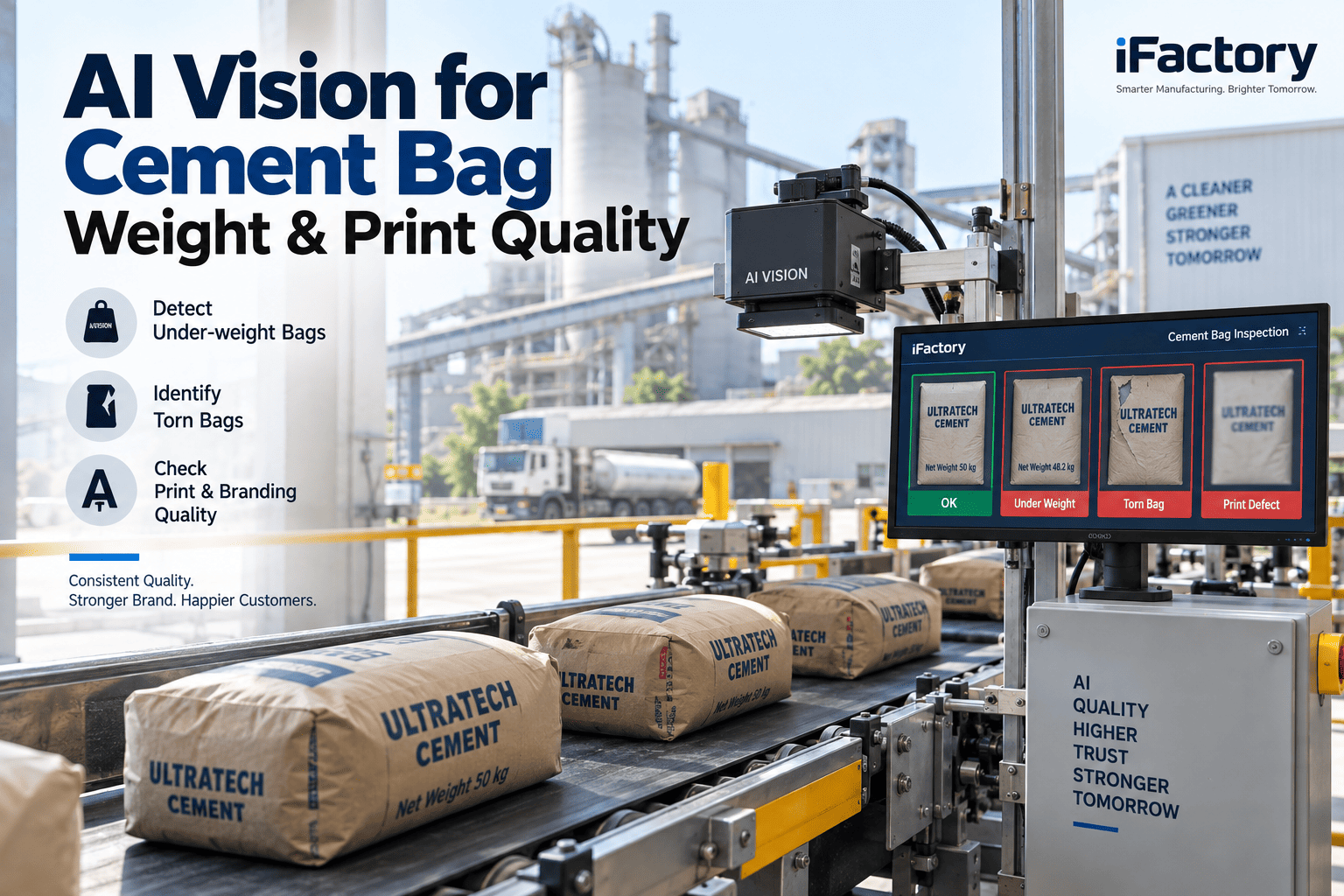
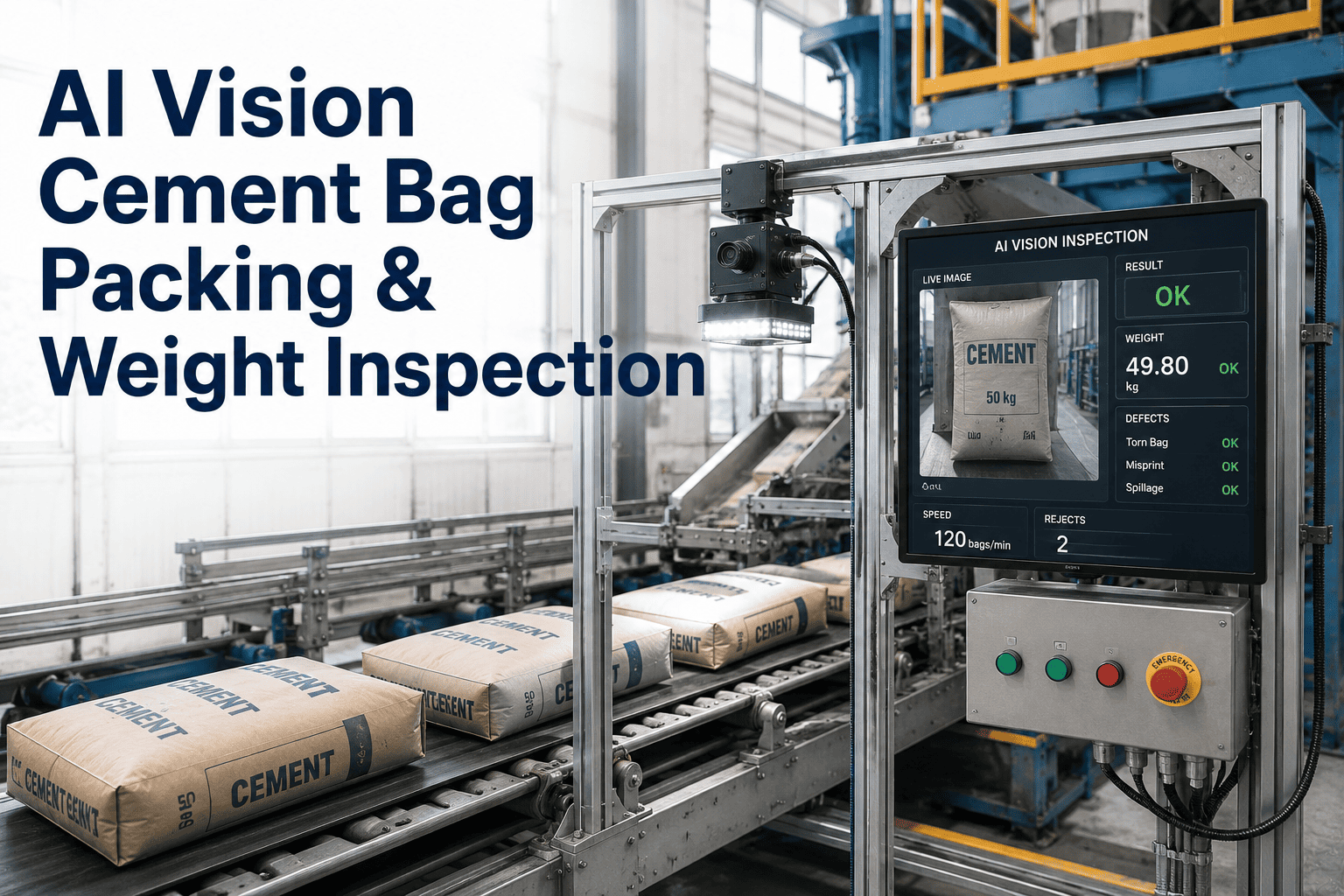
A 50 kg cement bag is not just a container — it is a signed commitment to the customer that the branded weight, the printed grade, and the sealed integrity match the invoice. When an under-weight bag reaches a housing project, a torn bag arrives on a construction site, or a wrong-brand pallet lands at a distributor, the write-off is the smallest part of the cost. The real damage is customer trust and the compliance liability under legal-metrology rules. Vision inspection at the packer catches all four failure modes — weight, tear, print, brand — in the last window before the bag leaves the plant, where a reject costs cents instead of thousands.
iFactory / AI vision for cement packing
Catch Every Under-Weight, Torn, or Mis-Printed Bag Before It Reaches Dispatch
AI vision cameras on the packing line inspect every bag for weight compliance, seam integrity, print quality, and brand match — with automatic rejection to divert and full audit trail for legal-metrology defence.
4 defects
weight · tear · print · brand
Per bag
100% inspection at packer speed
Auto-divert
reject to rework, not to dispatch
The Problem on the Packing Line
A modern rotary packer runs at 2,000 to 3,000 bags per hour. The human eye cannot inspect every bag at that speed for the four things that matter: is fill weight inside legal-metrology tolerance, is the seam intact, is the printed grade and MRP legible, is this the SKU the customer ordered. So plants sample — 1 in 100, 1 in 500, sometimes only at shift-end — and hope samples represent the population. They rarely do. Under-weight bags leak through when the fill scale drifts. Torn bags survive because the palletiser operator missed the split. Wrong-print or wrong-brand pallets ship when the changeover wasn't caught. The complaint arrives two weeks later — and the write-off is measured in truckloads.
Where the Reject Actually Escapes
Bag defects escape at the same four failure points in almost every packing hall. The specifics differ; the pattern is universal.
Sample-based check
QC picks 1 in 100 or 1 in 500 bags for weight verification. The 99% not checked assume the fill scale hasn't drifted. When it drifts mid-shift, the whole batch goes out under-weight before the next sample catches it.
Torn-bag miss
A bag with a seam split leaves the packer intact but tears at the palletiser. Operator misses it in the pallet build. Customer receives a torn bag and rejects the truck.
Print unreadable
Ink cartridge low or nozzle blocked. MRP, batch code, or grade prints faded or smudged. Bags stack fine but fail dealer-shop verification. Whole pallets returned.
Wrong SKU on line
Packer switched from PPC to OPC at shift change without a full line purge. First 40 bags carry the wrong brand print. Truck reaches distributor before anyone notices.
What Good Looks Like at the Packer
A working vision system holds four disciplines together — weight verification per bag, seam integrity check, print quality scoring, and brand/SKU match against the current run.
Weight Compliance
Every bag weighed and validated against the legal-metrology tolerance (±1% or per local rule). Drift on the fill scale triggers an alert before the next 10 bags go out.
Every bag, every gram
Seam Integrity
Vision inspection of the sewn or valve seam after packer discharge. Splits, weak stitches, and valve mis-seats caught before the bag reaches the palletiser or truck loader.
Catch tears at source
Print Legibility
OCR + image quality scoring on the printed grade, MRP, batch code, and manufacturing date. Faded, smudged, or missed prints trigger reject before the bag stacks.
OCR + quality score
Brand / SKU Match
Vision confirms the printed brand and grade match the currently commanded SKU on the MES production order. First bag after any product changeover verified before the line resumes.
Changeover verified
How iFactory AI Fits
iFactory AI works as an overlay on your MES, weighing controller, and existing bag-line PLC — Rockwell, Siemens, ABB, Schneider — adding the vision inspection layer with automatic reject-divert without disrupting the packer OEM control.
Bag Record
Vision + MES
Every bag with unique ID, weight reading, seam grade, print score, brand match, timestamp, and packer line — the record that answers 'was this bag inspected' at complaint review.
Reject Divert
Vision + PLC
Failed bags automatically diverted to rework belt via existing pusher or blow-off actuator. No manual reject calls; no bad bag reaches the palletiser.
Fill Drift Alert
Vision + SPC
Real-time SPC on weight readings. Trend drift toward the lower control limit alerts the packer operator before 10 more bags go under-weight.
Legal-Metrology Log
Compliance Layer
Weight-verification archive retained per your jurisdiction's legal-metrology rule (India Legal Metrology Act, US NIST Handbook 44, EU MID Directive) with full auditor export.
Pull last month's dealer complaints on bag weight, tear, or wrong brand. If any of those made it to the dealer, the sample-based check missed them at the plant. Book a packing line audit — we'll instrument one bag line for a week and quantify the escape rate.
12-Week Rollout on One Packer
One rotary packer, one shift rotation, twelve weeks. The pilot is scoped to prove the vision system runs at packer speed without slowing throughput and that the reject-divert actually catches the top complaint categories.
Weeks 1–2
Line Survey
Walk the packer, palletiser, and truck-loader flow. Map current sample-check cadence and dealer complaint pattern. Baseline the four defect rates from historic returns.
Weeks 3–4
Camera Install
Vision cameras mounted at packer discharge, seam check point, and print zone. Reject-divert actuator tied to existing pusher. Baseline images captured for the four defect types.
Weeks 5–8
Live on One Packer
Vision active on one rotary packer for real production. First two weeks are calibration — false-reject rate tuned, missed-defect rate baselined. SPC alerts active from week 6.
Weeks 9–12
Escape-Rate Match
Twelve-week window closes. Measure caught-at-packer vs escaped-to-dealer defect rate. Rollout to remaining packers decided on the escape-rate delta.
Who Owns the KPI
Vision on the packing line crosses packing operations, QC, logistics, and compliance. Each function needs a specific number they own or the vision system becomes a screen nobody reads.
Packing Supervisor
Caught-at-packer defect rate
Owns the front-line catch — the count of rejected bags per shift by defect category. Rising catch rate at pilot start is a good sign; the number to watch is dealer complaint decline.
QC Manager
Dealer complaints per truckload
Owns the escape number — the count of weight, tear, print, or brand complaints per 100 trucks dispatched. Pilot target is 70%+ reduction within eight weeks.
Dispatch Head
Truck rejections at customer end
Owns the logistics loss — truck rejections at distributor or project site that traced to bag defects. Zero is the pilot ambition.
Compliance Lead
Legal-metrology audit records completeness
Owns the audit posture — every dispatched bag with weight verification on file, exportable to inspectors on demand. 100% is the requirement, not a target.
FAQ
Can vision keep up with a rotary packer running at 3,000 bags per hour?
Yes, with the right camera and lighting setup. Modern industrial vision cameras run at frame rates well above what a 3,000 bph packer requires (a bag every 1.2 seconds). The processing runs edge-local so there's no network round-trip. What actually matters is the lighting — packing halls are dusty and lighting geometry has to be designed for the specific bag surface and print colour. That's why the pilot begins with a line survey and image baseline before any camera goes up.
What about integration with our existing weighing controller — Rice Lake, Mettler-Toledo, Yamato?
Vision inspection sits alongside the weighing controller, not in place of it. The controller continues to run the fill loop; the vision layer reads the final weight (via serial, Ethernet/IP, or Modbus TCP from the controller) and pairs it with the visual inspection into a single per-bag record. Rice Lake, Mettler-Toledo, Yamato, Ishida, Haver — all supported through their standard interfaces. The weighing controller doesn't change; the archive and the alert layer are new.
Book a demo to see the controller integration live on your platform.
What happens when the vision system flags a false positive — does it stop the line?
No. False positives divert the specific bag to the rework belt; they don't stop the packer. During the first two weeks of pilot, false-reject rate is tuned by adjusting the vision thresholds and lighting — the target is under 0.5% false rejection. If a bag is diverted incorrectly, the operator can inspect and return it to the palletiser. What the system prevents is the reverse failure — a genuine defect reaching the truck. Line-stop is reserved for systemic problems: fill drift beyond correction, camera-vision fault, or repeat brand mismatch that signals a changeover error.
Stop letting sample checks decide what reaches your customers.
Instrument One Packer for a Week and See the Escape Rate
Bring one rotary packer, last month's dealer complaint log, and your current weight-verification sample cadence. We'll instrument the line, run four days of production under vision, and quantify how many defects your current process misses.