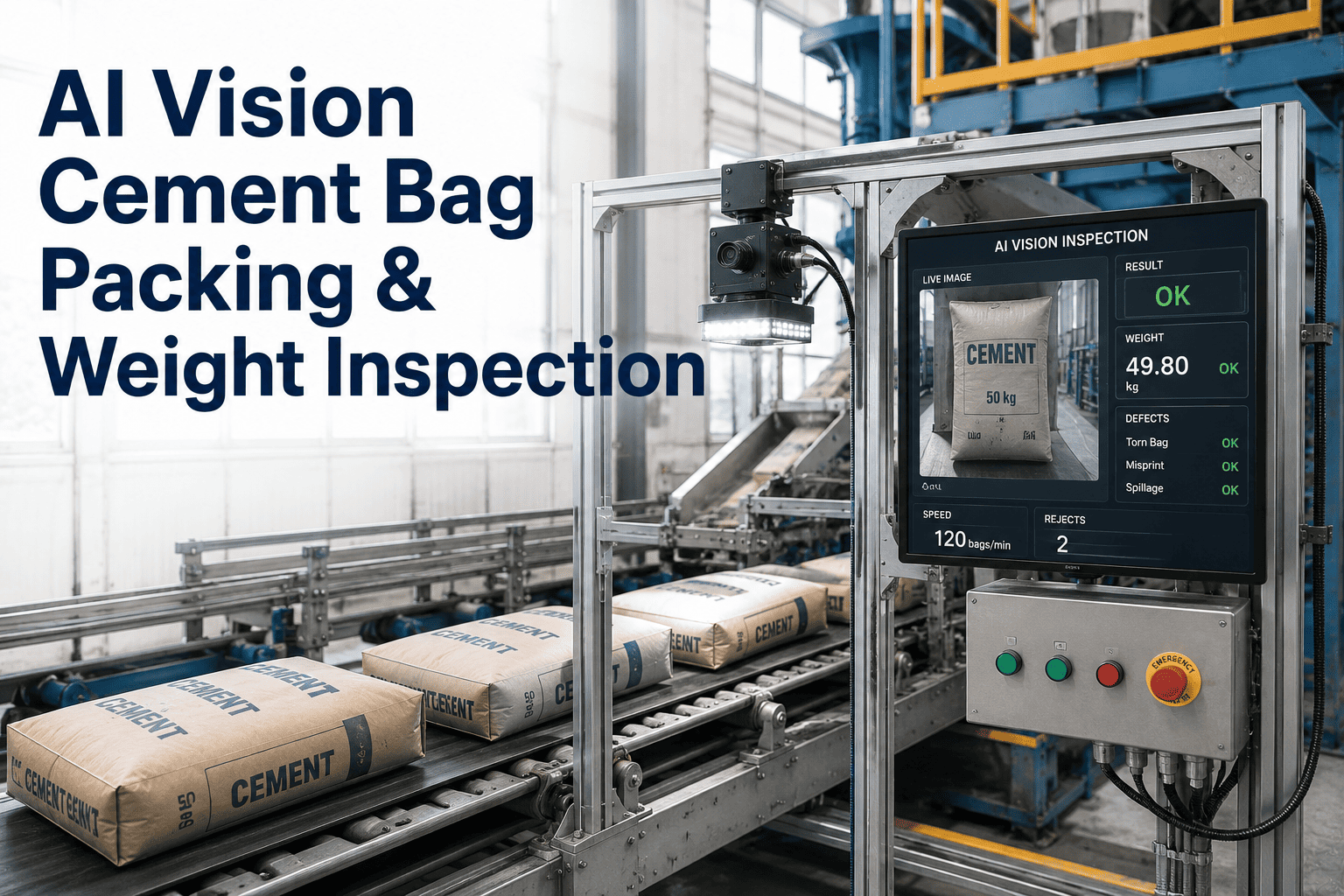
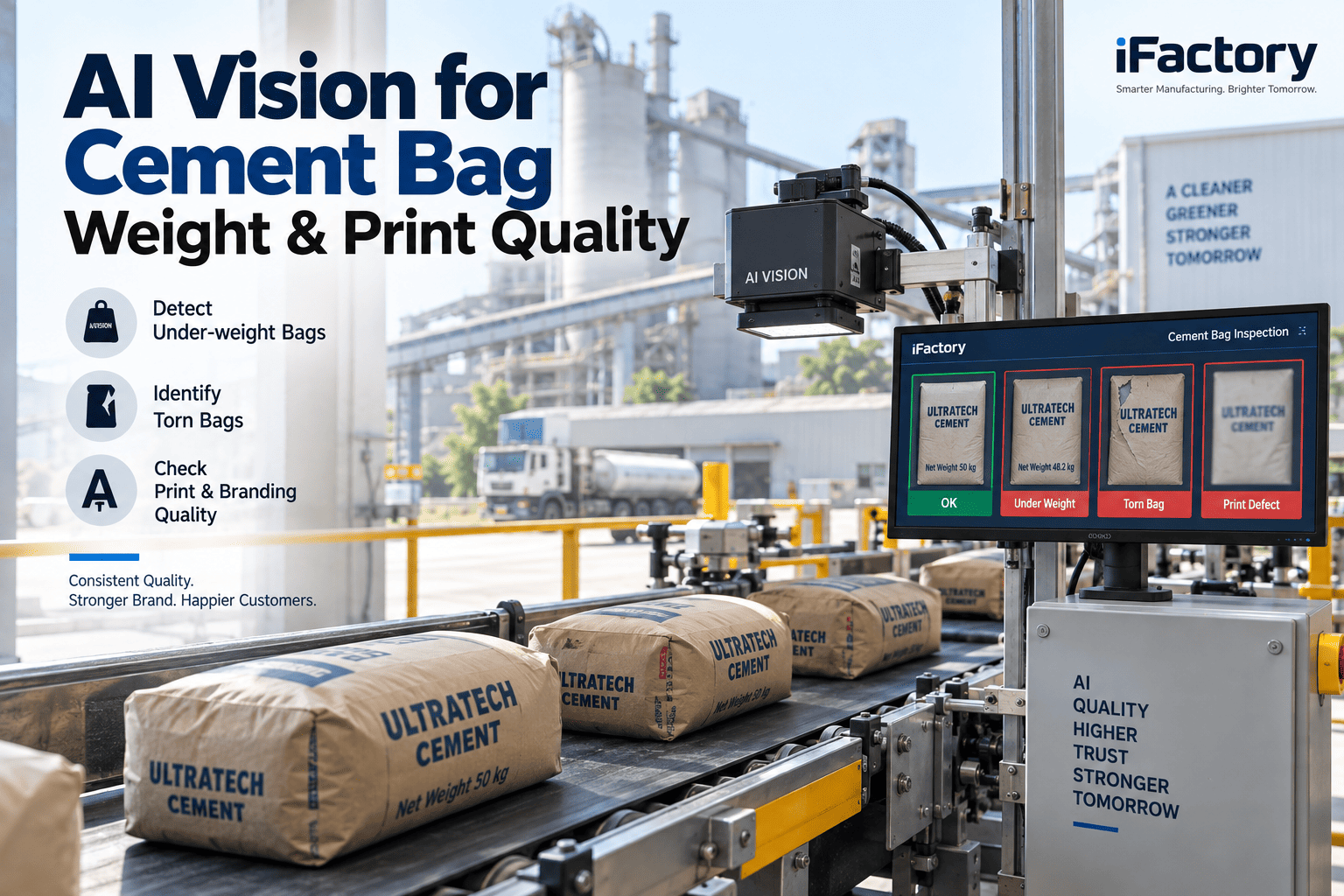
A cement packing line runs 3,000 to 3,200 bags an hour, and no human eye is fast enough to catch the torn valve seam at bag 847, the low-fill at bag 1,203, and the broken handle at bag 2,991 — not reliably, not across an 18-hour shift. So the defects ship. The customer calls. And the replacement bags cost more than the original order, before you count the contaminated pallet, the return freight, and the damaged relationship. Worse, cement is a regulated chemical product: a misprinted hazard symbol, an illegible weight declaration, or a wrong batch code isn't just a quality miss — it's a compliance failure that can bring legal and financial consequences. Manual inspection can't keep up, sampling is a gamble, and every line stop to pull a bad bag drags throughput. AI vision defect detection changes the math: a camera inspects every bag at full line speed, flags torn bags, underweight packs, misprints, and spillage in milliseconds, and — uniquely — links each defect pattern back to the packer head, weigher, or applicator causing it. To run a pilot on your packing line, book a demo.
CEMENT · AI VISION PACKING LINE INSPECTION
Inspect Every Bag at Line Speed — and Fix the Machine That Made the Bad One.
Torn bags, underweight packs, misprints, and spillage all ship when inspection is manual and the line runs 3,000+ bags an hour. iFactory's vision defect detection catches every one in milliseconds — then traces the defect pattern to the packer head, weigher, or coder behind it and raises the work order automatically, so the defect rate drops because the machines get better, not just because inspection did.
3,200/hr
Bags a packing line runs, faster than any human eye
95%
Reduction in defective bags palletized reported in the field
80%
Cut in manual inspection labor cost
3–6 mo
Typical payback on a single-line deployment
Why Bad Bags Ship From a Cement Packing Line
The failure isn't a lack of care — it's a mismatch of speed. A cement line produces a pass/fail decision several times a second, and manual quality control relies on a human catching defects at a rate no human can sustain. QA that leans on visual inspection is labor-intensive and vulnerable to optical illusions and fatigue, so defects slip through, and the ones that slip are expensive. Every undetected bad bag risks contaminating an entire pallet, and every line stop to remove one delays the whole packaging and loading flow. The plant is caught between shipping defects and killing throughput, and neither is acceptable.
No Eye Is Fast Enough
At 3,000-plus bags an hour across an 18-hour shift, a human simply cannot reliably catch a torn seam, a low fill, and a broken handle scattered through tens of thousands of bags. Human inspection suffers from fatigue and optical illusion, so detection is inconsistent by the hour and worse by the shift — the defects that ship are the ones attention missed.
Sampling Is a Gamble
Checking a sample of bags means betting that the ones you didn't inspect are fine — and on a fast line, a developing packer fault can put out a run of bad bags entirely between samples. Sampling can't catch a defect it never looks at, so a systematic problem ships in volume before the next check happens to land on it.
One Bad Bag Spoils a Pallet
A single defective bag that gets palletized can contaminate the whole pallet with spilled product or force a full return, so the cost of a miss is never one bag — it's the pallet, the return freight, the reimbursement, and the client relationship. The replacement order routinely costs more than the original, turning a small escape into a large loss.
Every Stop Costs Throughput
On a fast-paced line, every halt to remove a defective bag translates into a significant delay across packaging, palletizing, and loading, hitting the efficiency and productivity KPIs the plant is measured on. So manual QC forces a bad trade — stop the line to catch defects, or keep it running and let them ship.
The deeper issue is that catching a defect at the rejector treats the symptom, not the cause. A torn-bag reject tells you this bag failed; it doesn't tell you the packer head that's been tearing valve seams for the last hour is about to tear a hundred more. Inspection that only sorts good from bad leaves the machine that makes the bad ones untouched.
The Four Defect Classes Vision Catches
AI vision removes the sampling gamble entirely by inspecting every bag that passes the camera, flagging deviations in milliseconds and routing bad units to reject before they reach the palletizer. On a cement line, the defects that matter cluster into four classes — each with its own inspection logic and its own upstream cause.
TORN & BROKEN
Seam, body & handle integrity
High-resolution cameras inspect valve seams, bag body, and handles for tears, splits, and incomplete closure at full line speed. A torn valve seam or a broken handle means product loss, a contaminated pallet, and a bag that can't be safely handled downstream. Catching the integrity failure at the camera routes the bag to reject before it palletizes — and, more importantly, flags the packer head or applicator that's producing the tears.
UNDER/OVERWEIGHT
Fill level & weight verification
Vision confirms fill level falls within the approved tolerance band, complementing the weigher to catch fill errors that ship as underweight or overweight bags. Underweight bags trigger customer complaints and weight-declaration compliance issues; overweight bags give product away on every pallet. When the reject rate at the weigher climbs, it points upstream to a packer spout or load-cell issue rather than a random miss — a signal vision makes visible instead of leaving buried in reject counts.
MISPRINT & LABEL
Print clarity, date & batch code
Vision models check print clarity, label position and skew, brand and logo legibility, manufacturing date, batch code, weight declaration, and the chemical hazard symbols and handling instructions cement labeling law requires. Because cement is a regulated chemical product, a misprint isn't cosmetic — it's a compliance failure carrying legal and financial risk. Verifying every bag against a reference template ensures no non-compliant label leaves the facility, with barcode and QR readability confirmed for traceability.
SPILLAGE & LEAKAGE
Spout leak & product blow-back
Cameras detect spilled product, spout leakage, and blow-back that a fill or seal fault leaves on the bag and the line — the visible signature of an air-seal, spout, or over-fill problem. Spillage contaminates pallets and equipment, wastes product, and is a housekeeping and dust concern in its own right. Catching it visually links the spill back to the packer spout seal or fill fault causing it, so the fix targets the source rather than repeatedly cleaning up after it.
See Every-Bag Inspection on Your Packing Line
Bring your line speed, bag formats, and current reject and complaint rates to the call. iFactory engineers will show how vision inspects torn bags, fill, print, and spillage at full speed — and how each defect trend routes to the packer head, weigher, or coder behind it.
The Difference: From Sorting Bags to Fixing Machines
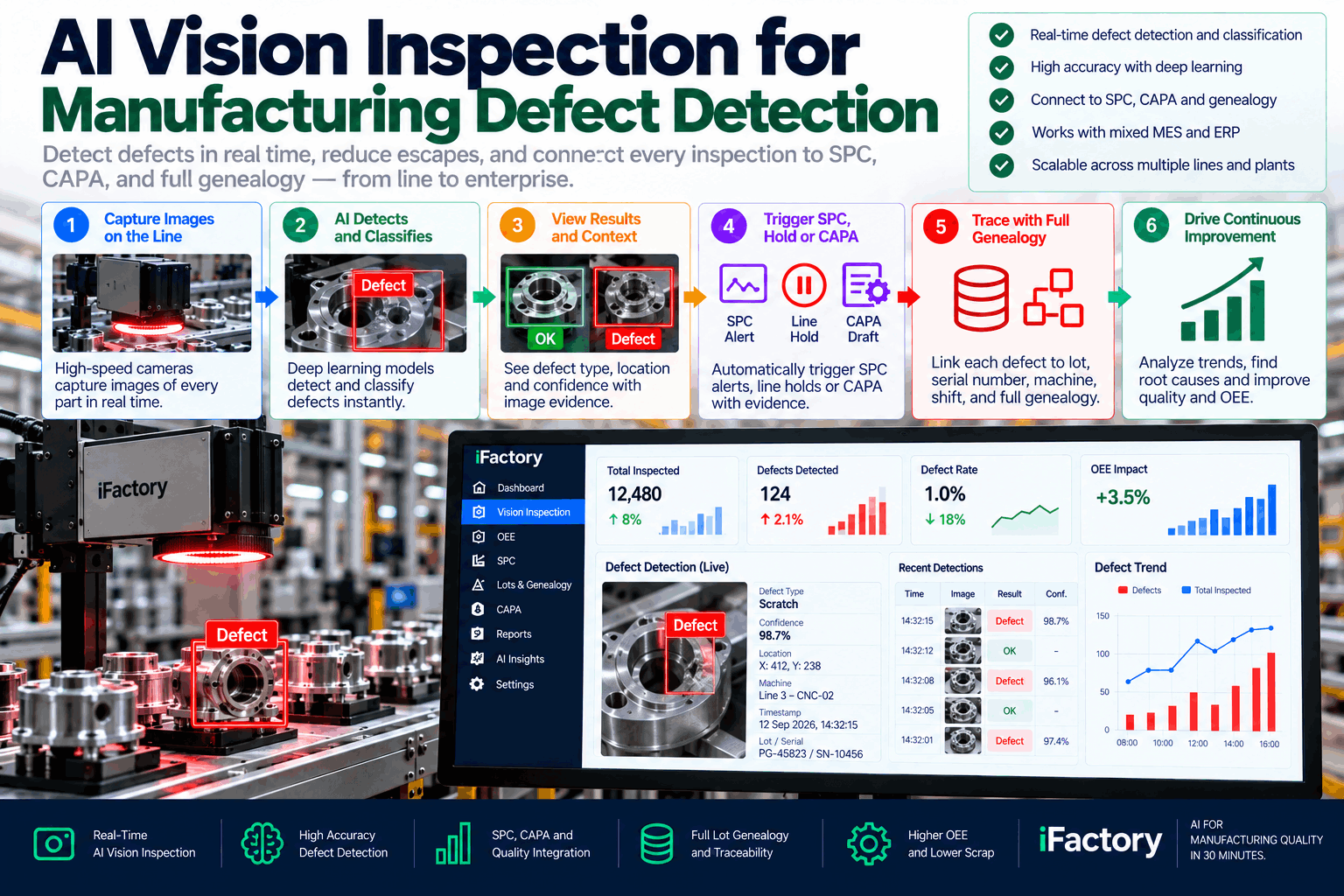
Most vision systems stop at detection — they sort good bags from bad and route the rejects. iFactory's vision defect detection goes a step further that changes the economics entirely: it connects each defect pattern to the equipment producing it and drives a maintenance action, so the defect rate falls because the machines improve, not just because inspection got sharper. This is the loop that turns quality data into fewer defects at the source.
1
Detect Every Defect at Line Speed
Cameras inspect every bag for tears, fill errors, misprints, and spillage in milliseconds, routing non-conforming bags to reject before they palletize and logging every event with its image for root-cause review. Nothing is sampled; nothing is missed to fatigue.
2
Recognize the Pattern, Find the Cause
When a pattern emerges — fourteen torn valve seams in one hour from the same packer head — the system identifies the probable equipment root cause rather than treating each reject as an isolated event. The trend points at the specific asset: the packer head, the weigher, or the label applicator.
3
Raise the Work Order Automatically
A maintenance work order is raised automatically for the linked asset with the defect evidence attached — no manual handoff between quality and maintenance. The technician receives it on mobile with defect images and machine history, so the corrective action targets the exact cause of the run of bad bags.
4
Confirm the Fix Against the Trend
After the repair, the defect rate before and after is visible in one view, confirming the maintenance action resolved the quality issue and establishing the service interval needed to keep defects below target. The loop closes — and each cycle makes the machine, not just the inspection, better.
This is why the defect rate drops over weeks in a way pure inspection never achieves. When a packer head is serviced, the defect rate before and after sits in the same view as its maintenance record — so quality and maintenance stop being separate conversations, and the equipment causing repeat defects gets corrected faster than a reject-only system ever could.
Compliance: Cement Is a Regulated Chemical Product
Bag inspection in cement carries a dimension most packaging lines don't face: the label itself is a legal document. Cement's nature as a chemical product means legislation dictates specific labeling requirements, and a printing or coding failure can carry legal or financial consequences — which makes print and label verification a compliance control, not a cosmetic check.
01
Every Regulated Element, Every Bag
Vision verifies the chemical hazard symbols, handling instructions, ISO certification marks, environmental compliance tags, and weight declaration that cement labeling law requires — on every bag, not a sample. A missing or illegible mandatory element is caught before the bag ships rather than discovered in a regulatory audit.
02
Date, Batch & Traceability Verified
Manufacturing date visibility, batch code accuracy, barcode scan verification, and QR functionality are confirmed against the reference so traceability data is intact end to end. A wrong or unreadable code breaks the traceability chain that both recalls and audits depend on — vision keeps it whole.
03
Misprint Risk Removed Before Shipping
Checking print clarity and content against a template on every bag means a coder drift or label misapplication is flagged at the camera, not by a customer or an inspector. That converts the misprint from a fines-and-recall exposure into a routed reject and a coder work order — a compliance risk defused at the line.
04
An Audit-Ready Evidence Trail
Because every inspection event is logged with its image, the plant holds a complete, timestamped record of label compliance across production — the documentation an auditor asks for, assembled automatically. Compliance becomes a queryable trail rather than a reconstruction under deadline.
Built for the Cement Packing Environment
A cement plant is dust, vibration, and constant format changes — an environment that defeats fragile inspection setups. The vision system is built to run in it, adapting to the plant's real conditions rather than demanding the plant adapt to the system.
Adapts to Every Bag Format
Models handle different bag sizes, colors, and brands, adjusting detection automatically by product type so inspection stays accurate across the full range. Per-SKU templates mean a changeover simply loads a different reference profile rather than requiring new hardware or manual reconfiguration — valuable on lines that switch products often.
Edge Processing, No Cloud
Inspection runs on edge devices at the line with no cloud dependency, so decisions are made in milliseconds at full speed and the plant's production imagery and data stay on-site. That keeps latency low enough for real-time reject and keeps operational data sovereign inside the plant network.
Start on One Line, Prove It, Scale
Adopting vision doesn't mean a plant-wide project on day one. The most successful deployments start with a focused, high-impact use case — cement bag inspection on the packing line — prove the ROI in your environment, and expand from there.
1
Camera on the Packing Line
High-resolution cameras are positioned at the packer, weigher, coder, and pre-palletizer points to inspect seam integrity, fill, print, and spillage, with the edge processor placed at the line — reading the equipment you already run without slowing it.
2
Train on Your Bags and Defects
The models learn your bag formats and reference labels and the defect signatures specific to your line, so detection is tuned to your products and your real failure modes rather than a generic template — and per-SKU profiles handle every changeover.
3
Link Defects to Assets and CMMS
Each defect class is linked to the packer head, weigher, applicator, or coder that produces it, and the system connects to your maintenance workflow so a defect trend raises a work order automatically against the right asset with evidence attached.
4
Prove ROI, Then Expand
Starting on one line proves the return in your specific environment, builds operator confidence, and creates the data foundation to scale — to more lines or to adjacent cement vision uses like conveyor hot-spot and belt monitoring or crusher big-rock detection.
What Changes for the Plant
Vision defect detection changes the packing line from a place where defects are caught late and sorted, to one where they're caught instantly and designed out — with measurable effects on cost, compliance, and the quality team's day.
01
Defective Bags Stop Reaching Customers
Inspecting every bag and diverting non-conforming ones before palletizing sharply cuts defective bags that get shipped — field deployments report around a 95 percent reduction in defective bags palletized and a move toward zero returns. The customer complaint and the costlier replacement order both fall away.
02
The Defect Rate Trends Down
Because each defect trend drives a maintenance action on the machine causing it, the overall defect rate drops over weeks — not because inspection improved, but because the packer heads, weighers, and coders producing defects got fixed faster than a reject-only system would ever address them.
03
Compliance Risk Comes Off the Table
Verifying every label's regulated elements against a template means misprint-driven regulatory exposure is caught at the line, not in an audit — removing a legal and financial risk that manual sampling could never fully close, with an image-logged evidence trail to prove it.
04
Quality Staff Move to Root Cause
Automated inspection cuts manual QC labor substantially and shifts the quality team from repetitive visual checks to reviewing flagged exceptions and defect trends — spending their expertise on root-cause work rather than staring at a fast line hoping to catch the next bad bag.
Frequently Asked Questions
The questions cement plant and quality managers ask most often when evaluating AI vision for the packing line.
How does vision inspect every bag at 3,000-plus bags an hour?
High-resolution cameras capture each bag as it passes and edge-based AI models evaluate it in milliseconds, so inspection keeps pace with full line speed rather than sampling. Every bag is checked against the reference for seam integrity, fill level, print and label content, and spillage, and non-conforming bags are routed to reject automatically before they reach the palletizer. Because the processing runs on edge devices at the line rather than in the cloud, there's no latency penalty and decisions are made in real time. This is the core advantage over manual QC: instead of a human catching what they can before fatigue sets in, or a sample missing the bags it never looks at, the camera inspects one hundred percent of production consistently across the whole shift. To see it matched to your line speed,
book a demo.
What makes this different from a standard reject system?
A standard system sorts good bags from bad and stops there — it treats the symptom. This system also connects each defect pattern to the equipment producing it and drives a maintenance action. When it sees a run of the same defect, such as fourteen torn valve seams in an hour from one packer head, it identifies the probable equipment root cause and automatically raises a work order for that asset with the defect images attached, delivered to a technician on mobile with the machine's history. After the repair, the defect rate before and after sits in one view, confirming the fix worked and setting the service interval to keep defects below target. The result is that the defect rate falls over weeks because the machines get better, not just because inspection got sharper — which a reject-only system can never deliver, since it never touches the cause.
Can it verify our labels meet cement labeling regulations?
Yes, and this is one of the highest-value uses because cement is a regulated chemical product whose labeling is a legal requirement. The system verifies every bag's regulated elements against a reference template — chemical hazard symbols, handling instructions, ISO certification marks, environmental compliance tags, weight declaration, manufacturing date, and batch code — plus barcode and QR readability for traceability. A missing, illegible, or drifted element is flagged at the camera and routed to reject before the bag ships, converting a misprint from a fines-and-recall exposure into a routed reject and a coder work order. Every inspection event is logged with its image, so the plant also holds an audit-ready evidence trail of label compliance across production. That means the compliance risk that manual sampling could never fully close is caught at the line on one hundred percent of bags.
Will it handle our different bag types and frequent changeovers?
Yes — the models are trained to adapt to different bag sizes, colors, and brands, and detection parameters adjust automatically by product type so accuracy holds across your full range. Detection templates are stored per SKU, so a changeover simply loads a different reference profile rather than requiring new hardware or manual reconfiguration, which is especially valuable on lines that switch products frequently. The inspection logic is configured per format rather than hardcoded, so adding a new bag type is a matter of training a profile, not re-engineering the system. This adaptability is essential in cement packing, where the same line may run multiple products and brands through a shift, and it means the vision system fits how your line actually operates instead of forcing a single rigid setup.
Do we have to instrument the whole plant, or can we start small?
You can absolutely start small, and it's the recommended path. The most successful deployments begin with a focused, high-impact use case — cement bag inspection on the packing line is the classic starting point — because it proves the ROI in your specific environment, builds operator confidence, and creates the data foundation for expanding later. Most cement plants see measurable returns within three to six months, driven by reduced defective packaging reaching customers, eliminated returns and reimbursement costs, and lower cost of poor quality. Once the packing-line deployment has proven itself, the same platform extends to adjacent cement vision applications — conveyor hot-spot and belt-misalignment monitoring, or crusher big-rock detection — so you scale from a proven base rather than committing to a plant-wide rollout up front. Contact
iFactory support to scope a single-line pilot.
CATCH EVERY BAD BAG · FIX THE MACHINE · PROTECT COMPLIANCE
Inspect Every Cement Bag at Line Speed — and Stop the Defects at Their Source.
Full-speed detection of torn bags, underweight packs, misprints, and spillage, with every defect trend routed to the packer head, weigher, or coder behind it and a work order raised automatically — edge-based, format-adaptive, and audit-ready for cement labeling compliance. Start on one line, prove the ROI, and watch the defect rate fall because the machines got better.