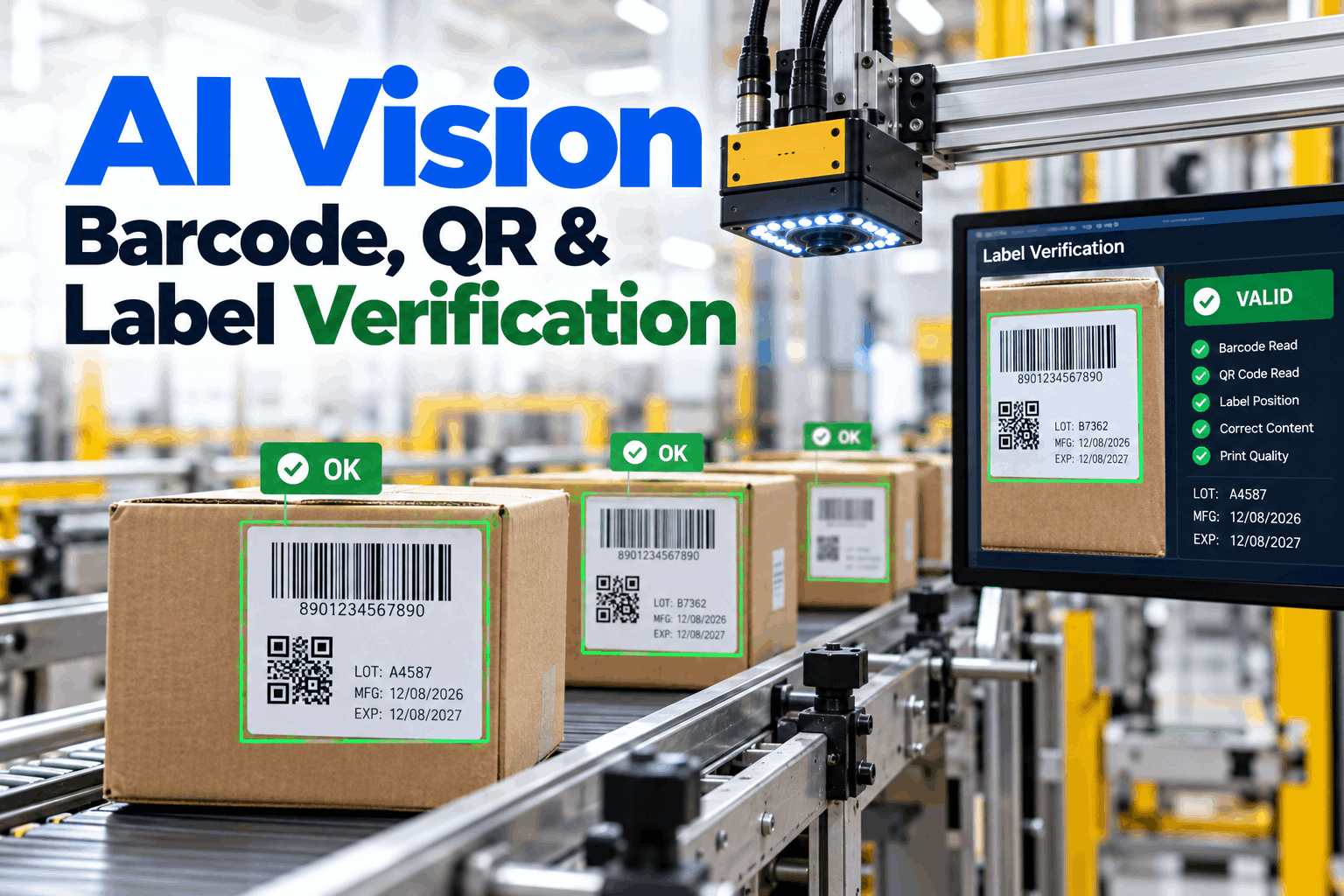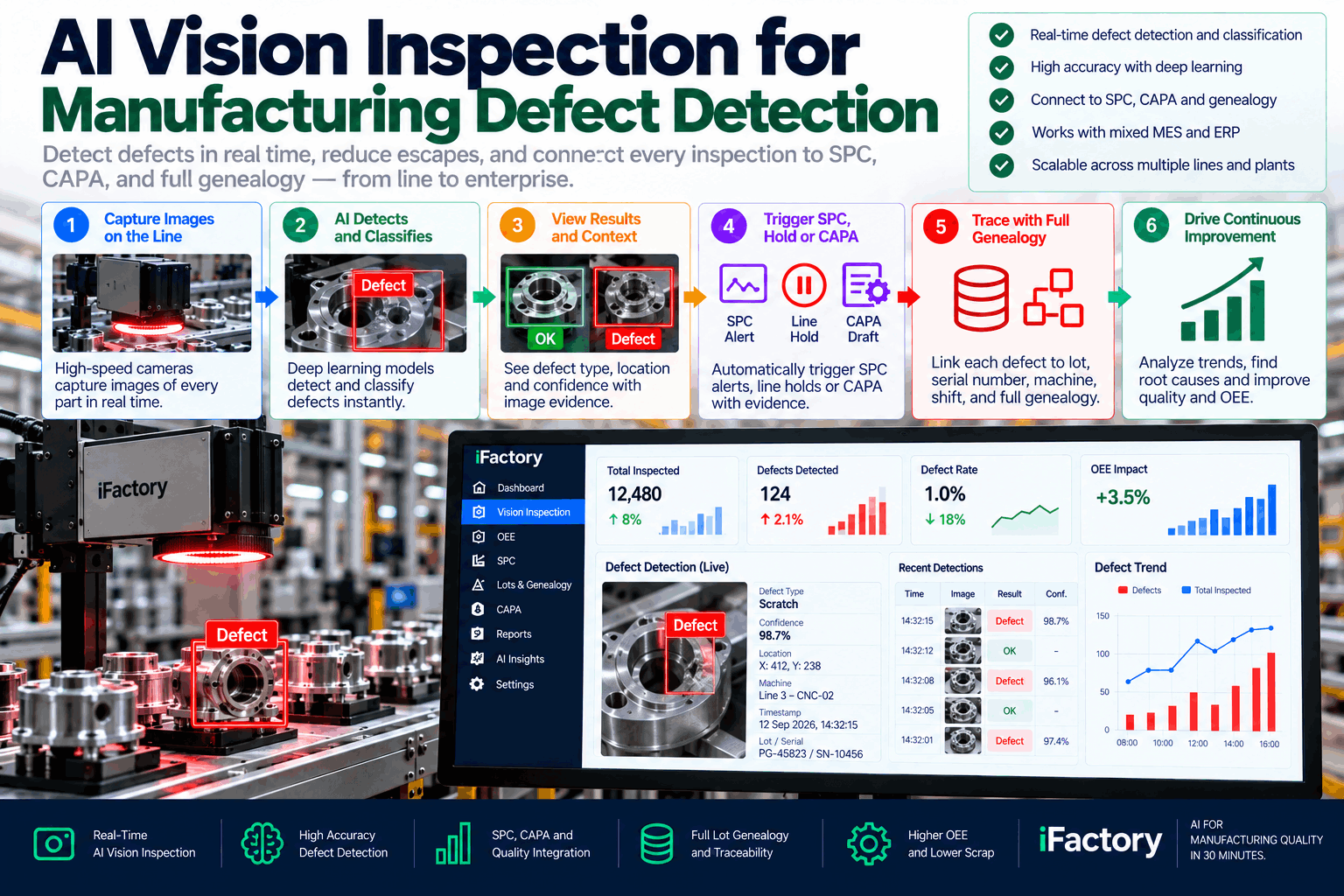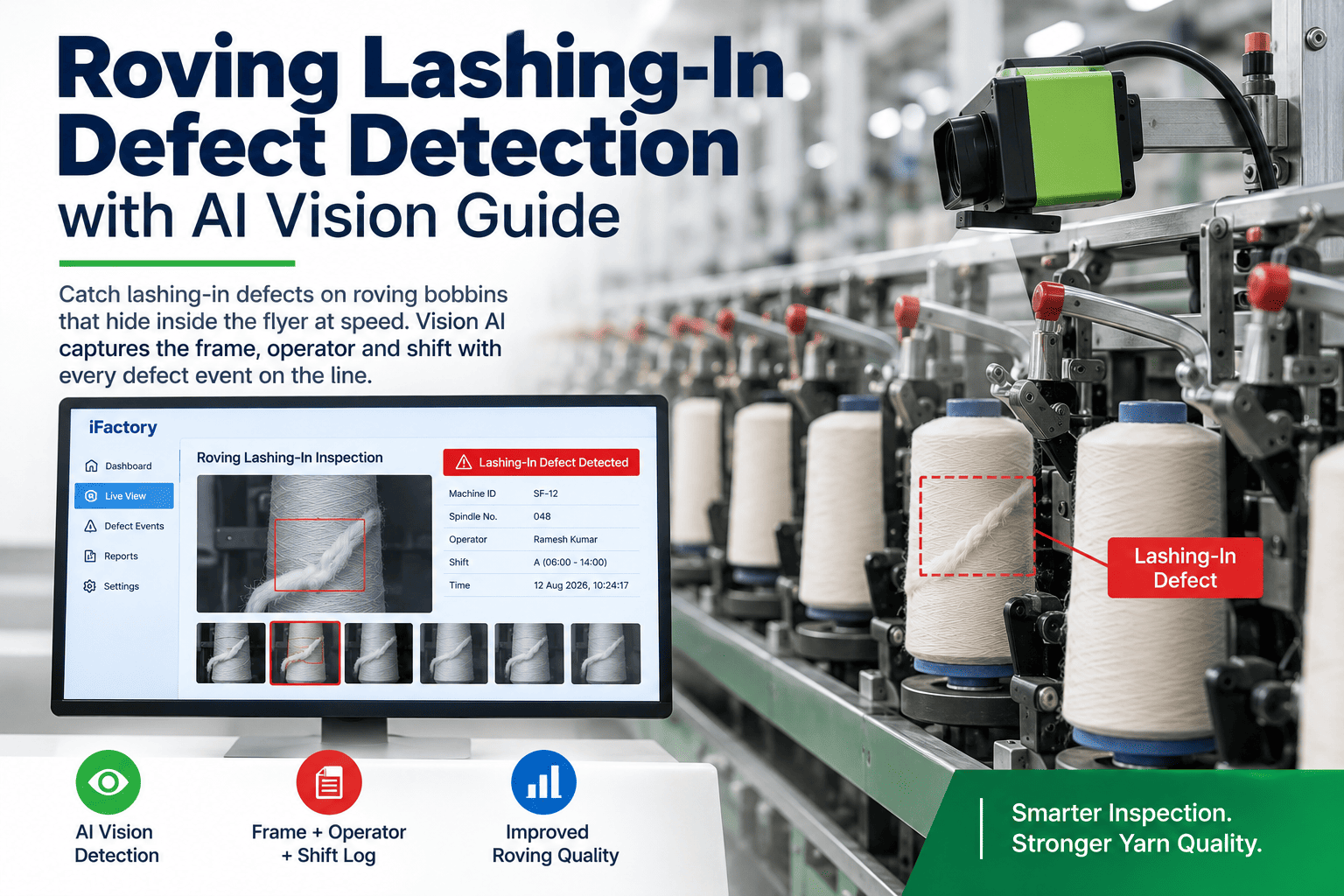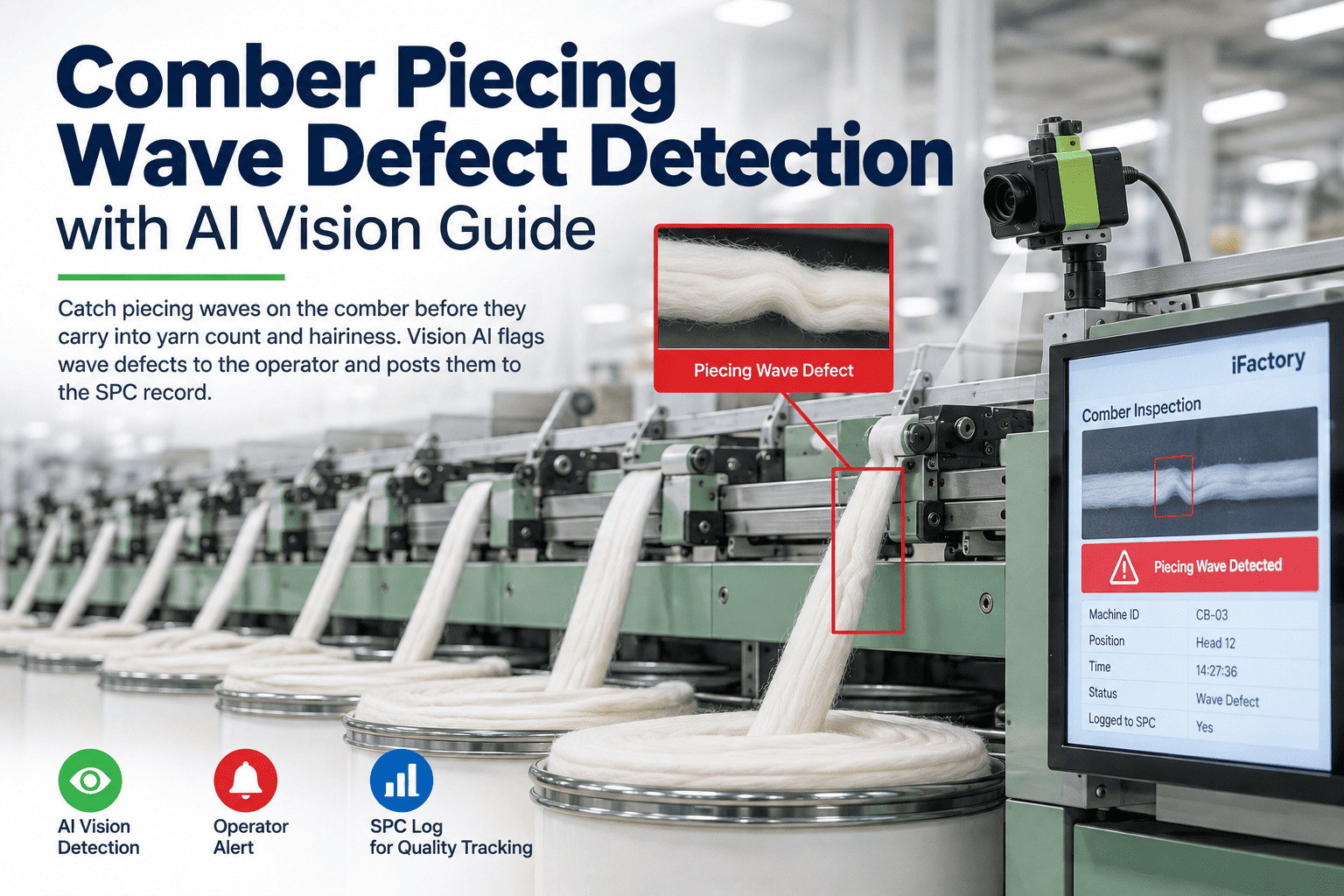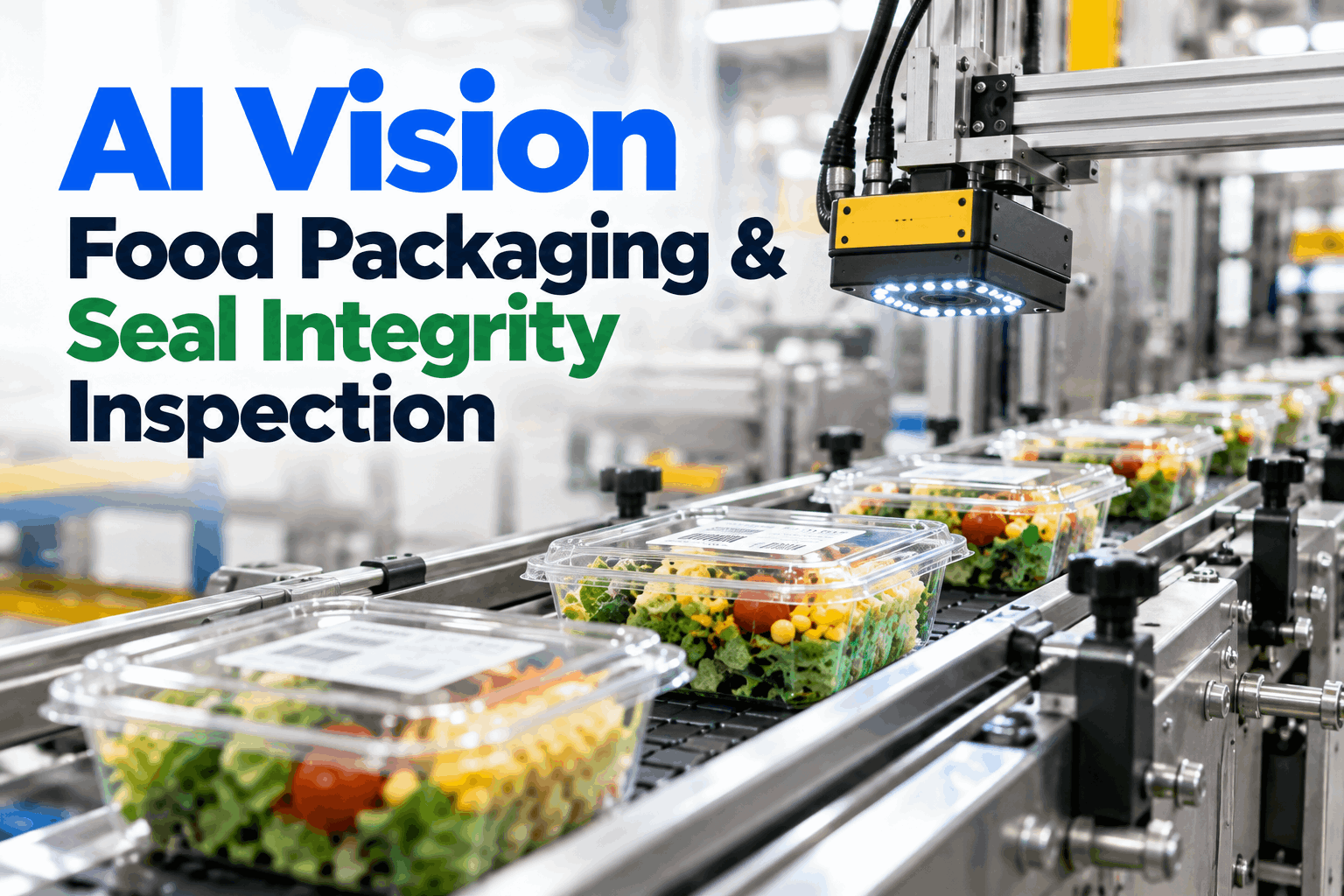
A packaging line can run hundreds of packs a minute, and one crumb in a seal, a wrong label or a smudged date code can turn a good batch into leakers or a recall. Manual checks only see a sample. AI vision checks seal, fill, label and date code on every pack at line speed, and rejects faults before case packing. To try it on one of your lines, book a packaging vision session.
AI Vision for Food Packaging and Seal Integrity Inspection
One camera system for the four checks that matter most on a packaging line: seal, fill, label and date code. Every pack inspected, faults rejected automatically, and every image kept for traceability.
- What each of the four checks catches, and why it matters
- Where vision works best, and where you still need a leak test
- How to tie rejects back to the sealer that made them
- 1Seal integrity. Product, wrinkles or gaps in the seal area, all the way round.
- 2Fill level. Under-filled or over-filled packs before they are sealed or shipped.
- 3Label. Right label for the product, placed straight, allergens shown.
- 4Date code. Present, readable and showing the correct date and lot.
Which checks you need depends on the pack. Trays, pouches, cartons, bottles and cans each have their own weak points, and the camera set-up follows them.
Why Packaging Faults Slip Through
Packaging lines are fast. People checking them are not.
A quality technician might pull a pack every few minutes for a seal and label check, between many other jobs. At line speed, that is a tiny fraction of production. A drifting sealer or a wrong label roll can run for a long time before the next check finds it, and every pack in between is at risk. Our vision support team can help you find where your faults start.
Sampling
A pack every few minutes cannot catch faults that come and go between checks.
Speed
Hundreds of packs a minute are too fast for the human eye to follow.
Changeovers
Label and film changes are when the wrong roll most often gets loaded.
Hidden seals
Printed films and dark trays hide small faults in the seal from a quick look.
Reject rate
By line, lane and fault type, every shift, with trends.
Leaker complaints
Customer and retailer reports per million packs, by line.
False rejects
Good packs thrown out by mistake. Keep it low, or the line will distrust the system.
Label incidents
Wrong or missing labels found anywhere in the chain. Aim for zero.
Undeclared allergens are among the most common reasons for food recalls, and many start with the wrong label or film on the right product. A label check on every pack, tied to the recipe running, closes that gap.
What Each Check Catches
Four checks, four kinds of fault, four different risks.
Seal faults cause leakers, spoilage and shorter shelf life. Fill faults cause short weight or giveaway, both of which cost money. Label faults cause allergen recalls and retailer complaints. Date code faults cause traceability gaps and rejected deliveries. To map the checks to your packs, book a line mapping call.
Most wrong-label incidents happen when the product, film or label roll changes. Make the vision system load the new recipe's label automatically at each changeover, so the first pack of the new run is checked against the right label, not the last one.
Vision does well at
- Visible product or debris in the seal
- Label presence, position and content
- Reading and checking date codes
- Fill level through clear or open packs
Still needs another test
- Pin-holes and micro-leaks
- Seal strength itself
- Faults hidden under opaque print
- Exact net weight
Sampling Versus Every Pack
Here is one shift on a 120-packs-a-minute tray line, checked by hand every ten minutes, and checked by camera on every pack.
From Rejects to Root Cause
Rejecting bad packs is good. Fixing the sealer that made them is better.
Seal faults rarely appear at random, even when they look random on the reject count. They cluster by lane, by sealing jaw, by temperature, or after a filler starts to drip. Linking each reject to the lane, the time and the sealer settings shows the cause quickly. If you want help linking rejects to your machines, our engineers can help.
Detect
Fault found on the pack, with its image and position.
Reject
Pack removed before the case packer, automatically.
Group
Rejects grouped by lane, sealing jaw and time.
Link
Matched to sealer temperature, pressure and dwell.
Alert
Rising faults flagged before they become a whole batch of rejects.
Fix
Cause fixed at the machine, and the reject rate checked again.
A handful of rejects an hour may be normal for a line. A steady climb on one lane is not. Alerts that fire on the trend, rather than on single rejects, give the line time to fix the cause before a whole pallet is affected.
Labels and Date Codes: Small Print, Big Risk
A pack can be sealed perfectly and still have to be recalled.
A wrong label can hide an allergen from the very people who need to see it. A missing or wrong date code can make a whole lot impossible to trace. Both are cheap to check on every pack and very expensive to miss once product has shipped, which makes them some of the best value checks on any line.
Right label, right product
Text or barcode matched to the recipe running, so the allergen panel is correct for every pack.
Readable and correct
Date and lot read and checked against the production order, not just seen to be there.
Proof for every lot
Images kept by lot, so a complaint or audit can be answered in minutes, not days.
A check that only confirms "a code is present" will pass a smudged or wrong date. Reading the characters and comparing them with the expected date and lot is what catches the real mistakes, such as yesterday's date left on the coder.
Getting the Set-Up Right
Good inspection starts with the camera, the light and the timing.
Shiny films, condensation, printed lids and fast-moving packs all make imaging harder on food lines. Most problems are solved by the right lighting, the right camera angle and a clean trigger, before the model is even trained. Get these right and the model has an easy job. To plan a set-up for your line, book a set-up review.
Control glare
Diffuse or angled lighting to see through shiny films and around reflections and condensation.
Trigger cleanly
One image per pack, taken as it passes a fixed point, at full line speed and without gaps.
Built for washdown
Cameras and lights rated for wet, cold and washdown areas, and easy to clean.
Pack formats and their weak points
Lidding seals
Product on the flange, wrinkled film and printed lids that hide faults from view.
Side and top seals
Creases, channels and product trapped in the top seal after filling.
Flaps and glue
Open flaps, poor glue, crushed corners and skewed or missing labels.
Fill and closure
Fill height, cap position, labels and codes on curved, shiny surfaces.
Contamination under printed or opaque films can be hard to see with normal cameras. Specialist methods, such as hyperspectral imaging, are used for these cases on some tray lines. Choose the method by pack type, not by habit.
How iFactory Vision Defect Detection Works on Packaging Lines
Every pack checked, every reject explained, every image kept.
iFactory's Vision Defect Detection runs deep learning models on an edge server next to the line. It checks seal, fill, label and date code on every pack, sends reject signals to your existing reject unit, and links each fault to the lane, recipe and machine settings, so the cause can be fixed at the source. Questions on fit go to our support desk.
Capture
Cameras at the right points on the line, triggered by each pack.
Check
Seal, fill, label and code judged in milliseconds, against the recipe running.
Reject
Signal to your existing reject unit before case packing.
Trace
Images and results stored by lot, ready for audits, complaints and retailer queries.
What the line team sees
- Rejects by lane and fault, live
- The image of each rejected pack
- Alerts when a fault starts to rise
What QA sees
- Label and code checks for every lot
- Images to answer complaints quickly
- Records ready for audits
Detection rates depend on the pack, film and fault type. We measure them on your own packs during the pilot, against your own checks, rather than promising a general figure.
Turnkey AI: Delivered, Connected and Live in 6–12 Weeks
You do not build this. It arrives ready.
iFactory ships as a pre-configured NVIDIA AI server, racked and ready, with the software pre-loaded. Rack it, plug in power and Ethernet, and the AI is live on your network.
Our team handles cabling, network setup, PLC and SCADA integration, operator training and 24×7 remote monitoring. The server sits inside your own network, so images and production data stay on site. For a scope matched to your lines, request a turnkey quote.
Ship, network and data
Server and cameras installed on the pilot line. Reject unit, coder and recipe data connected.
Model training and pilot
Models trained on your own packs and run beside current checks. Results compared fault by fault with your QA team.
Go-live and training
Automatic rejects switched on once results are agreed. Line and QA teams trained. 24×7 remote monitoring begins.
Frequently Asked Questions
Can AI vision check seal integrity?
It can find visible seal faults such as product in the seal, wrinkles, channels and short seals, on every pack. It cannot measure seal strength or find tiny pin-holes, so keep leak and strength tests on a sample, as your quality plan requires.
How does it check labels and allergens?
It checks that a label is present, straight and the right one for the product running, by reading text or a barcode and matching it to the recipe. That includes the allergen panel for the product, which is where many label recalls start.
Can it read date codes?
Yes. It reads the printed code and checks it is present, legible and matches the expected date and lot for the production order, catching mistakes like an old date left on the coder.
Will it keep up with our line speed?
It is designed to inspect every pack at full line speed, with decisions made on a server next to the line rather than in the cloud. Timing is tested during the pilot before automatic rejects are switched on.
Does it work on printed or opaque films?
Partly. Faults under heavy print or opaque films are harder to see with standard cameras. Some lines use specialist imaging, such as hyperspectral cameras, for those packs.
Does it replace the checkweigher or leak tests?
No. It works alongside them. The checkweigher confirms weight, leak tests confirm seal strength, and the camera covers visible faults on every pack in between.
How do we start?
With one line that has the most rejects, complaints or label issues, so the gains are easy to see. A 6-week pilot installs cameras, trains models on your packs and runs them beside your current checks. To plan it, contact our team.
Check Every Pack, Not Just a Sample
In thirty minutes we look at your packaging lines, rejects and complaints, pick the line most likely to pay back first, and sketch the checks a camera could take on. You keep the plan whether or not you go further with iFactory.
- 1Reject and complaint data by line
- 2Photos of your packs and seal faults
- 3Line speeds and pack formats
- 4Your label and date code rules
- 5Any recent label or allergen incidents