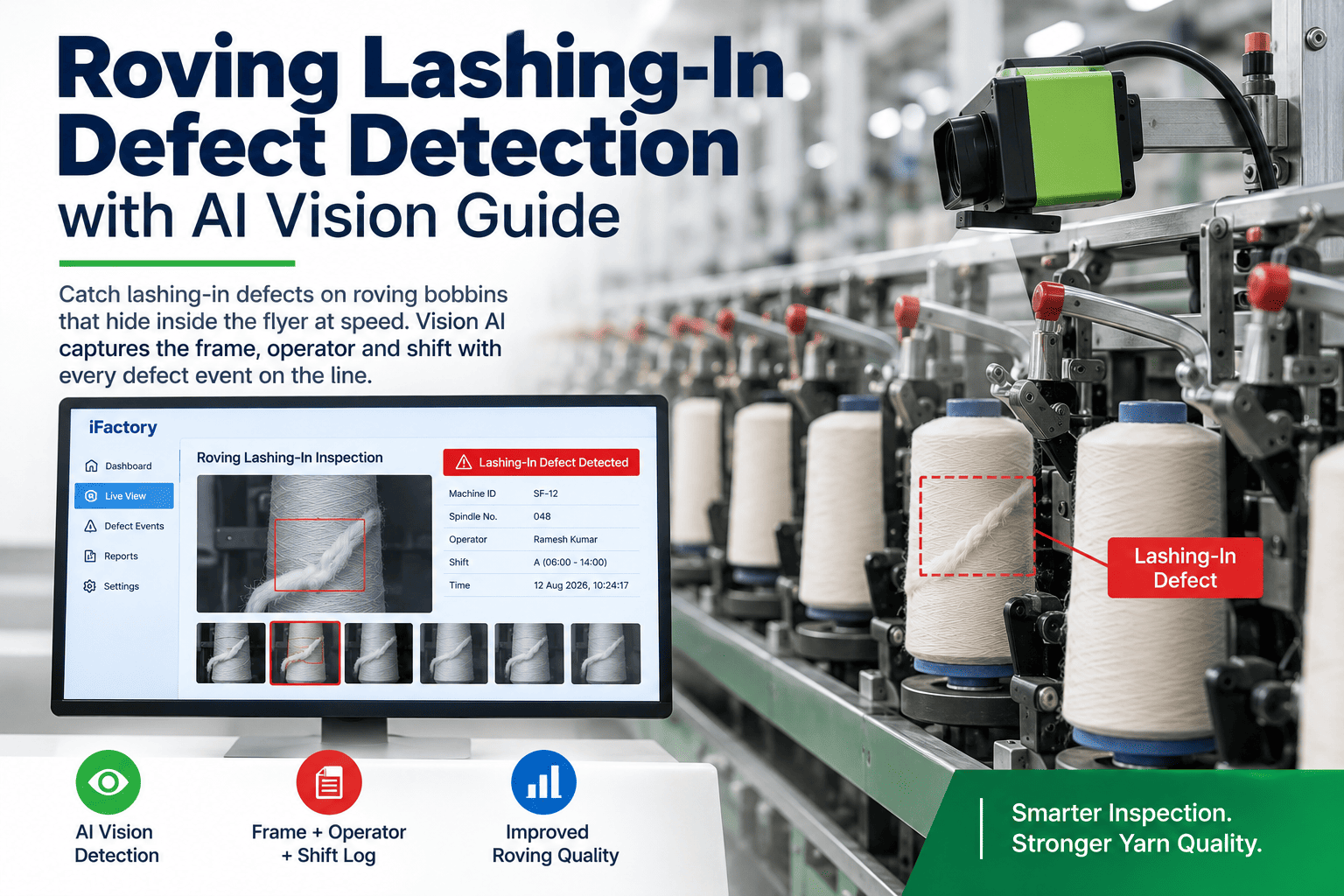
Roving lashing-in is the defect that hides inside a spinning flyer — the fibre wraps around the flyer top or bottom bell during high-speed rotation and stays invisible for the whole doff cycle. The operator only discovers it at bobbin change, when the flyer comes down with a tangled mess and a partially built package. Every event is fibre waste, position downtime, and mechanical stress on the flyer assembly. Yet almost none of it enters the MES with the frame, the spindle, the operator, and the shift attached — so a specific spindle that lashes twice a week never gets a maintenance work order.
iFactory / Roving lashing-in defect detection
Catch Every Lashing-In Event on the Flyer — With the Frame, Operator, and Shift Named
A vision agent watching the flyer top and bottom bell zone on every speed-frame position sees a lashing-in event as it forms, halts the position before the flyer takes damage, and writes the event with frame, spindle, operator, and shift into the MES.
Flyer top
HIDDEN during run
Bottom bell
HIDDEN during run
During doff cycle: invisible
At bobbin change: discovered
Inside flyer
hidden at run time
Frame + shift
the missing record
The Problem on the Line
Lashing-in happens when roving fibre wraps around the flyer top or the bottom bell during high-speed rotation instead of feeding cleanly into the bobbin. Because the flyer arm rotates and the wrap sits inside its geometry, the event is invisible during the doff — the position looks like it’s running normally. It only surfaces at doff when the operator sees tangled fibre and a partially built bobbin. Root causes vary: creel tension, atmospheric humidity, drafting-roller condition, or a spindle’s bearing behaviour. What is consistent is that the event doesn’t reach the MES with the frame, spindle, operator, and shift — so no frequency trend exists.
What Escapes Into the System of Record Today
Lashing-in is the defect the speed-frame department already knows about and can't measure. The event happens; the record almost never survives.
Paper
Operator clears the lashed flyer, discards the waste roving, notes "lashing on frame 4" on the shift sheet if at all. No spindle, no time, no cause hypothesis.
WhatsApp
Photo of a lashed flyer to the supervisor's phone during doff. The photo shows the event; the message doesn't name the spindle or track how often it happens on that spindle vs the others.
Winder-only data
No downstream signal exists at all — lashing-in produces waste at the speed frame, not directly a yarn defect. The whole cost of the failure mode is invisible in the winder record.
Nowhere at all
Repeated lashing on the same spindle (bearing wear, drafting-roller condition) never surfaces as a pattern because the events are not counted per spindle. The specific mechanical cause stays hidden until the flyer takes real damage.
What the Camera or Agent Actually Sees
A vision agent watching the flyer zone on every position sees the wrap forming in real time — not at doff, when the operator finds the mess. The point is not to prevent the wrap; it's to halt the position early enough that fibre loss is minimal and the mill has an actual record of every event.
Flyer Top
Fibre wrap forming around the flyer top just above the presser finger — the most common lashing site during high-speed rotation.
Watch: flyer top zone
Bottom Bell
Fibre building up in the bottom-bell zone as the wrap propagates downward — the secondary lashing pattern that damages the bell.
Watch: bottom bell zone
Position-Level ID
Which frame, which spindle, which flyer — enough spatial resolution to trend lashing frequency per spindle, not just per frame.
Read: spindle-specific
Halt Signal
Position halt signal into the speed-frame control the moment the wrap is detected, before the flyer arm takes mechanical stress and before fibre loss compounds.
Signal: to spindle drive
What Gets Written Back
The halt limits the damage. The MES record — with frame, spindle, operator, shift, and time — is what makes lashing-in a measurable failure mode instead of an operational rumour.
Lashing Event
Spinning MES
Event record with frame, spindle position, operator ID, shift, and timestamp — every lashing event becomes a data point, not an anecdote.
Spindle History
Speed Frame MES
Lashing frequency per spindle per week — a spindle drifting from the fleet average surfaces the mechanical or bearing issue for maintenance to schedule.
Environmental Note
Spinning MES
Department humidity and temperature at the event time joined to the record — a lashing-heavy shift on a low-RH day tells the mill something specific.
Operator Training
Training / L&D
Lashing rate per operator across shifts — a training gap on doff-side handling or piecing surfaces as a curve, not as a manager's suspicion.
Ask your speed-frame supervisor how many lashing-in events happened last month. If the answer is "a lot" instead of a number per spindle, the failure mode has no record and no root cause has been isolated. Book a speed frame assessment — we'll audit one week of doff events live.
12-Week Pilot Shape on One Station
One speed frame, all positions, six weeks. The pilot is scoped to prove that per-spindle lashing counts identify the spindles or the operators or the environmental conditions that produce most of the events — turning an unmeasured operational problem into an addressable one.
Weeks 1–2
Vision Setup
Cameras on the flyer zone of one speed frame across all positions. Two weeks of read-only capture. Baseline: lashing events per spindle per shift at your current settings.
Weeks 3–4
Detection Tuning
Wrap-formation detector tuned to your flyer geometry and roving speed. False-halt rate targeted below one per shift per frame — a lower rate than manual doff-time discovery.
Weeks 5–8
Halt + Log Live
Position halt into the speed-frame drive live. MES event write active with spindle, operator, shift, and environment data. Per-spindle frequency chart visible.
Weeks 9–12
Root-Cause Isolation
First six-week window closes. Spindles above fleet average identified for maintenance review. Operator training gap identified from cross-shift comparison. Environmental correlation confirmed or refuted with data.
Who Owns the KPI
Lashing-in is a defect that crosses production, maintenance, training, and environment. All four owners need their own number or the pattern gets attributed to the last one anyone thought about.
Speed Frame Sup.
Lashing events per frame per shift
Owns the frame-level trend. A frame consistently above fleet average signals something wrong with the whole machine — draft, creel, flyer condition — that needs review.
Maintenance
Lashing events per spindle per month
Owns the spindle-level trend. A specific spindle repeatedly lashing points at flyer bearing, spindle bearing, or presser finger geometry — a maintenance root cause.
Operator Trainer
Lashing events per operator per shift
Owns the human factor. An operator with a lashing rate above peers is a training gap, not a personnel issue; the data separates them.
Utilities / GM
Lashing rate vs department RH & temp
Owns the environmental correlation. When lashing rises with department humidity drop, the answer is often HVAC not spindle — and the data proves it.
FAQ
How do we detect a wrap inside a rotating flyer at all?
High-frame-rate imaging synced against the flyer rotation speed lets the vision agent effectively de-rotate the flyer view — the flyer becomes a stable image and any fibre accumulating on it appears as motion against the stable background. It's an established technique for high-speed rotating machinery. What matters is that the mill doesn't need to see individual fibres — it needs to see the density buildup that signals a forming wrap, and that's detectable at commercial camera speeds.
Will halting the position lose more roving than letting it run to doff?
Roughly the opposite. A wrap that forms and continues to run collects more fibre for the rest of the doff cycle — potentially thousands of metres of roving depending on timing — plus the risk of mechanical stress on the flyer arm. Early halt loses at most a few metres of roving and prevents the compounding loss. On top of that, the record of the event exists, which is worth more than the roving in the long run because it drives the root-cause work.
Can this run on older speed frames?
Yes. The camera and lighting installation is fixture-based and does not require modification of the speed-frame drive train — the same setup works on modern Rieter or Trützschler frames and on legacy machines from thirty years ago. What varies is the halt signal path: newer frames accept an external position-halt input directly; older frames may need a spindle-brake retrofit for the halt to be effective. The MES write-back is identical either way, so even on frames without halt capability the record layer works and the spindle-level trend surfaces.
Stop finding lashing at doff and forgetting it by lunch.
See Per-Spindle Lashing Counts on Your Own Frame
Bring one speed frame and one month of doff-time lashing observations. We'll show the vision agent, run one live position, and show what a per-spindle chart across six weeks would reveal about your specific frame.