A soft or oozed roving bobbin that reaches the ring frame creel is not one bad package — it is the trigger for an end-break epidemic that will last four hours. The bobbin looks acceptable on the doffing tray at the speed frame, then softens as its surface layers relax during transport. By the time it feeds the ring-frame drafting zone the roving is unstable, causes false draft, and produces a rash of end breaks on the receiving position and the ones next to it. The ring-frame supervisor spends the shift firefighting; nobody names the doff or the twist setting that started it.
iFactory / Roving bobbin doff inspection
Screen Every Roving Doff for Soft and Oozed Bobbins Before Creel-Up
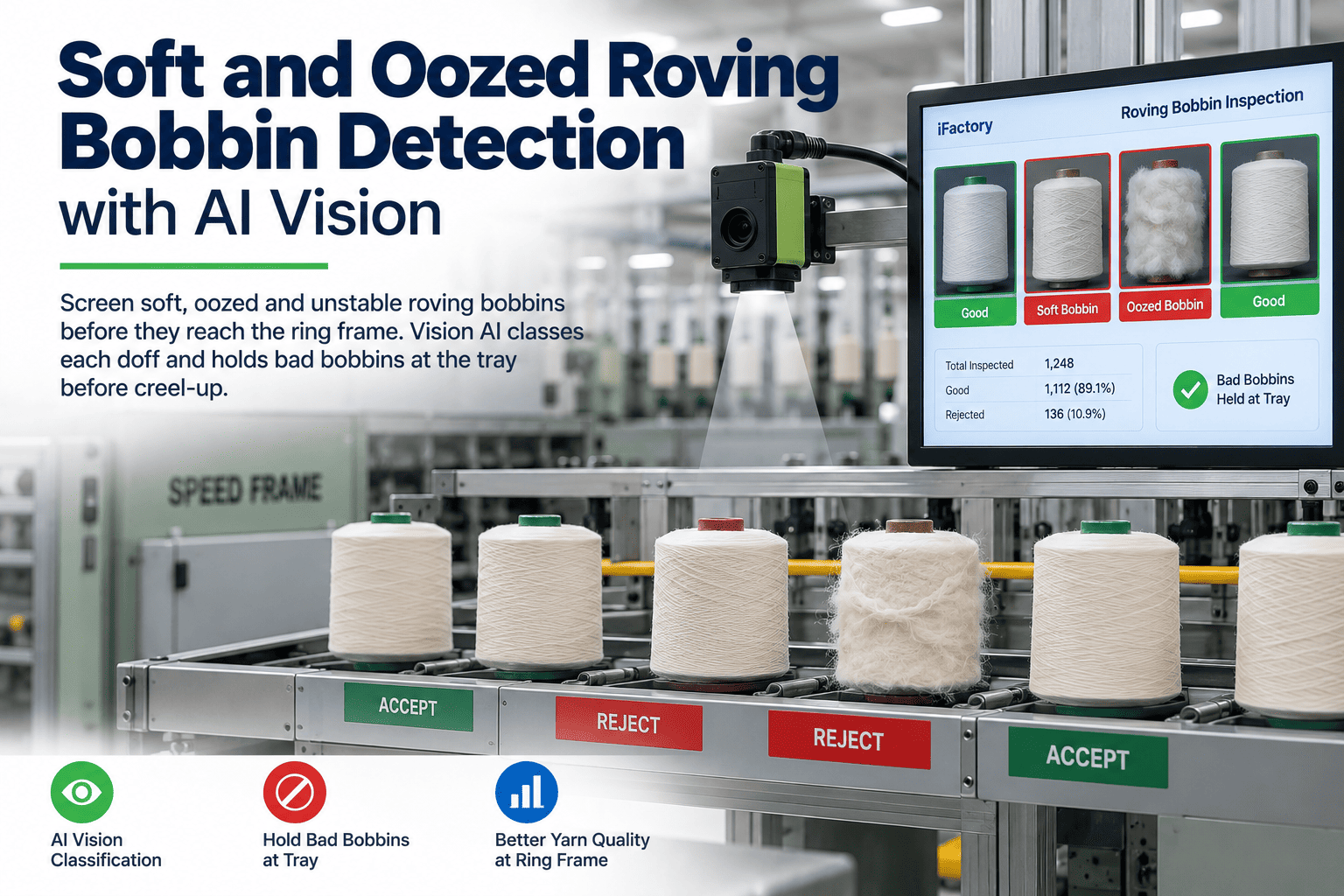
A vision agent at the doffing tray classes each roving bobbin at the moment it leaves the speed frame, holds soft, oozed, or unstable packages before they reach the ring-frame creel, and writes the classification into the MES for the frame and shift.
T + 0
At the trayBobbin looks acceptable, doff cleared
T + 20m
In transportSurface layers relax → bobbin oozes
T + 45m
At ring frame creelFalse draft → end break epidemic
T + 4h
Whole shiftSupervisor chasing breaks, root cause unnamed
60–132
spindles per speed frame
1 bad
bobbin = whole creel disrupted
Twist
the setting behind it
The Problem on the Line
A speed frame spins 60 to 132 roving bobbins at a time — every doff produces that many packages heading to the ring frame creel. A bobbin built with under-spec twist, uneven build, or a slack winding pattern looks normal on the tray for a minute, then softens or oozes as its surface layers relax. By the time it reaches the ring frame creel the package is unstable, feeds unevenly, causes false draft, and produces a rash of end breaks on the receiving position — plus neighbouring positions as fibre debris spreads. The supervisor spends the next four hours chasing breaks that all trace back to one bad doff.
What Escapes Into the System of Record Today
Bad roving bobbins are the classic case where the mill knows the problem exists — the ring-frame end-break spike proves it — but the specific bobbin, frame, and doff that caused it never lands in a system.
Paper
Ring-frame operator marks a rash of end breaks on the shift log. Nothing on the log names the roving bobbin, the speed frame, or the doff that fed the creel position.
WhatsApp
Ring-frame supervisor messages the speed-frame supervisor about "bad rovings again on RF-6." No frame, no doff, no photo — a memory, not a record.
Winder-only data
Downstream Uster Quantum cuts on the yarn from those bobbins show elevated thin-place and count-deviation counts. The winder record does not know which roving bobbin, from which speed frame, at which doff.
Nowhere at all
A soft bobbin ejected manually by a creel doffer into a scrap tray has no record at all — no image, no bobbin ID, no speed-frame trace. The cause disappears with the scrap.
What the Camera or Agent Actually Sees
A vision agent at the doffing tray of the speed frame classes each roving bobbin as it comes off — build shape, surface density signature, twist appearance, and stability. Bad bobbins are held on the tray with a red flag before they enter the transport to the ring frame creel.
Build Shape
Bobbin geometry captured — over- or under-built ends, taper deviation, and overall build regularity against the doff's target profile.
Class: build regularity
Surface Density
Surface layer density signature — a soft bobbin shows a diffuse, low-density surface pattern distinct from a firm, well-twisted package.
Class: density signature
Twist Appearance
Visible twist angle in the surface roving layers — under-twist looks visibly parallel, over-twist shows tight helical patterning.
Class: twist appearance
Stability
A soft or oozed bobbin visibly changes shape between the moment it leaves the flyer and the moment it sits on the tray — the stability check catches oozing before creel-up.
Class: stability at rest
What Gets Written Back
Holding a bad bobbin at the tray is the immediate action. The value in the MES record is that the speed frame, the doff, the head position, and the shift are named — so the root cause (twist setting, roller, drafting) can be traced instead of guessed at.
Bobbin Quality Event
Spinning MES
Hold event on the specific bobbin with class (soft / oozed / under-built / uneven), photo, doff number, and head position on the speed frame.
Frame Health
Speed Frame MES
Bad-bobbin rate per speed frame per doff — a specific head or a specific frame drifting surfaces against the fleet, pointing at drafting rollers or twist setting.
Twist Setting Note
Spinning MES
Twist setting active at the doff logged with the event so the setting-vs-quality relationship is on one chart, not distributed across a supervisor's memory.
Downstream Trace
MES Batch Genealogy
If a bad bobbin does reach the ring frame, the batch genealogy links the ring-frame end-break event back to the specific roving bobbin, speed frame, and doff.
Take one shift of ring-frame end-break records. If none of the elevated positions can be traced back to a specific roving bobbin from a specific speed frame doff, the source is invisible. Book a floor audit — we'll walk one doff live at the tray.
12-Week Pilot Shape on One Station
One speed frame, one shift, one roving hank. The pilot is scoped to prove that per-doff bobbin classification at the tray connects to fewer end-break events at the ring frame it feeds — and that the twist-setting adjustment lands based on data, not on the supervisor's memory.
Weeks 1–2
Vision at Tray
Camera above the doffing tray of one speed frame. Two weeks of read-only capture, human-labeled against your firmness / build standard. Baseline: bad-bobbin rate per doff, per head position.
Weeks 3–4
Classifier Tuning
Class definitions locked with your QA head — what counts as soft, oozed, uneven, under-twisted. False-hold rate targeted below the current human-inspector reject rate.
Weeks 5–8
Hold + MES Live
Tray-hold on classified bad bobbins active. MES event write live. Frame-level bad-bobbin trend visible. Twist setting logged with each doff.
Weeks 9–12
RF Break Match
Ring-frame end-break events on the fed frame mapped against roving-bobbin quality events. First time the mill can name the doff behind an end-break spike.
Who Owns the KPI
Roving-bobbin quality bridges speed-frame production and ring-frame consumption. Both supervisors need their own KPI, and the twist-setting owner needs the data too.
Speed Frame Sup.
Bad-bobbin rate per doff per head
Owns the speed-frame side — a specific head drifting means drafting-roller wear, weighting-arm pressure, or bobbin-drive slippage on that spindle.
RF Supervisor
End breaks traced to a bad roving bobbin
Owns the ring-frame loop-close — every elevated-break position should either trace to a held-back bobbin or to a bobbin that escaped the hold.
Operator Trainer
Twist setting vs bad-bobbin rate
Owns the setting-vs-outcome chart — the twist-multiplier that produced today's bobbin quality is on the same view as the outcome, so training corrections are data-driven.
Production / GM
Ring frame OEE loss to end breaks
Owns the OEE number now that end-break causes are correctly attributed to source, not to "quality issue this shift." The true cost of a bad doff is visible.
FAQ
Doesn't the doffer already reject obviously bad bobbins?
Yes, and a good doffer catches most of them — but not all, and not the marginal ones. A soft or slowly oozing bobbin often looks acceptable at the moment it leaves the tray and only degrades in the twenty minutes before it reaches the creel. The vision agent screens every doff to the same standard every time, catches the marginals a busy shift misses, and — more importantly — creates the record that lets the mill trace end breaks back to a source. It complements the doffer's eye; it does not replace it.
Can it tell us why the bobbin is bad?
It can name what it sees — soft, oozed, under-built, uneven twist — and the class is often enough to point at the cause. Under-twist across a whole doff points at the twist multiplier setting; a specific head consistently producing under-built bobbins points at that spindle's drafting rollers or weighting arm. The agent doesn't diagnose the mechanical root cause; it makes the pattern visible enough that the supervisor can. Most mills find one or two heads on each speed frame produce most of the bad bobbins, which is not a fact you can see without per-head data.
What if we already inspect roving bobbins at the ring frame creel?
Creel-side inspection at the ring frame catches some bad bobbins, but the bobbin has already travelled through material handling and the creel operator is under time pressure. Catching at the doffing tray — right where the bobbin was built — means the source information (speed frame, doff number, head position, twist setting) is still available and the material-handling cost of moving a bad bobbin was not incurred. Creel-side inspection is worth keeping as a safety net; tray-side inspection is where the data value is.
Stop letting one bad doff decide the next four hours.
Class One Doff Live at the Speed-Frame Tray
Bring one speed frame and one shift of the receiving ring frame's end-break records. We'll run the vision classifier on a live doff, show the tray-hold decision, and trace the historical breaks back to their source doffs.