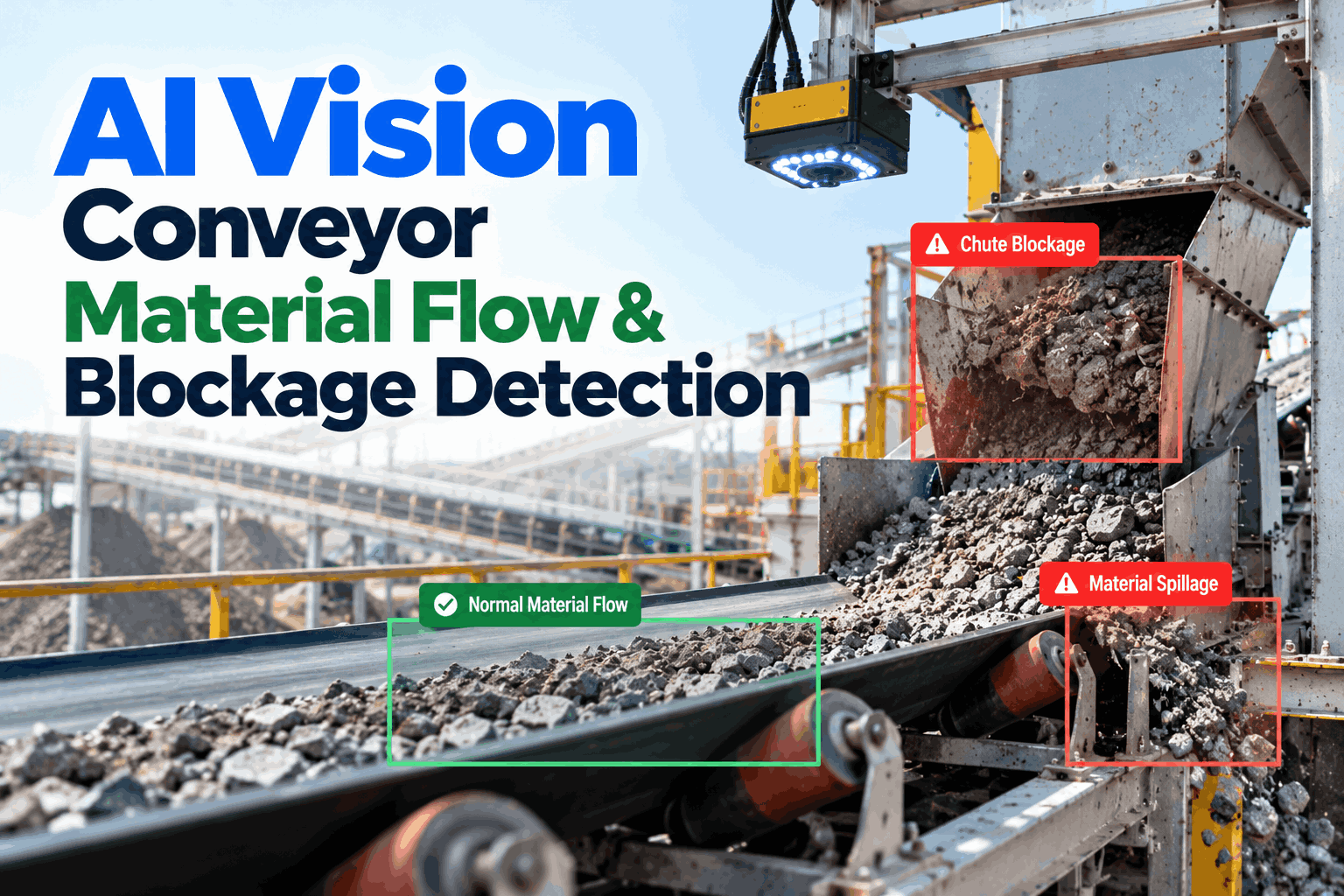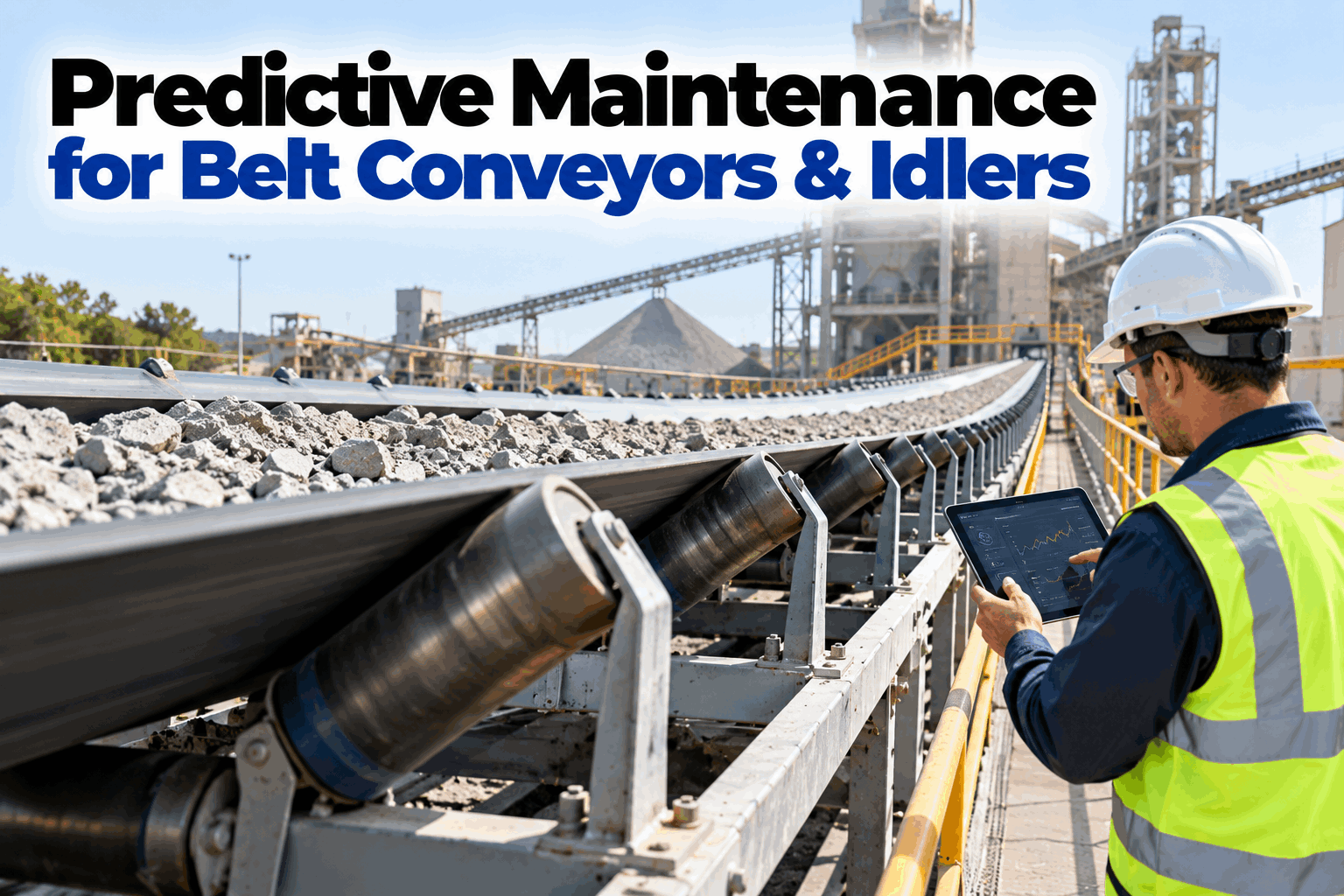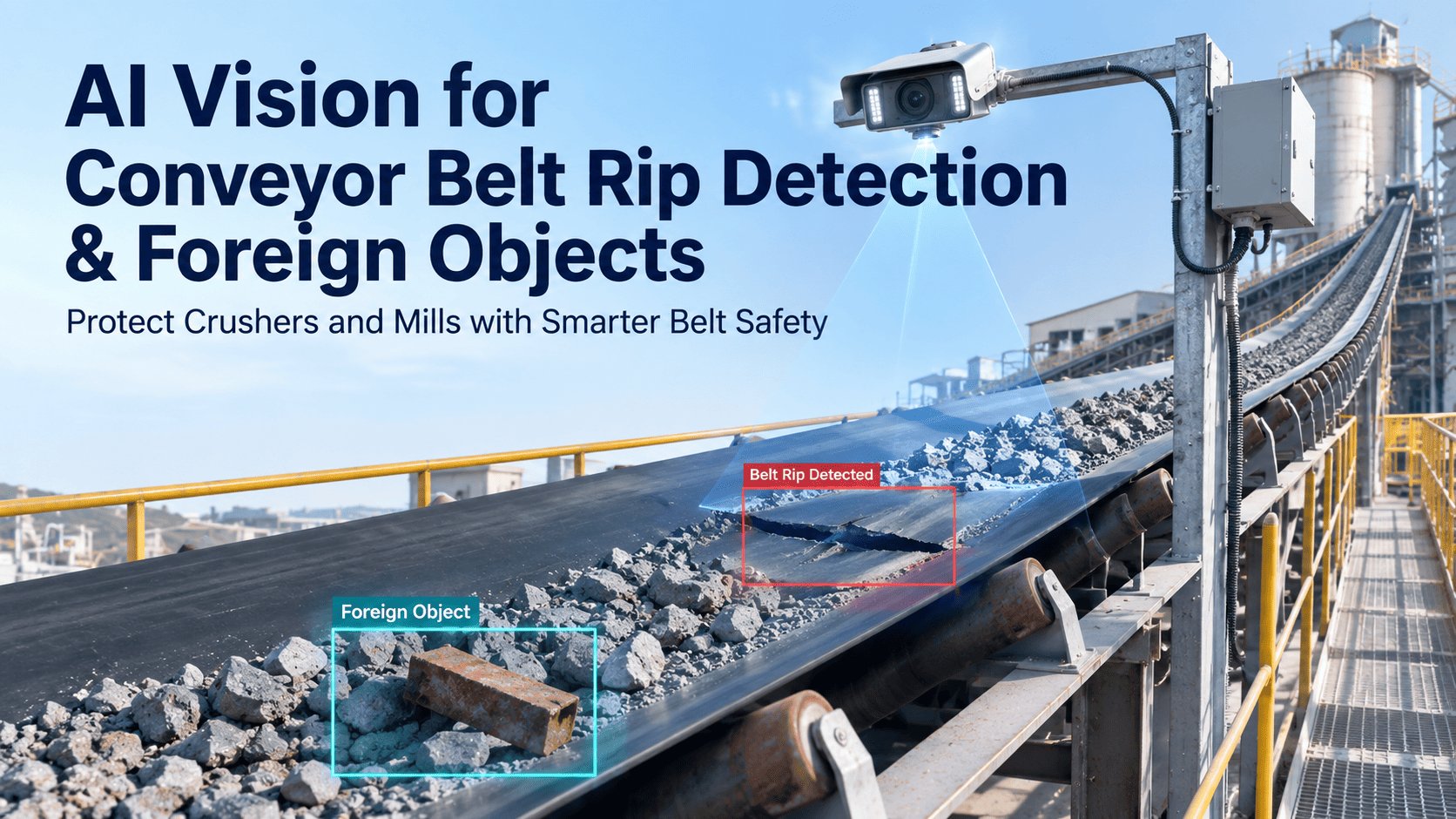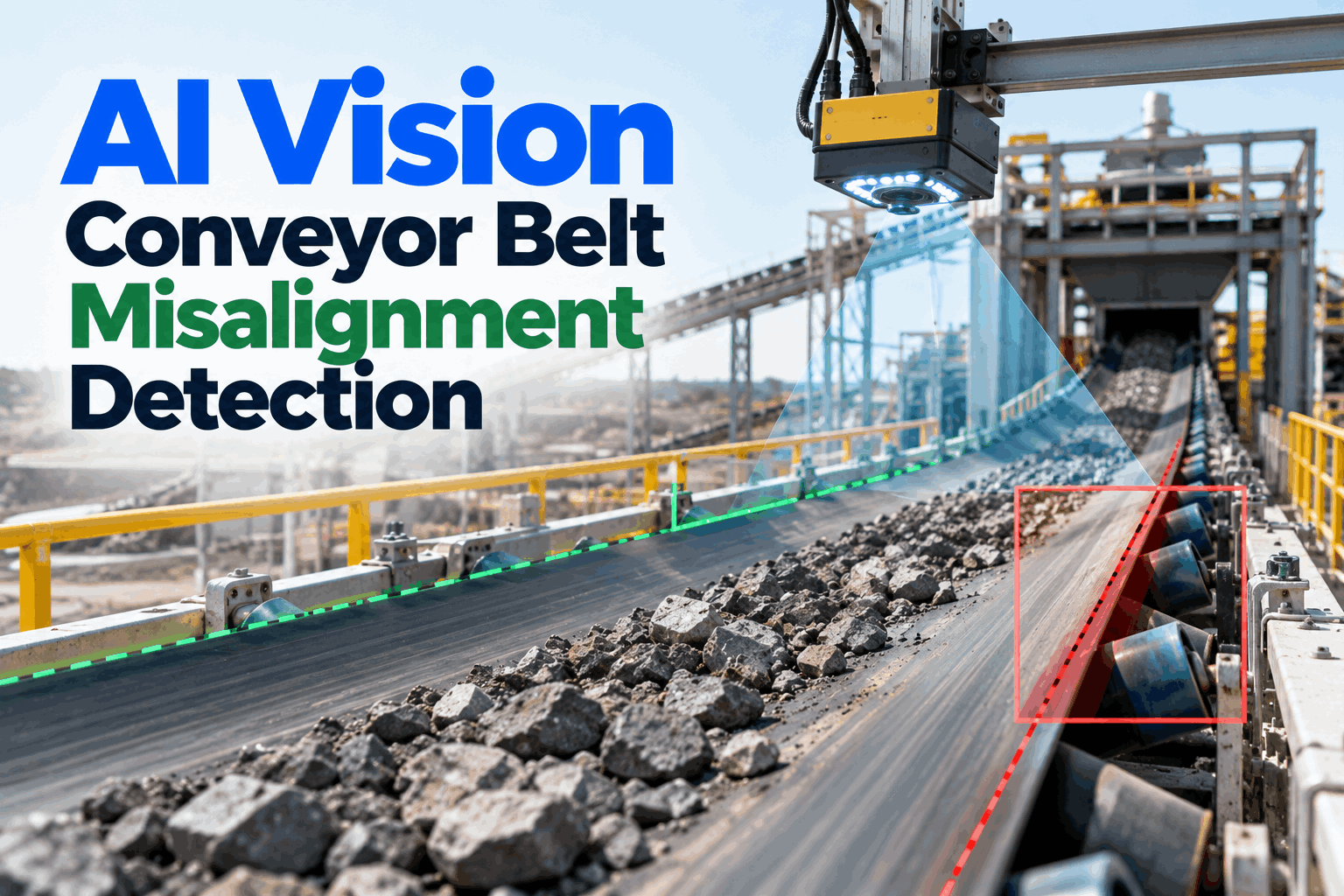
A conveyor belt rarely fails all at once. It wanders off centre, sways at the load zone, then rubs the frame until the edge frays, material spills and, in dusty plants, friction becomes a fire risk. Walk-by checks once a shift often miss these early signs. AI vision watches the belt edge on every revolution, spots drift, sway and edge damage early, and raises a work order with location and images. To see it on one of your conveyors, book a belt tracking session.
AI Vision Conveyor Belt Misalignment Detection
Cameras over the belt measure where the edges run, how much the belt sways, and whether the edge is fraying or spilling. When drift moves past your limit, the system raises a work order before the belt meets the steel.
- Why belts drift, and what each cause looks like on camera
- How to set allowable, actionable and critical limits
- How alerts turn into work orders your crew can act on
- Belt
- Allowed edge window (±60 mm)
- Conveyor centre line
Here the belt runs close to centre at the tail and load zone, then walks to the right along the carry side and passes its limit around idler 60. That pattern points to a local cause between idlers 40 and 60, not to the loading chute.
What Mistracking Really Costs
A belt off track damages more than the belt.
When a belt runs off centre, it starts to rub the frame, the skirting or the structure. The belt edge wears away, the steel wears too, and material spills over the side. Spillage then builds up on idlers and pulleys, which makes tracking worse, so the problem feeds itself. Our conveyor support team can help you work out where your losses start.
Worn edges
Rubbing strips away edge rubber and cords, narrows the usable width and shortens belt life.
Damaged steel
Frames, stringers and guards wear where the belt meets them, adding repair work.
Spillage
Product falls off the edge, is lost, and has to be shovelled up by hand.
Clean-up risk
Workers clearing spillage near a moving conveyor face pinch points and falling material.
Friction heat
A belt rubbing steel can become an ignition source, especially in dusty areas.
Fines and stoppages
In US mining, 30 CFR 75.1731 says belts must be aligned to stop them rubbing the structure.
In New South Wales, a worker at an underground coal mine found glowing embers under a conveyor near the drive head. The regulator said the cause appeared to be the belt tracking off course and rubbing a fixed structure. The worker put it out, but the lesson is clear: belt-to-steel contact needs to be found early.
Where Belt Drift Starts
The belt goes where the conveyor pushes it.
Most drift has a cause you can fix: off-centre loading, idlers or pulleys out of square, build-up on rolling parts, a poor splice, or a belt installed without resetting the structure. Some causes act all the time and some come and go with load, weather or material. Where the drift appears along the conveyor, and when, is often the best clue. To map likely causes on your own belts, book a drift review call.
A drift that rises and falls with load points at the feed. One that jumps once per revolution points at a splice. A slow, steady walk from one idler onward points at the structure. Trending each type separately keeps the crew from chasing the wrong cause.
Common shortcuts that backfire
- Knocking idlers over again and again to steer the belt
- Bolting side rollers on to push the belt back
- Mixing idler brands and sizes in one run
- Fitting a new belt without re-setting alignment
Fixes that last
- Square and level the structure to standard
- Centre the load with good chute design
- Keep rolls clean and carryback under control
- Use trainers that steer early, with low force
A Walk-By Check Versus Every Revolution
Here is one day on a 300 m conveyor running at 3 m/s, checked by a walk-by once a shift, and watched by camera on every pass of the belt.
Allowable, Actionable, Critical: Setting the Limits
Not every bit of drift needs a work order.
Every belt wanders a little. The aim is to separate normal wander from drift that needs action. Industry guidance sorts mistracking into three levels: allowable, actionable and critical. ISO gives an overall run-out figure, while CEMA sets allowances at pulleys, along the carry side and on the return. Our engineers can help you set limits for each belt.
Allowable
Normal wander for this belt and load. Logged and trended, no action needed.
Actionable
Drift is causing spillage or touching the belt edge or structure. Work order raised for the next planned window.
Critical
Immediate risk of serious damage or injury. Alarm to the control room and correction now.
If the action limit is ±60 mm, an early warning at about two-thirds of that gives the crew time to plan a fix in the next stop, rather than an emergency shutdown. Set limits per belt and per location, because pulleys, carry idlers and the return run have different room to move.
What the Camera Watches
Four signals, one view of belt health.
A tracking switch tells you the belt has already reached the edge. A camera shows how it got there. By measuring both belt edges on every revolution, vision sees the slow walk, the sway and the damage while there is still time to plan a fix. To choose camera points on your conveyors, book a camera layout session.
Drift
Steady movement of the belt centre to one side, trended over hours and days.
Sway
Side-to-side swing with load or speed changes, measured as a range, not a single point.
Edge damage
Fraying, nicks, missing cover and cord showing along the belt edge.
Spillage
Material on the return belt, the walkway or under idlers, linked to tracking events.
See
Camera captures both belt edges as the belt passes.
Measure
Edge offset and sway worked out in millimetres.
Classify
Drift typed as load-linked, splice-linked or steady.
Compare
Checked against the limit set for that belt and spot.
Raise
Work order raised with location, images and trend.
Confirm
After the fix, the trend shows if the belt is back on centre.
Vision Next to the Tools You Already Have
Cameras add warning time. Switches and trainers still do their jobs.
Belt sway switches stop the belt when it has gone too far. Self-aligning trainers push it back toward centre. Both are worth keeping. What neither does well is tell you that a belt has been slowly walking off for a week, which idler started it, or whether the edge is already damaged. That is the gap vision fills.
A trainer that is working hard all day keeps the belt on track while the real cause grows. Watching how far the belt sits off centre near a trainer, and how often it corrects, shows when the structure needs attention rather than more steering.
How iFactory Vision Anomaly Detection Works on Conveyors
Every revolution watched, every alert tied to a fix.
iFactory's Vision Anomaly Detection runs deep learning models on an edge server close to your conveyors. It learns the normal run of each belt, flags drift, sway, edge damage and spillage as they start, and raises maintenance work orders with the station, trend and images attached, so the crew knows where to go and what to bring. Questions on fit go to our support desk.
Per-belt baseline
Normal wander learned for each belt, speed and load, so alerts fit the conveyor.
Existing cameras
Uses new or existing cameras where the view and lighting allow.
Trend-based alarms
Warnings on rising drift, not on every swing, to keep false alarms low.
Work orders
Sent to your maintenance system with location, severity and images.
What operators see
- Live belt position on each conveyor
- Alerts by belt, station and severity
- Images of edge damage and spillage
What maintenance sees
- Work orders with the likely cause
- Drift history before and after each fix
- Belts ranked by tracking risk
How early drift is caught depends on camera position, lighting, dust and belt speed. We measure it on your own conveyors during the pilot, against your own inspections, rather than promising a general figure.
Turnkey AI: Delivered, Connected and Live in 6–12 Weeks
You do not build this. It arrives ready.
iFactory ships as a pre-configured NVIDIA AI server, racked and ready, with the software pre-loaded. Rack it, plug in power and Ethernet, and the AI is live on your network.
Our team handles cabling, network setup, PLC and SCADA integration, operator training and 24×7 remote monitoring. The server sits inside your own network, so images and plant data stay on site. For a scope matched to your conveyors, request a turnkey quote.
Ship, network and data
Server and cameras installed on the pilot conveyors. PLC signals and the maintenance system connected.
Baseline and pilot
Normal belt run learned and limits set with your team. Alerts compared with walk-by findings.
Go-live and training
Automatic work orders switched on once results are agreed. Crews trained. 24×7 remote monitoring begins.
Frequently Asked Questions
How does AI vision detect conveyor misalignment?
Cameras view the belt edges and the model measures how far each edge sits from where it should be, on every revolution. It trends that offset over time and alerts when drift passes the limit you set for that belt and location.
Can it tell normal sway from real drift?
Yes, that is the main job of the baseline. Each belt's normal wander with load and speed is learned first, so alerts fire on steady drift or growing sway, not on every swing as material lands.
Does it find edge damage too?
It flags visible edge damage such as fraying, nicks and missing cover along the edge it can see. Damage on the bottom cover or inside the carcass needs other inspection methods.
Will dust, rain or poor light stop it working?
Heavy dust, spray and glare make imaging harder. Camera housings, lighting and placement are planned for each site, and image quality is checked during the pilot before alerts are relied on.
Do we still need sway switches and trainers?
Yes. Switches are your safety limit and trainers correct normal wander. Vision adds early warning and the cause, so the belt is fixed before it trips the switch.
How are work orders raised?
When drift, sway, edge damage or spillage passes a limit, a work order is sent to your maintenance system with the conveyor, station, severity, trend and images, ready to plan into the next stop.
How do we start?
With the conveyor that has the most spillage, belt damage or tracking stops, so the gains are easy to see. A 6-week pilot installs cameras, learns the belt's normal run and checks alerts against your inspections. To plan it, contact our team.
Catch the Drift Before the Belt Hits Steel
In thirty minutes we look at your conveyors, tracking problems and spillage, pick the belt most likely to pay back first, and sketch where cameras would go. You keep the plan whether or not you go further with iFactory.
- 1A list of conveyors with belt widths and speeds
- 2Recent tracking stops and sway switch trips
- 3Photos of belt edge damage and spillage
- 4Belt replacement and repair history
- 5Your maintenance system and work order rules