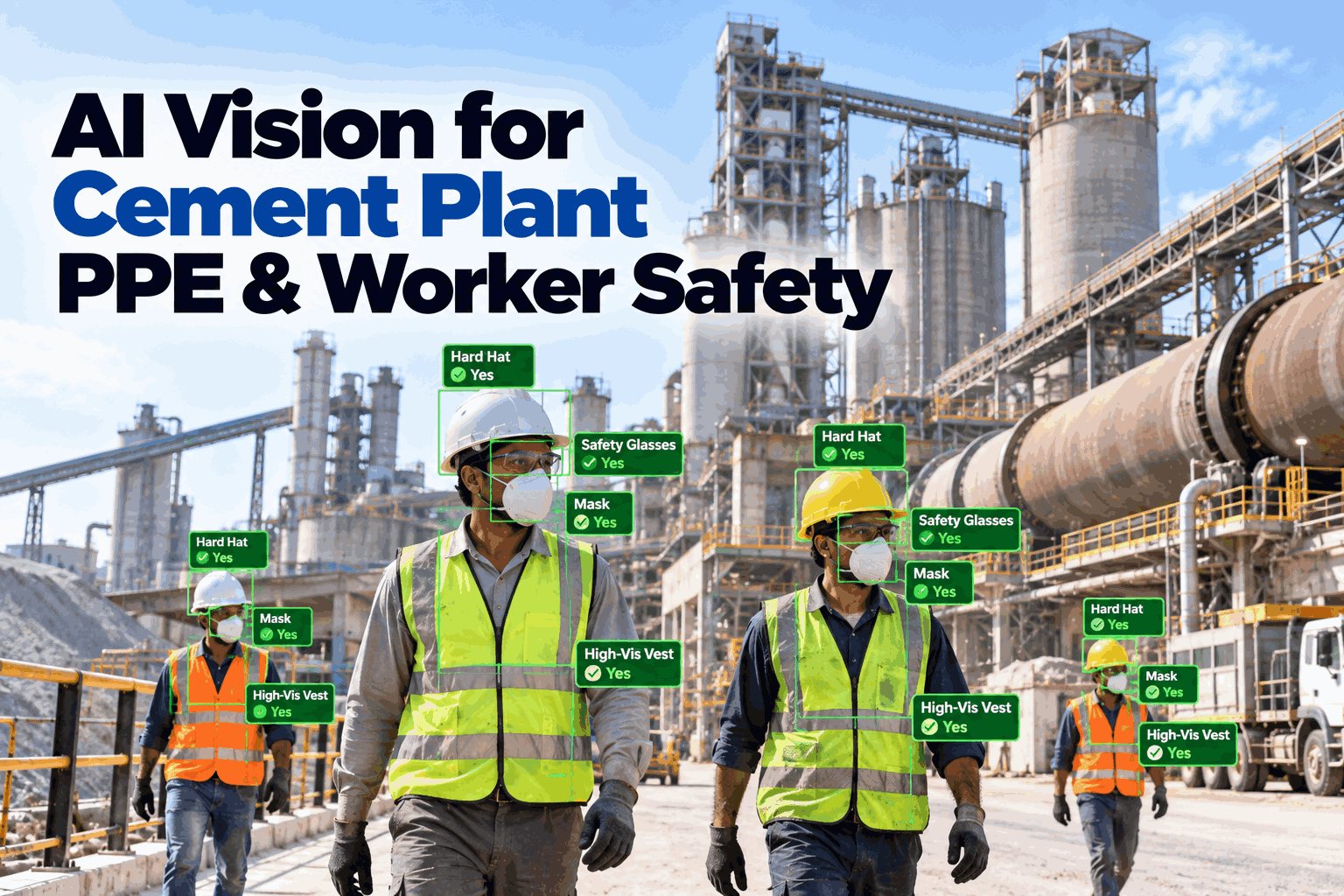
Cement and concrete manufacturing reported 2.5 to 4 recordable injuries per 100 full-time workers in recent BLS data — and most plants at the higher end of that range are still checking PPE compliance the same way: a safety officer walking the kiln, mill, and quarry for thirty minutes out of a twelve-hour shift, which works out to about 4% continuous coverage of what's actually happening on the floor. OSHA's respirable crystalline silica standard sets an 8-hour exposure limit of 50 micrograms per cubic meter — tight enough that a missed dust mask for part of a shift matters, and loose enough that nobody's writing it up after the fact. iFactory's AI Vision Camera Platform is built to close that 4%-to-100% gap: continuous hard-hat, high-vis, dust-mask, and safety-glass detection across kiln, mill, quarry, and dispatch, with every violation flagged the moment it happens instead of the next time someone happens to walk by.
iFactory AI Vision Camera Platform
Catch Every PPE Gap, Not Just the One the Safety Walk Happens to See
Continuous hard-hat, high-vis, dust-mask, and safety-glass detection across kiln, mill, quarry, and dispatch — 24/7, not a 30-minute walk-through.
2.5-4
recordable injuries per 100 workers
~4%
typical shift coverage, manual walk
50 µg/m³
OSHA silica limit, 8-hr TWA
24/7
continuous coverage, every zone
The Vision Cockpit — What Every Zone Should Say
Continuous visibility means every zone reporting live PPE compliance, not a once-a-shift snapshot. This is what that view looks like across a mixed cement site right now.
Kiln & Pyroprocessing
High-heat zone
Compliant
Hard hat99.2%compliance
High-vis98.6%compliance
Dust mask95.4%compliance
Violations today2flagged & resolved
Raw Mill & Grinding
Dust-intensive zone
Dust mask gap
Dust mask81.3%below target
Hard hat97.8%compliance
High-vis96.0%compliance
Violations today14mostly masks
Quarry & Blasting Zone
MSHA Part 56
High-vis gap
High-vis78.9%below target
Hard hat95.1%compliance
Safety glasses90.2%compliance
Violations today19mostly vests
Dispatch & Loading
Vehicle traffic zone
Critical zone
High-vis68.4%well below target
Near-miss flags5vehicle-pedestrian, today
Hard hat92.0%compliance
Violations today23highest of any zone
Coverage — Manual Spot-Check vs Continuous AI Vision
The gap between what a safety program intends to catch and what it actually sees comes down almost entirely to coverage — how much of the shift is actually being watched.
24/7 AI vision
100%
Every shift, every zone
Multiple daily safety walks
~15-20%
Best-case manual
Single daily safety walk
~4-6%
Typical
Weekly spot audit
<1%
Common at smaller sites
Incident-triggered review only
0%
Reactive only
*Illustrative: a daily 30-minute safety walk across a 12-hour shift sees about 4% of that shift. At a plant logging 50+ PPE violations a day across all zones, that math suggests the overwhelming majority never get seen at all — let alone corrected before the shift ends.
What the Camera Actually Watches For
Each zone carries a different PPE profile, and the platform is built to detect the categories that matter for that specific area rather than a one-size-fits-all checklist.
Hard hat / head protection
All zones
Universal requirement across kiln, mill, quarry, and dispatch.
High-vis vest
Quarry, dispatch
Highest-risk category in any zone with mobile equipment or vehicle traffic.
Dust mask / respirator
Mill, kiln, handling
Tied directly to silica and particulate exposure limits.
Safety glasses / face shield
Grinding, maintenance
Eye protection around crushing, grinding, and mechanical work.
Restricted-zone presence
Blasting, pinch points
Detecting a worker in an exclusion zone at all, not just missing PPE.
Want to see what your own cameras would catch? Book a demo — we'll run a pilot on one zone's existing feed.
Safety Walk vs AI Vision — Same Compliance Goal, Two Outcomes
Both approaches are trying to answer the same question. One answers it for a few minutes a day. The other answers it continuously.
Manual Safety Walk
"Was everyone wearing the right PPE this shift?"
Observed for the 20-40 minutes someone was actually walking the floor
Violations outside that window go unrecorded, not just unseen
Written up after the fact, often without photo evidence
Coverage depends on how many safety officers are on shift
AI Vision Platform
"Was everyone wearing the right PPE this shift?"
Every worker in every monitored zone, every minute of the shift
Violations timestamped and flagged the moment they happen
Photo and video evidence attached automatically for review
Coverage doesn't depend on headcount or shift pattern
How AI Vision PPE Detection Gets Built
The system is built to extend your existing safety program, not replace the judgment calls a trained HSE officer makes.
01
Connect Existing or New Cameras
Ingest live feeds from kiln, mill, quarry, and dispatch area cameras — existing CCTV or new installs.
02
Detect PPE Classes Live
Hard hat, high-vis, dust mask, and safety glasses detected per worker, per frame, continuously.
03
Flag Violations in Real Time
Missing or incorrect PPE flagged instantly, with zone, timestamp, and image attached.
04
Route to Supervisor
Live alert routed to the shift supervisor or HSE officer for immediate correction.
05
Log for Audit & Trend
Every event logged for OSHA/MSHA documentation and rolled up into zone-level compliance trends.
What Continuous Vision Monitoring Delivers
These are the outcomes plants typically see after moving from periodic safety walks to continuous AI vision coverage.
100%
Shift coverage
vs ~4-6% manual
24/7
Every zone monitored
kiln, mill, quarry, dispatch
Minutes
To flag a violation
not the next safety walk
Auto-logged
Evidence trail
for every flagged event
Curious what continuous coverage would surface at your site? Talk to our team — we'll walk through a pilot on your existing cameras.
Frequently Asked Questions
Does this replace our safety officers or support them?
It supports them. The platform catches what a part-time walk-through physically can't — continuous coverage across every zone — but the judgment calls around enforcement, coaching, and root-cause investigation stay with your HSE team. What changes is that they're acting on a complete picture instead of a sample.
How does the system handle worker privacy?
The platform detects PPE categories and zone presence, not individual identity — it doesn't perform facial recognition or track named individuals across the system by default. Most deployments are scoped to PPE and exclusion-zone detection specifically, with access to any identifiable footage restricted the same way existing plant CCTV access already is.
What camera infrastructure do we need?
Most plants already have some CCTV coverage in dispatch and high-traffic areas; the platform can ingest those existing feeds directly. For zones without adequate coverage — often the quarry and parts of the mill — we scope new camera placement as part of the engagement rather than assuming a full rebuild is required.
How accurate is PPE detection in dusty or low-light conditions like the kiln and mill?
Detection models are trained specifically on cement-plant conditions — dust, steam, variable lighting, and high-heat shimmer around kiln areas — rather than generic factory-floor footage. Accuracy is validated per zone during pilot deployment before it goes live, and camera placement recommendations account for the specific visibility challenges of each area.
How long does it take to get live PPE monitoring running?
Typically 4-8 weeks for a pilot zone using existing cameras, with full multi-zone coverage across kiln, mill, quarry, and dispatch usually running 8-12 weeks depending on how much new camera infrastructure is needed. Book a demo and we'll scope a pilot on your current setup.
Stop relying on a 30-minute walk-through.
See Every PPE Gap Across Your Plant, Live
Bring your camera layout and one zone's existing feed. We'll show live hard-hat, high-vis, dust-mask, and safety-glass detection running on your own footage before you commit to anything.