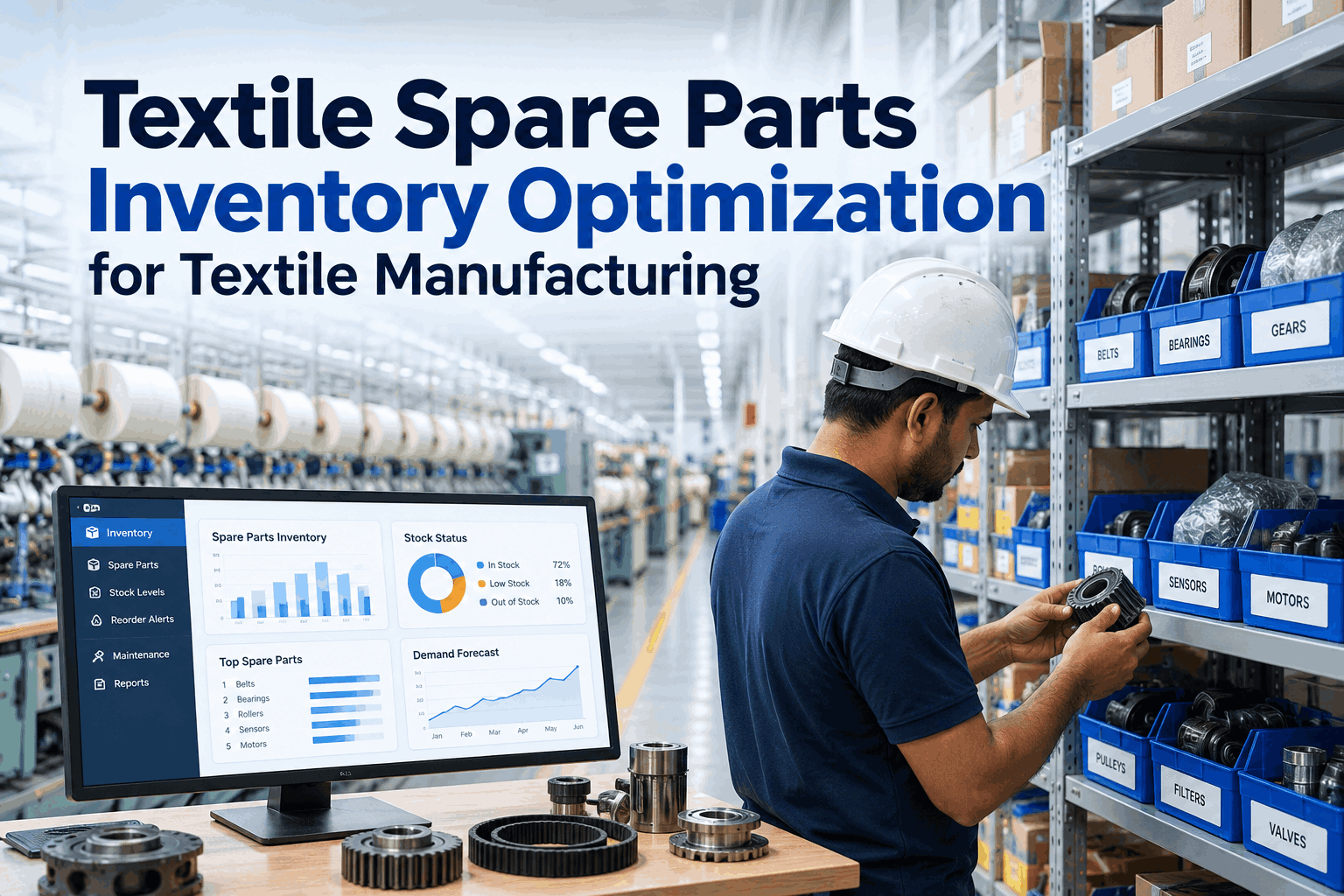
Ask a textile mill why a loom or ring frame sat idle, and the answer is often a part that wasn't there: a pack of travellers, a set of cots, a heald frame or a gearbox bearing on a long import lead time. Ask the stores manager about inventory and you'll hear the opposite problem, with shelves of slow-moving parts tying up cash. Spare parts optimization fixes both at once, and you can see how in a short live demo.
Stop Losing Looms and Spindles to Missing Parts, Without Overstocking the Store
iFactory links spare parts stock to machine hours, production and maintenance work orders. Every part gets a stocking rule that matches how critical it is, how fast it is used and how long it takes to arrive, so stockouts are flagged weeks ahead.
Thousands of Small Parts, a Few Critical Ones, and Long Lead Times
A textile mill carries an unusual mix of spares. There are high-volume consumables replaced on a cycle, such as travellers, cots, aprons, knitting needles and warp stop wires. There are medium-volume wear parts, such as card clothing, heald frames, reeds and rapier tapes. And there are a few critical, slow-moving parts, such as main drive gearboxes, motors and electronic boards, that rarely fail but stop a whole line when they do. Many of these come from overseas machine builders with long and variable lead times. A single rule can't handle all three groups well, which is why most mills end up short of some parts and overstocked on others at the same time. If your stores data is spread across spreadsheets, our support team can help bring it together.
Usage tracks production volume and machine hours, so stock should follow the production plan, not last year's average.
A change in yarn count or fabric style changes which travellers, reeds or needles are needed, often at short notice.
Lead times of weeks or months mean the reorder point has to cover the whole wait, plus a buffer for delays.
Slow movers with a high downtime cost need a deliberate insurance stock, even if the part sits on the shelf for a year.
Typical Textile Spares and How to Stock Them
Each department has its own spare parts profile, and the right stocking method depends as much on how a part is used as on what it costs. The matrix below groups common examples and suggests a stocking approach for each. Treat it as a starting point and adjust to your machine population, yarn counts and fabric range. A mill running mostly coarse counts on older ring frames will have a very different consumption profile from one spinning fine compact yarn, even with the same machine count. We can map your own parts list to this structure in a working session.
ABC-VED: Combine Value and Criticality
ABC classification ranks parts by annual spend. VED classification ranks them by how critical they are to production: vital, essential or desirable. Used together, they show where to hold safety stock and where to cut. A cheap traveller can be vital, and an expensive spare can be desirable if it's easy to source. Classifying a few hundred active parts by both measures is usually a few days' work for stores and maintenance together, and it sets the policy for everything that follows. Our stores specialists can help you classify your parts list.
Reorder Point and Safety Stock, With a Worked Example
For parts with steady usage, a reorder point covers expected usage during the lead time plus a safety stock for variation in usage and delivery. Vital parts with unreliable suppliers deserve a larger safety stock than desirable parts from a local distributor, which is where the ABC-VED class feeds directly into the numbers. The example below uses illustrative numbers for ring frame top roll cots. Substitute your own consumption and supplier data. You can see the calculation run on your data in a short demo.
If the mill plans more spindle hours next month, or a change to a finer count, cot and traveller usage will change with it. Forecasting consumables from planned machine hours and the yarn count plan keeps the reorder point right as production shifts, instead of trailing behind last quarter's average.
Know Which Part Will Run Out Before It Stops a Machine
iFactory reads machine hours and the production plan, forecasts consumable usage and warns stores and maintenance when a critical spare's cover falls below its lead time.
Stockouts and Overstock Have the Same Root Cause
Stockouts and excess stock usually show up together, because both come from stocking rules that don't reflect real usage. When a machine stops for a missing part, the natural reaction is to order extra next time, and over the years that habit fills the store with the wrong parts while the right ones still run short. Mills that fix the rules tend to reduce both at the same time. The comparison below shows the typical symptoms. Our support team can review your current position.
- Machines waiting for parts during breakdowns
- Emergency air freight for imported spares
- Parts borrowed from idle machines
- PM jobs postponed because kits are incomplete
- Worn parts run past their limit, hurting yarn and fabric quality
- Parts for retired machines still on shelves
- Style-specific reeds and needles no longer in use
- Duplicate part numbers for the same item
- Rubber cots and aprons ageing past their shelf life
- Working capital locked in slow movers
Connect Spares to Work Orders So Every Job Starts Complete
When parts and work orders live in separate systems, a technician can arrive at a loom only to find the job can't be finished. Linking each preventive maintenance task to its parts list lets stores pick and kit parts ahead of the planned window, and reserves the parts so they aren't used elsewhere. It also turns every completed job into usage data, which makes the next forecast more accurate. We can show kitting linked to your PM calendar in a guided demo.
Four Habits That Keep Spares Inventory Out of Balance
These patterns show up in most mills before they optimize. Each is cheap to fix once you can see it, and fixing even one or two usually makes a visible difference within a quarter. Our stores specialists can help you spot them in your data.
The same min-max logic for travellers and gearboxes ignores the very different risks they carry.
Levels set years ago don't reflect today's machines, counts, styles or supplier lead times.
Duplicates and vague descriptions hide stock that already exists and cause parallel orders.
Without PM and failure data, stores can't anticipate demand and only react to it.
Four Measures That Show Whether Spares Control Is Working
Spares optimization should show up in numbers that both stores and maintenance care about, not just in a lower inventory value on the balance sheet. Tracking a small set of measures each month shows whether stockouts are falling without stock simply growing to compensate. Most of these can be calculated automatically once stores and maintenance data are connected. We can set up these measures for your mill in a setup session.
The share of parts requests met from stock on the first ask. This is the stores service level that maintenance feels.
Machine hours lost while a job waited for a spare. This links inventory decisions directly to production.
Rush orders and air freight for parts that should have been planned. A falling count shows rules are working.
The value of stock with no use in a set period, which shows whether cash is being released.
Software, Data Connections and AI Server in One Package
iFactory delivers spares optimization as a turnkey bundle. A pre-configured NVIDIA AI server ships racked and ready with the software pre-loaded. You rack it, plug in power and Ethernet, and the AI is live. To scope it for your mill, request a turnkey quote.
- Pre-configured NVIDIA AI edge server, racked and ready
- Connectors for ERP stores, maintenance and machine data
- Part master cleanup and ABC-VED classification
- Cabling and plant network setup
- Machine-hour and production-plan forecasting
- Training for stores, maintenance and planning teams
- 24×7 remote monitoring
Server installed, stores and machine data connected, part master reviewed.
ABC-VED set, reorder points recalculated for one department and checked against reality.
All departments live, kitting linked to PM, teams trained.
Spares Optimization Built for Textile Mills
iFactory connects stores, maintenance and production so stocking decisions follow how the mill actually runs. Our support team can review your current setup before a pilot.
What Textile Stores and Maintenance Teams Ask
Keep the Right Spares on the Shelf, and Only Those
Forecast consumables from production, protect critical parts with deliberate insurance stock, kit parts for planned work and clear out slow movers. The full system is delivered turnkey and goes live in 6 to 12 weeks.