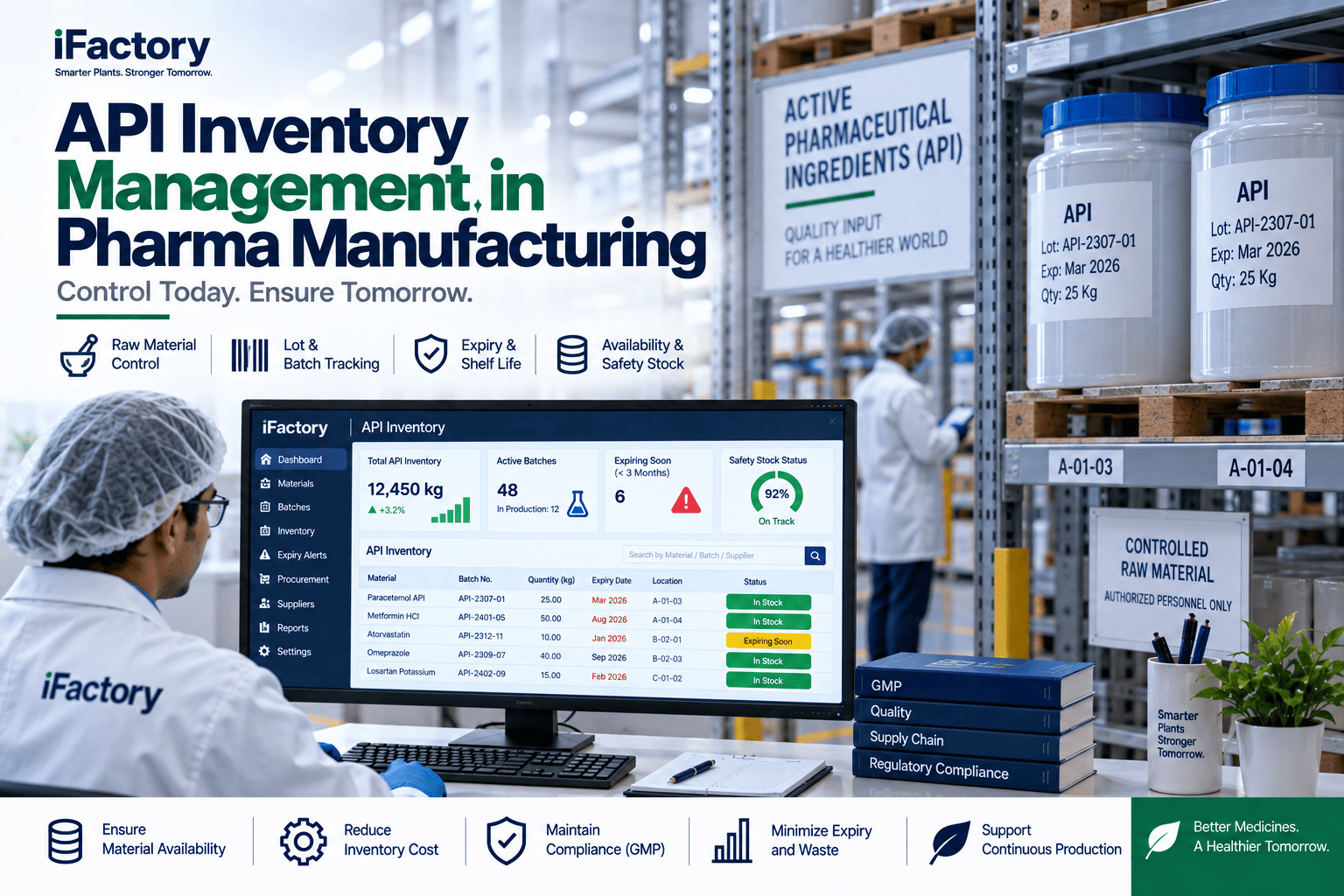
Active pharmaceutical ingredients are the highest-consequence inventory a pharma plant holds. They are expensive per kilogram, they are strictly lot-controlled with retest dates as well as expiry, they are often single-sourced from a DMF-registered supplier that took years to qualify, and they are the one class of material where a stockout can immediately halt a multi-million-dollar campaign. Yet in many plants the API inventory record lives in the same ERP module as consumables and packaging — with the same safety-stock logic, the same reorder rules, and the same visibility. It is not the same, and treating it as if it were is how the shift supervisor discovers on Monday morning that the campaign cannot start.
iFactory / API inventory management
Protect the API Inventory That Actually Stops Production
Lot-level API management with DMF-linked supplier control, retest-date discipline, dedicated safety-stock logic per campaign, and expiry / potency traceable from goods receipt to batch record.
8–16 wk
typical qualified-source lead time
DMF
registered supplier constraint
Retest
+ expiry (not one, both)
The Problem on the Floor
An API is not a raw material — it is the drug substance itself. Every kilogram is expensive, every lot has a DMF-linked supplier and a retest date in addition to a formal expiry, and most APIs have a qualified-source lead time of 8 to 16 weeks that cannot be shortened by paying a premium because the alternate supplier isn’t filed. When a plant runs one API buffer for a $20M commercial campaign and one for a low-volume clinical batch on the same shelf with the same reorder logic, the stockout risk on the commercial campaign is compounded because the buffer has already been drawn down. The surprise breaks on Monday morning.
What Escapes Into the System of Record Today
API records are technically in the ERP. What is missing is the API-specific discipline: supplier constraint, retest-date logic, campaign allocation, and potency-adjusted quantity. Without those, the ERP shows the number the shelf has and hides the number the campaign actually needs.
Paper batch log
Certificate of Analysis printed and filed with the goods-receipt paperwork. Retest date noted on a Post-it. When the QA head needs to check retest status across five lots, they walk to the file cabinet.
Spreadsheet
API allocation-vs-inventory maintained on a supply-chain spreadsheet. Updated weekly, sometimes daily. Diverges from ERP within days. The gap between the two is where campaign-blocking surprises live.
Chart recorder / data logger
Supplier lead-time drift lives in the buyer’s memory. A DMF supplier whose lead time went from 8 to 14 weeks over the last six months is a known fact that has never entered the reorder calculation.
Nowhere at all
Potency variation between lots (say, 98.5% vs 100.1%) is on the CoA but rarely fed back into the ERP as usable quantity. The batch record adjusts for it — the inventory system does not — and the mismatch causes silent over-issue.
What the WMS Actually Does
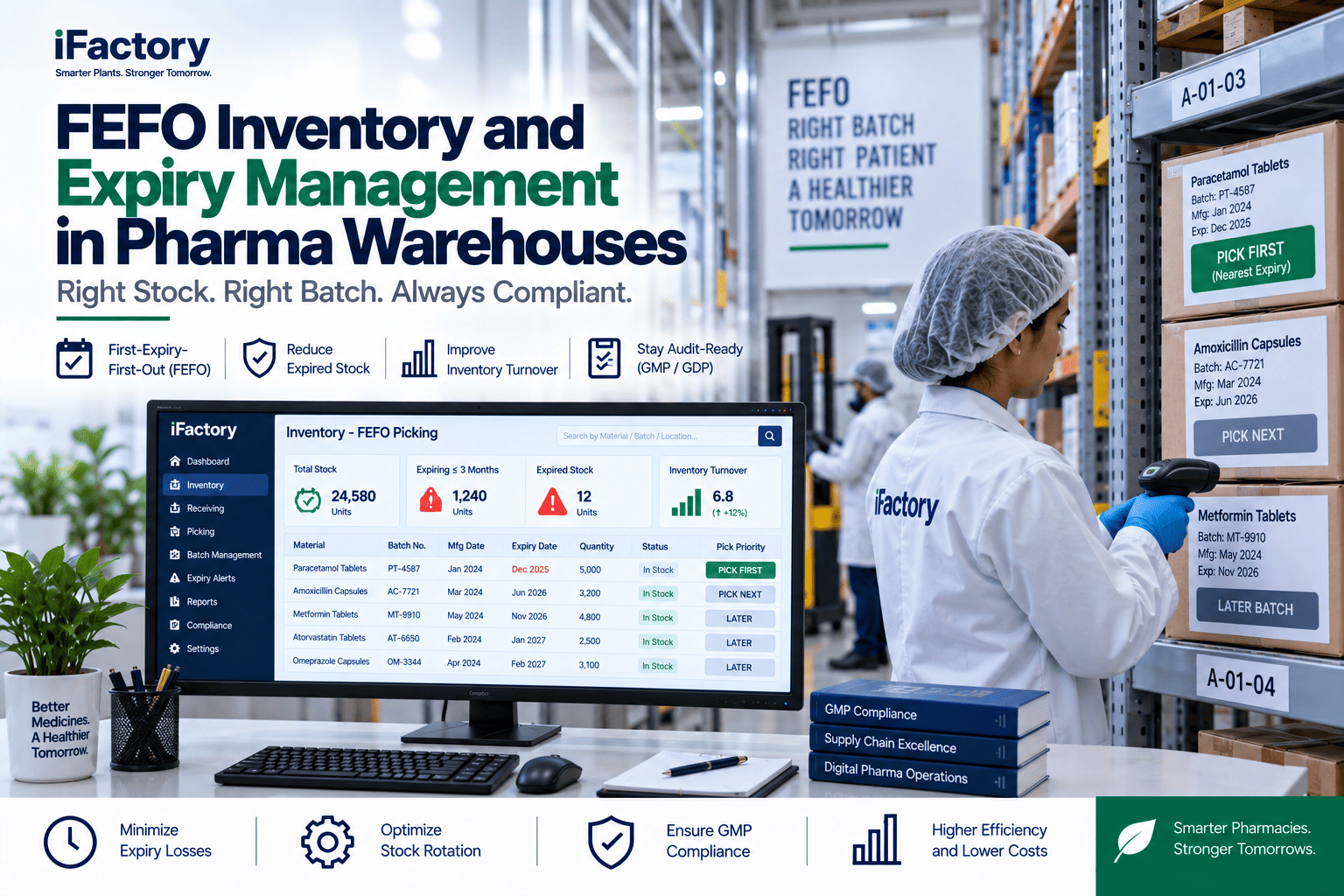
An API-aware inventory layer separates API from other materials in the way it manages them — lot-level records, DMF supplier binding, retest-date-driven FEFO, campaign-linked reservation, and potency-adjusted usable quantity all built in from the start.
Lot Master
Every API lot carries manufacturer, DMF reference, CoA, retest date, expiry date, potency, and any use restriction (e.g., approved products only) at the record level.
Discipline: DMF-linked
Retest Logic
Retest date drives review workflow — lot expiring within 30 days of retest requires QC re-test with defined method before further release. Not the same as expiry.
Discipline: retest + expiry
Campaign Reservation
APIs allocated to specific campaigns are reserved, not just “available.” Reallocation requires named authority with reason code. No silent cross-consumption.
Discipline: reserved not free
Potency Adjust
Potency read from CoA at receipt used to convert nominal kg into potency-adjusted usable kg for the ERP. Batch record and inventory speak the same number.
Discipline: adjusted quantity
What Gets Written to the System of Record
The ERP shows what the plant has. An API inventory layer shows what the plant can actually use, on which campaign, from which supplier, within what retest window — and it writes the answer back where every function reads it.
API Lot Record
ERP + LIMS
Complete lot record: DMF number, manufacturer, CoA, retest date, expiry, potency, restriction flags, and full receipt-to-consumption history.
Campaign Allocation
ERP + MRP
Reservation against specific commercial or clinical campaigns, with reallocation control and named-authority release for cross-use.
Retest Workflow
LIMS + QMS
Retest scheduling per lot, method-linked, results feeding back to release status. Lots inside the retest window blocked at pick.
Supplier Score
ERP Supplier Master
Lead-time actual vs contract, quality performance, DMF filing status — the record procurement uses at annual supplier review.
Check the last three API late-arrivals your plant absorbed. If the buyer’s memory said “X supplier is drifting” before the arrival, and the ERP reorder logic was still using the contract lead time, the stockout risk was invisible by design. Book a demo — we’ll audit one API’s lead-time-vs-reorder gap.
12-Week Pilot Shape on One Warehouse
One high-value API, one manufacturing campaign, twelve weeks. The pilot is scoped to prove that campaign-reserved inventory, retest-driven FEFO, and supplier lead-time-aware reordering land in the ERP and change the buyer’s and QA head’s decisions at the weekly S&OP meeting.
Weeks 1–2
API Selection & Data Load
Pick one high-value or single-sourced API. Load the last two years of consumption, supplier deliveries, retest events, and campaign allocations into the model.
Weeks 3–4
Rules Configuration
DMF binding, retest logic, campaign reservation rules, and potency adjustment configured with QA and supply-chain leads. Named-authority override paths defined.
Weeks 5–8
Parallel Run
Live on one API alongside existing spreadsheet-based logic. Discrepancies logged. Reorder recommendations reviewed weekly against buyer’s judgment.
Weeks 9–12
S&OP Integration
Weekly S&OP meeting uses the pilot API’s dashboard as source-of-truth. Manual spreadsheet retired. Rollout plan for remaining APIs sized based on pilot findings.
Who Owns the KPI
API inventory is not one role’s problem — it crosses procurement, QC, production planning, and QA. Each needs a specific number they own on the KPI board, or the discipline reverts to whoever shouted last week.
API Buyer
Actual lead time vs contract per DMF supplier
Owns the supplier drift number. A supplier whose actual lead time has moved from 8 to 14 weeks is the reorder-point calculation input that is usually missing.
QC / Analytical
Retest turnaround per lot
Owns the retest cycle time — a lot that enters retest window has a defined method and target turnaround. Missed retest windows equal blocked inventory.
Production Planning
Campaign starts on time vs API-blocked
Owns the outcome that matters — whether campaigns start when planned or wait for API. A campaign delay traced to API-blocked is the failure mode this is built to eliminate.
Site Director / GM
Working capital in API inventory $
Owns the balance-sheet number — how much cash is tied up in API inventory, and what portion of that is actually protecting production vs sitting in the AD/dead-stock cells.
FAQ
Doesn’t our ERP’s batch management already handle lots and expiry?
Batch management in most ERPs tracks lot, expiry, and quantity — which is enough for consumables and packaging. What ERP typically does not do out of the box is retest-date logic separate from expiry, DMF supplier binding, campaign-level reservation with named-authority reallocation, or potency-adjusted usable quantity. Those four pieces are the API-specific discipline that turns “we have 200 kg” into “we have 187 kg allocated, 45 kg free, 30 kg in retest window, and the DMF supplier is 3 weeks late on our replenishment order.” That is the number the S&OP meeting actually needs.
How does retest date differ from expiry for APIs?
Expiry is the formal end of stated shelf life — after that date the material cannot be used. Retest date is earlier and different in kind: it is the date by which the material must be re-tested to confirm it still meets specification before further use. Many APIs have a 24-month expiry but a 12-month retest interval; some have retest-only status with no formal expiry. Ignoring retest is one of the top warehouse-related observations in FDA API inspections. The inventory system has to hold both dates and drive workflow off whichever is closer.
What about API supplier qualification and the risk of a DMF being withdrawn?
DMF withdrawal is a real event — it happens to individual APIs when suppliers exit the market, fail an inspection, or have quality issues. When that occurs, all downstream products relying on that DMF need alternate-source qualification, and the timeline to qualify a new source is months. The inventory system has to hold the DMF reference on every lot, track supplier qualification status, and flag any product whose entire API supply relies on a single DMF that shows warning signs. Procurement uses this at annual planning to prioritise second-source qualification investment.
Book a demo to see the DMF-level supplier view.
Stop finding out about the API on Monday morning.
See One API Managed End-to-End — Supplier, Retest, Campaign
Bring one high-value API and last quarter’s consumption and supplier delivery history. We’ll show the DMF-linked lot management, retest workflow, and campaign-reserved inventory live — and audit where the ERP hides the risk today.