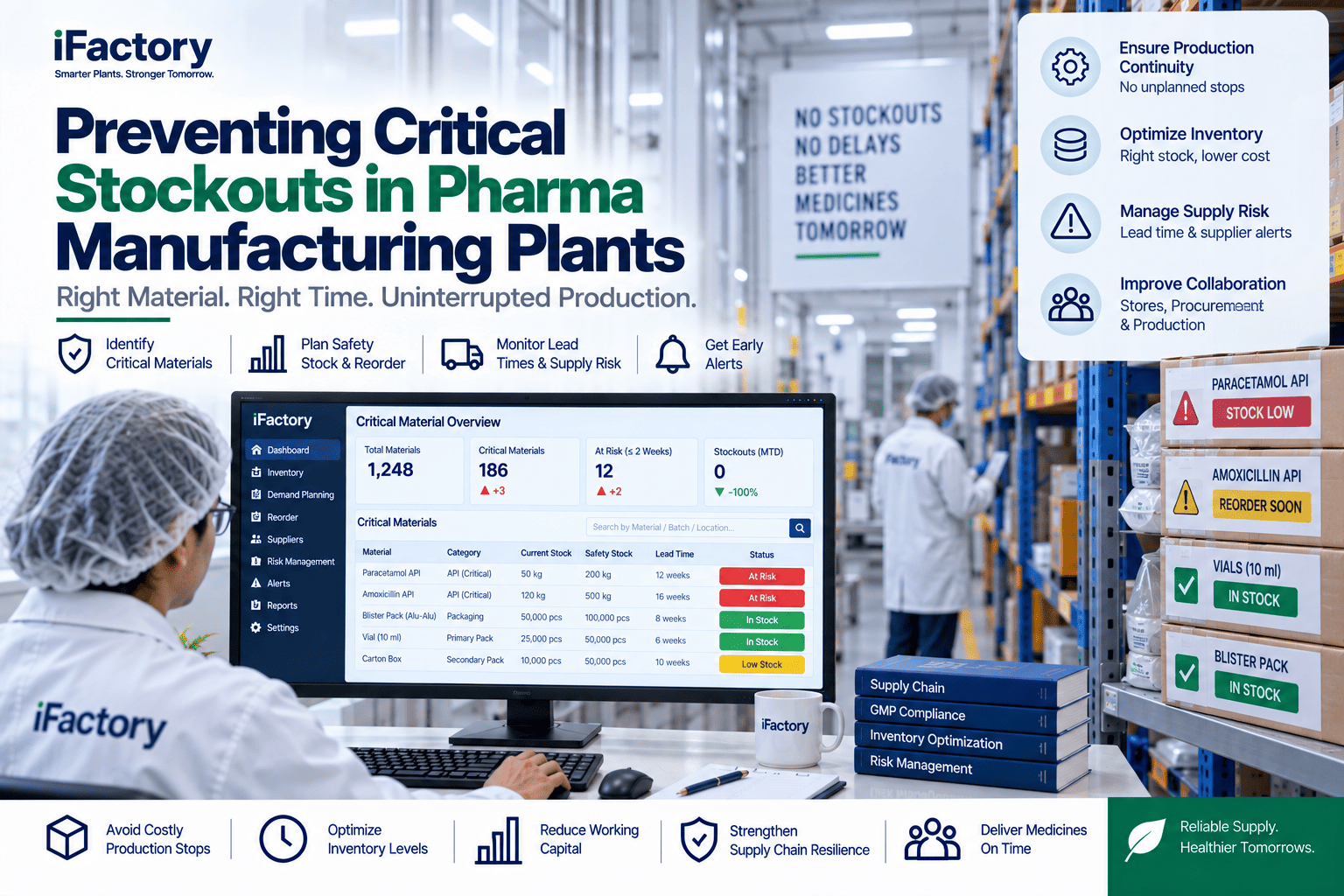
A pharma manufacturing plant can hold $8 million in inventory and still lose a $20 million commercial campaign to a single missing component that cost $400. That is the arithmetic of pharma stockout: value in the store has almost no relationship to whether production can actually start, because it is the specific vital-classified component with a 12-week qualified-source lead time that decides whether the campaign runs. The item is in the ERP catalog. What went wrong is that no one connected supplier drift to safety stock, no one flagged the vital-class item at the escalation tier, and the shortage was invisible until the campaign kickoff meeting.
iFactory / Pharma stockout prevention
Never Lose a $20M Campaign to a $400 Missing Part
Criticality-tiered inventory with lead-time-aware reorder points, campaign-linked reservation, supplier drift alerts, and stockout risk quantified before the campaign kickoff meeting.
✓API on handOK
✓Excipients stagedOK
✓Primary packagingOK
!Filter cartridge (Vital)MISSING
✓Labels & leafletsOK
$20M
campaign stops for a $400 part
$20M
campaign risk on 1 vital part
12+ wk
qualified-source lead time
Vital
tier: never stock out
The Problem on the Floor
Every pharma plant runs commercial campaigns, clinical batches, and validation lots from the same warehouse. A single vital-class item — a specific filter cartridge, a stopper, a sterile-grade excipient — that runs out can halt a $20M campaign for weeks while an alternate is qualified and delivered. The mistake most plants make is treating that vital item with the same reorder logic as any A-class expensive component. Value and criticality are different axes: a cheap consumable that stops production is more critical than an expensive spare that doesn’t. Without a criticality tier that separates the two, the ERP shows healthy inventory value while the parts that stop production quietly run down.
What Escapes Into the System of Record Today
Stockout risk is knowable, but only if the data is joined. Consumption rate, supplier lead-time actual vs contract, criticality tier, and campaign schedule all live in different systems in most plants. The stockout is what happens when nobody joins them.
Paper batch log
Reorder points set once at ERP go-live and rarely recalculated. Actual consumption diverges from the model. The buyer’s memory holds the true supplier lead-time drift.
Spreadsheet
Supply-chain team maintains a criticality list on a spreadsheet updated ad hoc. Not integrated with ERP reorder logic. The vital item is on the list; the reorder rule doesn’t know.
Chart recorder / data logger
Supplier delivery performance tracked in the purchasing module but not fed into the safety-stock calculation. A supplier trending late gets a phone call; the reorder point stays where it was.
Nowhere at all
Campaign schedules live in the production planning system. Component availability lives in inventory. Neither system automatically flags the campaign that will start without a vital component — that surprise breaks in the campaign kickoff meeting.
What the WMS Actually Does
Preventing pharma stockouts is a data-joining exercise. Consumption trend, real supplier lead time, criticality tier, and campaign schedule joined into one live picture — with vital-class items on separate stocking rules from A-class expensive ones.
Criticality Tiering
Every SKU classified on ABC (value) and VED (Vital / Essential / Desirable). The nine-cell matrix drives different stocking rules — the AV cell simply never stocks out.
Matrix: 9 cells, 9 rules
Lead-Time Truth
Actual supplier lead time trended per supplier per SKU. Drift beyond the contract lead time flags the reorder-point calculation to update, not the buyer’s inbox.
Signal: actual vs contract
Campaign Reservation
Components allocated to a specific commercial campaign are reserved. Cross-consumption requires named authority. The vital component for next quarter’s campaign is not silently drawn down.
Reserved: not free
Stockout Risk Score
Live risk score per campaign per component — combines current stock, incoming orders, actual lead time, and campaign schedule. Rising risk fires before the shortage.
Score: live per campaign
What Gets Written to the System of Record
What lands in the system of record is the joined picture. Every function — buyer, planner, campaign lead, site director — sees the same live view of what will stop what, when, and why.
Criticality Matrix
ERP + WMS
Every SKU’s ABC and VED classification with the specific reorder rule attached. Vital-class items on separate stocking discipline from A-class expensive ones.
Reorder Recalc
ERP MRP
Reorder points and safety stock recalculated monthly from actual consumption and actual supplier lead time — not from the model set at go-live.
Campaign Reservation
ERP + Planning
Component allocation linked to specific campaigns. Reservation visible to planning and to procurement. Cross-consumption logged with named authority.
Risk Dashboard
S&OP Layer
Live risk per campaign per component. Weekly S&OP meeting works from this dashboard — no spreadsheet reconciliation, no last-minute surprises.
Take the last three campaign delays your plant absorbed. If any of them was traced to a component that was in the ERP catalog but not on the shelf at kickoff, that stockout was preventable with the right criticality logic. Book a demo — we’ll classify one campaign’s BOM live.
12-Week Pilot Shape on One Warehouse
One high-value campaign, its full bill of materials, twelve weeks. The pilot is scoped to prove that criticality tiering plus lead-time-aware reordering plus campaign reservation surfaces the risk before it becomes a delay — and moves the S&OP conversation from spreadsheet to data.
Weeks 1–2
BOM & Classification
Take one campaign’s complete BOM. Classify every component on ABC and VED with QA, procurement, and planning together. Identify the vital-class items.
Weeks 3–4
Lead-Time Truth
Pull two years of supplier delivery data per component. Calculate actual lead time vs contract. Recalculate reorder points and safety stock on actual data.
Weeks 5–8
Reservation Live
Vital components reserved against the pilot campaign. Cross-consumption alerts configured. Risk score dashboard visible to S&OP team.
Weeks 9–12
Kickoff Test
Campaign kickoff runs against the new dashboard. Any risk that surfaced ahead of time is documented. Compare to prior campaigns’ kickoff-surprise rate.
Who Owns the KPI
Stockout prevention crosses procurement, planning, QA, and site leadership. Each needs their own KPI or the discipline reverts to the buyer’s memory of who complained last.
Procurement
Supplier lead-time drift alerts closed <14 days
Owns the supplier signal. When actual lead time drifts past contract, the reorder recalc has to happen — not the phone call to the supplier that changes nothing.
Planning
Campaign starts on-time vs component-blocked
Owns the outcome metric — how many campaigns started on schedule versus how many waited for a component. Every blocked campaign traces to a specific vital item.
QA / Compliance
Vital-class SKU stockout events per quarter
Owns the compliance angle — a vital-class item running out risks both the campaign and the regulatory filing. Zero events per quarter is the working target.
Site Director
Working capital vs stockout risk balance
Owns the balance-sheet number — the total inventory investment relative to the stockout risk exposure. The number that reaches the board discussion.
FAQ
How is this different from the reorder logic our ERP already has?
ERP reorder logic typically uses static rules: fixed reorder point, fixed safety stock, fixed lead time — all set at go-live. It does not distinguish vital-class from A-class expensive items, does not update automatically when supplier lead time drifts, and does not tie reservation to specific campaigns. The stockout prevention layer sits between the ERP and reality: it applies criticality-tiered logic, recalculates on real consumption and real lead time monthly, and enforces campaign reservation with named-authority override. It writes the results back to the ERP as the number of record — nothing runs in parallel.
Book a demo to see the ERP write-back on one SKU.
How is VED criticality actually assigned to a component?
VED is assigned per component based on production consequence: does the component being unavailable Vital (halt production), Essential (degrade output within 48 to 72 hours), or Desirable (workaround-manageable)? For pharma specifically, a sterile-grade filter that has no substitute qualified for the process is Vital regardless of its cost — the classification follows the consequence, not the price. The assignment is agreed between QA, production, and procurement together, documented per SKU, and reviewed annually or when process changes affect the criticality picture. The AV cell (high value plus vital) gets the tightest stocking discipline; the CD cell (low value, desirable) gets basic bulk reorder.
What about single-source components with long qualification cycles?
Single-source vital components are the hardest case in pharma stockout risk, because the alternate-source qualification cycle is typically 6 to 18 months. The stockout prevention layer treats these separately: it holds a larger safety stock (reflecting the qualification time as effective lead time), it flags the single-source status prominently in the risk view, and it feeds into procurement’s annual planning for second-source qualification investment. The right answer for these SKUs is not just more inventory — it is a working list of components where second-source qualification would materially reduce risk, sequenced by criticality and cost.
Stop finding the $400 stockout at the $20M kickoff.
Classify One Campaign’s BOM Against the Criticality Matrix
Bring one high-value campaign and its complete bill of materials. We’ll run ABC-VED classification live, recalculate reorder points on actual consumption and supplier lead time, and show which components would have surfaced as risk before the kickoff.