Ask any pharma packaging plant what their OEE is and you will hear a confident number in the 70s. Instrument the same line with direct sensors and the reality is closer to 55%. The 15-to-20-point gap does not come from operator effort — it comes from what nobody is measuring, and the single largest culprit is changeover. Benchmark data across 120+ blister lines puts top-quartile plants at 18–25 minute changeovers, while the median plant burns 35–50 minutes per format change. That is not a rounding difference. It is one to two extra shifts of lost production every week, hiding inside an OEE report that says everything is fine. A structured pharma changeover reduction program attacks that single loss category and pays back inside a quarter.
iFactory OEE & Changeover
Pharma Changeovers Are Silently Destroying Your OEE — Here Is How to Stop It
Measure real changeover the way benchmark studies do, apply SMED to the specific transitions costing you the most, and recover 4–8 OEE points on blister and cartoning lines in the first 60 days — without touching validated equipment.
18-25 min
top-quartile blister changeover
35-50 min
median blister changeover
56%
real median blister OEE
4-8 pts
recovered in 60 days
Your Reported OEE vs. What Is Really Happening
Almost every pharma packaging plant reports OEE in the 70–80 range. When those same lines are measured with direct sensors running in parallel to the official report, the numbers collapse. Micro-stops go unlogged. Speed losses go unmeasured. And changeover — the single biggest loss category — gets miscategorized as "planned" and quietly excluded from the score.
Reported
72%
The number on the executive dashboard. Feels safe. Justifies budgets. Misses everything that happens between the logged events.
Micro-stops under 3 minutes: uncounted
Changeover time: partially "planned"
Speed loss: not measured
−17 ptsthe hidden gap
Measured
55%
Direct sensor reading across 120+ blister lines. The number the CFO would see if every stop, every slow-run, and every changeover minute were captured.
Every stop captured, every second
Full door-to-door changeover clock
Speed loss vs. rated capacity live
Where Every Minute of a Pharma Changeover Actually Goes
A pharma packaging changeover is not one activity — it is a sequence of five distinct time buckets, most of which are invisible on the shop-floor clock. This is why changeovers "feel" like 20 minutes to operators and land at 45 minutes when you measure them door-to-door.
Line Clearance & Cleaning
The biggest bucket. Reconciliation of previous batch, wipe-down, changeparts removal, cleaning validation swabs.
Format Change & Tool Swap
Forming tools, sealing dies, cartoner buckets, feeder change-parts. The visible mechanical work everyone thinks is the whole changeover.
Material Staging & Verification
Foil, film, cartons, leaflets, labels — checked in, barcode-verified, staged at line-side. Almost always done "internal" when it should be external.
First-Article Inspection
Seal integrity, pocket fill, print registration, torque, weight. Runs while the line waits. Prime target for parallel work.
Batch Record & Sign-Off
Electronic batch record update, QA release for start-up. Paper-driven plants lose the most minutes here — pure documentation drag.
Curious where your own minutes are actually going? Book a demo and we'll run a live Pareto on 48 hours of your changeover data.
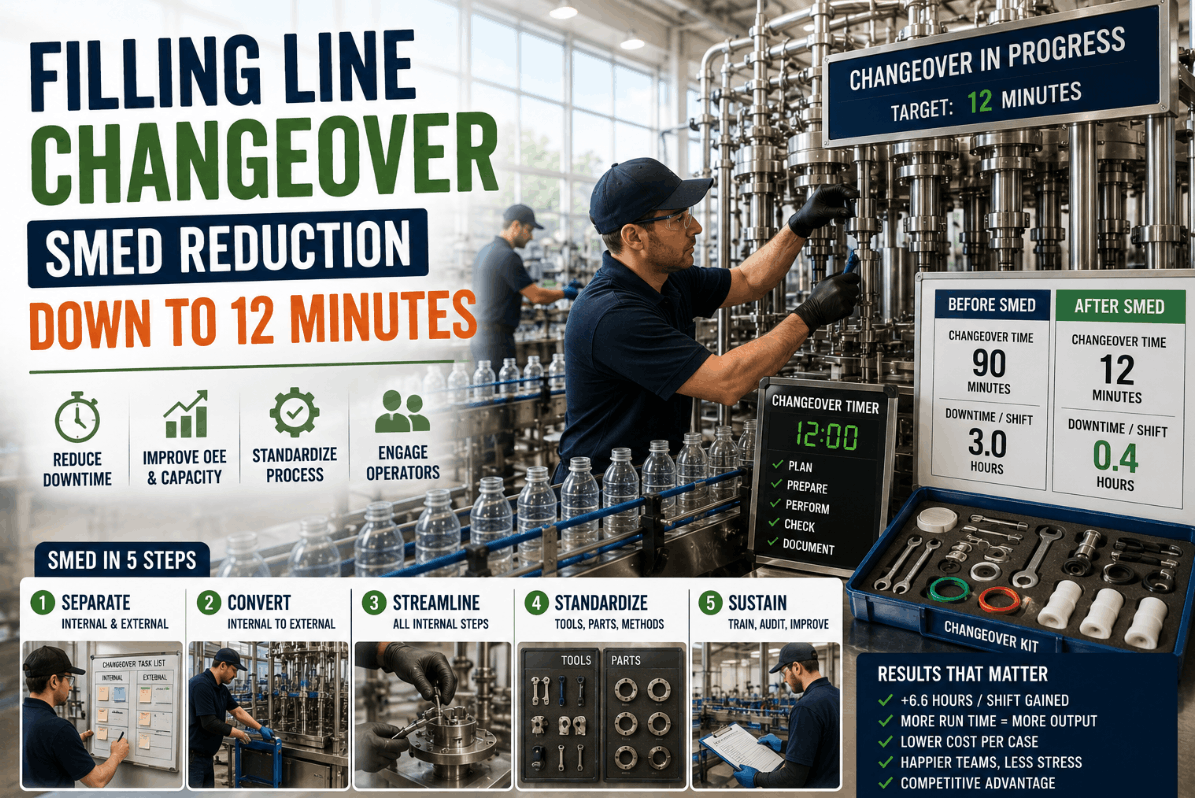
SMED — But Adapted for Regulated Pharma
Single-Minute Exchange of Die works in pharma, but only if it respects GMP. The classic four-step method drives most of the win — and iFactory's platform digitises each step so the improvement sticks instead of drifting back within a quarter.
01
Observe & Measure
Instrument the line and capture the door-to-door changeover clock, broken down by step, shift, and product transition. No stopwatches, no operator self-report — real duration data, tamper-evident.
02
Separate Internal vs. External
Classify every step as internal (line stopped) or external (line running). In most pharma plants, 25–50% of what teams currently do "internal" can be moved external — the biggest single lever available.
03
Convert Internal to External
Pre-stage materials, pre-verify barcodes, pre-set torque values, pre-warm sealing plates. Do everything possible before the line stops — inside the constraints GMP actually allows.
04
Streamline What Remains
Quick-release changeparts, colour-coded tools, standardised torque, parallel operator paths. Reduce the residual internal minutes with engineering, not heroics.
Top Quartile vs. Median — Where the Points Come From
The benchmark data is unambiguous: five operational practices separate top-quartile blister lines from the median. None of them require new equipment. All of them can be started this month.
Practice
Median plant
Top-quartile plant
Blister changeover time
35–50 min
18–25 min
Micro-stops per shift
42–55
20–28
Measured OEE (blister)
56%
68%
External steps in changeover
Ad-hoc, undocumented
Standardised, pre-staged
Changeover measurement
Operator log, end-of-shift
Sensor-captured, live
iFactory's Changeover Attack Kit
You cannot fix what you cannot see, and you cannot sustain what you cannot audit. iFactory ships six capabilities specifically for pharma changeover reduction — layered on top of your existing DCS, SCADA and MES, without touching validated equipment.
01
Auto Changeover Clock
Detects changeover start and end from equipment state — no operator button-press required. Every minute counted, every transition tagged with the product pair.
02
Step-Level Timing
Break the changeover into named steps (line clearance, tool swap, first article, sign-off). Operators tag completion on the HMI. Variances by shift become obvious.
03
Transition Pareto
Identifies which specific product-to-product transitions eat the most cumulative time. Concentrating SMED on the top-3 transitions delivers most of the win.
04
Internal / External Analyzer
Flags steps that ran with the line stopped but could have run external — with historical evidence to back the reclassification through change control.
05
Shift & Team Benchmarking
Same transition, same tools, different crews — different times. Surfaces training gaps and best-practice teams without blame, using measured evidence.
06
21 CFR Part 11 Audit Trail
Every changeover event attributable, contemporaneous, and tamper-evident. ALCOA+ by design — the same record that proves efficiency proves compliance.
The 90-Day Recovery Path
Points do not come from spreading effort thin — they come from focusing on the specific transition that costs you the most. This is the timeline pharma plants typically follow after switching from operator-logged to sensor-measured changeover.
Days 1-30
Baseline & Pareto
Instrument the line, capture real door-to-door changeover, and build the transition Pareto. First quick wins from stopping mis-categorised "planned" time. Typical gain: 1–2 OEE points.
Days 31-60
SMED on the Dominant Transition
Run structured SMED on the single transition consuming the most cumulative minutes. Convert internal steps to external, pre-stage materials, standardise tool swap. Typical gain: 4–8 OEE points.
Days 61-90
Lock In & Roll Out
Standard work published, training embedded, second and third transitions targeted. Cross-line rollout to sister packaging lines. Typical gain: additional 2–4 OEE points, sustained.
Want the 90-day playbook applied to your line? Talk to our pharma team and we'll scope a 48-hour POC on your highest-changeover line.
Frequently Asked Questions
Our official OEE is 74%. Why would a measured baseline come out lower?
Almost every plant sees the same drop. Reported OEE typically excludes micro-stops under three minutes, treats a chunk of changeover as "planned", and assumes rated speed instead of measured speed. Direct-sensor measurement across 120+ pharma lines routinely finds blister at 52–62% and cartoning at 48–58%. The 15–20-point gap is the recoverable opportunity — it does not mean the team is failing, it means the score is not seeing them.
Can SMED actually work under GMP, or does regulation block the wins?
It works. GMP does constrain how far you can push internal-to-external conversion — some verification steps must remain internal because they are part of the batch release. But the SMED literature and real pharma case studies show 50% changeover reductions and 25% OEE gains are achievable inside GMP boundaries. The trick is respecting the constraints rather than fighting them: pre-stage what you can, standardise what remains, and document the changes through your normal change-control process.
Do we need to re-validate our packaging line to install iFactory?
No. iFactory reads the OPC and historian tags your DCS, SCADA and MES already publish. It layers on top of the validated stack rather than modifying it. Where sensors are needed at all, they attach non-invasively in under 30 minutes per machine without qualification impact — data visible from Day 1, no impact on your validated state.
How is the audit trail handled for 21 CFR Part 11 and EU Annex 11?
Every record is attributable to a unique user ID, timestamped contemporaneously, captured originally with no edit-in-place, and retained for the required period. ALCOA+ is the design baseline. Because data-integrity findings continue to make up a significant share of FDA drug GMP warning letters, this is not an add-on — it is how the system stores every changeover event by default.
Where should we start if we have never run this kind of measurement layer?
Pick your highest-changeover validated line — usually a blister or cartoner running two or more format families. Instrument it and run two to four weeks to baseline OEE and generate the changeover Pareto. That single Pareto tells you which product transition to SMED first, and typically returns 4–8 OEE points inside the following 30 days. Book a demo and we'll show you what the first 48 hours of your data would look like.
Attack the biggest loss first.
See What Your Real Changeover Time Actually Is
In a 30-minute demo we'll walk a live pharma packaging dashboard, show the changeover Pareto that decides where to SMED first, and scope a 48-hour POC on your highest-changeover line — GMP-compatible, non-invasive, no qualification impact.
GMP
compatible, non-invasive
Part 11
audit trail by design