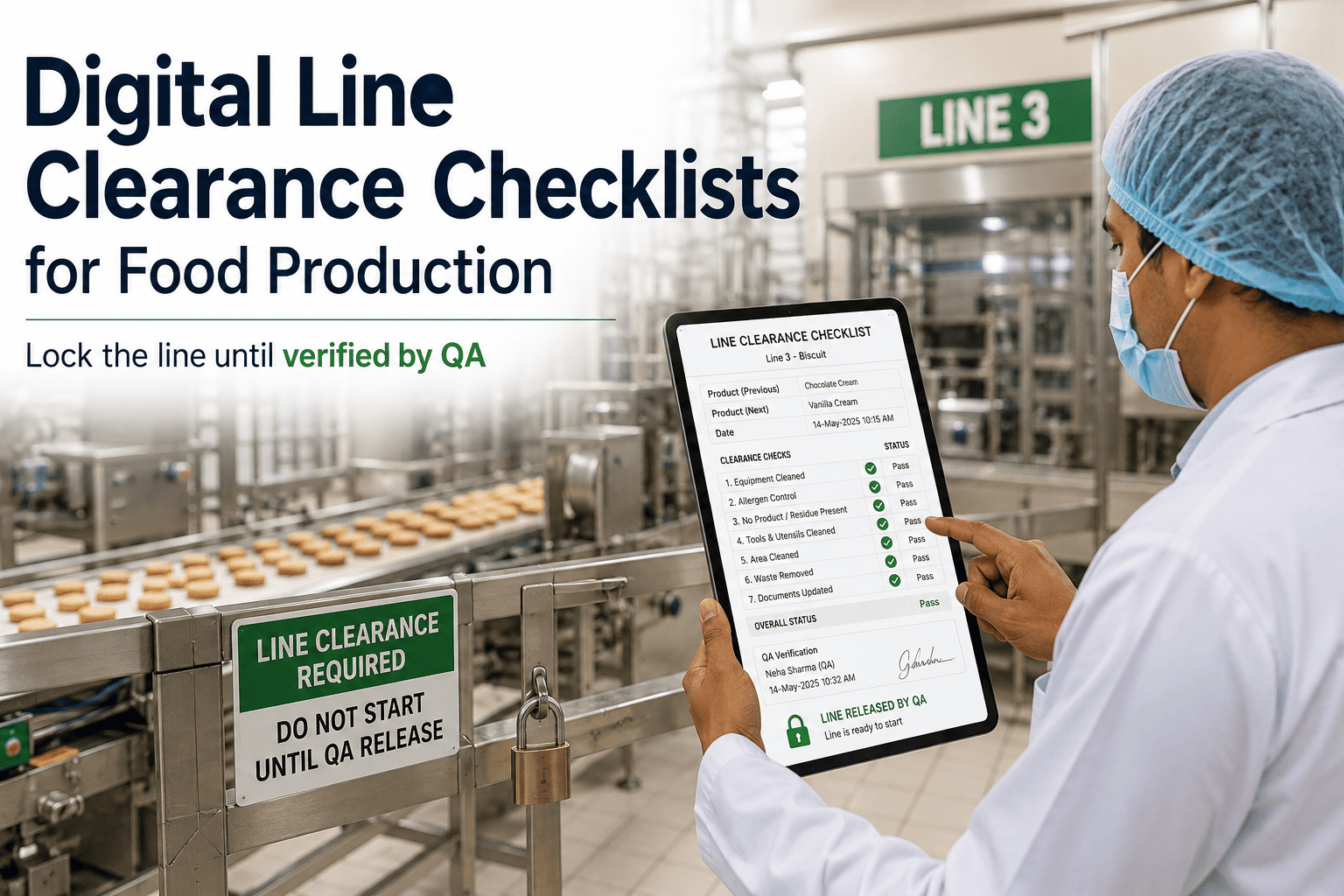
Line clearance is the quiet firewall between two batches. At every changeover, someone has to confirm that the line is completely clear of the last product — every tablet, every stray label, every leftover component and document — before the next one starts. Get it wrong and you get the nightmare that ends in recalls and patient harm: a mix-up. It is that important, and yet on paper it is consistently among the most common findings an auditor writes up. Boxes ticked without the check being done. Signatures missing. Times filled in later. A form that proves nothing because it could have been completed at any point. A digital line clearance checklist fixes this at the root — enforcing every step in order, timestamping who did what, and locking the line until QA has verified it.
Production Execution for Pharma Operators
Digital Line Clearance Checklists for Pharma Production
Turn the paper checklist that auditors love to flag into an enforced, timestamped, photo-verified process — one that will not release the line to the next batch until every step is done and QA has signed.
The Most Common Finding in the Room
Ask a quality professional what an auditor reaches for first, and line clearance documentation is near the top of the list. The requirement itself is not controversial — clear the line, verify it, record it. The failure is almost always in the record. A paper checklist cannot prove that a step was done at the moment it was signed, cannot stop the next step from happening before this one is complete, and cannot guarantee the second-person check was independent. It captures an outcome, not the discipline behind it, and auditors know exactly where to look.
Why Paper Line Clearance Fails
The problems with paper are not carelessness; they are built into the medium. A form sits still while the process moves, and every gap between the two is a finding waiting to be written.
Line Clearance Record — Line 3
✓Remove prior product and componentssigned, not witnessed
✓Clear all labels and printed materials
Inspect equipment and surfacesstep skipped
✓Reconcile documentationillegible
Time completed: laterbackdated
Operator sign: __________missing signature
Every flag here is a data-integrity gap — a failure of the ALCOA+ principles that require records to be attributable, legible, contemporaneous, original, and accurate.
A Checklist That Cannot Be Faked
A digital line clearance is not a paper form on a screen. It enforces the process itself: each step must be completed and verified before the next unlocks, every entry is stamped with who and when, and evidence is captured as it happens — not reconstructed afterward.
Line Clearance — Line 3, changeover to Batch B-2291
1. Remove prior product and components
Verified · 09:14 · J.Rao / M.Ito
Verified
2. Clear all labels and printed materials
Verified · 09:21 · J.Rao / M.Ito
Verified
3. Photo evidence of cleared line
In progress · photo required
Current
4. Reconcile documentation
Locked until step 3 complete
Locked
5. QA verification and line release
Requires QA e-signature
Locked
The Check That Locks the Line
This is the difference that matters most. A paper checklist relies on everyone doing the right thing; a digital one makes the wrong thing impossible. Until every step is verified and QA has signed, the line stays locked — the next batch cannot be released to start.
Line locked
Next batch cannot start
Released only when both are met
Every step completed and verified
QA electronic signature
Line released
Batch B-2291 can start
Paper Versus Digital, Side by Side
The same six problems auditors keep finding on paper are the six things a digital checklist is built to prevent.
Paper checklist
Can be completed or backdated later
Steps skipped or done out of order
Boxes signed without the check
Missing or illegible signatures
QA verifies after the fact
Forms lost, damaged, or hard to find
Digital line clearance
Timestamped and contemporaneous
Sequence enforced, nothing skipped
Photo evidence captured in the moment
Attributable e-signatures, mandatory fields
QA verifies in real time to release
Retrieved for an audit in seconds
How many of those six paper failures would survive your next audit? Book a 30-minute demo and we'll walk your line clearance through a digital run.
Built for Data Integrity
Digital line clearance is not just tidier — it is designed around the data-integrity principles regulators expect, and it produces the electronic records and audit trail that 21 CFR Part 11 calls for.
A
Attributable
Every action tied to a named user login
L
Legible
Typed and clear, never a scrawl
C
Contemporaneous
Recorded at the moment it happens
O
Original
The primary record, with full history
A
Accurate
Enforced fields, no ambiguous entries
What Digital Line Clearance Delivers
Fixing line clearance removes a perennial audit liability and speeds the changeover at the same time — the discipline and the pace both improve.
↓↓
Audit findings
the common paper gaps designed out
Locked
Until verified
no batch starts on an uncleared line
Faster
Changeover
guided steps and real-time QA sign-off
Seconds
To retrieve
complete records on demand, nothing lost
Frequently Asked Questions
How does locking the line actually work?
The line clearance must reach a released state before the next batch can begin, and that state is only granted when every step is completed, evidence is captured, and QA has applied an electronic signature. Depending on your setup, the release can gate the batch record and, where integrated, the equipment start itself. Until then the process is held, so an uncleared line cannot quietly run the next product.
Does it satisfy 21 CFR Part 11 and data integrity expectations?
It is built for it. Each action is attributable to a user, recorded contemporaneously, legible, and preserved as an original record with a full audit trail, and QA sign-off uses controlled electronic signatures. Those are precisely the ALCOA+ and Part 11 attributes that paper line clearance so often fails to demonstrate.
Can we keep our existing SOPs and checklist content?
Yes. The digital checklist is configured to your approved line clearance SOPs and their exact steps, sequence, and second-person requirements, so the process the auditor expects is the process the system enforces. You are digitizing and strengthening your procedure, not replacing it with a generic one.
Will this slow operators down during changeover?
In practice it usually speeds changeover up. Operators follow a guided sequence with clear next steps, capture photo evidence on the spot, and QA can verify in real time rather than hunting down a paper form later. The time lost to corrections, missing signatures, and after-the-fact chasing tends to outweigh the few seconds each digital step takes.
What is the best way to evaluate it?
Start with one line and one changeover. Bring your current line clearance checklist and SOP, and we will configure a digital version and run it live — showing the enforced sequence, photo evidence, the QA release lock, and the audit trail it produces. That single line makes the difference from paper obvious.
Retire the Checklist Auditors Love to Flag.
See Your Line Clearance Run Digitally, End to End
Bring your line clearance SOP and checklist. We'll configure a digital version, run it on one line, and show the enforced steps, photo evidence, QA release lock, and the audit-ready record it leaves behind.