Scheduling a pharma plant is not like scheduling a factory that stamps metal. A pharma planner is juggling constraints most scheduling tools have never heard of: campaigns that must run in the right order to limit cleaning, equipment that can only stay dirty for so many hours before it must be cleaned and only stays clean for so long after, rooms and lines that must hold a valid qualification, intermediates with a shelf life ticking down, and a QC lab that has to release before anything moves. Miss one and you do not just lose efficiency — you write off a batch to expiry, or you run a product on a line whose qualification lapsed. Most tools, and certainly most spreadsheets and ERP modules, quietly ignore these. This guide walks through what a real pharma production scheduling system has to do.
Production Scheduling for Pharma Planners
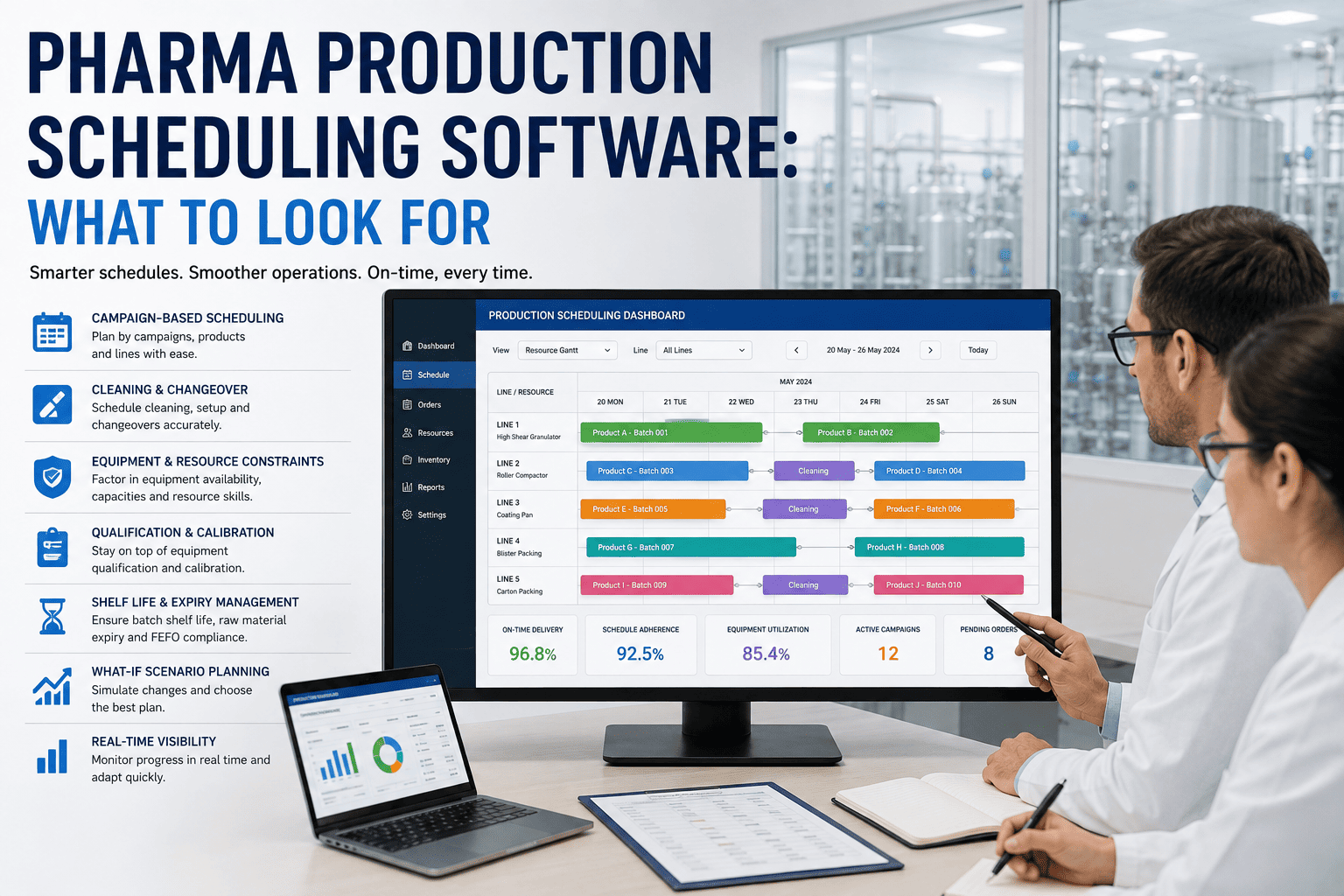
Pharma Production Scheduling Software: What to Look For
Campaigns, cleaning, qualification, shelf life, and QC release make pharma scheduling a different problem. Here are the constraints that break generic tools — and the must-have features a real pharma scheduling system needs to handle them.
Campaign
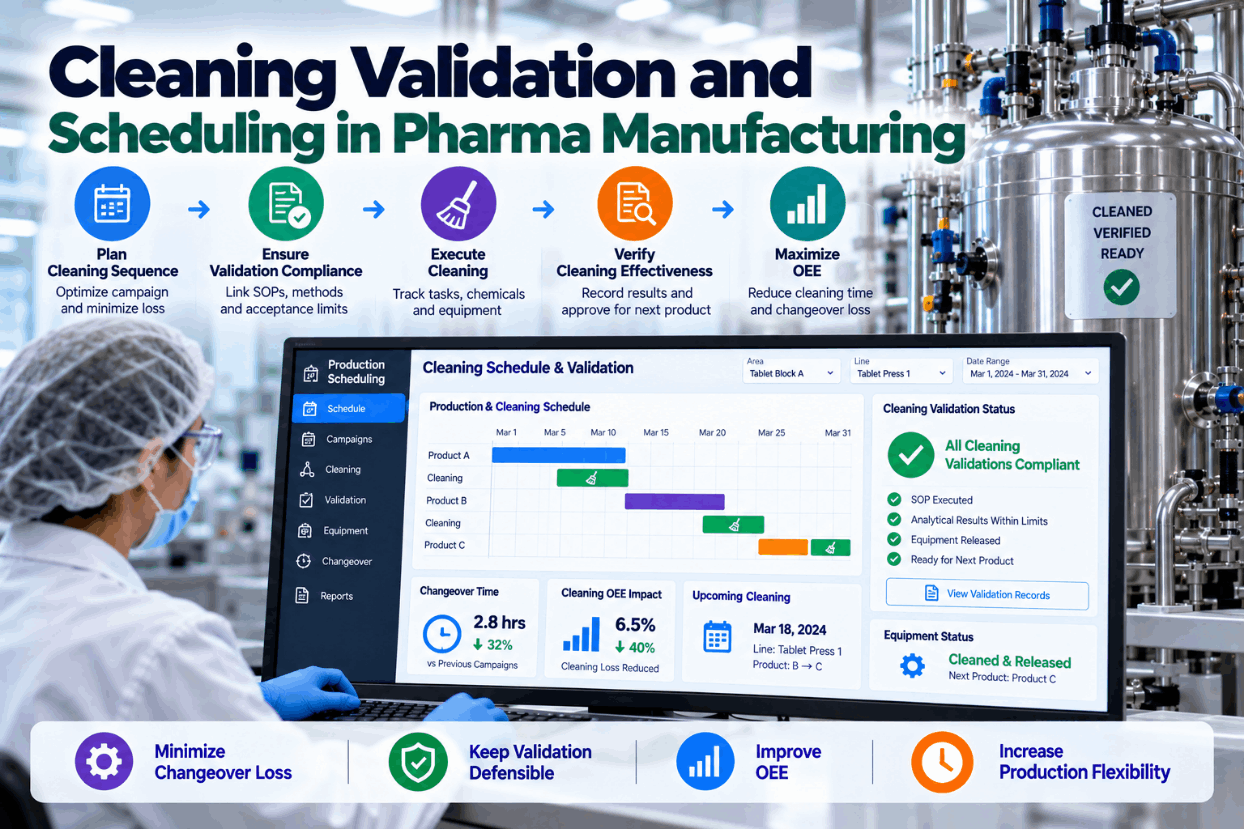
and cleaning aware
Shelf life
and QC release
Why Pharma Scheduling Breaks Generic Tools
Generic schedulers assume a job takes a machine for a duration and then the next job starts. Pharma does not work that way. The order of products drives the cleaning burden, the cleaning consumes the equipment and the clock, the equipment has to be in a qualified state to be used at all, and the material flowing through it is aging against an expiry date the whole time. A tool that cannot model those relationships will produce a schedule that looks feasible on screen and is impossible on the floor.
The Constraints a Pharma Scheduler Must Respect
Before evaluating any software, know the constraints it has to honor. These five are where pharma diverges from ordinary manufacturing, and each one is a place generic tools fall down.
01
Campaign sequencing
Products must run in an order that limits cleaning and cross-contamination — sequence is not free.
02
Clean and dirty hold times
Equipment can only stay dirty, or stay clean, for a validated window before it must be re-cleaned.
03
Qualification status
A line or room out of qualification cannot be scheduled, however free it looks.
04
Shelf life and expiry
Materials and intermediates age against hold times and dating that the plan must respect.
05
QC and QA release
Testing lead time and lab capacity gate every step; nothing moves until release.
What the Schedule Actually Looks Like
A good pharma schedule is not a list — it is a finite-capacity plan across suites, with cleaning and QC holds built in as first-class blocks, not afterthoughts. This is the shape of it.
A finite-capacity schedule across suites
Day 1Day 2Day 3Day 4Day 5Day 6Day 7Day 8
Formulation
Campaign A
CIP
Campaign B
CIP
QC lab
QC release A
QC release B
Campaign
Cleaning / CIP
QC release
Qualification / PM
The Hold-Time Trap
The constraint generic tools miss most often is the hold time. Equipment that finishes a batch is on a dirty clock — it must be cleaned within a validated window. Once cleaned, it is on a clean clock — it must be used within another window or it needs re-cleaning. A schedule that ignores these creates work that cannot legally be executed.
Dirty hold time
must be cleaned before this window closes
limit
Clean hold time
must be used before this window closes
limit
A real scheduler treats these windows as hard constraints, warning the planner before a batch is placed outside them — not discovering the problem when the paperwork is signed.
ERP Plans, but It Does Not Schedule
Many plants assume their ERP already handles this. It does not. ERP does material planning at infinite capacity in time buckets; it does not sequence real equipment against real cleaning and hold-time rules. You need finite-capacity scheduling on top of it, not instead of it.
ERP / MRP alone
Infinite capacity, planned in time buckets
No sequence-dependent cleaning
Blind to clean and dirty hold times
Ignores qualification status
No QC lead-time or lab capacity
Finite-capacity APS
Schedules real equipment to real limits
Optimizes campaign order and cleaning
Enforces hold-time windows
Blocks unqualified lines and rooms
Models QC release and reschedules live
The Must-Have Checklist
When you evaluate pharma scheduling software, this is the list to hold it against. Anything missing here is a constraint your planners will end up managing by hand — and eventually a batch lost to it.
Must have
Finite-capacity scheduling
Plans against real equipment and resource limits, not infinite buckets.
Must have
Campaign and cleaning optimization
Sequences products with a sequence-dependent changeover and cleaning matrix.
Must have
Clean and dirty hold-time rules
Treats validated hold windows as hard constraints on every placement.
Must have
Qualification-aware
Knows which lines and rooms are qualified now and blocks the rest.
Must have
Shelf-life and expiry constraints
Respects material dating and intermediate hold times across batch genealogy.
Must have
QC release modeling
Accounts for testing lead time and lab capacity as real scheduling gates.
Must have
What-if and live reschedule
Replans instantly when a batch fails, equipment drops, or QC slips.
Must have
ERP, MES, and LIMS integration
Pulls orders, execution, and results so the schedule reflects reality.
How many of these does your current scheduling approach actually cover? Book a 30-minute demo and we'll walk your constraints against the checklist.
What Good Scheduling Delivers
Get the constraints right and the payoff is not just a tidier Gantt — it shows up in yield, compliance, and how much of the plant you actually use.
Fewer
Cleanings
smart campaign order cuts changeover time
↓
Expiry write-offs
shelf life and hold times respected upfront
On time
Release
QC gates planned, not discovered
↑
Utilization
a feasible plan uses more of the plant
Frequently Asked Questions
We already run SAP. Do we still need scheduling software?
Yes, and the two are complementary. ERP handles demand, materials, and planning at a high level, but it plans at infinite capacity and does not sequence real equipment against cleaning, hold times, qualification, and QC constraints. A finite-capacity scheduler sits on top, turning the ERP plan into an executable schedule and feeding realistic dates back. You keep ERP; you add the layer it was never designed to provide.
Can it really model our cleaning and hold-time rules?
That is a core test of any pharma scheduler. It should support a sequence-dependent cleaning matrix, so the cleaning required depends on what ran before and what runs next, and it should enforce clean and dirty hold-time windows as hard constraints. If a tool cannot do both, it will keep producing schedules your planners have to fix by hand.
How does it handle a disruption, like a failed batch or a QC delay?
A good scheduler replans in the moment. When a batch fails, equipment goes down, or QC release slips, it reschedules the affected work while respecting all the same constraints, and shows the planner the impact and the options. What-if scenarios let you test a change before committing it, so disruptions become decisions rather than fire drills.
Does it work across multi-stage processes?
It should. Many pharma products move through linked stages, from API or intermediate through formulation, fill, and pack, each with its own equipment and constraints. The scheduler needs to synchronize these stages and carry material dating and hold times through the genealogy, so an intermediate is used within its window and downstream steps are timed to it.
What is the best way to evaluate a scheduler for our plant?
Test it against your hardest real week — the one with tight cleaning, a requalification, an expiring intermediate, and a QC bottleneck. The best next step is a demo where we build a slice of your actual schedule against your constraints and show how it sequences, enforces hold times, and reschedules when something slips.
Schedule Against Reality, Not a Spreadsheet.
See Your Constraints Run in a Real Pharma Scheduler
Bring your toughest scheduling week — the cleaning matrix, the hold times, the requalification, the QC bottleneck. We'll build a slice of your schedule and show how it sequences campaigns, enforces the constraints, and reschedules when something slips.