Campaign Scheduling in Pharma Plants: From Excel to APS
By James C on August 24, 2026
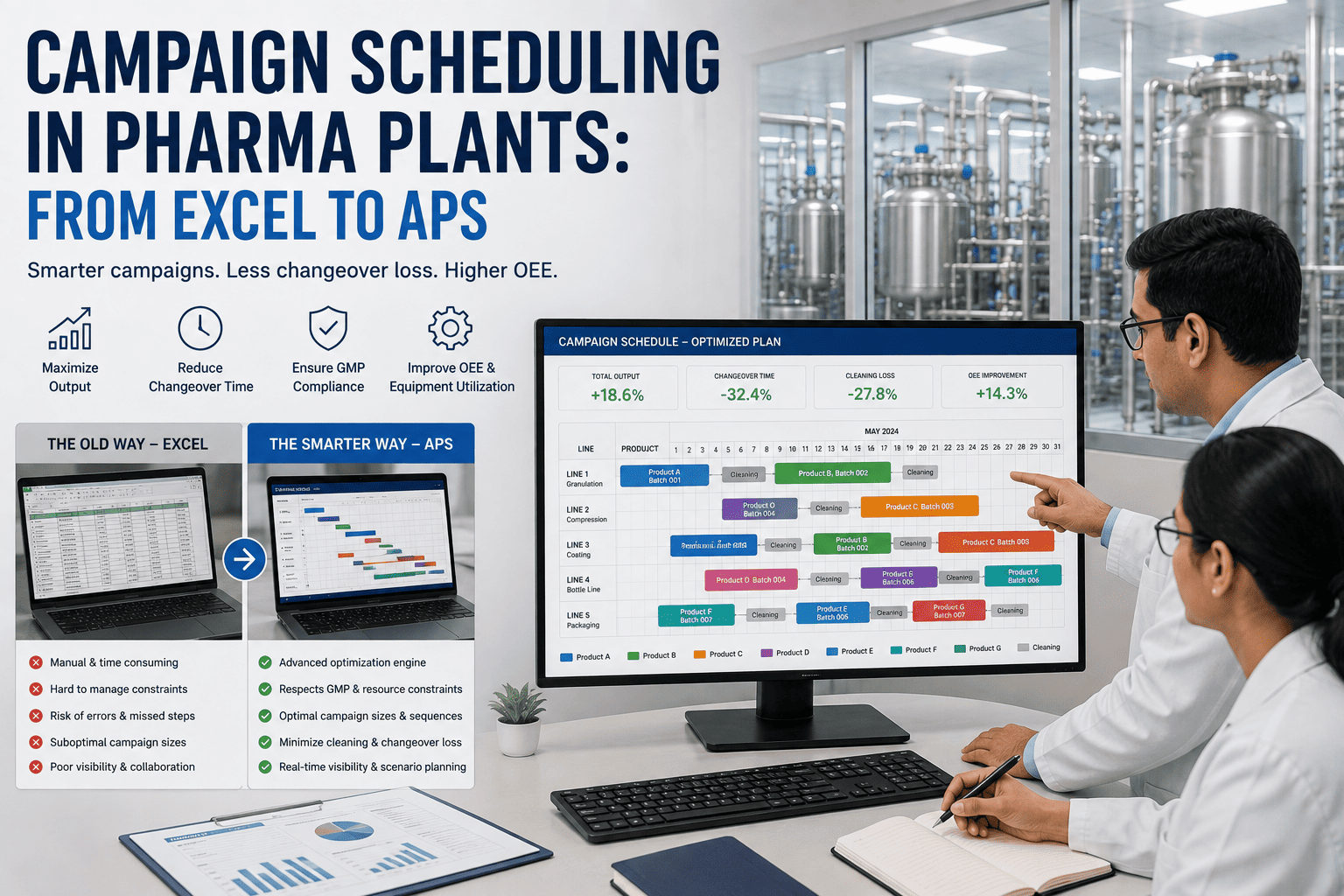
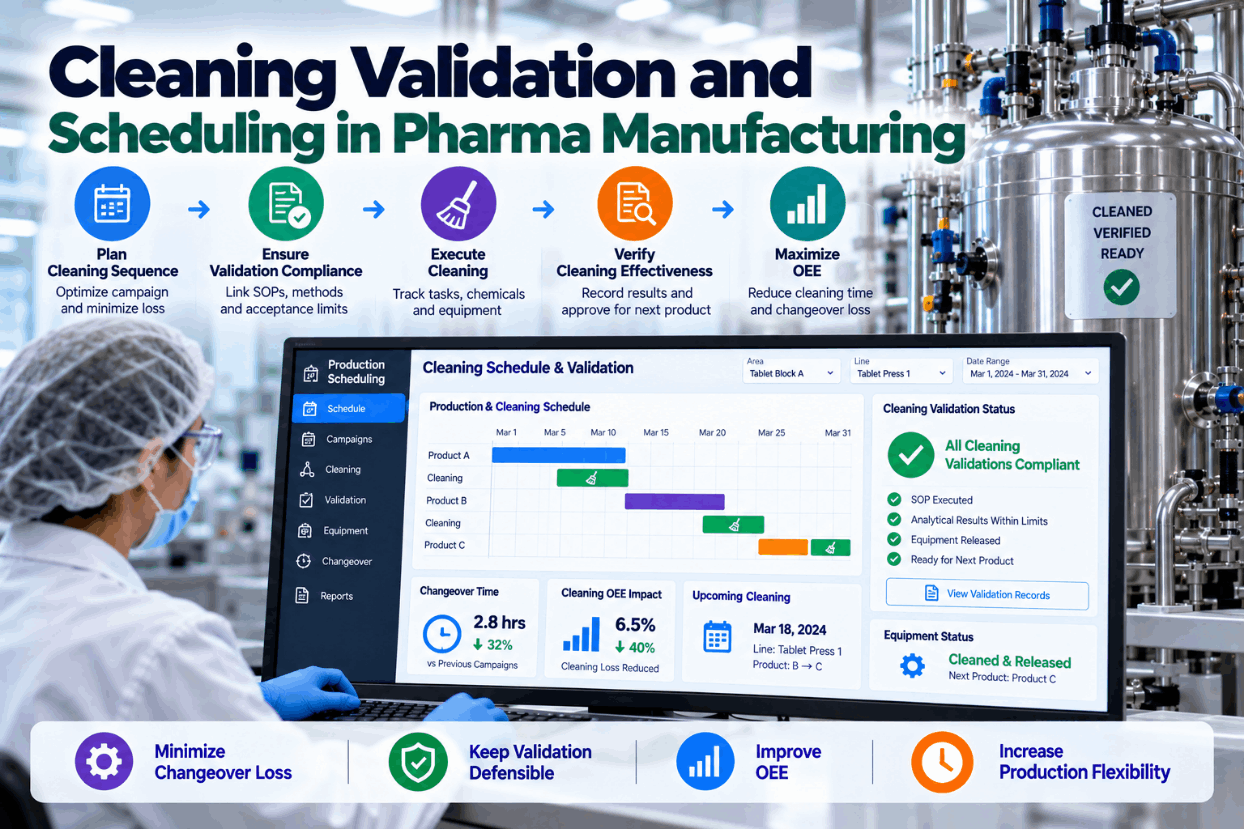
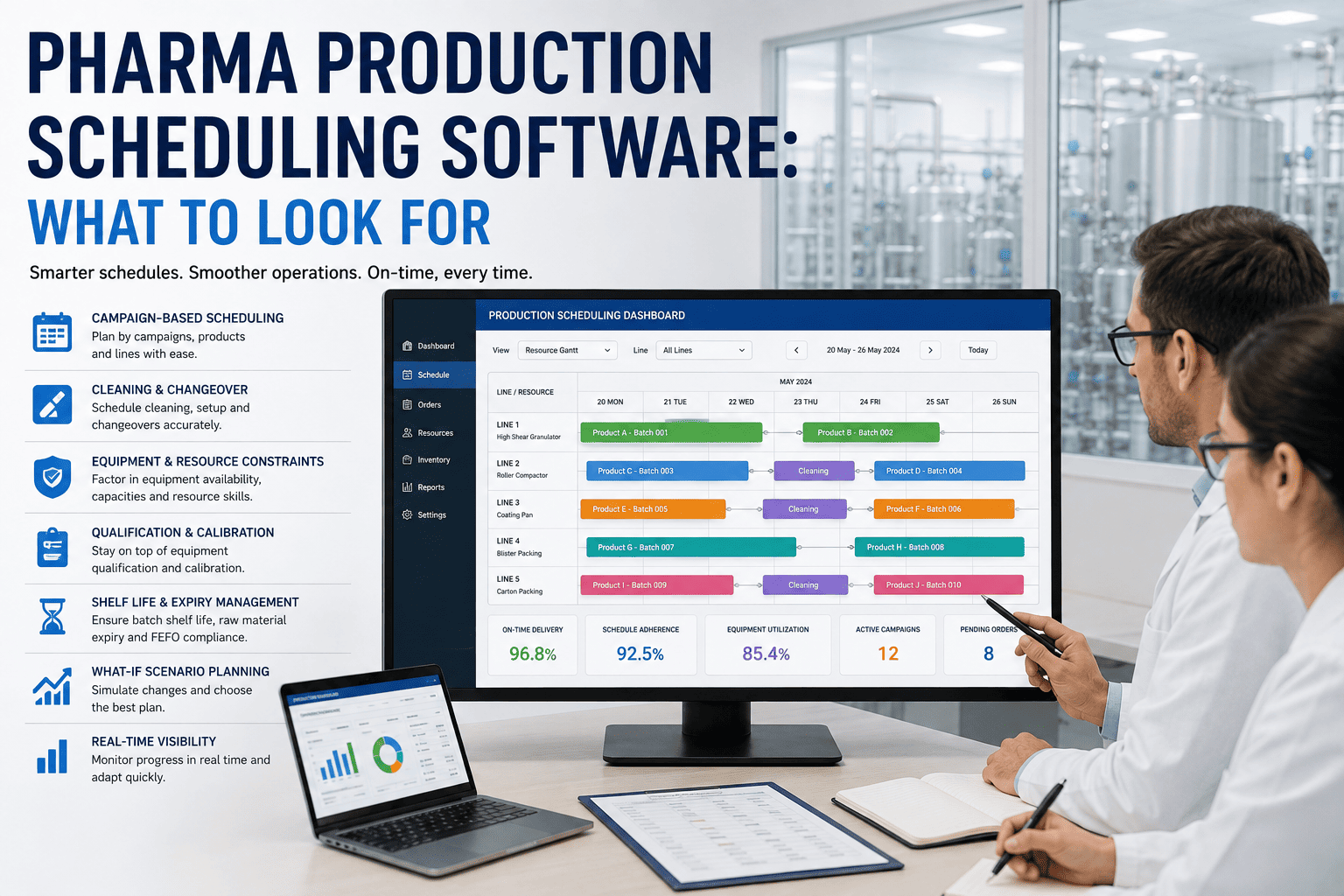
Campaign scheduling is where a pharma planner quietly decides how much of the plant actually turns into product. Run long campaigns of one product and you amortize the expensive cleaning across many batches — but you pile up inventory, tie up capital, and lose the flexibility to answer demand. Run short campaigns and you stay nimble, but every switch costs a cleaning cycle, and the changeovers eat your availability alive. Somewhere between those extremes is the campaign size and sequence that maximizes output without breaking a GMP limit — and most plants are still hunting for it in a spreadsheet. Moving campaign planning from Excel to APS turns that hunt into an optimization.
Production Scheduling for Pharma Planners
Campaign Scheduling in Pharma Plants: From Excel to APS
Campaign size and sequence decide cleaning loss, changeover time, and OEE. See how to plan pharma campaigns for maximum output — balanced against inventory, responsiveness, and the GMP limits you cannot cross.
A cleaning cycle produces nothing. It occupies the equipment, consumes the utilities, and burns hours that could have been batches — pure availability loss in OEE terms. Campaigns exist to spread that loss across as many batches as possible, which is why the instinct is always to run them longer. But longer is not free, and beyond a point the costs it creates elsewhere outrun the cleaning it saves. Getting campaign scheduling right means finding that point deliberately, not by feel.
The Campaign Size Trade-Off
Campaign size is a balance between two opposing costs. Cleaning cost per unit falls as campaigns grow, because you clean less often. Inventory and flexibility cost rises, because you make more before you can switch. Add them together and there is a clear minimum — the campaign size that costs you least in total.
Finding the least-cost campaign size
The bottom of the total curve is the target — but only if it sits within the GMP ceiling. When the least-cost size would run longer than validation allows, the ceiling wins.
But GMP Caps How Long You Can Run
The trade-off is not the whole story, because a campaign cannot run indefinitely. Validation sets a maximum campaign length — a limit on batches or time before a mandatory clean, driven by bioburden and cross-contamination control. That ceiling is non-negotiable. A good campaign plan finds the economic optimum and then respects the GMP limit above it, never trading compliance for a slightly lower cost per unit.
Sequence Decides the Cleaning Bill
Size is only half the problem. The order you run products in changes how much cleaning you owe, because the cleaning required depends on what ran before and what runs next. Sequence the campaigns well and you travel the cheap transitions; sequence them badly and you pay for the worst-case clean again and again.
Cleaning effort by transition — from one product to the next
From \ To
A
B
C
D
A
none
low
high
med
B
low
none
med
high
C
high
med
none
low
D
med
high
low
none
The same set of campaigns can cost very different amounts of cleaning depending only on their order. Optimizing the sequence is free capacity most Excel plans leave on the table.
How much of your changeover time is just a bad campaign order? Book a 30-minute demo and we'll model your cleaning matrix and campaign sequence.
From Excel to APS
Most campaign planning grows up through the same three stages. Each is a step forward, and the last is where campaign scheduling stops being a guess and starts being an optimization.
Stage 1
Excel
Campaigns sized by habit and sequenced by memory. Static, hard to change, and blind to the real cost trade-off. One disruption and the plan is manual again.
Stage 2
Rules
Fixed campaign sizes and simple sequence rules. More consistent, but rigid — the rules cannot adapt to demand, and they rarely find the true optimum.
Stage 3
APS
Optimizes campaign size, sequence, and mix against cleaning, demand, inventory, and GMP limits at once — and reschedules when reality changes.
What APS Changes About Campaign Planning
Once the campaign plan is optimized rather than assembled by hand, the gains show up across every number the trade-off touches.
Right
Campaign size
least total cost, within GMP limits
↓
Cleaning loss
sequence tuned to the cheapest transitions
↑ OEE
More uptime
fewer changeovers means more batches
Balanced
Inventory
output without over-building stock
Frequently Asked Questions
Isn't a longer campaign always more efficient?
Only up to a point. Longer campaigns lower cleaning cost per unit, but they raise inventory, tie up capital, add expiry risk, and reduce your ability to respond to demand. Past the optimum, those rising costs outweigh the cleaning you save, so the most efficient campaign is a balance, not the longest one — and it must also stay within the GMP maximum campaign length.
How does sequencing actually reduce cleaning?
Cleaning requirements are sequence-dependent: the effort to switch from one product to another varies with the pair, driven by shared equipment, potency, and cross-contamination control. By ordering campaigns to favor the low-effort transitions and avoid the worst-case cleans, the total cleaning burden drops without changing what you produce. Optimizing that order is one of the fastest capacity gains available.
Can APS respect our validated campaign length limits?
Yes, and it should treat them as hard constraints. The optimizer finds the economic best size and then caps it at your validated maximum campaign length, so it never proposes a campaign that would run longer than validation allows. Compliance limits bound the optimization rather than competing with it.
We plan campaigns in Excel today. Is it really worth changing?
Excel is fine for recording a plan but poor at optimizing one. It cannot weigh the size trade-off, optimize the sequence across a cleaning matrix, or replan when demand shifts or a batch fails. The gap between an Excel plan and an optimized one is usually measured in avoided cleanings and recovered uptime, which tends to make the move pay for itself quickly.
What is the best way to see the benefit for our plant?
Use your real product mix and cleaning matrix. The best next step is a demo where we take a representative month, optimize the campaign sizes and sequence against your constraints, and compare the cleaning loss and OEE to your current plan. That side-by-side makes the opportunity concrete.
Stop Guessing Campaign Size in a Spreadsheet.
See Your Campaigns Optimized for Size and Sequence
Bring your product mix, cleaning matrix, and campaign length limits. We'll optimize a representative month's campaigns and show the cleaning loss avoided and the OEE recovered against your current Excel plan.