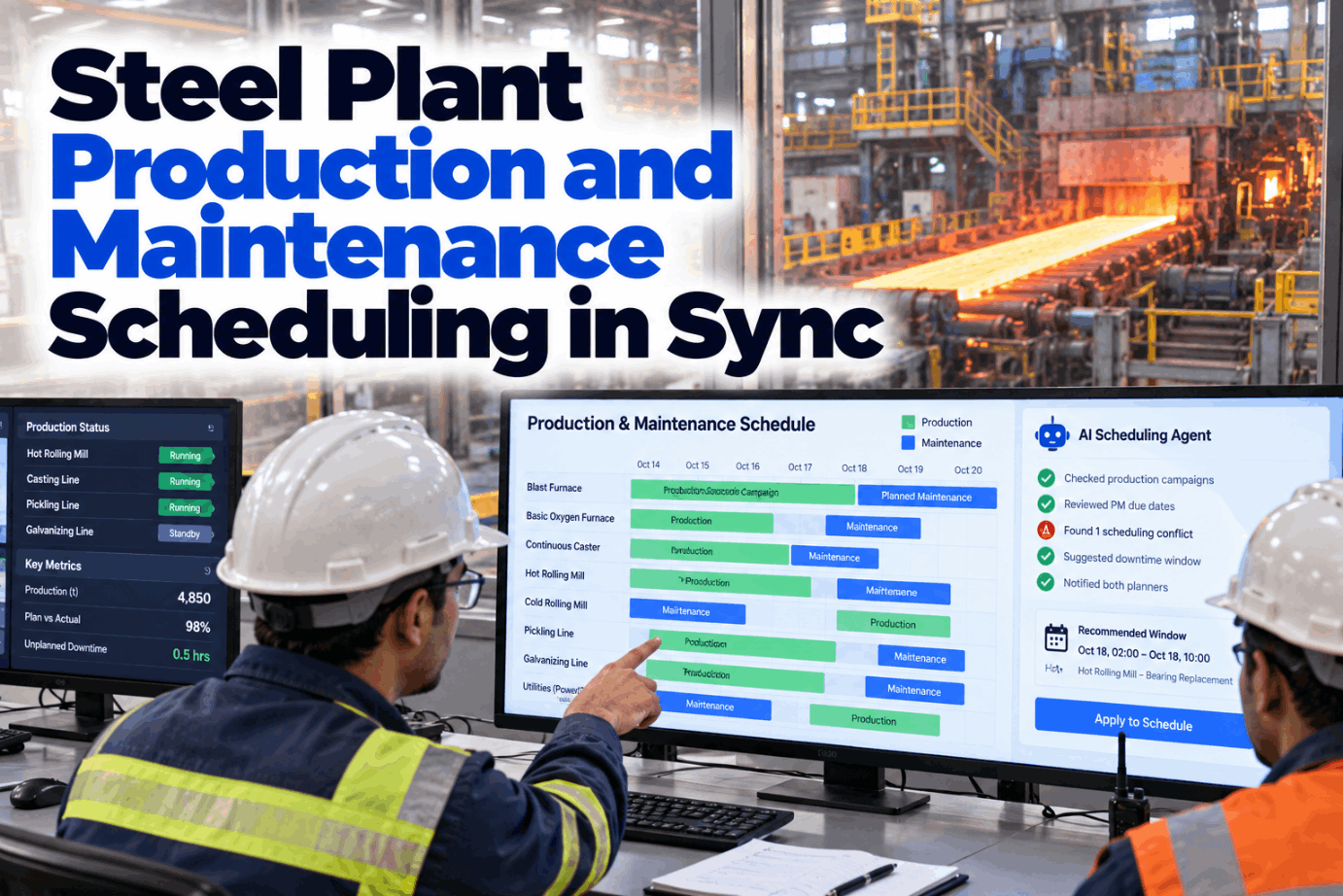
Steel Plant Production and Maintenance Scheduling in Sync

By Josh Brook on October 23, 2026

steel-plant-production-maintenance-scheduling-sync

In most steel plants, the production plan and the maintenance plan are built by different people, in different systems, against different targets. Production protects the campaign. Maintenance protects the PM due date. When the two plans meet on the shop floor, someone loses, and it is usually the PM that slips or the sequence that ends early. This guide shows how to agree shared downtime windows before the clash, and how an AI scheduling agent helps both planners do it. See it negotiate a real week in a short scheduling agent demo.

SCHEDULING AGENT · STEEL PLANTS

One Shared Downtime Window Instead of Two Competing Plans

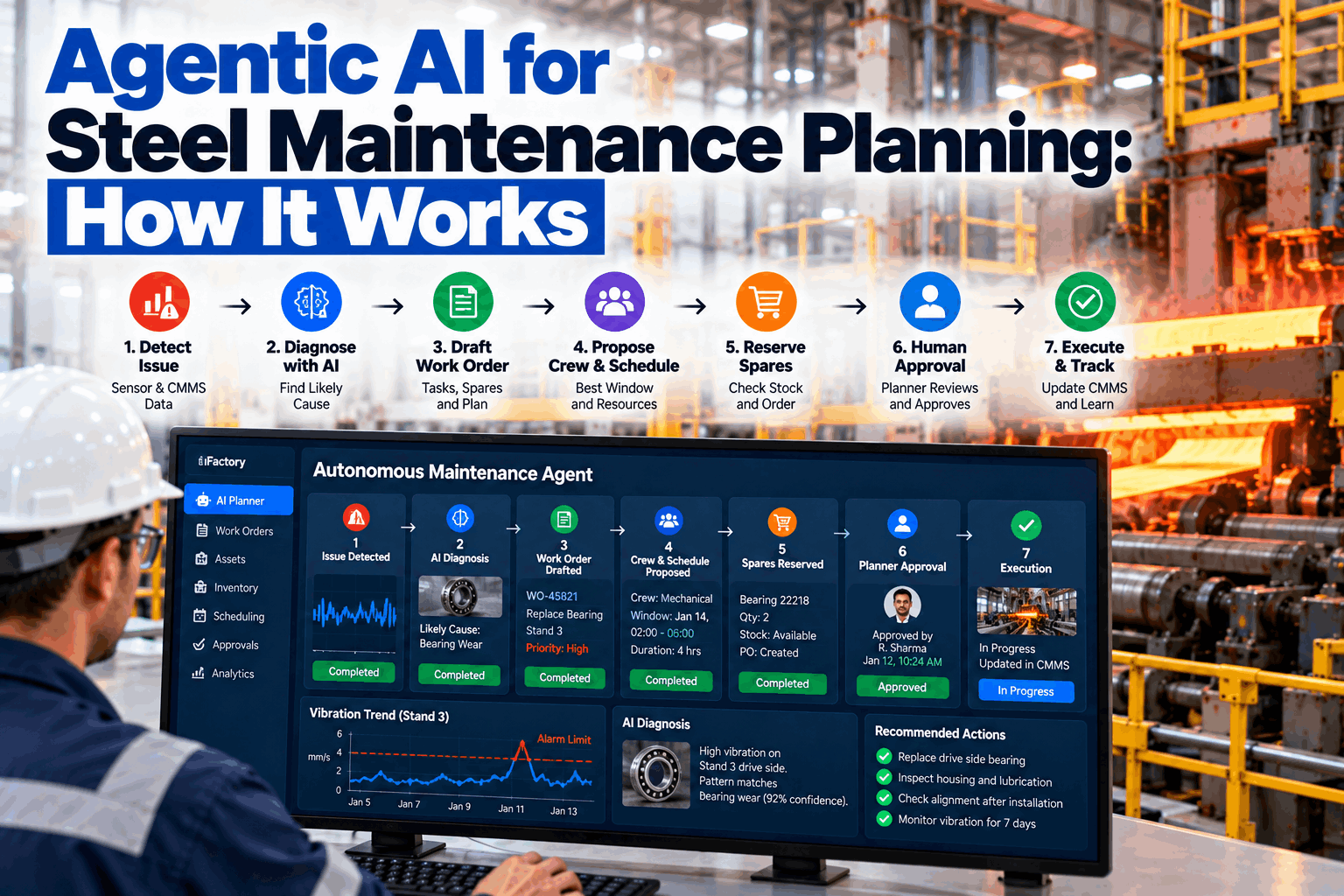
The iFactory Scheduling Agent reads production campaigns and PM due dates, then proposes shared downtime windows that both planners can accept. When a conflict appears, it alerts the production and maintenance planners by voice, with the options already worked out.

Window proposal · Hot strip millWeek 44
Read: rolling program, caster plan, 41 PMs due
Rolling round 4417 endsTue 06:00 · roll change
PMs that fit the gap6 jobs · 11.5 crew-h
Window asked forTue 06:00 to 10:00
Voice alert to both planners · 13:12"Caster segment 7 PM falls due Thursday, mid-sequence. Two options sent."
Production planner: accepted · Maintenance planner: accepted
OPERATIONS MAINTENANCE CONFLICT

Why Two Good Plans Still Collide

Neither side is wrong. A production planner who stops a caster sequence early pays for a new tundish and a restart. A maintenance planner who lets a PM slip carries the risk of a failure in the middle of the next campaign. The conflict comes from planning alone and negotiating late, often at the morning meeting on the day the work should start. Talk through your own planning cycle with our scheduling team.

PRODUCTION PLANNER SEES
  • Order book, due dates and grade mix
  • Caster sequences and rolling rounds already promised
  • Restart costs, transition coils and yield loss
  • Maintenance asking for time with little notice
MAINTENANCE PLANNER SEES
  • PM due dates, tolerances and overdue backlog
  • Crew hours, contractors and parts on hand
  • Condition alarms that will not wait for a month-end stop
  • Windows that open and close without warning
CAMPAIGN SCHEDULING

The Campaigns That Decide Where Steel's Natural Windows Are

Steel units do not run in steady batches. They run in campaigns, and each campaign has a natural end where stopping costs little. A caster sequence ends with a planned tundish change or turnaround. A hot strip mill rolling round ends with a work roll change. On a hot strip mill, rounds are often built in a "coffin" shape: start narrow, rise to the widest product as the rolls warm, then step back down to narrow as they wear. Those ends are where maintenance time is cheapest. Map your own campaign ends in a campaign mapping session.

Unit
What a campaign is
Natural end
Cost of stopping mid-campaign
Window fit
Blast furnace
Years of continuous operation between relines
Planned stops for tuyere and stave work
Thermal upset and a slow return to full output
Planned stops only
EAF and ladle furnace
Heats on a tap-to-tap cycle, lining campaigns
Between heats, refractory and electrode work
Lost heats and a melt shop out of step with the caster
Short gaps
Continuous caster
A sequence of heats cast without stopping
Sequence end, turnaround or tundish change
New tundish, restart risk and transition slabs
Sequence end
Hot strip mill
A rolling round in a width and gauge pattern
Work roll change at the end of the round
Worn or warm rolls out of profile, schedule rework
Roll change
Cold mill and coating lines
Width, grade or coating campaigns
Roll changes, pot or coating changeovers
Transition material and line threading time
Changeovers
Whole plant
The annual or multi-year outage plan
Planned outage with contractors
Lost tonnes across every linked unit
Outage plan
DOWNTIME WINDOW PLANNING

Four Kinds of Window, Four Different Negotiations

Not every window is agreed the same way. A roll change gap is already in the production plan, so the negotiation is only about what fits inside it. A weekly maintenance shift is a standing agreement that both sides protect. An annual outage is a project with its own scope and budget. An unplanned stop is a surprise, and the only question is which ready jobs can start before the unit restarts. Review your window types with our support team.

Campaign-end gap
Already in the planRoll changes, tundish changes and sequence ends. Short, frequent and the easiest window to use well.
Maintenance shift
Standing agreementA regular planned stop each week or two. Both planners protect it and fill it from the ready backlog.
Planned outage
Its own projectAnnual or multi-year outages with frozen scope, contractors and a critical path.
Unplanned stop
Opportunity, not a planA breakdown elsewhere stops the unit. Ready, short jobs can start if the risk and permits allow.

A Conflict Raised Days Ahead, Not at the Morning Meeting

The iFactory Scheduling Agent watches campaign plans and PM due dates together. When they collide, both planners hear about it by voice, with the shared window options already costed in hours and jobs.

Melt shop and caster · Production planner and iFactory
Production plannerWhy can't segment 7 wait until Saturday's sequence end?
iFactoryIts PM tolerance ends Friday night. Saturday would be outside it. Thursday's tundish change gives a 3 h gap that covers the job.
Production plannerAnd if we take that gap, what moves?
iFactoryTwo heats shift by 3 h. The rolling round is not affected. The maintenance planner has the same proposal now.
PRODUCTION MAINTENANCE SCHEDULING STEEL SOFTWARE

How the Agent Builds a Shared Window Proposal

The agent does the reading and matching that planners rarely have time for. It never moves a campaign or a PM on its own. It produces a proposal, explains the trade, and waits for both planners to accept, revise or reject it. Every decision is kept, so next week's proposals learn from this week's. Walk through the logic in a planning workshop.

1Read campaignsSequences, rolling rounds and changeovers from the production plan
2Read PMsDue dates, tolerances, durations and crew needs from the CMMS
3Find windowsCampaign ends, maintenance shifts and outages that line up
4Pack the gapFit ready jobs by crew hours, permits and parts on hand
5Propose to bothOne shared proposal, sent to both planners together
6Alert on conflictVoice alert when a plan change breaks an agreed window
PRODUCTION MAINTENANCE SCHEDULING STEEL BEST PRACTICES

A Weekly Window Meeting That Ends in One Agreed Schedule

Doc Palmer's Maintenance Planning and Scheduling Handbook sets out a one-week schedule that assigns work for every available labour hour, agreed in a weekly meeting where operations is present. Palmer argues it is better to load the schedule fully and break it than to under-load it and meet it, and he measures adherence with schedule compliance. Many plants then freeze the week once both sides sign. Use this checklist as a start, and ask our support team for a version built around your units.

01Before the meetingPlanner
02In the meetingBoth sides
03After sign-offAll week
PLANNED DOWNTIME STEEL

Ready Jobs for the Stop Nobody Planned

DNV describes opportunistic maintenance as a form of preventive maintenance that takes advantage of a planned or unplanned shutdown to replace items while the system is already down. In a steel plant, a breakdown in one unit often stops the next one too. If ready jobs are sorted by how long they take, the shift supervisor can start the right ones within minutes of the stop. Build your ready list with our maintenance planners.

Under 30 min
Inspections, lubrication points, quick filter or sensor checks
30 to 90 min
Nozzle cleaning, guide checks, small seal or hose changes
2 to 4 hours
Component swaps with kits staged and permits pre-drafted
Full shift
Only if the restart is confirmed to be later than the job
PRODUCTION MAINTENANCE SCHEDULING STEEL EXAMPLES

Three Typical Clashes and How a Shared Window Settles Them

These are illustrations of how the agent usually responds, not case studies. The final call always stays with your planners and your own procedures. Bring a recent clash to a scheduling review and we will walk through it.

Caster PM due mid-sequence
Moved into a tundish change gapThe agent finds a planned tundish change before the tolerance end and proposes a short gap instead of ending the sequence.
Rolling round extended
Conflict raised the moment the plan changedProduction adds coils to a round. The roll change now passes a coiler PM due date, and both planners hear it by voice.
Breakdown upstream
Ready jobs started on the stopped millA furnace delay stops rolling for two hours. The ready list shows four short jobs that fit, and the supervisor starts them.
PRODUCTION MAINTENANCE SCHEDULING STEEL IMPLEMENTATION GUIDE

A Shared Window Record Both Planners Sign

Every agreed window should leave a record that production, maintenance and the shift team read the same way. Use these fields as a template, with or without an agent. Request a blank copy from our planning team.

Unit and windowCaster 2, tundish change gap
Campaign linkSequence 8812, after heat 9
Agreed timeThu 14:00 to 17:00
Jobs insideSegment 7 PM, two inspections
Crew and permits4 fitters, isolation drafted
Production effectTwo heats shifted by 3 h
FallbackSaturday sequence end, if still in tolerance
Signed byBoth planners and the area manager
PRODUCTION MAINTENANCE SCHEDULING STEEL COST AND ROI

Size the Value With Your Own Numbers

The clearest value comes from using campaign-end gaps that already exist, so fewer PMs need dedicated downtime. The example uses assumed inputs only, to show the arithmetic. Replace each one with figures from your plant, and our team can help you build the full case.

Campaign-end gaps per week across the units10, assumed
Usable crew-hours inside each gap3, assumed
Share of those hours used today40%, assumed
Share used with shared proposals80%, assumed
Extra PM crew-hours per week inside existing gaps10 × 3 × (0.80 − 0.40) = 12
Per year, at 50 working weeks12 × 50 = 600 crew-hours

Those hours no longer compete for the weekly maintenance shift. Value them at your own rate for dedicated downtime, then add planner time saved on reconciling two plans. Leave failure-avoidance savings out unless your own history supports them.

TURNKEY AI DEPLOYMENT

Scheduling Agent, Voice Alerts and NVIDIA Server in One Package

iFactory delivers the Scheduling Agent as a turnkey bundle. A pre-configured NVIDIA AI server ships racked and ready with the agent, the campaign readers and the voice service pre-loaded, so planning data stays on site. You rack it, plug in power and Ethernet, and the AI is live. To scope it for your plant, request a turnkey quote.

What's Included
  • Pre-configured NVIDIA AI edge server, racked and ready
  • Readers for caster, rolling and melt shop plans
  • CMMS link for PM due dates, tolerances and crew hours
  • Shared window proposals sent to both planners
  • Voice alerts to planners' headsets and handhelds
  • Window records and weekly compliance review
  • 24×7 remote monitoring of the agent and hardware
Live in 6–12 weeks
Wk 1–4
Connect and Map

Production plans and CMMS linked, campaign ends and window types mapped for each unit.

Wk 5–8
Propose in Shadow

The agent drafts proposals alongside the weekly meeting, and planners compare them with their own.

Wk 9–12
Go-Live and Training

Proposals and voice alerts switched on, planners trained, weekly review started.

HOW iFACTORY FITS

Integrated Scheduling Without Taking the Decision From Planners

iFactory sits between the production plan and the CMMS and keeps both sides looking at the same windows. Our support team can walk you through a pilot plan.

1
Reads both plans. Production campaigns and PM due dates are read together, every time either one changes.
2
Proposes shared windows. Ready jobs are packed into campaign ends, maintenance shifts and outages.
3
Alerts both planners by voice. A conflict reaches production and maintenance at the same moment.
4
Keeps the record. Every agreed window, change and break-in feeds the weekly review.
1000+
Industrial clients running iFactory
99.9%
Platform uptime for continuous steel operations
6-12 wks
From racked server to live window proposals
FREQUENTLY ASKED QUESTIONS

What Plant Managers Ask About Production and Maintenance Scheduling

What does production maintenance alignment mean in a steel plant?
It means both plans are built around the same downtime windows. Caster sequences, rolling rounds and furnace campaigns set where stopping costs least, and PMs are placed inside those windows before the week starts, instead of being argued over on the day.
Does the agent change the production plan on its own?
No. It reads the plans, proposes shared windows and explains what each option moves. Production and maintenance planners accept, revise or reject every proposal, and the agent records the decision.
How does it know a PM can wait?
Each PM carries a due date and a tolerance that your site sets. The agent proposes windows inside that tolerance. If no window fits, it raises the conflict to both planners rather than letting the PM slip quietly.
Why use voice alerts for planners?
Planners in steel plants spend much of the day on the floor and in meetings. A short spoken alert on a headset or handheld reaches both of them at once, so the conflict is discussed while there is still time to act.
How does it handle unplanned stops?
It keeps a ready list of short, interruptible jobs for each unit, sorted by duration. When a stop is logged, the shift supervisor sees which jobs fit the expected restart time and can start them if permits and risk allow.
Where should we start?
Start with one pair of linked units, such as a caster and the hot strip mill it feeds. Map their campaign ends, connect the CMMS and run the agent alongside your weekly meeting for a few weeks. Our support team can plan that pilot with you.

Agree the Window Before the Campaign Starts

Read campaigns and PM due dates together, propose shared downtime windows and alert both planners by voice when a conflict appears. The full system is delivered turnkey and goes live in 6 to 12 weeks.
Example week summary · Caster and hot strip mill
Windows agreedRoll changes, tundish changes, one shift
PMs placedInside tolerance, inside windows
ConflictsRaised by voice to both planners
Break-insLogged for the weekly review
One schedule, signed by both sides

Share This Story, Choose Your Platform!