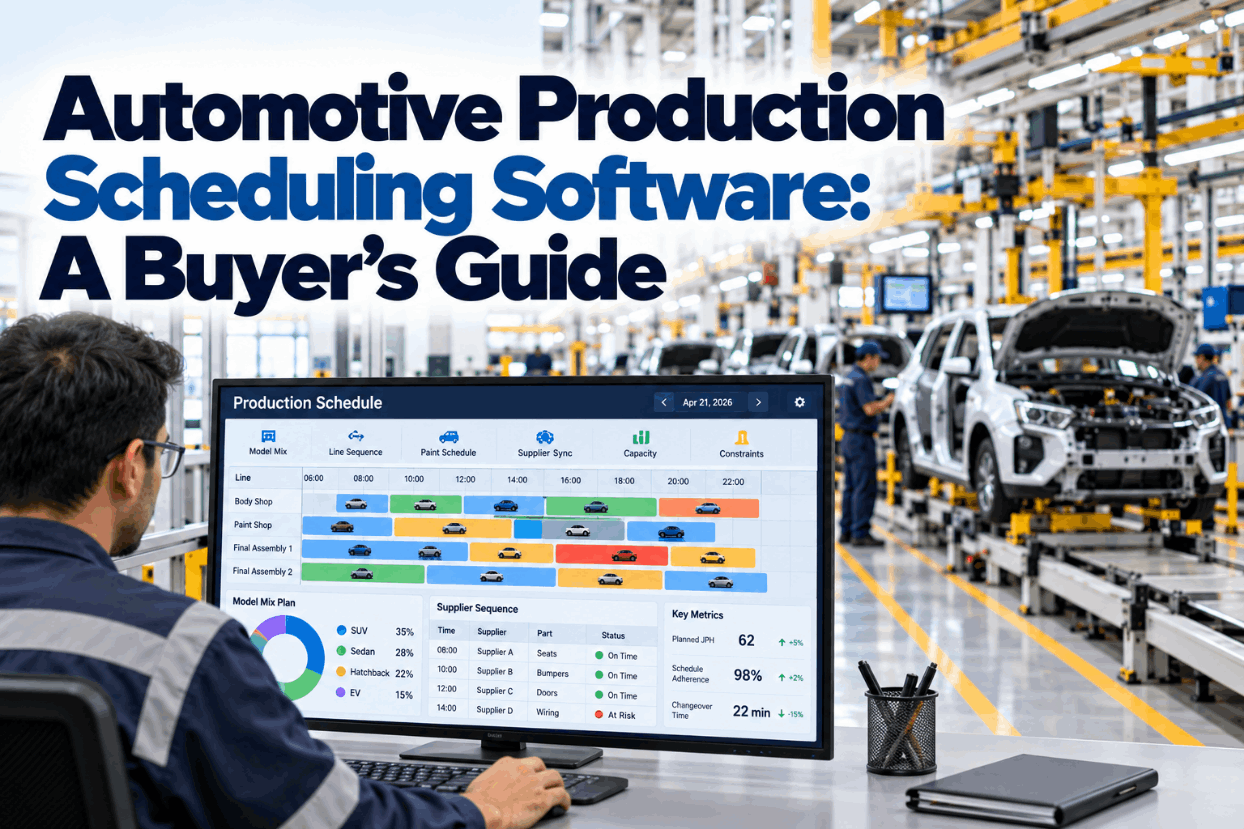
Scheduling an automotive plant is harder than scheduling most factories. Every vehicle is a different combination of model, engine, colour and options. The sequence must respect station workload, keep paint colours in blocks, feed just-in-sequence suppliers in the right order and recover when bodies leave the chain for repair. Spreadsheets and ERP planning modules cannot carry all of that at once. Advanced planning and scheduling (APS) software built for automotive can, but products differ widely. This buyer’s guide explains the scheduling problem, the must-have capabilities, how to test vendors on your own data, which integrations matter and how to compare options fairly. To see automotive scheduling on your orders, book a short walkthrough.
Automotive Production Scheduling Software: A Buyer’s Guide to Must-Have APS Features
What automotive APS must handle, from sequencing rules and colour blocks to JIS call-offs and paint resequencing, and how to test vendors on your own orders before you commit.
Why Automotive Scheduling Needs Specialist Software
A general scheduling tool thinks in jobs, machines and due dates. An automotive assembly schedule thinks in sequence. The order of vehicles on the line decides whether stations can keep up, whether the paint shop can batch colours and whether suppliers delivering in sequence send the right seat or cockpit at the right moment.
The problem is well known in operations research. In 2005 the French operations research society ROADEF set Renault’s car sequencing problem as its industrial challenge: order vehicles to respect ratio constraints at assembly stations while minimizing paint colour changes. Many research teams competed, and the problem remains a benchmark because it is hard to solve well at production speed.
Spreadsheets and ERP planning modules can handle volumes and dates, but they rarely manage ratio rules, colour blocks, JIS call-offs and resequencing together. That is where automotive APS earns its place.
The stakes are practical, not academic. A poor sequence overloads stations, forces paint purges, confuses supplier deliveries and can stop the line. A good one keeps all of those in balance day after day, which is why the scheduling engine sits at the centre of plant performance.
Choosing well starts with knowing what your plant actually needs. We can review your planning process on a call.
Capabilities Automotive APS Must Have
Use this list as the core of any evaluation. Weight each item by how much it matters in your plant.
| Capability | What to look for | Why it matters |
|---|---|---|
| Ratio and spacing rules | p-in-q rules, minimum spacing, hard and soft constraints | Keeps station workload feasible |
| Colour batching | Colour block targets and purge costs | Reduces paint waste and defects |
| Work content balancing | Minutes per station by variant | Smooths labour load |
| JIS and JIT call-offs | Sequence-driven call-offs to suppliers | Right part, right order |
| Paint resequencing | Painted body storage logic and gap filling | Restores sequence after repairs |
| Frozen horizon control | Clear rules for what can change and when | Protects supplier commitments |
| What-if scenarios | Test mix, shift and capacity changes | Better decisions before commitment |
| Maintenance windows | Planned stops reflected in the schedule | Realistic plans |
Not every plant needs everything at the same depth. A plant with a large painted body storage needs strong resequencing; a plant with many JIS suppliers needs robust call-off logic. The weighting should reflect your own constraints.
Turning this list into a weighted scorecard makes vendor comparison fair. Our planners can help build it.
Sequencing and JIS: The Heart of the Evaluation
Sequencing capability is where automotive APS products differ most.
Ask vendors to show how they trade off conflicting rules. Real sequences rarely satisfy every soft rule; the question is whether the software makes those trade-offs visible and adjustable by planners.
Also ask how the engine explains its choices. Planners must be able to see why a vehicle was placed where it is and which rules were relaxed. A black-box sequence is hard to trust and harder to fix when something goes wrong.
Testing sequencing on your own orders is the only reliable comparison. See how that test works in a demo.
Handling Paint Shop Disruption
Bodies regularly leave the planned sequence in the paint shop for repair or rework, then rejoin later. Good scheduling software manages the consequences.
Paint audit or defect detection removes a body from its planned slot.
Choose a suitable body from painted body storage to keep the sequence intact.
Find a slot where it fits ratio rules and supplier sequences.
Adjust call-offs only where the frozen horizon allows.
Keep buffer mix balanced so gaps can be filled.
Track the share of vehicles entering assembly in planned position.
Painted body storage is the key buffer. Software that understands its lanes and contents can fill gaps and keep the sequence stable; software that treats it as a black box cannot.
Resequencing capability is often where shortlisted vendors separate. Ask our team what to test.
Integrations That Matter
Automotive APS sits between business planning and the shop floor. Integration decides how well it works day to day.
Customer and dealer orders from ERP or order management.
Volumes and mix planned against capacity.
Daily sequence built with rules and colour blocks.
Sequence sent to MES and body tracking.
JIS and JIT call-offs sent from the sequence.
Actual progress and disruptions returned to planning.
The feedback loop is often the weakest link. If the APS does not see actual body positions, repairs and stops in near real time, planners end up correcting sequences by hand.
Maintenance data belongs in the loop too. Planned stops for equipment work change available capacity, and a schedule built without them will promise output the line cannot deliver. APS products that read maintenance windows from the CMMS produce more realistic plans.
Ask each vendor for reference plants with similar systems to yours. We describe typical integration patterns during implementation.
APS Versus Spreadsheets and ERP Planning
Many plants start with spreadsheets or ERP planning modules. The comparison shows where they run out.
- Volumes and dates handled well
- Ratio rules checked by hand
- Colour blocks managed by experience
- Resequencing done manually
- What-if tests slow and error-prone
- Knowledge held by a few planners
- Volumes, dates and sequence together
- Ratio rules enforced automatically
- Colour blocks balanced with assembly rules
- Resequencing supported with PBS logic
- What-if tests in minutes
- Rules documented in the system
Spreadsheets are flexible and familiar, which is why they persist. The risk is that the plant depends on a few experts who carry the rules in their heads.
Moving to APS does not remove those experts; it frees them. Instead of checking ratio rules by hand, planners spend their time on exceptions, scenarios and supplier issues, where their judgment adds most value.
A pilot on one line shows the difference quickly. Discuss one with our specialists.
How to Evaluate Vendors
A structured evaluation avoids choosing on demos alone.
The most revealing test is giving each vendor the same week of real orders, rules and a set of disruptions, then comparing the resulting sequences on the same measures.
Scoring those results against your weighted list keeps the decision objective. We can help run the test in an evaluation workshop.
What Good Scheduling Software Is Worth
The value of automotive APS comes from a more stable, more feasible sequence.
With automotive downtime around $2.3 million an hour on Siemens’ figures, even small reductions in sequence-related stops matter. The exact value depends on how often your line is disrupted by sequence problems today.
Recording sequence-related stops before the project starts makes the case concrete. Many plants find they have never separated these stops from general downtime, and doing so is often revealing on its own.
A review of last quarter’s sequence disruptions shows the size of the gain. Book one with our advisors.
How iFactory Delivers Automotive Scheduling
Ratio rules, spacing and colour blocks together.
Supplier call-offs driven by the frozen sequence.
Gap filling from painted body storage.
Mix, shift and capacity changes tested fast.
Planned stops reflected in the schedule.
Sequence adherence tracked by day and line.
It works with your ERP, MES, body tracking and supplier systems. Share a week of orders and rules and we will sequence them in a session.
Test Automotive APS on Your Own Orders
Share a week of orders, ratio rules and colour targets. We sequence them, show the trade-offs and compare the result with your current plan.
Handles ratio rules and colour batching well. No native painted body storage resequencing; would need a separate tool.
A Vendor Gap Found During Evaluation
This exchange shows how a planning manager might use iFactory during an APS evaluation.
iFactory ships as a pre-configured NVIDIA AI server, racked and ready with the production scheduling and sequencing models loaded. Rack it, plug in power and Ethernet, and the AI is live on your network. Our scope covers sensors and data connections across body, paint, assembly and utility systems, PLC/SCADA, MES, CMMS and ERP integration, cabling and network setup, operator and quality team training, and 24×7 remote monitoring.
Server installed, PLC, MES and ERP links live, historical production, quality and maintenance data loaded.
Models calibrated on your own lines, then run in advisory mode on one line or area with your planners and engineers reviewing every output.
Rollout to the agreed lines under your change management, planner, supervisor and engineer training, and 24×7 remote monitoring in place.
Software, server and integration come as one package. For pricing on your plant, contact our sales team.
Frequently Asked Questions
Advanced planning and scheduling software built for vehicle plants, handling model mix, ratio rules, colour blocks, JIS supplier call-offs and paint resequencing together.
They handle volumes and dates but rarely enforce ratio rules, balance colour blocks, drive JIS call-offs and resequence around paint disruption at the same time.
Limits such as no more than two vehicles with a sunroof in any five consecutive cars, which keep station workload within capacity.
With a weighted scorecard and a test on your own orders, rules and disruptions, plus references from plants of similar complexity.
ERP or order management, MES and body tracking, supplier call-off systems and CMMS for maintenance windows, with real-time feedback of actual progress.
A first line can typically be sequenced within a 6–12 week rollout, depending on integrations. Plan it with our planners.
Choose Scheduling Software That Fits Your Line
iFactory sequences your own orders against your rules, resequences around paint disruption and feeds suppliers a stable plan, so you can judge the result before you commit.
Illustrative scores from a weighted checklist, tested on your own orders.