When the Takata airbag defect surfaced in 2013, the recall grew to more than 67 million vehicles across multiple carmakers and eventually drove the supplier into bankruptcy — not because the defect was that widespread, but because nobody could prove which vehicles actually had the faulty inflators. In the absence of unit-level genealogy, the safest legal answer was to recall everything. That is the cost of imprecise traceability written in nine-figure numbers. In 2024, NHTSA hit Ford with a $165 million civil penalty — the second-largest in NHTSA history — over recall-process and reporting failures, with a corrective action that mandated developing a VIN-based system capable of tracing components to individual vehicles. Every hour a line stays down after a non-conformance without documented genealogy costs about $250,000 in automotive. IATF 16949 clause 8.5.2.1 requires traceability "at a level that enables nonconforming and/or suspect product to be identified" — a sentence that reads modest and that has been interpreted by every major OEM into specific serial-level requirements for safety-critical parts, retained for 10 to 15 years, backed by CSRs (Ford Q1, GM BIQS, Stellantis MOPS, VW Formel-Q, Toyota TPS, BMW VDA) that stack additional teeth on top. The plants that survive a recall event with their supplier ratings intact don't do it because their parts never fail. They do it because when a part does fail, they can answer the "which VINs" question in minutes, not months. iFactory Traceability is built to run exactly that — serial-level birth history bound to every VIN, forward and backward genealogy, and recall scoping in minutes.
iFactory Traceability for Automotive
When the Recall Hits, Answer "Which VINs?" in Minutes — Not Months
Serial-level part genealogy bound to every VIN, forward and backward traceability across suppliers, IATF 16949 and CSR-compliant retention, and surgical recall scoping when it counts.
67M
vehicles, Takata recall
$165M
Ford NHTSA penalty, 2024
$250K/hr
line shutdown cost
15 yrs
CSR retention typical
The Recall Scope Problem — Visualized
The single biggest driver of recall cost isn't the fix. It's the scope. Without unit-level genealogy, the safest legal answer is always "recall everything that might have the defect." With it, you recall only the VINs that actually have the affected part. This is what the difference looks like on a single defect.
WITHOUT GENEALOGY
Broad Market Recall
All 40 possible units affected
Weeks-months to define scope
100% recall + logistics cost
WITH SERIAL GENEALOGY
Surgical VIN-Level Recall
5 of 40 actually affected VINs
Minutes to define scope
~12% of the broad recall cost
Same defect. Same suspect lot from the same supplier. The only difference is whether the plant can prove which specific VINs received parts from that lot.
Genealogy — Forward and Backward, From Raw Material to VIN
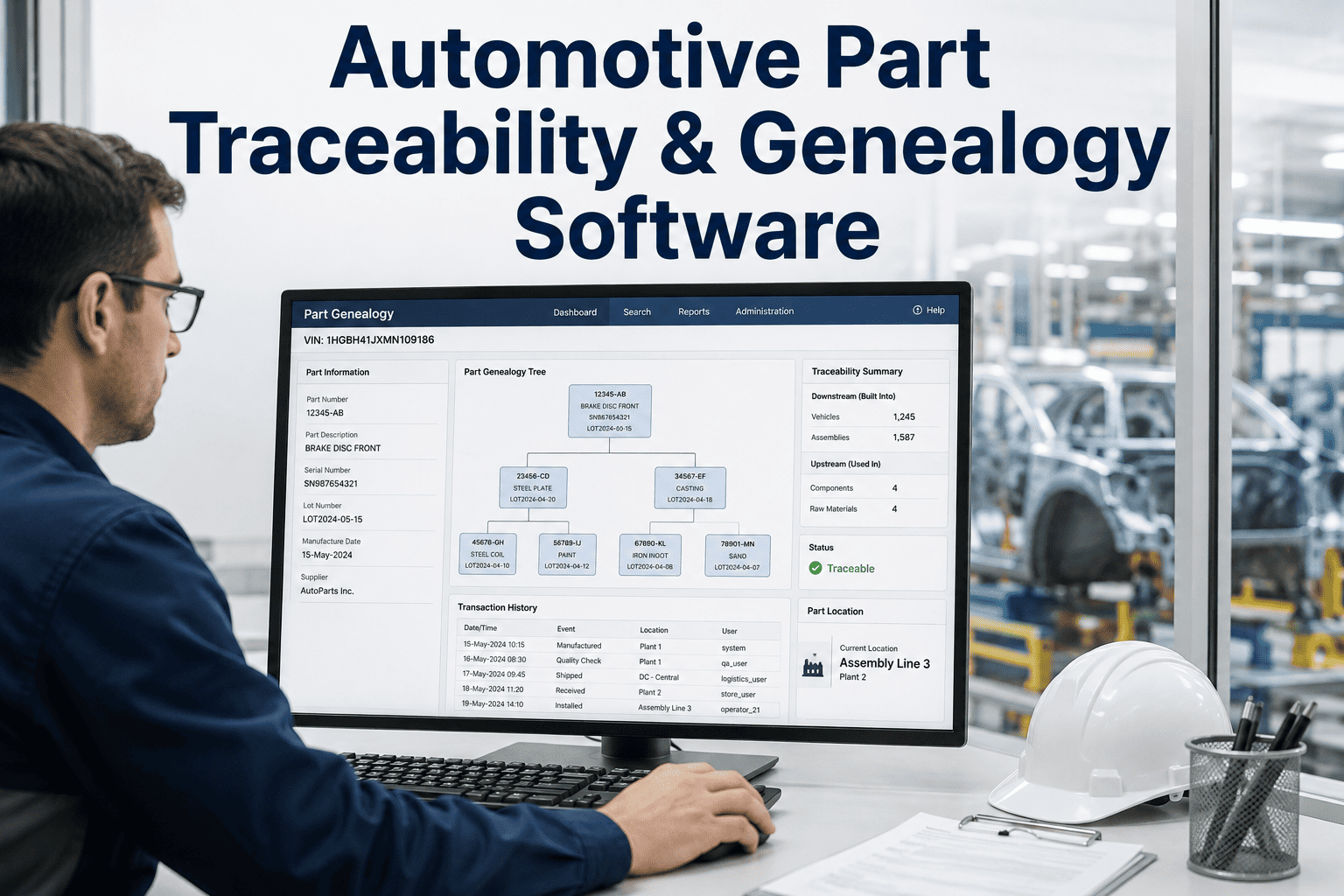
Automotive genealogy has to run both directions. Forward: "Where did every part from this suspect lot end up?" Backward: "What raw material, machine, operator, and shift produced this failed part in the field?" A traceability system that only handles one direction is broken by design.
One VIN, unpacked
Level 4 — Major Assembly
BodyBody-in-white SN 4712
PowertrainEngine SN 8834
ChassisChassis SN 2201
Level 3 — Subassembly
AirbagDriver airbag SN 907
BrakeABS module SN 1123
ECUPowertrain ECU SN 5602
BatteryHV pack SN 3390
Level 2 — Component & Lot
InflatorLot A447, Supplier X
SensorLot B012, Supplier Y
FastenerLot C889, Supplier Z
Level 1 — Raw Material
SteelHeat 224-11, Mill M
AlloyCast 189-07, Foundry F
PolymerBatch 445, Chem C
Forward: "Where did parts from Lot A447 end up?" › returns 47 VINs
Backward: "What produced VIN ...456's airbag inflator?" › returns Lot A447, machine, shift, operator
Traceability Granularity — The Three Levels
Not every part needs serial-level tracking. But every safety-critical part does. IATF 16949 leaves the level to interpretation — every major OEM CSR interprets it into specific requirements. This is what the three levels cost and enable.
Level 1
Batch Traceability
Groups of thousands
Trace to production batch, day, shift
Recall scope: entire batch (thousands to tens of thousands)
Lowest cost, lowest granularity
Acceptable for non-safety consumables
Level 2
Lot Traceability
Groups of hundreds
Trace to specific manufacturing lot
Recall scope: hundreds to low thousands
Standard for most controlled components
Balance of cost and containment
Level 3
Serial Traceability
Individual units
Unique ID per part bound to VIN
Recall scope: only VINs actually affected
Required for safety-critical: airbag, brake, steering, EV battery
Required by ISO 26262 functional safety
Not sure which level your OEM CSRs demand? Book a demo — bring your CSR pack and we'll map it.
The Regulatory Stack Every Tier 1 Sits Under
Traceability in automotive is not one standard — it's a stack. IATF 16949 sets the base. ISO 26262 stacks functional safety on top. Every OEM adds a customer-specific requirement (CSR) that tightens granularity, retention, or process-event capture. And NHTSA's teeth close the loop on the market side.
| Standard / Authority |
What it requires |
Retention |
| IATF 16949 §8.5.2.1 |
Traceability sufficient to identify nonconforming or suspect product |
10-15 years |
| ISO 26262 |
End-to-end traceability across safety lifecycle for E/E systems |
Product life + 15 years |
| Ford Q1 / CSR |
Individual-part traceability on critical features |
15 years |
| GM BIQS |
Serial-level for safety and emissions-critical parts |
15 years |
| Stellantis MOPS |
Named process-event capture, tightened granularity |
15 years |
| VW Formel-Q |
VDA-aligned traceability with supplier scrutiny |
15 years |
| Toyota TPS-adjacent |
JIS-compatible build-order verification |
Per Toyota manual |
| NHTSA (US) |
VIN-based component-to-vehicle tracing capability |
Regulator-defined per matter |
How iFactory Traceability Runs the Loop
Serial-level genealogy is not a report exercise — it's a live loop from part scan through VIN bind, held in a historian with a retention horizon matched to the strictest applicable regulation.
01
Capture at Every Node
2D DPM codes and RFID read at every handoff — supplier receipt, subassembly, station-by-station bind, final VIN association.
02
Bind Process Events
Every torque, weld, dispense, gap check, and test result timestamped and linked to the serial number of the part it touched.
03
GS1 & EPCIS 2.0
Native GS1 identifiers (SGTIN, GTIN, SSCC, GLN) with EPCIS 2.0-compliant events — supplier-OEM interoperability out of the box.
04
Retain 15+ Years
Historian layer with tiered retention matched to IATF 16949, ISO 26262, and every applicable CSR — immutable, indexed, searchable.
05
Query in Minutes
"Show me all VINs with Lot A447 airbag inflators" — returns the exact VIN list in minutes, with full birth history and audit trail.
What Serial-Level Traceability Delivers
Traceability's value shows up in three moments: an audit, a customer complaint, and a recall. In every one, it's the difference between hours and months, targeted and blanket, and supplier ratings intact or destroyed.
Minutes
Recall scope defined
not weeks or months of investigation
88%
Typical scope reduction
vs. batch-only broad recalls
15 yrs
Retention built in
IATF 16949 and CSR-compliant
Zero
Failed CSR audits
on genealogy scoping demonstrations
Want to see how narrow your next recall could actually be? Talk to our automotive team — we'll replay a hypothetical scoping against your build data.
Frequently Asked Questions
Do we really need serial-level traceability if IATF only says "identify nonconforming product"?
IATF 16949 §8.5.2.1 leaves the granularity to interpretation. Every major OEM has interpreted it into serial-level requirements for safety-critical parts through customer-specific requirements (CSRs) — Ford Q1, GM BIQS, Stellantis MOPS, VW Formel-Q. Batch-only traceability is defensible for non-safety consumables. For airbags, brakes, steering, and EV battery components, serial is the practical standard whether the base text says so or not. And when NHTSA gets involved, they expect VIN-level tracing — that was explicit in the 2024 Ford consent order.
Why is Takata the standard cautionary tale?
Takata's inflator defect was real but not present in every unit shipped. Because unit-level genealogy across the multi-OEM supply chain didn't exist, regulators and OEMs couldn't scope the recall precisely — the safest legal path was to recall every vehicle that could have received the affected inflators. That expanded to 67+ million vehicles across most global brands, drove Takata into bankruptcy, and became the reference case for why traceability is a survival question, not a documentation question. Every major OEM has retooled its CSRs since.
How does iFactory Traceability handle supplier data?
GS1 identifiers (SGTIN, GTIN, SSCC, GLN) and EPCIS 2.0-compliant event data are used throughout, which is what makes supplier-OEM-retailer interoperability work without custom integrations. Suppliers can push part-level birth records into the plant's traceability historian via standard EPCIS events; the plant binds those records to VIN at the appropriate assembly stations. When a supplier defect surfaces, the query runs across the supplier's data and the OEM's data in one operation.
What technologies does the capture layer actually use?
A mix, driven by the operation. 2D Data Matrix codes (DPM) are dominant for piece-part identification — they survive paint, thermal cycling, and rough handling. RFID/RTLS handles line-of-sight-limited handoffs and JIS-sequence verification. Torque tools, welders, dispensers, and vision systems push their event data directly into the genealogy record via their control systems. The result is capture without adding operator overhead — the workers don't fill in forms; the equipment reports.
How does this integrate with our existing MES and ERP?
Native connectors handle the major MES platforms (Siemens Opcenter, Rockwell FactoryTalk, GE Proficy, SAP DMC) and the major ERPs (SAP, Oracle, IFS). The traceability layer typically sits alongside — not replacing — those systems, adding the serial-level genealogy historian and query engine that MES and ERP by themselves rarely provide well. Where a plant is greenfield, iFactory Traceability can also serve as the primary genealogy backbone.
Can we run a pilot on one line before rolling out plant-wide?
Yes — that's the recommended path. Pick one safety-critical station or subassembly (typically airbag, brake, or torque-critical bolt-up), and we'll instrument it with 2D or RFID capture, bind process events into the genealogy record, and prove the query workflow with a mock recall scenario. Pilots typically run 6-10 weeks and give you real per-station cost and effort numbers before you commit to a plant-wide program.
Stop recalling everything to be safe.
See Serial-Level Traceability Running on One of Your Own Lines
Pick one safety-critical station — airbag, brake, torque-bolt, ECU. We'll instrument it, bind process events into a genealogy historian, run a mock recall scoping query on real production data, and produce the audit evidence pack — the exact one an OEM CSR audit or NHTSA investigation would demand.
-—-live-spc-for-tier-1-oem-programs.png)