When a supplier flags a suspect lot, the first question from the quality team is simple: which vehicles have it? If the answer takes days of spreadsheets, scan logs and phone calls, the recall grows while you search. If the answer comes back in minutes, with a list of VINs and a list of the few that need a physical check, the recall stays as small as the evidence allows. That difference is traceability and batch genealogy. This guide shows how to build part-to-VIN traceability that holds up under regulator, IATF 16949 and customer investigations: what the chain must contain, where it usually breaks, which KPIs prove it works and how to test it before a real recall does. To see how it looks on your own scan and station data, book a traceability walkthrough.
Automotive Traceability and Batch Genealogy for Recall Readiness
A practical guide for quality teams: how to link every supplier lot, component and sub-assembly to the VIN it ended up in, find the gaps in the chain and prove the trace works before a recall tests it.
- What a part-to-VIN genealogy chain must contain
- Where the chain breaks between supplier, line and shipment
- How to measure and drill recall readiness
Four causes explain more than four fifths of the broken traces. The dashed line marks where the cumulative share passes 80%. Unscanned lots are line-side lots consumed without a scan, unlinked holds are scrapped or substituted parts not tied to the record, and system handover covers records lost between the MES and ERP.
What Traceability and Batch Genealogy Really Mean
Traceability links every finished vehicle to every part and lot that went into it.
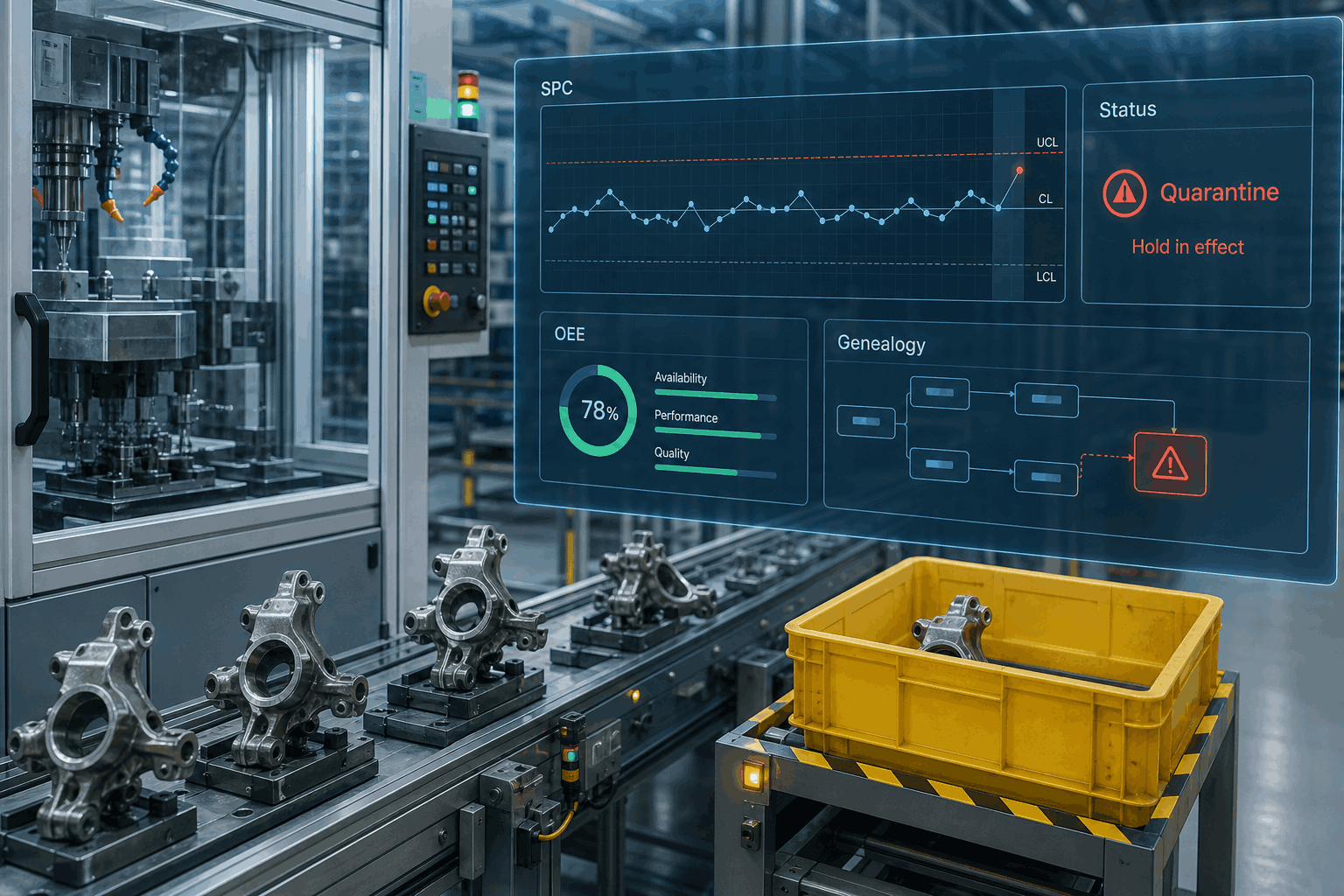
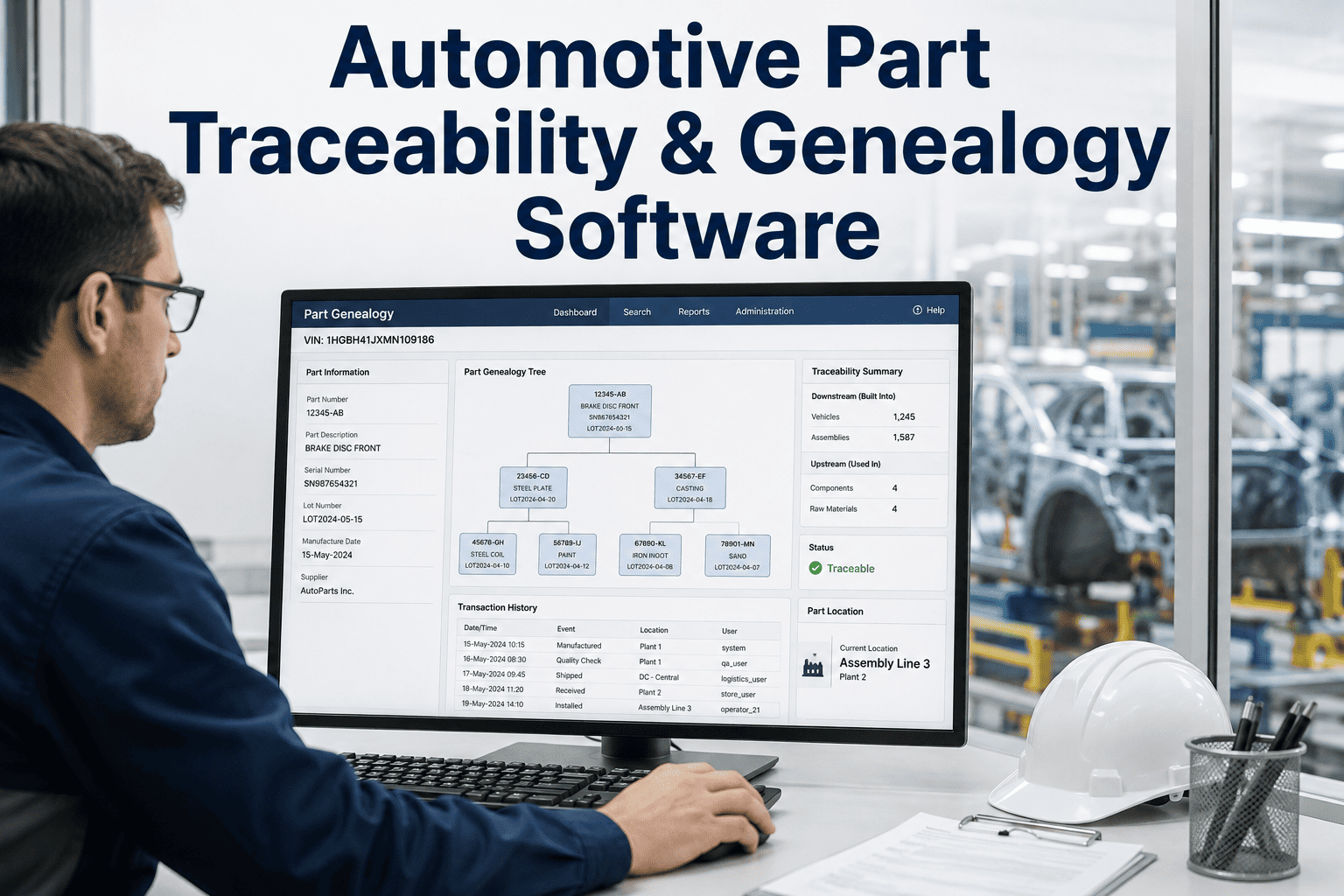
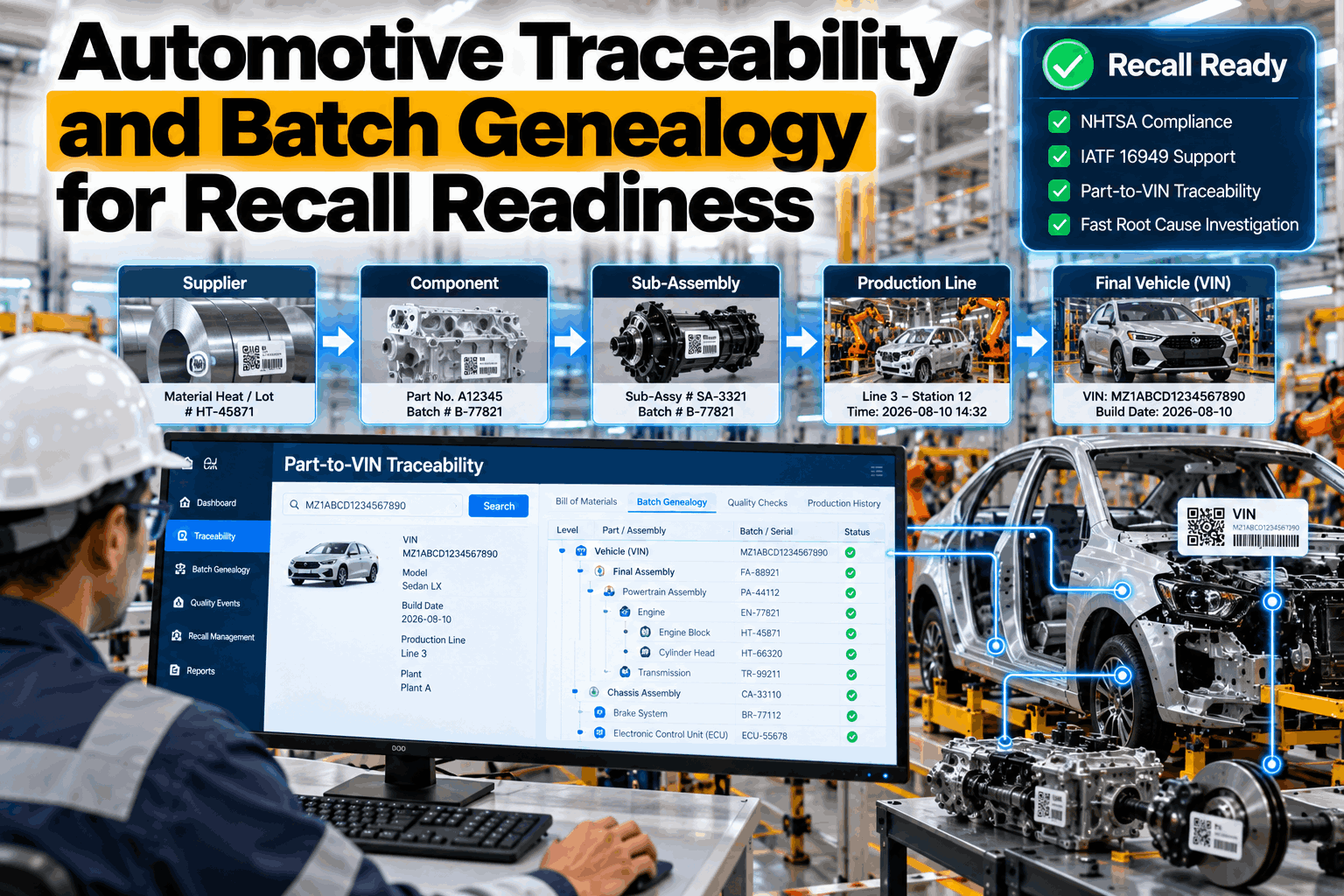
Batch genealogy is the record behind it: a tree that ties each VIN to its sub-assemblies, each sub-assembly to its components, and each component to the supplier lot, station, time and process data from when it was fitted. A trace is only as good as its weakest link, so one unscanned lot or one unrecorded repair can leave you scoping a recall by date range instead of by evidence. Our traceability analytics team can show how this maps to your own lines.
Give every item an ID
Supplier lot labels, part serials and VINs, readable by scanner.
Record parent and child
Each part tied to the assembly it was fitted into, with station and time.
Trace both ways
From a lot to the VINs, and from a VIN back to its lots.
Keep audit-ready records
Complete, readable and retained for as long as you are required to keep them.
Forward trace starts with a suspect lot and asks which VINs contain it. Backward trace starts with a failed VIN and asks which lots went into it. A recall needs both, and a system that only answers one leaves you guessing on the other.
What Regulators and Customers Expect
A recall is only as precise as the records behind it.
Several requirements meet at the recall. Regulators expect the affected vehicle population to be identified, IATF 16949 expects product to be identified and traceable through the process, and customer-specific requirements add their own rules on labelling and containment. The table shows what each one needs you to hold ready. To check your records against these, book a recall readiness review.
Requirements differ by market, vehicle type and customer, and they change. Check the current text of the regulations, IATF 16949 and your customer-specific requirements with your compliance team before setting your own targets.
Where the Chain Breaks Between Supplier and Shipment
Each stage breaks the chain in its own way.
A genealogy chain crosses many systems and many hands. Gaps rarely come from one big failure. They come from small ones at the points where a part changes owner, a lot is split or a unit leaves the line for repair. Start with the safety-critical parts, then widen.
A vehicle that leaves the line for repair often comes back with a part replaced and no record of which lot went in. Treat the repair loop as a station in its own right, with the same scan rules as the main line.
Set the Traceability KPIs Before You Need Them
You cannot trust a trace you have never measured.
These KPIs show whether the chain would hold in a real recall. Take a baseline first, then set targets from your own part classes and customer requirements, because a safety-critical part needs a stricter target than a trim clip.
Pick a lot you know went into a set of vehicles, then run the trace as if it were a recall. The vehicles the system misses are your real gaps, and they tell you exactly which station or record to fix.
What a Tighter Recall Scope Is Worth
Without lot-level genealogy, scope falls back to a production window and every vehicle built in it is included. With it, the scope shrinks to the vehicles that carry the suspect lot, plus a short list that needs a physical check.
From Gap to a Recall-Ready Chain
A trace is ready once you have run it and it passed.
The order matters. Decide what must be traced, make each item identifiable, capture it at the station, link it into the genealogy and only then test it. Skipping the test is how plants discover their gaps during a real recall.
Define
Safety-critical parts and lots to trace.
Identify
Labels and serials that scanners can read.
Capture
Scans at the station, not typed later.
Link
Parent and child records in one genealogy.
Query
Forward and backward traces on demand.
Drill
Mock recalls with the misses recorded.
Common Traceability Mistakes
Most weak traces come from records that were never captured.
Traceability looks complete on a diagram and fails on the line floor. A few simple rules keep the chain real.
Good practice
- Trace safety-critical parts first, then widen
- Link rework and repair records to the VIN
- Run a timed mock recall on a regular schedule
Common mistakes
- Tracing by production date range alone
- Typing lot numbers by hand at the station
- Keeping genealogy in separate MES, ERP and supplier files
When genealogy is incomplete, the only safe scope is the whole production window. That is the broadest and most expensive answer, so every gap you close narrows the next recall.
How iFactory Traceability Analytics Works
Scan and station data in, a queryable genealogy out.
iFactory collects scan, serial, station and test records from your MES, PLCs, barcode and vision stations and ERP, and builds a parent-child genealogy from supplier lot to VIN. It answers forward and backward trace queries, flags stations and shifts where scan coverage drops, and reports the result of each mock recall. It runs on an on-prem server inside your network, with one view across all lines and sites. It supports your recall process, while recall decisions stay with your quality, legal and regulatory teams. Questions on fit go to our support desk.
All trace signals
Scans, serials, station and test records from MES, PLC and ERP.
One genealogy
Supplier lot, component, sub-assembly and VIN in a single tree.
Both directions
Lot to VINs and VIN to lots, with the unscanned listed.
Mock recall reports
Each drill scored, with every miss traced to a station or record.
Results depend on your lines, your systems and how fully parts are scanned today. We measure trace completeness and the effect of each fix on your own data during the pilot, rather than promising a general figure.
Turnkey AI: Delivered, Connected and Live in 6–12 Weeks
You do not build this. It arrives ready.
iFactory ships as a pre-configured NVIDIA AI server with the software pre-loaded. Rack it, plug in power and Ethernet, and the AI is live on your network. Our team handles cabling, network setup, PLC and SCADA integration, team training and 24×7 remote monitoring. Data stays on your own network. For a scope matched to your plant, request a turnkey quote.
Ship, network and scan feeds
Server installed. Scan, serial and station feeds connected for the pilot lines.
Genealogy model and baselines
Critical parts agreed. Genealogy built and trace completeness baselined with your teams.
Go-live and first mock recall
Trace queries live. First mock recall run. Teams trained. 24×7 remote monitoring begins.
Frequently Asked Questions
What is batch genealogy in automotive manufacturing?
It is the record that ties each finished vehicle to the sub-assemblies, components and supplier lots that went into it, together with the station, time and process data from when each was fitted.
What does part-to-VIN traceability mean?
It means you can start from a part, serial or lot and list every VIN that contains it, and start from a VIN and list every part and lot inside it. Both directions have to work for a recall.
Does NHTSA require a specific traceability system?
Not a specific tool as far as we know, but manufacturers must be able to identify the affected vehicle population when they report a defect or noncompliance. Strong genealogy is how you do that precisely. Confirm the current requirements with your compliance team.
What is a mock recall?
A timed drill where you pick a known lot, run the trace as if it were a real recall and compare the result with what you know. The vehicles the trace misses show where the chain is broken.
Which parts should we trace first?
Safety-critical parts and any part a customer or regulator names, such as brake, steering, airbag and restraint components. Widen to other parts once the first group traces cleanly.
How do we start?
With one model line and its safety-critical parts. A 6-week pilot connects the scan and station feeds, builds the genealogy and runs a first mock recall. To plan it, contact our team.
Know Whether Your Trace Would Hold in a Recall
In thirty minutes we look at your traceability records, your scan coverage and how you answer a lot query today. You keep the notes whether or not you go further with iFactory.
- 1The bill of materials for one model
- 2The list of safety-critical parts
- 3A sample of scan and station records
- 4The last recall or containment case
- 5Supplier lot label formats