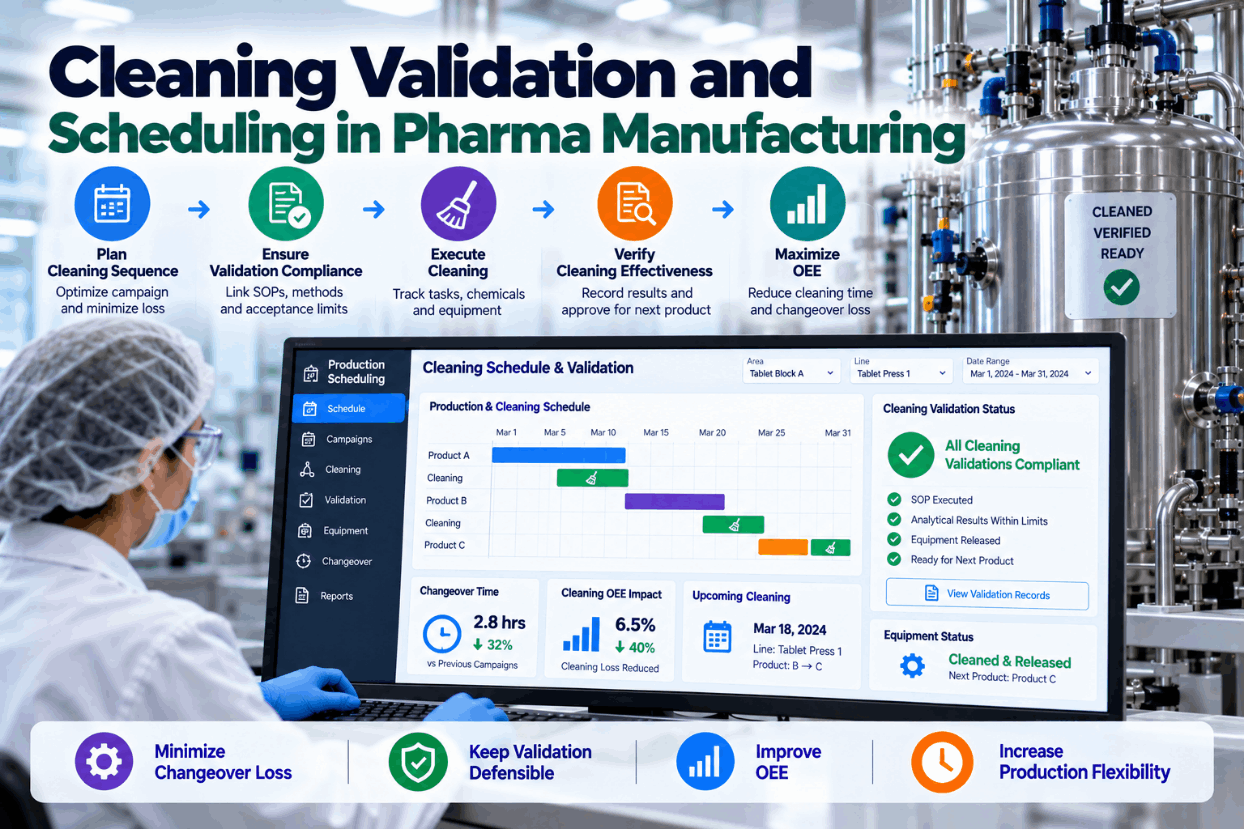
Cleaning takes more production time than almost anything else in a multiproduct pharma plant, and it rarely shows up as a named loss. Equipment waits to be cleaned, is cleaned, then waits to be used, all under validated limits for how long each state can last. Schedule cleaning badly and you lose hours to unnecessary full cleans, waiting and expired hold times. Schedule it aggressively without regard to validation and you put the validated state at risk. This guide explains which cleaning validation rules shape the schedule, how to build a cleaning matrix, how to sequence products, track hold times and set campaign lengths so the plant recovers time while keeping cleaning status defensible. To see cleaning-aware scheduling, book a short walkthrough.
Cleaning Validation and Scheduling in Pharma: Recover Lost Hours Without Risking Validated Status
Dirty hold, clean hold, campaign length and product sequence built into the schedule, so cleaning happens when it is needed and every equipment state stays inside its validated limits.
Why Cleaning Is the Silent OEE Loss
Cleaning time is often buried inside planned downtime, so it escapes the attention unplanned stops receive. Benchmarks compiled by IntuitionLabs put typical pharma OEE in the mid-30s percent, with roughly one-third of time lost to planned activities such as cleaning, changeover and setup. In multiproduct suites, cleaning is usually the largest part of that.
Much of the loss is not the cleaning itself but the waiting around it: equipment sitting dirty because the cleaning crew is elsewhere, clean equipment expiring its hold time before the next batch is ready, full cleans done where a minor clean was validated, or a campaign cut short for no validated reason. Each of these is a scheduling problem, not a cleaning problem.
Treating cleaning as part of the schedule, with its validation limits built in, recovers time without touching the validated process. We can look at your cleaning losses on a call.
The Cleaning Validation Rules That Shape Every Schedule
The 2015 revision of EU GMP Annex 15 set out cleaning validation expectations that directly constrain scheduling. Knowing them precisely stops planners from being either too cautious or too bold.
Every one of these limits can be expressed as a scheduling rule. When the planning system knows them, it can avoid breaches automatically instead of relying on planners to remember. We translate them during set-up.
Building a Cleaning Matrix for Your Products
A cleaning matrix states, for every pair of products, what cleaning is required when one follows the other on the same equipment. It is the foundation of cleaning-aware scheduling.
| From product | To product | Required cleaning | Reason |
|---|---|---|---|
| Product A, batch n | Product A, batch n+1 | Minor clean, within campaign limit | Same product, validated campaign |
| Low-potency A | Higher-potency B | Minor or full per matrix | Carryover of A into B assessed against B’s dose |
| High-potency B | Low-potency A | Full clean | Carryover of B must meet PDE-based limit in A |
| Any product | Product with allergen or colour concerns | Full clean plus verification | Specific acceptance criteria |
| End of campaign | Any product | Full clean | Campaign length reached |
The rows above are illustrative. Your matrix will come from your cleaning validation data, product potencies and equipment trains. Once it exists in digital form, the scheduler can choose sequences that need the fewest full cleans while never skipping one the matrix requires.
Keeping the matrix under change control, and reviewing it when products are added, is essential. We help digitize and maintain the cleaning matrix.
Sequencing Products to Minimize Cleaning
With the matrix in hand, product sequence becomes a lever for recovering time.
Group products that share equipment and have compatible residues.
Where the matrix allows minor cleans, order products to use them.
Plan transitions from lower to higher risk where the matrix rewards it.
Size campaigns up to, not past, validated time and batch limits.
Confirm every dirty and clean hold stays inside its limit.
Check the sequence still meets delivery dates and stock targets.
Sequencing is a trade-off. The sequence with the fewest full cleans may not meet demand dates; the one that meets every date may need extra cleans. A scheduler that can compare both, with cleaning time and demand impact side by side, lets planners choose knowingly.
Even small sequence changes often remove several full cleans a month in a multiproduct suite. See a sequence comparison in a demo.
Tracking Dirty and Clean Hold Times Live
Hold times are where validated status is most often put at risk, because they depend on real events rather than plans. A batch finishes late, cleaning is delayed, and the dirty hold time quietly expires.
Illustrative values. Live tracking shows every piece of equipment’s hold status and warns before any limit is reached.
If a hold time is exceeded, the usual consequences are extra cleaning, additional testing or a deviation, depending on your procedures. Live tracking prevents most of these by warning planners and cleaning crews while there is still time.
Clean hold times matter just as much. Cleaning too early, before the next batch is ready, can mean the equipment expires and needs cleaning again. Timing cleaning to the next use saves both labour and equipment time.
Hold time status should also gate equipment use on the operator panel, so expired equipment cannot be started by mistake. That link is built into our equipment status views.
Setting Campaign Lengths That Balance Time and Risk
Longer campaigns mean fewer full cleans but more residue build-up and more batches at risk if a problem appears. Validated campaign limits set the ceiling; planning decides how close to run to it.
- More full cleans and changeovers
- Lower build-up risk
- More flexibility to respond to demand
- Higher cleaning labour and utilities
- More time lost to cleaning
- Easier to fit around other products
- Fewer full cleans
- Build-up managed within validated limits
- Less flexibility mid-campaign
- Lower cleaning labour per batch
- More production time
- Needs stable demand and materials
The right answer differs by product. High-volume, stable products usually benefit from longer campaigns. Low-volume or volatile products may be better in shorter runs. Data on cleaning time, demand stability and past campaign performance makes the choice evidence-based.
Extending validated campaign limits is a validation activity, not a scheduling one, and needs its own evidence. Our specialists can help identify where it may be worth pursuing.
Cleaning Scheduling Checklist
Use this checklist to build cleaning into planning properly.
The first measure most sites add is waiting time around cleaning, because it is usually the largest and easiest to reduce. Ask our team for a measurement template.
Where the Recovered Hours Come From
Cleaning-aware scheduling rarely shortens a validated cleaning procedure. It recovers time from everything around it.
Each source is small on its own. Together, in a busy multiproduct suite, they can add up to many hours a week. Measure your current cleaning and waiting time first, so the gain can be proven.
We usually start with one suite and one month of data to size the opportunity before any change. Book that assessment with our planners.
How iFactory Delivers Cleaning-Aware Scheduling
Required cleaning for every product transition.
Dirty and clean hold status for every piece of equipment.
Cleaning time and demand impact side by side.
Runs planned up to validated time and batch limits.
Expired or unclean equipment blocked on the operator panel.
Cleaning and waiting time measured by suite and week.
It works with your ERP, MES and scheduling tools. Bring one suite’s schedule and we will show its cleaning losses in a session.
Find the Hours Hidden Around Your Cleaning
Choose one multiproduct suite. We digitize its cleaning matrix and hold times, track cleaning and waiting live and compare your current sequence with cleaning-aware alternatives.
Equipment used for batch 5521 has been waiting 51 hours. Validated dirty hold is 72 hours.
A Hold Time Warning Acted On in Time
This exchange shows how a production planner might use iFactory in a solid dose suite.
iFactory ships as a pre-configured NVIDIA AI server, racked and ready with the cleaning-aware scheduling models loaded. Rack it, plug in power and Ethernet, and the AI is live on your network. Our scope covers sensors and data connections across production suites and planning systems, PLC/SCADA, MES, LIMS and ERP integration, cabling and network setup, operator and quality team training, and 24×7 remote monitoring.
Server installed, sensors and system links live, historical batch, lab and maintenance records loaded.
Models trained on your own batches and equipment, then run in parallel on one area with your quality and engineering teams reviewing every output.
Rollout to the agreed areas under your change control and validation procedures, team training and 24×7 remote monitoring in place.
Software, server and integration come as one package. For pricing on your suites, contact our sales team.
Frequently Asked Questions
Validated dirty and clean hold times, campaign limits and the cleaning matrix set hard rules for when cleaning must happen, how long equipment can wait and which products may follow each other.
Dirty hold time is the longest validated time equipment may wait between use and cleaning. Clean hold time is the longest validated time cleaned equipment may wait before its next use. EU GMP Annex 15 expects both to be defined.
A matrix stating the cleaning required for every product-to-product transition on shared equipment, based on cleaning validation, product potency and residue limits.
By sequencing products to use validated minor cleans, sizing campaigns to validated limits, scheduling cleaning crews to batch ends and timing cleaning to the next use.
No. Scheduling works inside validated limits. Changing limits, such as extending campaign length, is a separate validation activity requiring its own evidence.
A first suite can usually be running within a 6–12 week rollout, including matrix digitization, hold time tracking and schedule links. Plan it with our planners.
Schedule Cleaning Like the Production Resource It Is
iFactory knows your cleaning matrix, hold times and campaign limits and plans around them, so you recover lost hours and every piece of equipment stays inside its validated state.
Waiting time is the easiest loss to recover through better sequencing.