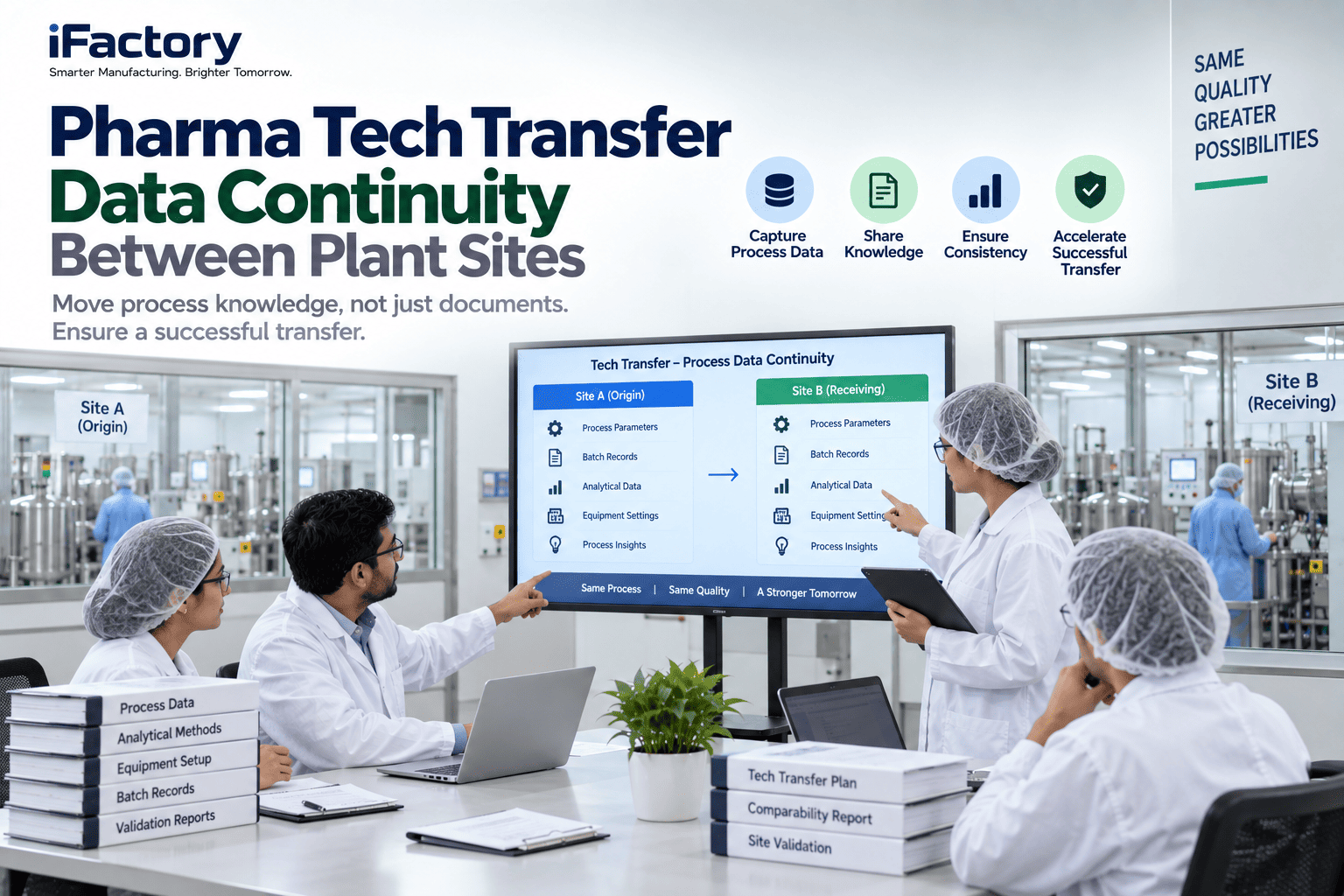
Tech transfers fail on the details nobody wrote down, not the ones in the protocol. Six months of momentum can be killed by one missing parameter — a mixing speed everyone-knew was standard at the sending site but was not documented, an emulsion sensitivity understood tacitly but not captured. Under ICH Q10 tech transfer is the systematic handover of product and process knowledge between development and manufacturing or between manufacturing sites; the ISPE Good Practice Guide formalises sending-unit and receiving-unit roles. What determines whether a PPQ passes at the receiving site is not the completeness of the master batch record — it is whether tacit process context that lives in the sending site's operators and engineers arrived with it.
iFactory / Pharma tech transfer
Transfer the Tacit Process Context, Not Just the Master Batch Record
Structured tech transfer with CQA/CPP/IPC transfer, process characterization data, analytical method transfer, and — critically — the tacit process context that determines whether PPQ runs pass at the receiving site.
✓
Master batch record + specs
✓
Analytical methods + validation
✓
Process characterization data
◆
Tacit process context (what breaks)
ICH Q10 + Q12
knowledge management
ISPE GPG
tech transfer 2nd ed
Sending + receiving
both sides equipped
The Problem in Pharma Tech Transfer
A typical pharma tech transfer — whether from R&D to commercial, between internal sites, or from sponsor to CDMO — takes six to nine months when it runs well and much longer when it does not. The transfer package looks complete: master batch record, specifications, analytical methods, validation reports, quality agreement. Kick-off meetings, gap analyses, and pilot runs happen on schedule. Then the first process performance qualification run at the receiving site fails on a parameter nobody thought to document — a mixing speed assumed universal, a hold time everyone-knew mattered but was never codified. Two failed PPQ runs later, the transfer is months behind and cost has ballooned.
Where Tech Transfer Actually Fails
Tech transfer failure modes are consistent across sponsor-to-CDMO, internal site-to-site, and R&D-to-commercial transfers. Each is a documented pattern in ISPE, PDA, and academic case studies.
Tacit context missing
Sending site assumes 'everyone knows' high-shear disrupts this emulsion. Receiving site assumes mixing speed is standard. PPQ run fails on the assumption nobody documented.
Method transfer drift
Analytical method transferred with SOP but not the tacit troubleshooting knowledge. Receiving lab's results drift from sending site's without either understanding why for weeks.
CPP range narrow
Critical process parameters transferred at nominal setpoint without the design space explored during development. Receiving site's equipment operates at a corner of the space nobody tested.
Supply chain gap
API and excipient inventory not reserved for validation batches. Delays in material sourcing add weeks to the timeline. Contingency inventory never planned.
What Good Looks Like in Tech Transfer
A working tech transfer discipline holds four things together — structured knowledge package, tacit context capture, comparability protocol before PPQ, and supply chain reservation for validation.
Structured Package
Master batch record, specifications, analytical methods, process description, validation reports, and quality agreement organised per ISPE Good Practice Guide structure. Nothing missing at kick-off.
ISPE GPG structure
Tacit Context Capture
Structured extraction of process context from sending-site operators and engineers — what breaks, what to watch for, what the design space corners actually looked like. The knowledge that never lands in a batch record.
What actually breaks
Comparability Before PPQ
Comparability protocol run against sending-site data before PPQ commits. Discrepancies surface at pilot scale where they cost days rather than at PPQ where they cost months.
Pilot before commit
Supply Reserved
API and excipient inventory reserved for the full PPQ scope plus contingency, sourced from multiple lots where the risk assessment requires. Timeline protected from material availability.
Materials never gate
How iFactory AI Fits
iFactory AI overlays your PLM, QMS, LIMS, and MES — providing the structured tech transfer knowledge management layer that ISPE GPG describes but most transfers run on shared drives and email.
Transfer Package
Knowledge Layer
Structured document set per ISPE GPG — master batch record, specifications, methods, process description, validation reports, quality agreement. Version-controlled, sending-and-receiving-site visible.
Tacit Capture
Knowledge Layer
Structured interview and observation workflow for capturing process context from sending-site operators — what to watch for, what to do if X, how to know Y is drifting. Codified for the receiving team.
Comparability
Knowledge + Analytical
Comparability protocol data captured at pilot scale against sending-site historical data. Statistical discrepancy analysis surfaces the parameters that need attention before PPQ commits.
Supply Watch
Knowledge + Supply
Material inventory reservation for PPQ plus contingency, multi-lot sourcing where required. Timeline gated by process readiness, never by material.
Ask your last tech transfer's technical lead what killed the schedule — the answer is almost never the documented protocol. It is what somebody at the sending site knew but never wrote down. Book a tech transfer review.
16-Week Tech Transfer Pilot on One Product
One active or upcoming tech transfer, sixteen weeks. The pilot deploys the structured knowledge management on the transfer, captures tacit context from the sending site, and closes the first comparability protocol before PPQ.
Weeks 1–3
Package Structure
Load current transfer package into structured ISPE GPG format. Identify documentation gaps. Kick-off meeting between sending and receiving sites with joint visibility.
Weeks 4–8
Tacit Capture
Structured interviews with sending-site operators, engineers, and QA. Process context codified in receiving-team-usable form. Design space corners documented from historical batches.
Weeks 9–13
Comparability
Pilot-scale runs at receiving site with comparability protocol against sending-site data. Discrepancies surfaced and resolved before PPQ commits.
Weeks 14–16
PPQ Ready
PPQ ready with material reserved, tacit context transferred, comparability validated. Rollout to remaining transfers in the pipeline scoped based on time-to-PPQ improvement.
Who Owns the KPI
Tech transfer crosses R&D, technical operations, QA, supply chain, and site leadership at both sending and receiving sites. Each function owns a specific KPI or the transfer stalls on information asymmetry.
Technical Ops Lead
Time to first successful PPQ
Owns the transfer velocity — the time from kick-off to first successful PPQ run. The KPI that determines whether the receiving site is ready for commercial supply.
Sending Site QA
Tacit context capture completeness
Owns the knowledge extraction — the completeness of tacit process context transferred alongside the formal package. Measured against a structured capture framework.
Receiving Site Ops
PPQ first-pass success rate
Owns the receiving execution — the share of PPQ runs that pass on first attempt. Repeat failures are the signal that transfer completeness or comparability testing was insufficient.
Supply Chain Lead
Material available at go-decision
Owns the supply readiness — API, excipient, and packaging material reserved and available at the PPQ go-decision. Material shortfall is unforgivable delay.
FAQ
How does ICH Q12 fit — does that change how we structure tech transfer?
ICH Q12 (Technical and Regulatory Considerations for Pharmaceutical Product Lifecycle Management) formalises how post-approval CMC changes are managed and provides tools like Established Conditions and Post-Approval Change Management Protocols (PACMPs) that make site transfers more predictable. When the sending site's process is characterised under ICH Q12 with clear Established Conditions, the receiving site's transfer scope is defined precisely by which Established Conditions apply — and post-transfer changes can be managed under PACMPs rather than requiring full variation submissions. The workflow supports ICH Q12 Established Conditions capture as part of the transfer package structure, aligning the transfer with the post-transfer lifecycle management the receiving site will need.
What about sponsor-to-CDMO transfers — do the dynamics differ?
Yes, in ways worth naming. Sponsor-to-CDMO transfers add commercial dynamics — contract terms, IP protection, competing CDMO relationships — that internal site-to-site transfers don't carry. The CDMO market grew to $170-190B in 2024 with continued expansion to $260-290B forecast by 2030, and nearly 50% of global biologics manufacturing forecast to CDMOs by 2029, so the volume of sponsor-CDMO transfers is only rising. The workflow supports sponsor-CDMO transfer with access control that respects IP boundaries (sponsor sees receiving-site process performance; CDMO sees sending-site knowledge only for products they manufacture), quality-agreement-driven communication cadences, and structured escalation to sponsor when receiving-site issues need sending-site expertise.
Book a demo to see the CDMO-specific transfer view.
How does this integrate with our validated PLM, QMS, and MES?
The tech transfer overlay reads from PLM (product structure, specifications, drawings), QMS (validation reports, deviations, CAPAs), MES (historical batch data, process performance), and LIMS (analytical method data, test results) rather than replacing any of them. What the overlay adds is the transfer-specific structure — package assembly per ISPE GPG, tacit context capture, comparability analysis, cross-site visibility — that these systems individually do not provide. Where the sending site and receiving site run different PLM or MES vendors (increasingly common), the overlay provides the neutral collaboration layer that bridges them without requiring one side to adopt the other's stack. Validation posture is preserved because underlying systems remain unchanged.
Stop losing six months to what somebody didn't write down.
Walk One Active Transfer Through Structured Knowledge Capture — Live
Bring one active or upcoming tech transfer, the current transfer package structure, and a sending-site process expert for a 30-minute conversation. We'll demonstrate the tacit context capture workflow and the comparability discipline that surfaces gaps before PPQ commits.