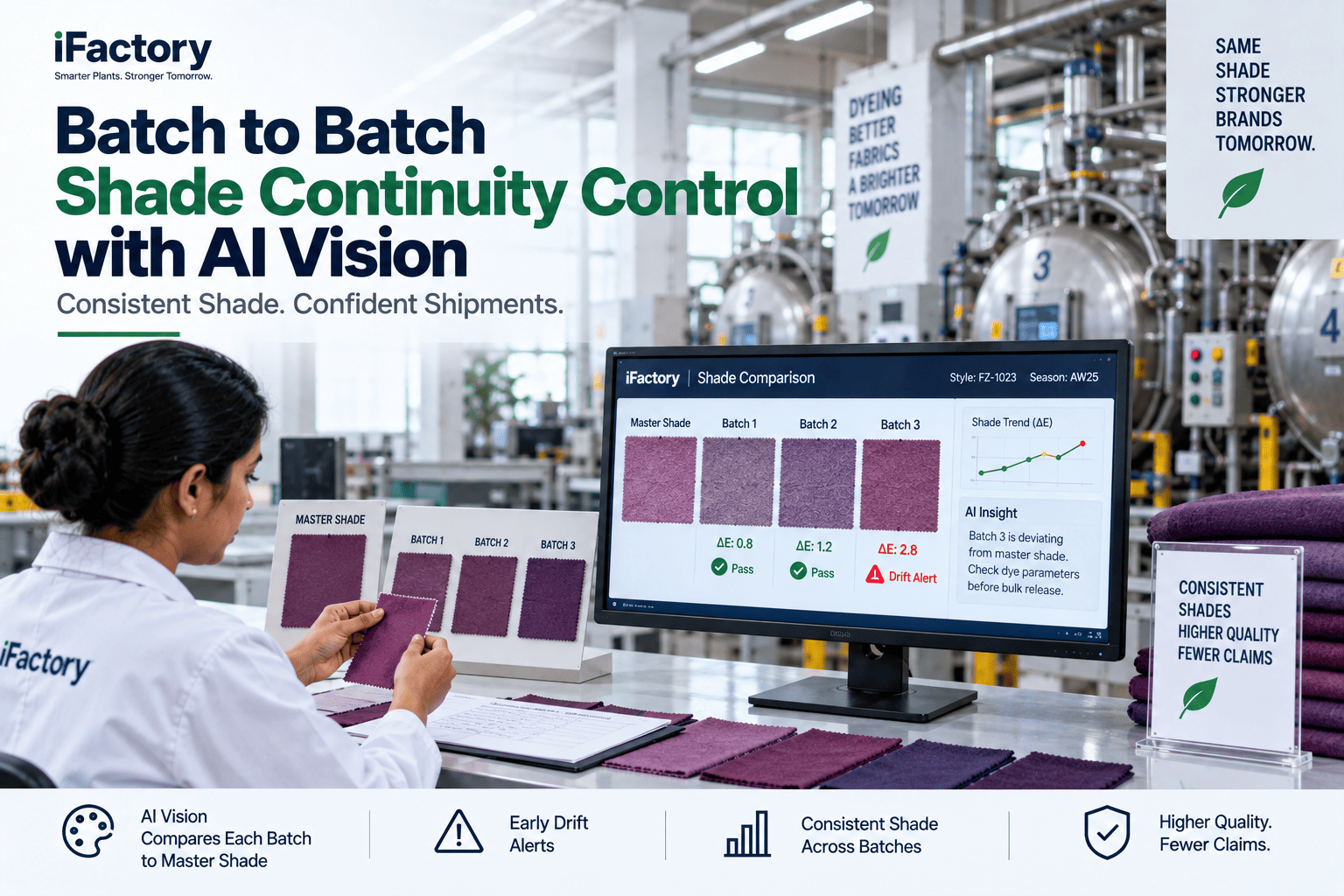
Batch to Batch Shade Continuity Control with AI Vision
By David Cook on September 19, 2026
Each batch passed. That is what makes continuity failures so expensive: nothing was ever rejected. Batch 4 sat just inside tolerance on the warm side, batch 9 a little warmer still, batch 14 warmer again, and every one of them was approved against the standard because tolerance is judged one batch at a time. Then a cutting room lays panels from three of those batches into the same garment, the shade step is visible under store lighting, and the claim covers the whole delivery. iFactory's shade continuity AI compares every batch to the master and to the batches before it, so drift is caught as a trend while the yarn is still in your warehouse.
AI Quality Control for the Dyehouse
Batch to Batch Shade Continuity Control with AI Vision
Every batch compared to the master standard and to the batches that came before it. Drift is flagged as a direction and a cause, before a season's worth of nearly-passing batches turns into a shipped claim.
A tolerance is a boundary around a single batch. It says nothing about where inside that boundary the batch sat, or which way the last six have been moving. Drift is created by things that change slowly and legitimately: a new dyestuff lot with slightly different strength, water that hardens through the dry months, a machine that has been serviced, a substrate supplier who changed something small. None of these produces a failure. Each moves the result a fraction in the same direction, and the accumulated distance between the first batch of a style and the fifteenth is far larger than the step between any two consecutive ones. The customer never sees your tolerance. They see two panels side by side.
Watch the Trend, Not the Verdict
Plotted against the master standard, drift is obvious long before anything fails. The alert is raised on the direction of travel and the rate, which gives the dyehouse time to correct while the correction is still small.
Shade difference from the master, batch by batch
Every point on this chart passed its own inspection. The alert comes from the slope, which is why it arrives while a small recipe correction is still enough to bring the next batch back.
Direction Matters More Than Distance
A single difference number tells you how far off you are but not which way, and correcting the wrong way is how one miss becomes three. Plotted in colour space, the drift has an obvious direction, and that direction points at its own cause.
Where the batches sit around the standard
The recent batches have not scattered. They have moved together in one direction, which is the signature of a changed input rather than random process noise, and it narrows the search to the things that changed at the same time.
A Decision Before the Batch Ships
The continuity check runs when the batch is measured, not at the end of the order. It answers two separate questions: does this batch match the standard, and does it match what the customer already has.
Continuity check — style 7140, batch 15
Referencemaster standard · batches 1 to 14
Orderseason programme, repeat colour
Against master standardinside toleranceOK
Against the last five batchesdrifting, same directionwatch
Against batch 1 of the stylevisible stepwatch
Dyestuff lotchanged at batch 11watch
Machine and waterunchangedOK
Ship this batch against orders already supplied from batches 11 to 14, correct the recipe for the new dyestuff lot strength, and keep batch 1 to 10 material for a separate cut.
What Continuity Control Covers
Four capabilities turn a pile of spectrophotometer readings into a decision someone can act on.
Master referencing
Every batch measured against the approved standard for the style, with the reading stored against the batch rather than a paper card.
Trend and drift detection
Consecutive batches watched for direction and rate, so a run of passing batches heading the same way raises an alert on its own.
Cause attribution
Drift correlated against dyestuff lot, water, machine and substrate changes, so the investigation starts with a short list.
Shipment grouping
Batches grouped by measured shade for allocation, so material going into one cut comes from batches that actually match.
What Shade Continuity Delivers
The saving is mostly in the claims that never happen, which is also the part that is hardest to see until it stops.
Fewer
Shade claims
caught before dispatch, not after
Smaller
Corrections
drift fixed while it is still small
Matched
Within a cut
allocation by measured shade
Traceable
Colour history
every batch of the style on record
Frequently Asked Questions
Why do batches drift when every one of them passes?
Because tolerance is applied per batch and drift is a property of the sequence. A batch sitting near the edge of tolerance on the same side as the one before it is perfectly acceptable on its own terms, but fifteen of those in a row have moved a long way from where the style started. The inputs that cause it change slowly and legitimately, so nothing looks wrong at any single point. Only the trend shows it.
How is this different from the spectrophotometer checks we already do?
You already have the measurement; what is usually missing is the memory and the comparison. A typical reading is taken, judged against the standard, recorded and filed. Continuity control keeps every reading against the style, compares each new batch to the master and to its predecessors, watches the direction of travel, and connects movement to the things that changed in production. The measurement is the same. What is done with it is not.
Can it tell us what is causing the drift?
It narrows it substantially. Because every batch carries its dyestuff lot, water analysis, machine, substrate lot and recipe as dosed, the system can show what changed at the point the drift started and how strongly each candidate correlates with the movement. In practice a dyestuff lot change, a seasonal water shift or a machine coming back from service explains the majority of cases. The final judgement stays with your technologist, but they start from evidence rather than from a meeting.
What should we do with batches that have already drifted?
Group them rather than scrap them. Material that does not match batch 1 may match batches 11 to 14 perfectly well, and if it is allocated to orders supplied from that group, the customer sees continuity even though the whole programme has moved. That allocation decision is only possible if you know the measured shade of every batch in stock, which is exactly what the record gives you.
Does this work for repeat colours across seasons?
That is the hardest version of the problem and where the history matters most. A colour re-ordered eight months later is dyed with different dyestuff lots, different water and possibly a different substrate supplier, and the only reliable anchor is the measured record of what was shipped the first time. Keeping every batch's reading against the style means a repeat order is matched to what the customer actually received, not to a standard card that has been handled for two years.
Catch the Drift While It Is Still Small.
See the Continuity Trend on Your Own Repeat Colours
Bring the spectro readings for a style you run all season. We'll plot every batch against the master and each other, show where the drift began, and line it up against what changed in production that week.

-—-mold-level-and-tundish-spc-for-slab-quality.png)