Every changeover is time when a line makes nothing: a press waiting for a die, a weld cell waiting for new tips, a paint robot flushing one colour out for the next. In an OEM plant these minutes are planned, so they rarely show up as a problem, and that is exactly why they are worth a second look. This playbook applies the SMED method to the four places it matters most, stamping, weld, paint and trim, and gives a 24-point checklist you can walk on the floor. It also shows how iFactory times each changeover automatically and points at the minutes that can go. To see where yours are spent, book a timing review.
Auto Changeover Time Reduction Playbook for OEM Plants
Three SMED moves and 24 checks for stamping, weld, paint and trim, so less of every shift is spent getting ready to produce.
- Six checks for each of the four shops
- What a realistic reduction looks like, with evidence
- Every changeover timed without a stopwatch
The one definition this playbook depends on. It includes fetching, waiting, adjusting and the slow start afterwards, not only the swap itself.
What a Changeover Means in Each Shop
The word is the same in every shop. The work is not.
A die change is the classic changeover, and the one SMED was invented for. But a body shop changes weld tips, a paint shop changes colour hundreds of times a shift, and a trim line changes its parts and tool settings with every model that comes down it. Each loses time in a different place. Our support team can map the changeovers in your plant.
Because changeovers are in the schedule, most plants leave them out of the downtime discussion. Yet a changeover that takes 26 minutes when the best crew does it in 14 is losing 12 minutes every time, just as surely as a breakdown would. The only difference is that nobody is asked to explain it.
SMED in Three Moves
Do what you can before the line stops. Move more of it there. Then speed up what is left.
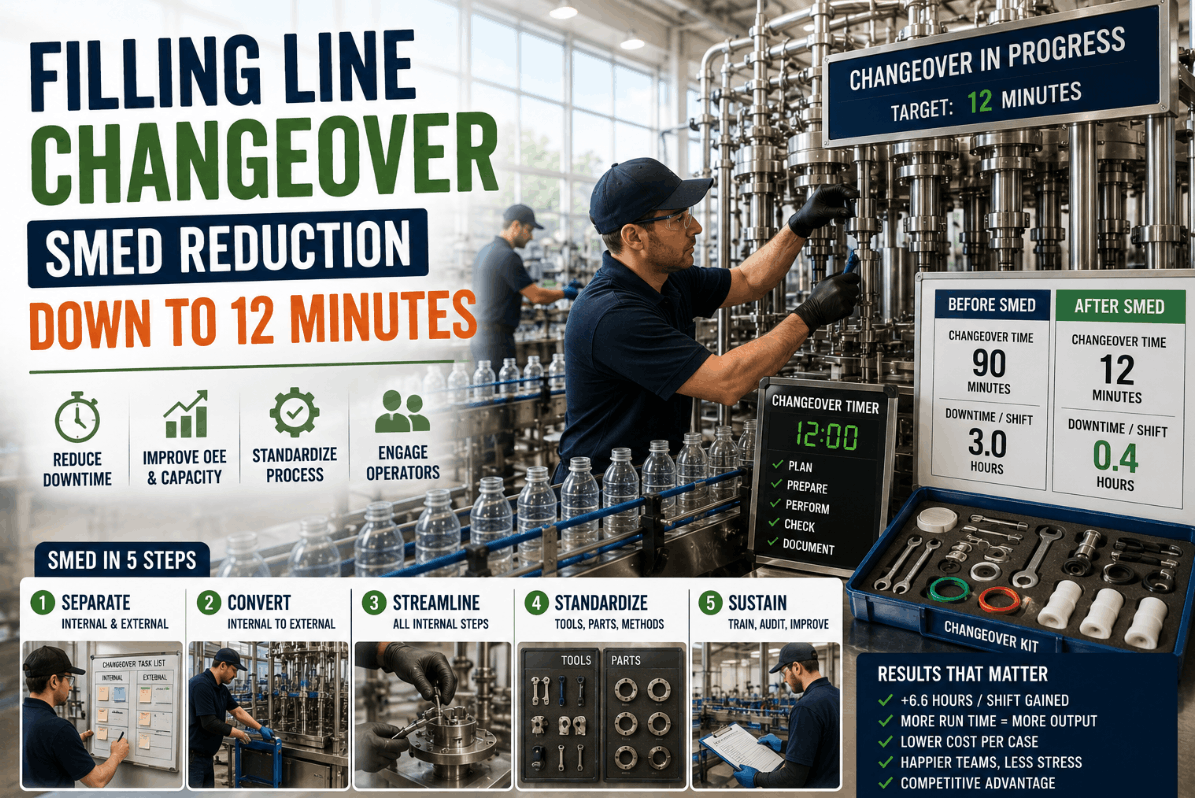
SMED stands for single-minute exchange of die: a changeover in single-digit minutes. Shigeo Shingo developed it with Toyota in the 1950s and 60s. The whole method rests on one distinction. Internal work can only be done while the line is stopped. External work can be done while it is still running. To sort your own changeover into the two, book a working session.
Separate
List every task. Mark each as internal or external. Do all external tasks before the stop or after the restart.
Convert
Turn internal tasks into external ones: pre-heat, pre-assemble, pre-set, pre-stage.
Streamline
Shorten what must stay internal: quick clamps, work in parallel, no adjustment after fitting.
Move 1 costs almost nothing and takes out 30%. Moves 2 and 3 need some engineering and reach 60%.
Internal or external? A quick test
- Fetching the next die. External. The press can run while it is brought.
- Finding tools and bolts. External. They belong on a cart, ready.
- Heating the die. External, if you have a pre-heat station.
- Unclamping and lifting out. Internal. Make it fast.
- Adjusting after fitting. Internal, and avoidable with fixed heights and stored settings.
A shorter changeover can buy more output, or it can buy smaller batches with the same output. Smaller batches mean less stock and a faster response to the schedule. Agree which one you want before you start, and change the plan to match. Otherwise the saved minutes simply disappear into the shift.
Checklist: Stamping and Weld
Twelve checks for the two shops where tooling physically changes.
Walk these on the floor during a real changeover, not from a desk. Each one is a yes or a no. A no is not a failure; it is the next improvement. Stamping usually has the longest single changeovers, and weld has the most frequent small ones. Ask our press shop specialists for a printed version.
- 1. The next die is beside the press before the last stroke of the run.
- 2. The die has been inspected, cleaned and, where needed, pre-heated.
- 3. Tools, bolts and hoses are on a dedicated cart, not fetched.
- 4. Dies share a standard height and clamping points, so nothing is shimmed.
- 5. Press settings for the die are stored and recalled, not dialled in by feel.
- 6. The first panel is good, or the number of trial hits is counted and falling.
Modern servo press lines are sold with fully automatic die changes of about three minutes. On older lines, the gap to that figure is your opportunity.
- 7. Tip dressing and tip changes are timed to breaks and natural gaps, not mid-run.
- 8. New tips and caps are kitted at the cell before they are needed.
- 9. The weld program follows the body's identity automatically, with no manual choice.
- 10. Fixtures for a model locate on pins and connect with quick couplings.
- 11. Sealer and adhesive are changed on a low-level warning, never on empty.
- 12. After any tooling change, position is confirmed by a check, not by re-teaching the robot.
A tip change takes little time. Taken at the wrong moment, across a whole body shop, it adds up to a great deal.
One Die Change, Before and After
The same worked example as the three stages, line by line. The largest single gain is the one that needs no investment.
Checklist: Paint and Trim
Twelve checks for the two shops where the changeover is in the sequence, not the tooling.
In paint and trim nobody wheels in a new die. The changeover is hidden inside the order the bodies arrive in. Group colours well and the paint shop flushes less. Sequence variants well and the trim line never waits for a part. These checks are about planning as much as about equipment. To review your own sequence rules, book a sequence session.
- 13. Bodies are grouped into colour blocks wherever the buffer allows.
- 14. Paint and solvent used per colour change are measured, not assumed.
- 15. Flush and clean settings are reviewed for each colour pair, not one setting for all.
- 16. Low-volume and special colours are scheduled together.
- 17. The next colour is circulating and at the right viscosity before its block arrives.
- 18. The first body after a change is checked for traces of the previous colour.
A current atomizer can switch between the three main colours in about four seconds with no rinsing, and its maker says those three cover more than half of all bodies.
- 19. Parts for each vehicle arrive in build order, kitted or sequenced.
- 20. Tool settings follow the vehicle's identity automatically.
- 21. Heavy-content variants are spaced apart in the sequence, not back to back.
- 22. Pick lights and error-proofing switch with the variant.
- 23. Rare variants come with a prompt at the station, so nobody relies on memory.
- 24. Model-year and running changes are trialled off-shift before they reach the line.
On a mixed line the changeover happens every cycle. Done well, it takes no time at all. Done badly, it shows up as line stops.
Paint wants long runs of one colour. Assembly wants bodies in the order customers and suppliers expect. The two pull in opposite directions, and the buffer between the shops is where the argument is settled. Any change to colour grouping should be judged on both sides: paint and solvent saved, and sequence disturbed.
Measure, Rank, and Hold the Gain
You cannot shorten what you have not timed, and you cannot keep what you do not check.
A stopwatch study captures one changeover on one day with everyone on best behaviour. iFactory times every changeover from the machine's own signals: when the last good part left, when each stage ended, when the first good part arrived at full speed. That turns a one-off study into a ranked list. Our integration team can confirm which signals your lines already provide.
Illustrative. The gap between average and best is the cheapest gain in the plant: your own people have already done it once.
Five habits that hold the gain
- Write it down. Standard work for each changeover, with a time against every step.
- Name the roles. Like a pit crew: who does what, in what order.
- Review the worst three. Every week, with the crews who did them.
- Film one a quarter. People see things on video that they miss on the day.
- Use the new time. Put it in the schedule, or it will drift back.
Count the tail
The swap is finished, the line restarts, and for the next ten minutes it runs slowly and makes scrap while settings are trimmed.
That tail is part of the changeover. Plants that stop the clock at the first stroke leave a real share of the loss uncounted.
iFactory keeps timing until output is good and at full rate.
One set of data, three views
- Crew leader. The last changeover, stage by stage, against the best one.
- Shop manager. Every die, colour pair or variant ranked by time lost this month.
- Planner. Real changeover times to schedule with, not the figure from years ago.
iFactory measures and advises. The changeover itself stays with your crews and your equipment.
Turnkey AI: Delivered, Connected and Live in 6–12 Weeks
You do not build this. It arrives ready.
iFactory ships as a pre-configured NVIDIA AI server, racked and ready, with the software pre-loaded. Rack it, plug in power and Ethernet, and the AI is live on your network.
Our team handles cabling, network setup, PLC and SCADA integration, operator training and 24×7 remote monitoring. The server sits inside your own network, so production data stays on site. For a scope matched to your shops, request a turnkey quote.
Ship, network and data
Server installed. Press, cell and paint signals connected for the pilot area. Start and end of a changeover agreed with the shop.
Model training and pilot
Changeovers timed and split into stages automatically. Results checked against a filmed changeover, then tuned.
Go-live and training
Ranked lists and crew views go live. Crew leaders and planners trained. 24×7 remote monitoring begins.
Frequently Asked Questions
What is changeover time?
The time from the last good part of one job to the first good part of the next, made at full speed. It covers fetching, waiting, the physical swap, any adjustment and the slow start afterwards. Measuring only the swap makes the number look better and hides most of what can be improved.
What is SMED?
Single-minute exchange of die: a method for cutting changeovers to single-digit minutes. It was developed by Shigeo Shingo with Toyota. The idea is to do everything possible while the line still runs, convert more tasks so they can be done that way, and then shorten what is left.
Is a 30 to 60% reduction realistic?
On changeovers that have never been studied, yes. One published study of an automotive press line recorded 62%. On lines where SMED has already been applied, expect much less: a Volkswagen press that had been through it gained two minutes from a design change. Your starting point decides the answer.
Does SMED apply outside the press shop?
Yes, though the changeover looks different. In weld it is tips and fixtures. In paint it is the colour change and how colours are grouped. In trim it is parts and tool settings that change with every vehicle. The same question applies everywhere: what can be made ready before the line needs it?
Do we need new equipment?
Not for the first two moves. Staging dies, kitting tools, storing settings and timing tip changes to natural gaps cost very little. Quick clamps, standard die heights and automatic couplings come later, and by then you will have the data to show which of them pays.
How does AI help with changeovers?
It times every changeover automatically, splits it into stages, and compares each one with the best ever achieved on that die, colour pair or variant. That shows where minutes are lost and whether a fix has held. It replaces occasional stopwatch studies with a continuous record.
How long does it take to go live?
Six to twelve weeks from delivery for a first area. We need a place for the server with power and Ethernet, read access to machine signals, and time with the crews who do the changeovers. To check your set-up first, contact our team.
Bring Your Longest Changeover
In thirty minutes we take one changeover, sort its steps into internal and external, and mark which could move before the stop. You keep the marked-up list whether or not you go further with iFactory.
- 1The changeover you most want shorter
- 2Its current steps, in order, with rough times
- 3How often it happens in a week
- 4A phone video of one, if you can take it
- 5The batch sizes the plan uses today